
Research article · 2018 · Full text
International Journal of Agriculture Extension and Social DevelopmentSocioeconomic factors influencing performance of community-based women organizations (CBWOs) in rural development projects in Imo and Rivers state
Volume 1(2) · Pages 20–25 · DOI: 10.33545/26180723.2018.v1.i2a.83 ↗
Research areasMicrofinance and Financial Inclusion
Abstract
Author-writtenCommunity based organizations serve as the apex organizations by which communities can embark on agricultural development projects, small scale industries, vocational and trade, skills, rural transportation and other rural economic activities. However, certain factors hinder their performance. This paper seeks to unravel these factors. The study was conducted in Imo and Rivers States, Nigeria. A total of 240 CBWOs were selected for the study. Questionnaire was administered to then and data collected were analyzed with percentages and regression modal. The result of socio-economic characteristics showed that Community-Based Women Organizations had mean years of 21.1 and 28.9 of existence in Imo and Rivers States. Regression results of the socioeconomic factors influencing role performance of community-based women organizations showed that coefficients for age, membership size, number of meetings, type of project, access to credit and income influenced role performance of CBWOs in Imo, while membership size, number of meetings, type of project, access to credit and income were significant variables influenced CBWOs in Rivers State. The implication of the finding is that there was significant relationship between role performance and the selected variables. Based on the findings of the study it was recommended that agricultural policy makers should take into consideration the identified socio-economic characteristics of CBOs that influence their role performance.
Summary
Source-checkedPlain-language reading of the full paper, prepared with AI and checked against the text. Each point links to the authors' own words.
Why it matters
- Community-based organizations (CBOs) are primary vehicles for rural communities to implement agricultural development, small-scale industries, and other economic activities. View evidence ↗
- The proliferation of CBOs is partly driven by a lack of public confidence in central authorities due to failed top-down government approaches and insufficient grassroots involvement. View evidence ↗
- Development agencies view CBOs as effective tools for harnessing local resources and improving agricultural development structures. View evidence ↗
The question
- The study aims to evaluate the socioeconomic factors that influence the role performance of community-based women organizations (CBWOs) in agricultural development within Imo and Rivers States, Nigeria. View evidence ↗
What they did
- The researchers surveyed a total of 240 community-based women organizations across the two states using structured questionnaires and interview schedules. View evidence ↗
- A two-stage random sampling technique was employed, first selecting local government areas from agricultural zones and then selecting 10 CBWOs per local government. View evidence ↗
- Data analysis involved the use of percentages and multiple regression, testing four different functional forms (linear, semi-log, exponential, and Cobb-Douglas) to find the best fit. View evidence ↗
What they found
- CBWOs showed stability in existence, with mean years of 21.1 in Imo State and 28.9 in Rivers State. View evidence ↗
- A high percentage (85.8%) of CBWOs in both states had access to credit, which was primarily generated internally within the groups. View evidence ↗
- In Imo State and in the pooled data, the age of the association was positively and significantly related to role performance, suggesting that more experienced organizations perform better. View evidence ↗
- The study found that as membership size increased, the role performance of CBWOs decreased, which the authors noted disagreed with some prior research on collective competence. View evidence ↗
- A higher number of annual meetings was positively and significantly related to better role performance in both Imo (1% level) and Rivers (5% level) states. View evidence ↗
- Access to credit was positively and significantly related to role performance across both states and in the pooled analysis. View evidence ↗
- Realized income was positively and significantly related to role performance at the 1% level for both individual states and the pooled sample. View evidence ↗
- The type of project executed was positively and significantly related to role performance at the 1% level in both states. View evidence ↗
What it means
- The authors recommend that agricultural policymakers should consider the specific socioeconomic characteristics that influence CBO performance when designing policies. View evidence ↗
- The study concludes that there is a significant relationship between the selected socioeconomic characteristics and the role performance of CBWOs in rural development projects. View evidence ↗
Figures & tables
From the original paper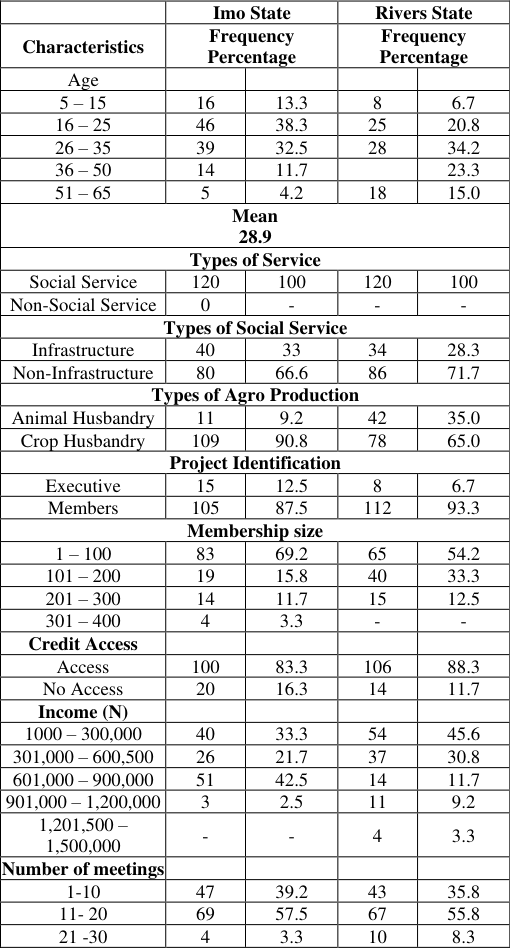 Table 1
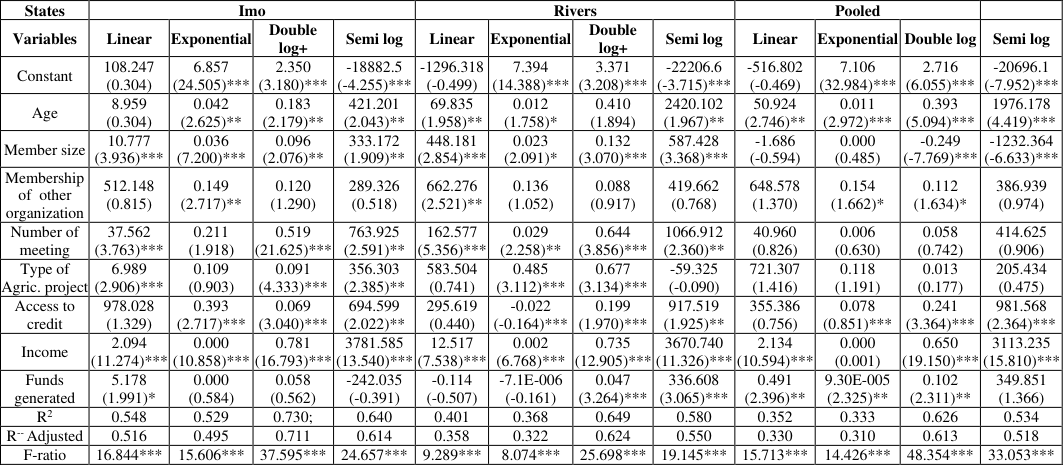 Table 2
Introduction
Community based organizations otherwise known as local organizations have been given different names in different places.
These include 'community development associations', 'neighbourhood councils' and united community among others (Agbola, 1998) [4] . Community based organizations are set up by collective efforts of indigenous people of homo or heterogeneous attributes but living or working within the same environment. Their coming together creates conditions which broaden the base of self governance and diffusion of power through a wider circle of the population (Adeyemo, 2002; Adejumobi, 1991) [3, 2] . It is seen as voluntary, non-profit, non-governmental and highly localized or neighbourhood institutions whose membership is placed on equal level and whose main goal is the improvement of the social and economic well being of every member (Abegunde, 2004) [1] . CBOs are localized institutions in that their spheres of influence hardly extend beyond their immediate communities or neighbourhood. They are non-profit and non-governmental because all members contribute economically towards the fulfillment of their responsibilities to the immediate environment and not depend on government before fulfilling these (Claudia, 2003). Benefits accrued from members' contributions to the associations are shared accordingly with fairness. They are concerned with the development problems of and development programme projects in their various areas (Esman and Upholt, 1984; Bralton, 1990) [9,7] . They respond to community felt needs rather than market demand or pressure. They have been deeply involved in activities that has impacted on the livelihood of rural people. Community based organizations are formal voluntary social groups that are found in communities which differ in size, objectives and degree of interaction among members. In these organizations members have had the ability to influence ideas and actions of others (Matthews-Njoku, Angba, and Nwakwasi, 2009) [11] . For this reason most community and agricultural development agencies have sought the support of these organizations as effective means of changing the structure of communities, harnessing their resources and improving agricultural development. Such is the importance of community based organization's role in the development of the area. Poor performance of government in meeting the socioeconomic quests of citizens has been identified as one of the reasons behind the proliferation of community based organizations (CBOs) in the new millennium. Along this line, Wahab (2000) [12] observed that people in developing nations have until recently looked up to their governments to meet their basic socio-economic demands. Of a truth, governments in African nations have evolved both top-down and bottom-up approaches to achieve sustainable development of their people. These include establishment of www.extensionjournal.com lead industries at key centers so as to create job opportunities, provide basic infrastructure and utilize regional natural and man-made resources to stimulate growth and economic development that would spread to lagging regions. The failure of governments' top-down approach and lack of involvement of the people at the grassroots in the bottom-up strategy have weakened the confidence of the public in central authorities. Communities therefore seek solace in indigenous institutions, which pressurize government for attention to development problems in their communities and/or undertake development programmes and projects that they observe that are very needful in their immediate communities. The indigenous organizations are associated with self-help (Ogundipe, 2003) [13] . They constitute the media for resources mobilization to confront local challenges.
The above shows that community based organisations have played far reaching roles in community development. One of which is agricultural development. Certain factors influence the performance or otherwise of CBOs in executing their roles. This study therefore evaluates factors influencing role performance of community based organisations in agricultural development in Imo and Rivers States, Nigeria.
Methodology
The study was carried out in Imo and Rivers States. The first stage involved the random selection of four local government areas from each of the zones, to give a total of 12 from Rivers State. In the second stage, 10 community based women organizations were randomly selected in the following arrangement -4 Women groups, 3community development unions and 3 -Co-operative societies to make up the required 120 Community Based Organisations per local government. On the whole 240 community-based organizations were used for the study for the two states. A total of 240 questionnaires were distributed. Data were collected by use of structured questionnaire and interview schedule and analyzed using percentages presented in frequency table and multiple regression to isolate factors influencing role performance of CBOs. The four functional forms of regression model viz: linear, semi-log, exponential and cobb-douglas were tried. The best fit was chosen as the lead equation based on its conformity with econometric and statistical criteria such as the magnitude of R 2 , F-ratio and number of significant variables. The four functional forms are expressed as follows:
i. Linear Function Y = b0+ b1X1+ b2X2+ b3X3+ b4X4+ b5X5+ b6X6+ b7X7+ b8X8+ b9X9+ei
ii. Semilog function Y= Lnb0+b1Lnx1+ b2Lnx2+ b3Lnx3+ b4Lnx4+ b5Lnx5+ b6Lnx6+ b7Lnx7+ b8Lnx8+ b9Lnx9+ ei The multiple regression analysis produced coefficients and t-ratios that were compared with t-tabulated values at specified alpha level and n-k degrees of freedom to test the hypotheses.
Results and Discussion
The socio-economic characteristics considered in this study include: age of CBWOs, services rendered, types of social services, types of agricultural production, project identification, membership size, credit access, income and number of meetings per year
Age (Years Of Existence Of CBWOS)
Result in Table 1 shows the CBWOs years of existence for each State. The Table reveals that a good proportion (70.8%) and (57.5%) of the CBWOs have been in existence for 16-35 years and 26-50 years with mean years of 21.1 and 28.9 in Imo and Rivers respectively. This implies that the groups have the stability and doggedness to attend to agricultural and rural development projects. However, there is an indication that the CBWOs in Rivers State with the mean ( came into existence earlier than the ones www.extensionjournal.com in Imo State (
| — | Imo State | — | Rivers State | — |
|---|---|---|---|---|
| Characteristics | Frequency Percentage | Frequency Percentage | ||
| Age | ||||
| 5 – 15 | 16 | 13.3 | 8 | 6.7 |
| 16 – 25 | 46 | 38.3 | 25 | 20.8 |
| 26 – 35 | 39 | 32.5 | 28 | 34.2 |
| 36 – 50 | 14 | 11.7 | 23.3 | |
| 51 – 65 | 5 | 4.2 | 18 | 15.0 |
| Mean 28.9 | ||||
| Types of Service | ||||
| Social Service | 120 | 100 | 120 | 100 |
| Non-Social Service | 0 | - | - | - |
| Types of Social Service | ||||
| Infrastructure | 40 | 33 | 34 | 28.3 |
| Non-Infrastructure | 80 | 66.6 | 86 | 71.7 |
| Types of Agro Production | ||||
| Animal Husbandry | 11 | 9.2 | 42 | 35.0 |
| Crop Husbandry | 109 | 90.8 | 78 | 65.0 |
| Project Identification | ||||
| Executive | 15 | 12.5 | 8 | 6.7 |
| Members | 105 | 87.5 | 112 | 93.3 |
| Membership size | ||||
| 1 – 100 | 83 | 69.2 | 65 | 54.2 |
| 101 – 200 | 19 | 15.8 | 40 | 33.3 |
| 201 – 300 | 14 | 11.7 | 15 | 12.5 |
| 301 – 400 | 4 | 3.3 | - | - |
| Credit Access | ||||
| Access | 100 | 83.3 | 106 | 88.3 |
| No Access | 20 | 16.3 | 14 | 11.7 |
| Income (N) | ||||
| 1000 – 300,000 | 40 | 33.3 | 54 | 45.6 |
| 301,000 – 600,500 | 26 | 21.7 | 37 | 30.8 |
| 601,000 – 900,000 | 51 | 42.5 | 14 | 11.7 |
| 901,000 – 1,200,000 | 3 | 2.5 | 11 | 9.2 |
| 1,201,500 – 1,500,000 | - | - | 4 | 3.3 |
| Number of meetings | ||||
| 1-10 | 47 | 39.2 | 43 | 35.8 |
| 11- 20 | 69 | 57.5 | 67 | 55.8 |
| 21 -30 | 4 | 3.3 | 10 | 8.3 |
Table text extracted from the original PDF; superscript letters are shown inline. The original table image is below.
View original table image
Types of Service
The findings also revealed that the CBWOs of each State were involved fully in social services such as rehabilitation of community hall, provision of toilet facilities, flood control/drainage system, health-care facilities etc. This implies that CBWOs in the study area play dominant roles in social service provision in the rural areas which is also a statutorily responsibility of the government. The findings agree with Rivera et al (2000) who observed that government alone cannot provide resources for rural development because of dwindling national resources and ever increasing competing needs.
Types of Agricultural Production
The Table indicate that majority (90.8%) and 65% of the respondents engaged in crop production in Imo and Rivers States respectively. Again, few CBWOs (9.2%) (Imo State) and 35% (Rivers State) were engaged in animal production. Crop production has proved to guarantee food security for the household. This result corroborates the findings of Ogbonna and Asumugha (2009) [11] which states that over 70% of the rural farmers in Nigeria focus on food crop production as chief source of carbohydrate, income and employment.
Project Identification
In terms of project identification carried out by the group, the overall results reveal that 90.6% of the group members identified the projects by themselves. It is a strong indication that the group adopted a bottom-top approach in project identification. This paradigm shift could be due to the need for getting projects sustained through spirit of collectivism and unity of purpose from project initiation through completion. This finding agrees with Njoku (2008) who avers that community-based organizations are built on the assumption that, "united we stand, divided we fall". It implies that the poor and oppressed can be empowered to participate fully in their society when they act collectively. There might be times when the poor and oppressed may assume power, but if they assume it individually, they will not be successful in changing their community significantly.
Membership Size
From the Table 1 membership size of CBWOs both in Imo State (69.2%) and Rivers State (54.2%) ranges from 1-100 persons, with the overall mean of 142. This suggests a manageable membership size which is an indication that the members can readily pool their resources together to execute reasonable number of agricultural and rural development projects. Also, it shows a good avenue to attract loans from granting bodies, as well as members sharing/ exchanging ideas pertaining to agriculture and development. Until recently, citizens have looked up to their governments to meet their basic socio-economic demands. Wahab (2000) [12] observed that people in developing nations have until recently looked up to their governments to meet their basic socio-economic demands. The poor performance of government in meeting the socio-economic quests of citizens, necessitated the proliferation of community-based organizations (CBOs) which encourage membership. This is in line with Abegunde (2009) who identified poor performance of government in meeting the socio-economic quests of citizens as one of the reasons behind the proliferation of Community-Based Organizations (CBOs) in the new millennium. Along this line Wahab (2000) [12] observed that people in developing nations have, until recently, looked to there up government to meet their basic socio-economic demands.
Access to Credit
The result from the Table 1 also reveals that 85.8% of the CBWOs in both States had access to credit which is generated within the group. It implies that members were able to take absolute control of the funds to achieve a specific goal/target. In essence, the CBWOs members could be described as creditworthy. This agrees with the findings of Mathews -Njoku et al., (2009) [11] that funding of the association came from contributions made by members and rarely were donations received from external sources.
Annual Income
The mean annual income generated by the groups was N556.950 and N441, 716.7 from Imo and Rivers respectively. This signifies that Imo State CBWOs generated more money than Rivers State, which could be as a result of having a strong desire for the development of agriculture & other rural projects in their communities. This result agrees with Mathews -Njoku et al., (2009) [11] stating that with the huge income earned from agricultural activities in Imo State, they would be encouraged to engage more in agricultural development.
Number of Meetings
The result of analysis on number of meetings held per year as shown on table 1 This means that as the age of CBWOs increase, the role performance also increases. Increased age could be likened to years of experience in handling issues associated with rural development projects acquired over the years. This result is in tandem with the findings of Effiong et al., (2012) [8] where ages of cooperators were determinants of participation in membership of organizations in Cross River State, Nigeria.
Coefficients for membership size (2.076) and (3.070) were positive and significant at 5% (Imo) and 1% (Rivers) levels of probability and pooled (-7.769) are related to role performance of CBWOs in both States. This means that as membership size increased, the role performance of CBWOs also decreases. Increased membership could mean greater pool of human resources towards achieving their set goals. This disagrees with the findings of Boreham ( 2004) [6] that members of an organization/community can team up to attain socio-economic development.
Coefficients for number of meetings in Imo (21.635) and Rivers (2.256) States were positive and significantly related at 1% and 5% respectively to role performance of CBWOs. This means that as the number of meetings held in a year increases, identification and articulation of the roles to perform by CBWOs also increased. Lavery (2005) affirmed that people coming together on a regular basis can increase collaboration and facilitate skill acquisition necessary for project actualization. Coefficient for membership of other social organizations (1.634) was significant at 10% and positively related to role performance of CBWOs in the pooled States. This means that as membership of other social organizations increases, the role performance also increased. Membership of other social organizations could mean bridging knowledge as well as financial/non-financial resource gaps necessary for actualizing community projects. The result corroborates with Aribaba (2013) [5] that performance cooperators influence their participation in rural development projects.
Coefficients for access to credit (3.040) were significant at 1% (Imo State) and (1.970) at 5% (Rivers) and pooled (3.364). This are positively related to role performance of CBWOs in the States. This implies that as access to credit increase, role performance also increased. Increased access to credit could be linked to the high receptiveness of the members to the ideas of the CBWOs and the relevance of the projects to them and their communities. This supports the findings of FAO (2004) [10] which states that credit is one of the basic requisites for increasing agricultural and rural development project. Hence, farmers need credit to increase their scope of agricultural and rural developmental project.
Coefficient for funds generated from project (3.264) was significant at 5% levels of probability in Rivers State and pooled (2.311) at 5%. This implies that as funds generated from projects increase, the role performance also increased. Increase in fund generated could be due to the viability of the projects executed by CBWOs. The result is in agreement with Onweagba (2000) [14] , who stated rural www.extensionjournal.com women organizations help to spread incentives and benefits which allow majority of the populace to be positively involved in the development process. Coefficient for income realized (16.793) (Imo) and (12.950) Rivers were significant at 1% level respectively and were positively related to role performance of CBWOs and pooled (19.160) at 1% in the study areas. This means that as income increases, the role performance also increases. Increase in income realized could be due to the high level of commitment of members to their monthly contributions/support, and other funds realized outside the organizations. Types of project executed (4.333) in Imo and (3.143) Rivers were significant at 1% and positively related to role performance of CBWO. This means that as the type of project executed increases, the role performance of CBWOs also increases. The type of project executed shows general acceptability, and most appropriate project that addresses the needs of the members and the community at large. This shows that rural communities have different perceptions from that of the government as to what constitutes development and as such they do not share government enthusiasm on what they consider to be their felt needs. He further stated that the communities would always undertake activities/projects that they considers more relevant to their felt needs and aspirations. The hypothesis which states that, there is no significant relationship between selected socio-economic characteristics of respondents and their role performance in rural development projects in Imo and Rivers States is hereby rejected.
Figures and tables from the paper
References
14 in the original paper- Abegunde AA. "Community Based Organizations in the Sustainable Development of the Rural Area of Atiba L.G.A., Oyo State. J. Inst. Town Plan 2004;17:1-14.
- Adejumobi S. "Processes and Problems of Community organization for self-reliance". Nigerian Institute of Social and Economic Research, Ibadan, Nigeria. Monograph 1991, 1.
- Adeyemo R. "Self-help Promotion for Sustainable Small Holder Agriculture: Blueprint Versus Greenhouse". Obafemi Awolowo University, Ile-ife, Nigeria. Inaugural Lecture 2002, 157.
- Agbola T. "Nigeria Voluntary Agencies and their contributions to Housing Development: An Appraisal." In Nigeria Institute of Social and Economic Research, Ibadan, Nig. J 1998;13(1, 2)14(1, 2):25-41.
- Aribaba FO. An Investigation of the Performance of Cooperative Thrift and Credit Societies in Financing Small-Scale Businesses in Nigeria. Mediterranean Journal of Social Science 2013;4(1):34-49.
- Boreham N. "A Theory of Collective Competence: Challenging the Neo-Liberal Individualization of Performance at Work" Bri. J. Edu. Stud. 2004;52(1):517. www.extensionjournal.com
- Bratton M. Non-Governmental Organizations in Africa, Can They Influence Public Policy? Development and Change 1990, 21.
- Effiong EO, Ayanam BM, Umoh GS. Analysis of performance of cooperative cassava farmers in Uyo Local Government Area of AkwaIbom State, Nigeria. Nigerian Journal of Agriculture, Food and Environment 2012;8(3):39-46.
- Esman MJ, Uphoff NT. Local Organisation Intermediaries in Rural Development and Local Development World, Cornell University Press, New York 1984.
- FAO Gender and Rural economics 2004. http//www.fao.org/gender/en/rur-e-htm
- Matthews-Njoku EC, Angba AO, Nwakwasi RN. Factors influencing role performance of community based organisations in agricultural development. International NGO Journal 2009;4(6):313-317.
- Wahab B. "Sustainable Community Development Project Approach in Osun State, Nigeria, in the new Millenium: The Need for Project Planners at the Local Government Level". Paper Presented at the Workshop on Urban Planning and Sustainable Developemnt in Osun State Local Governments held in Osogbo, Osun State 2000.
- Ogundipe AO. "The Challenge of Community Development in Ijebu, Ogun State, Nigeria". Ogun J. 2003;16:5-8.
- Onweagba AE. Local Organization and Women empowerment for agricultural enterprise development. In Nwosu. A.C et al., (eds) Agricultural transformation in Nigeria. Owerri: Novelty Industrial Enterprises Ltd 2000.