
Research article · 2018 · Full text
International Journal of Research in AgronomyProper design and layout of drip and fertigation system in apple orchards
Volume 1(2) · Pages 26–30 · DOI: 10.33545/2618060x.2018.v1.i2a.55 ↗
Research areasIrrigation Practices and Water ManagementPlant Physiology and Cultivation Studies
Abstract
Author-writtenApple (Malus demestica) is produced commercially in countries in temperate regions of the world and in some high altitude area. The north western Himalayas are a suitable area for apple in India. The apple is believed to be healthy and it helps in alerting many incidences of dental caries, obesity, and supply energy also. The consumption and demand of apple is huge, due to health benefits and as such to meet this requirement new varieties were introduced which can be grown successfully in the low chilling area and in hot climate also. The crop productivity can be improved if they are supplied with proper moisture and nutrition. The new irrigation technology of trickle or drip irrigation can be successfully adopted in this crop. The drip irrigation is a system with high water efficiency particularly for tree crops on slopes’ process of supplying precise and slow application of water in the form of discreet drops, continuous drops, tiny streams or miniature sprays.The fertigation is another hand in hand technology that can also be used with drip water.by the nutrient efficiency can be achieved to higher levels.asn apple orchard bearing 150 tonnes/ha would have uptake of 128 kg N through the drip irrigation, 187 kg of K, 15 kg Pand 15 Kg of Caper ha in fruits.
Summary
Source-checkedPlain-language reading of the full paper, prepared with AI and checked against the text. Each point links to the authors' own words.
Why it matters
- Apple demand is high due to its health benefits, leading to the introduction of new varieties capable of growing in hot climates and low-chilling areas. View evidence ↗
- Providing apple crops with appropriate nutrition and moisture is essential for improving overall productivity. View evidence ↗
- Uncertain snowfall and rainfall patterns have made water availability inadequate for the normal growth and fruiting of apple trees. View evidence ↗
The question
- The paper explores how drip irrigation and fertigation technologies can be successfully implemented in apple orchards to improve efficiency. View evidence ↗
What they did
- Drip irrigation is defined as applying water and fertilizers at low rates and frequent intervals directly to the root zone to maintain an air-water balance. View evidence ↗
- The recommended timing for drip irrigation is to start two weeks after petal fall and continue through October. View evidence ↗
- Mature apple trees on fully dwarfing rootstock typically require 25-35 liters of water per day during the months of May, June, July, and August. View evidence ↗
- Drip irrigation systems are used to maintain available soil moisture (A.S.M) at 85-90 percent under the emitters. View evidence ↗
What they found
- In India, apple productivity is highest in Jammu-Kashmir compared to Himachal Pradesh and Uttarakhand. View evidence ↗
- Drip irrigation is found to increase various vegetative growth metrics, including tree height, girth, volume, and leaf area. View evidence ↗
- The use of drip irrigation stimulates anthocyanin formation, which accelerates the development of the red color in apples. View evidence ↗
- Fertigation allows phosphorus and potassium to move more rapidly into the root zone, improving the tree's nutritional status. View evidence ↗
- An apple orchard producing 150 tonnes/ha is estimated to have a fruit uptake of 128 kg N, 187 kg K, 15 kg P, and 15 kg Ca per hectare. View evidence ↗
What it means
- The authors conclude that combining fertigation with proper scheduling can reduce water usage by up to 50% compared to fixed schedules. View evidence ↗
- Further research is needed to investigate the interaction between nutrient and water application rates to optimize fertilizer and irrigation volumes. View evidence ↗
Visual summary
3 visualsIllustrations explain the paper; charts are replotted from the paper's own table values.
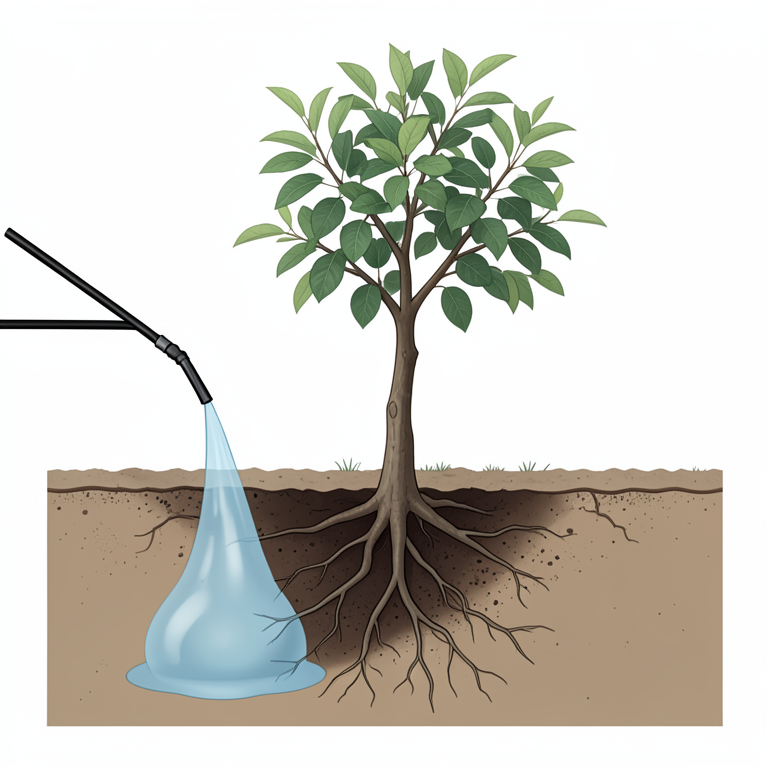
Drip Irrigation Root Zone Concept
AI-generated conceptual illustration (apple tree in soil). It explains the idea and does not show study data.
View source evidence ↗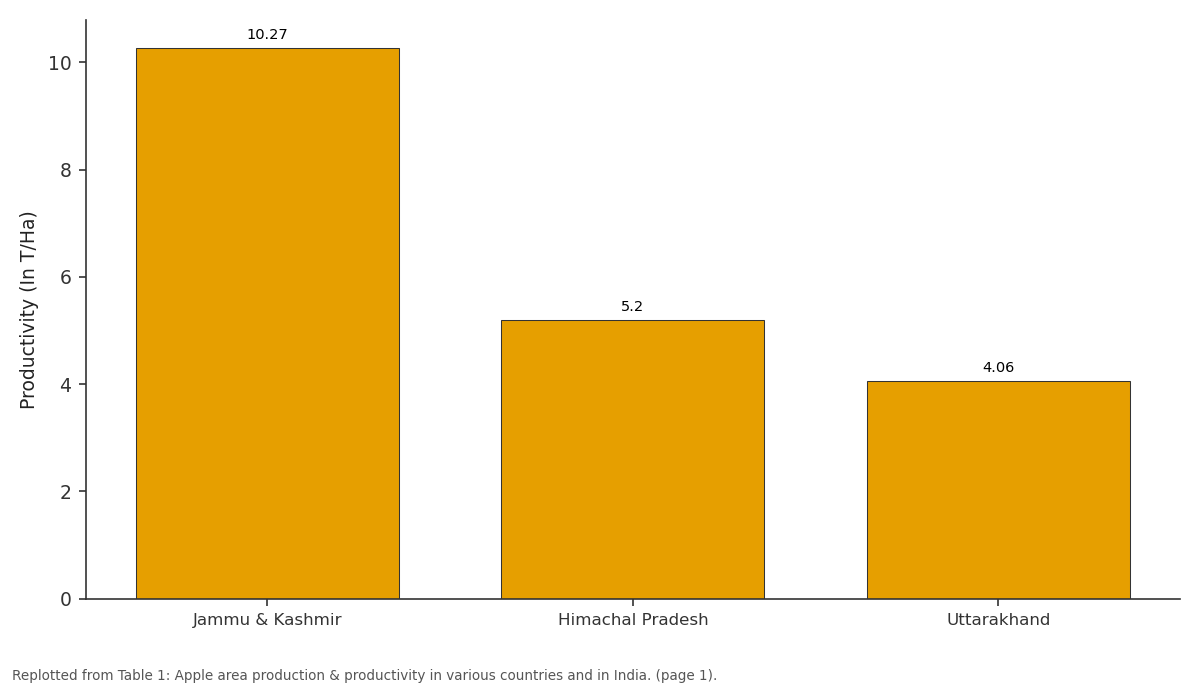
Productivity (In T/Ha): Jammu & Kashmir vs Himachal Pradesh vs Uttarakhand
Replotted from Table 1 (page 1) of the original paper. Every bar is the paper's own table value.
View source evidence ↗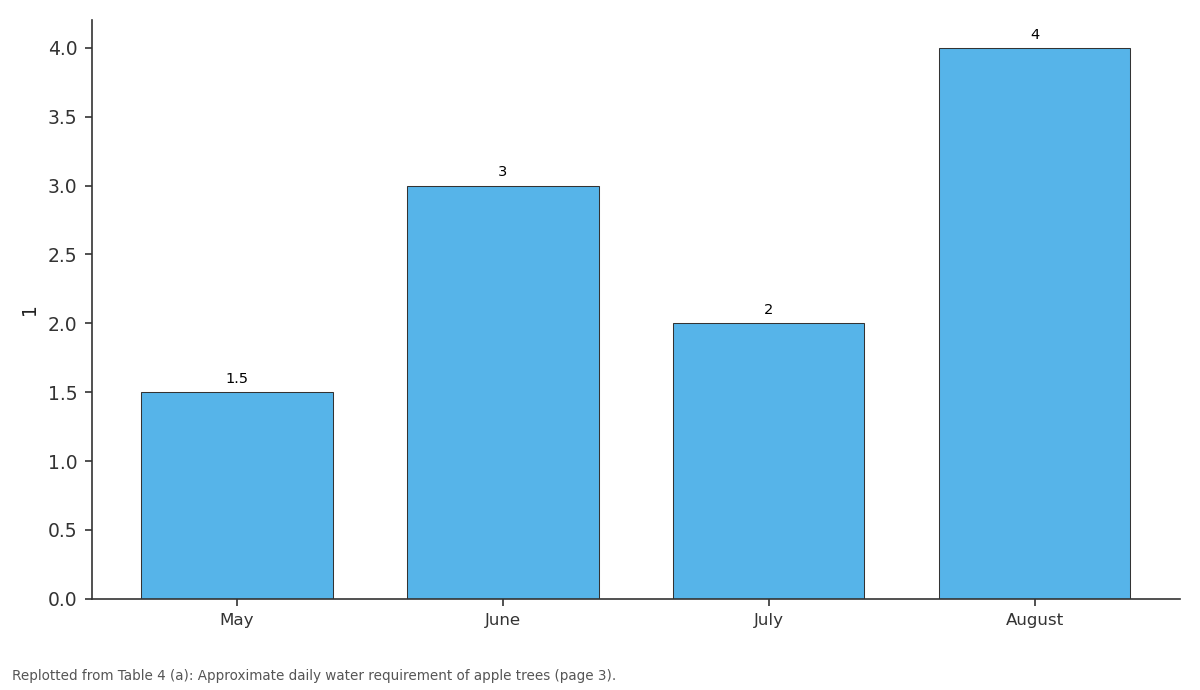
1: May vs June vs July vs August
Replotted from Table 4 (page 3) of the original paper. Every bar is the paper's own table value.
View source evidence ↗Figures & tables
From the original paper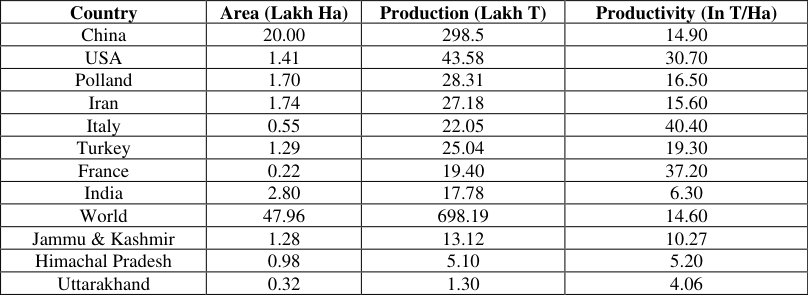 Table 1
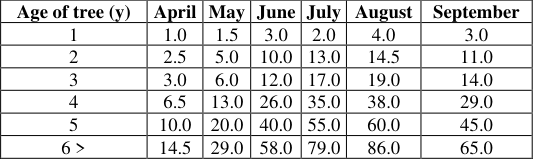 Table 4
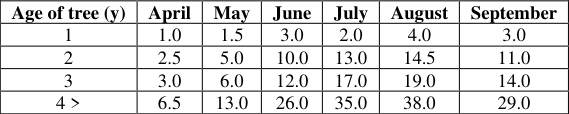 Table 4
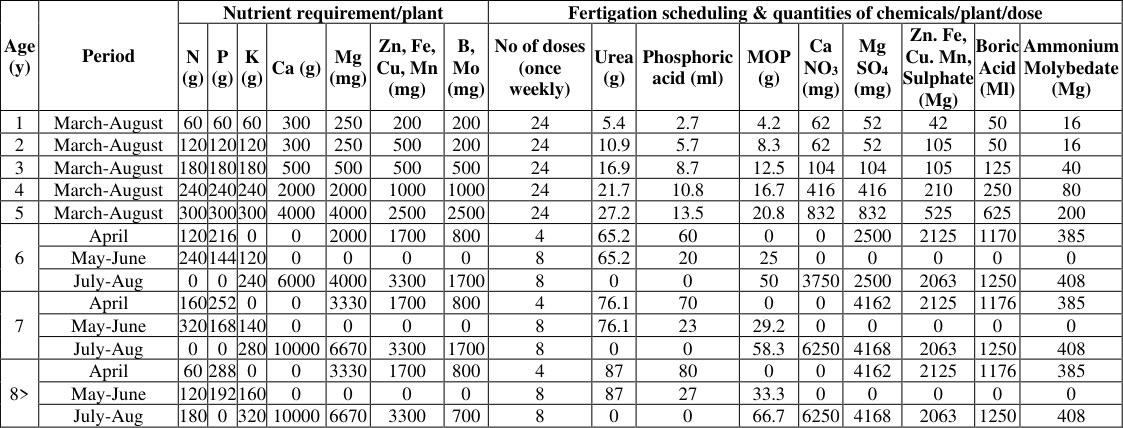 Table 3
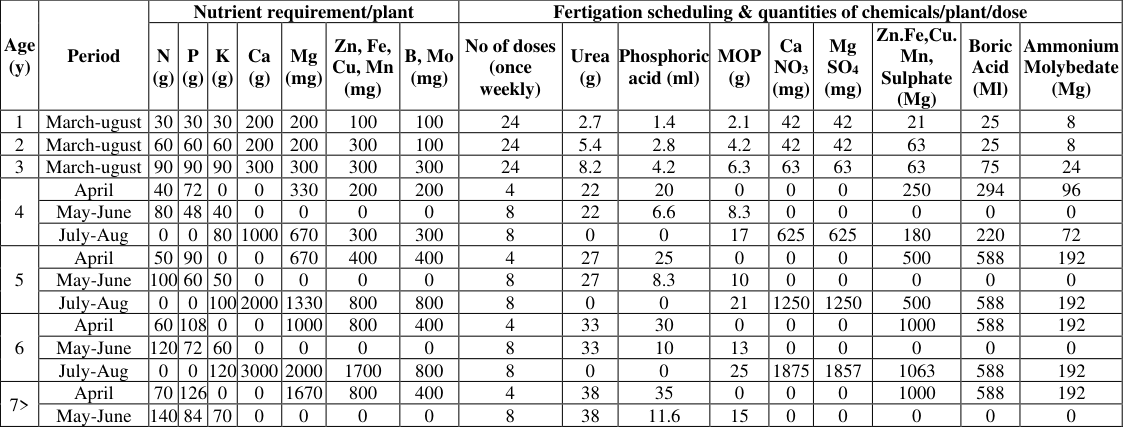 Table 4
Introduction
Apple cultivation in India started during eighteenth century and now it is an important crop of temperate regions. Apple crop ranks sixth amongst fruits production in India. China is largest apple producer in the world with 43 percent share, however, India has only 3% share. In India, apple is primarily grown in the states of Jammu-Kashmir, Himachal Pradesh and Uttarakhand as the chilling requirement of apple buds are fully met here from the snowfall and frost during winter when the trees are in deep dormancy. The area, production and productivity data of apple in these states have been given in Table -1 In Jammu-Kashmir, there are regular snowfalls and winter rains which provide sufficient moisture in the soil to protect the bloom from spring frosts, resulting in good fruit-set. Further, this zone being in inner Himalayas, the summers are cool and dry and there is plenty of sunlight available to the growing crop. The shortage of moisture during critical periods of crop growth and fruit development affects both yields and sizing of produce, thus affecting receipts through both volume of production and average price. If precise irrigation facilities are created, and a systematic approach to cultural practices is adhered-to, the yields and quality can be increased manifold.
The main limitations are the non-availability of 1. Irrigation 2. Suitable cultivar which can produce sustainable yields under changing environment. 3. Nutrition for their efficient use during the growth stage when an apple tree demands. 4. Training and pruning. 5. Disease and pest management. 6. Protection of fruits from hailstorms. 1) During early days the snowfall in winters and rains during summers were regular, hence people did not realize need for irrigation. From last few decades neither snowfall nor rains occur at proper timessome years in excess, in other years, deficient. Looking to the topography of apple growing areas, water can be stored in tanks and can be used whenever necessary through drip system for irrigation. 2) Cultivars have been developed which do well under fluctuating temperatures. These are to be popularized on priority basis. 3) Fertigation can be used for application of nutrients along with irrigation water. The nutrient can thus be made available to the trees when they require them most. 4) Although the system of training and pruning is recommended since long, however, it has not been used as an essential practice. Proper training and pruning gives strong framework to a tree and also enable the tree to yield a normal crop on a regular basis. 5) The first precaution to be taken up for management of diseases and pests is to maintain proper sanitary conditions in the orchard, provide conditions for aeration and sunlight upto the inner parts of the tree. Use of appropriate fungicides and insecticides at proper timings are very important for their control and to check their spread. 6) In some pockets, during summer, the hailstorms occur regularly which adversely affect the quality and production. Planting of apple orchards in these areas should be avoided and be put under temperate nuts like walnut, pecan nut etc. 7) Several orchards do not have sufficient number of pollinizer varieties.
Irrigation and Fertigation of apple
Due to low frequency and uncertainty conditions of snowfalls and rains, the availability of water has become inadequate for normal growth and fruiting. Due to rainfed conditions or improper conventional irrigation practices, apple yield is affected greatly. Due to tough competition from imported apples in Indian market as well as competition and stringent quality expectation in export market, there is a great need of adoption of advanced irrigation and fertigation techniques. According to Stiles et al. (1995) [6] with fertigation, nutrients dissolved in water can be more quickly delivered to the root zone of apple trees. This is an additional benefit of microirrigation that effects yield, quality and growth.
What is drip irrigation?
Drip Irrigation is the method of application of water and fertilizers directly near the root zone at frequent intervals and at low application rate so as to maintain proper air-water balance within the root zone of the crop. It is the pressurized irrigation system, water reaches to the farthest end under pressure and gives equal volume of water within the field area.
Characteristics of drip irrigation 1.
Water is applied at a low rate to maintain optimum air-water balance 1) Within the root zone.
2) Water is applied over a long period of time.
3) Water is applied to the plant and not to the land. 4) Water is applied at frequent intervals. 5) Water is applied via a low pressure delivery system On resumption of growth after winter dormancy, apple trees should start getting irrigation. The flowering starts when the trees attain 4-5 years age. Drip Irrigation should commence two weeks after petal fall and continue till October. In case the water availability is limited, it should be used judiciously at critical stages of water requirement i.e., at (i) 20-25 days prior to flowering (ii) 1-2 weeks after petal fall (iii) 4-5 weeks after petal fall (iv) 3-4 weeks prior to fruit maturity (v) .In such conditions drip irrigation plays vital role.
Lay out for apple drip irrigation
Lay out for apple drip irrigation
Advantages of drip irrigation system in apple
• With use of drip irrigation overall yield and quality of apple increases.
• During the prolonged gap of rainfall, drip irrigation is useful to avoid water stress, this timely survival irrigation also help to increase the yield. • Minimized soil erosion.
In water scarce areas for the purpose of drip irrigation, water can be stored in poly lined tanks from the water sources such as roof water harvesting, natural water springs, tube wells or by lifting water from rivers. If water is available near orchard from river, canals, etc., irrigation system can be directly connected from there. In cold regions, losses due to evaporation and transpiration are comparatively less as compared to warmer areas. The irrigation to plots can be designed accordingly during rainy season, if there is no rain for several days, irrigation has to be provided. On the basis of tree age, the approximate water requirement has been given in Table 4. Girona et al. (2010) [1] observed an initial low crop coefficient of 0.2 at bud break that continued to increase until harvest where the crop coefficient reached an average maximum of0.8, which then dropped down to 0.4 at the end ofthe irrigation season after fruit harvest. These values are for true temperate climate where winters are severe and are experiencing regular snowfalls. In summers, rains are scanty and precipitation is confined to few centimeters only. Area specific refinements are only possible through experiences or by using location specific climatic data and considering soil type. For intercrops like potato, french bean, tomato, cauliflower, cabbage etc., additional quantities of water will be required which can be estimated for each of these crops.
| Age (y) | Period | Nutrient requirement/plant | — | — | — | — | — | — | Fertigation scheduling & quantities of chemicals/plant/dose | — | — | — | — | — | — | — | — |
|---|---|---|---|---|---|---|---|---|---|---|---|---|---|---|---|---|---|
| N (g) | P (g) | K (g) | Ca (g) | Mg (mg) | Zn, Fe, Cu, Mn (mg) | B, Mo (mg) | No of doses (once weekly) | Urea (g) | Phosphoric acid (ml) | MOP (g) | Ca NO3 (mg) | Mg SO4 (mg) | Zn.Fe,Cu. Mn, Sulphate (Mg) | Boric Acid (Ml) | Ammonium Molybedate (Mg) | ||
| 1 | March-ugust | 30 | 30 | 30 | 200 | 200 | 100 | 100 | 24 | 2.7 | 1.4 | 2.1 | 42 | 42 | 21 | 25 | 8 |
| 2 | March-ugust | 60 | 60 | 60 | 200 | 200 | 300 | 100 | 24 | 5.4 | 2.8 | 4.2 | 42 | 42 | 63 | 25 | 8 |
| 3 | March-ugust | 90 | 90 | 90 | 300 | 300 | 300 | 300 | 24 | 8.2 | 4.2 | 6.3 | 63 | 63 | 63 | 75 | 24 |
| 4 | April | 40 | 72 | 0 | 0 | 330 | 200 | 200 | 4 | 22 | 20 | 0 | 0 | 0 | 250 | 294 | 96 |
| May-June | 80 | 48 | 40 | 0 | 0 | 0 | 0 | 8 | 22 | 6.6 | 8.3 | 0 | 0 | 0 | 0 | 0 | |
| July-Aug | 0 | 0 | 80 | 1000 | 670 | 300 | 300 | 8 | 0 | 0 | 17 | 625 | 625 | 180 | 220 | 72 | |
| 5 | April | 50 | 90 | 0 | 0 | 670 | 400 | 400 | 4 | 27 | 25 | 0 | 0 | 0 | 500 | 588 | 192 |
| May-June | 100 | 60 | 50 | 0 | 0 | 0 | 0 | 8 | 27 | 8.3 | 10 | 0 | 0 | 0 | 0 | 0 | |
| July-Aug | 0 | 0 | 100 | 2000 | 1330 | 800 | 800 | 8 | 0 | 0 | 21 | 1250 | 1250 | 500 | 588 | 192 | |
| 6 | April | 60 | 108 | 0 | 0 | 1000 | 800 | 400 | 4 | 33 | 30 | 0 | 0 | 0 | 1000 | 588 | 192 |
| May-June | 120 | 72 | 60 | 0 | 0 | 0 | 0 | 8 | 33 | 10 | 13 | 0 | 0 | 0 | 0 | 0 | |
| July-Aug | 0 | 0 | 120 | 3000 | 2000 | 1700 | 800 | 8 | 0 | 0 | 25 | 1875 | 1857 | 1063 | 588 | 192 | |
| 7> | April | 70 | 126 | 0 | 0 | 1670 | 800 | 400 | 4 | 38 | 35 | 0 | 0 | 0 | 1000 | 588 | 192 |
| May-June | 140 | 84 | 70 | 0 | 0 | 0 | 0 | 8 | 38 | 11.6 | 15 | 0 | 0 | 0 | 0 | 0 |
Table text extracted from the original PDF; superscript letters are shown inline. The original table image is below.
View original table image
| Age of tree (y) | April | May | June | July | August | September |
|---|---|---|---|---|---|---|
| 1 | 1.0 | 1.5 | 3.0 | 2.0 | 4.0 | 3.0 |
| 2 | 2.5 | 5.0 | 10.0 | 13.0 | 14.5 | 11.0 |
| 3 | 3.0 | 6.0 | 12.0 | 17.0 | 19.0 | 14.0 |
| 4 > | 6.5 | 13.0 | 26.0 | 35.0 | 38.0 | 29.0 |
Table text extracted from the original PDF; superscript letters are shown inline. The original table image is below.
View original table image
| Age of tree (y) | April | May | June | July | August | September |
|---|---|---|---|---|---|---|
| 1 | 1.0 | 1.5 | 3.0 | 2.0 | 4.0 | 3.0 |
| 2 | 2.5 | 5.0 | 10.0 | 13.0 | 14.5 | 11.0 |
| 3 | 3.0 | 6.0 | 12.0 | 17.0 | 19.0 | 14.0 |
| 4 | 6.5 | 13.0 | 26.0 | 35.0 | 38.0 | 29.0 |
| 5 | 10.0 | 20.0 | 40.0 | 55.0 | 60.0 | 45.0 |
| 6 > | 14.5 | 29.0 | 58.0 | 79.0 | 86.0 | 65.0 |
Table text extracted from the original PDF; superscript letters are shown inline. The original table image is below.
View original table image
In high density, all super dwarf and semi dwarf clonal rootstock have a limited root volume, most of the roots that feed are located in the top 30 cm of soil profile. The M.9 rootstock is much less tolerant to dry soils than the vigorous rootstocks like MM-111 or apple seedlings. Further, large highly feathered trees produce much more leaf area shortly after planting than unfeathered trees which creates a high water demand before the root system can re-grow sufficiently to support the trees. Frequent and early drip irrigation can help these trees produce good growth in the first year. Hence, it is recommended that growers should install drip irrigation system soon after planting to prevent water stress and maximize initial years tree growth. Soil that have adequate moisture available throughout the growing season are likely to establish better trees, grow more fruit bearing shoots, initiate more and healthier fruit buds and produce larger, better keeping quality apples. Each mature apple tree on fully dwarfing rootstock may require 25-35 litres of water per day in May, June, July and August when applied with a drip irrigation system. Irrigation can influence the individual sizes of fruit in the orchard, and have a positive effect on the following year crop. A tree experiences stress of available moisture long before its leaves wilt. The ideal situation is to have a continual supply available all through the season so growth is not interrupted and the tree is not stressed. A level of 40-50 per cent 38 Apple Hi-Tech Cultivation Practices available soil moisture(A.S.M) is considered adequate for all soil types. With drip irrigation system the A.S.M under the emitters is maintained at 85-90 percent. The A.S.M. can be determined by feel. Fine textured soils (silt and clay loams), which can be cupped in the hand and gently squeezed and moulded into the ball that holds together, probably contains upto 50 per cent A.S.M. A ball which is somewhat crumbly, although holds together with pressure, may contain only 30 to 40 per cent A.S.M. or less.
Frequent low doses of nitrogenous fertilizer delivered at least twice weekly through the drip system for the first 12 weeks of resuming growth will greatly improve tree growth during the first 2 years to speed development of the canopy. With high tree densities as with the Slender Spindle system and highly feathered trees, almost no lateral tree growth is required and only vertical extension growth is needed. Adoption of immediate fertigation of highly feathered trees will considerably improve tree growth and vastly improve yield potential during the initial years of orchard establishment. Kiiciikyumuk et al. (2012) [2] also found that through the use of drip irrigation, they could increase the quality and quantity of apples, while decreasing the amount of applied water and decreasing the evapotranspiration (ET) rate. For moderate densities, trees must be grown vigorously for several years to fill the allotted space with canopy and relatively high nitrogen fertilization is desirable for 2-3 years after planting. However, excessive N fertilization can cause too much growth which results into delayed flowering, reduced yields, poor fruit quality and greater pruning. After the development of canopy, the mature trees should be fed with low nitrogen fertilization to keep the trees "calm" with a balance between vegetative growth and fruiting. The soils which are rich in organic matter or have complex proteinacious substances in them produce 30 to 60 kg/ hectare of nitrogen annually through nitrification. This is almost half of the total amount needed by mature high density orchards. The 1/3rd of N requirement is given in April as active root growth starts before any obvious bud development in the tree canopy. The remaining 2/3rd of the N requirement is applied in equal amounts with subsequent irrigation in May and June, but not thereafter. In place of Phosphoric acid, the mono-ammonium phosphate (MAP) can be used. Alternatively SSP or DAP can be applied in soil during Dec -Jan. Termination of N application in June is required to slow vegetative growth and promote hardening off for winter. Calcium nitrate is the preferred N source for fertigation of fruit trees because soil acidification occurs more slowly. The K is injected in equal amount with each irrigation in July and August. The delayed application of K relative to N is to enhance fruit colour, winter hardiness, tree growth and disease resistance during the latter half of the growing season. The drip lines must be flushed immediately after each fertigation to prevent plugging of the emitters. Fertigation has been successful in apple orchards, where nutrient application is synchronized with plant demand, as influenced by plant age, growth cycle and weather conditions. Positive effects have been reported on tree nutritional status; for example, phosphorus and potassium (K) can move more rapidly into the root zone (Neilsen et al., 1999) [4] . Fertigation can increase vegetative and reproductive growth, and improve fruit quality (Neilsen and Neilsen, 2002; Treder, 2006; Rakićević et al., 2012) [7,4,5] . 1. Fertilizer schedule needs to be adjusted as per crop growth stages as months may vary with locations. April refers to before flowering and leafing stage, May-June refers to fruit growth and July-Aug. refers to fruit enlargement stage.
Fertigation of apple
Fertigation of apple
Conclusion
The nutrient interaction with water application rate needs further investigation in order to optimize both the units of fertilizer and irrigation volumes for growers. This would allow growers to satisfy the apple orchard's nutritional requirements at the right time with the right quantity of fertilizer, without creating excessive vigor that could negatively affect fruit yield and quality. Combining fertigation with appropriate irrigation scheduling can save up to 50 percent of the amount of water used compared to a fixed irrigation schedule. Depending on soil type, leaching of nutrients into the ground water also may be reduced, further enhancing agricultural sustainability.
Figures and tables from the paper
| Country | Area (Lakh Ha) | Production (Lakh T) | Productivity (In T/Ha) |
|---|---|---|---|
| China | 20.00 | 298.5 | 14.90 |
| USA | 1.41 | 43.58 | 30.70 |
| Polland | 1.70 | 28.31 | 16.50 |
| Iran | 1.74 | 27.18 | 15.60 |
| Italy | 0.55 | 22.05 | 40.40 |
| Turkey | 1.29 | 25.04 | 19.30 |
| France | 0.22 | 19.40 | 37.20 |
| India | 2.80 | 17.78 | 6.30 |
| World | 47.96 | 698.19 | 14.60 |
| Jammu & Kashmir | 1.28 | 13.12 | 10.27 |
| Himachal Pradesh | 0.98 | 5.10 | 5.20 |
| Uttarakhand | 0.32 | 1.30 | 4.06 |
Table text extracted from the original PDF; superscript letters are shown inline. The original table image is below.
View original table image
| Age (y) | Period | Nutrient requirement/plant | — | — | — | — | — | — | Fertigation scheduling & quantities of chemicals/plant/dose | — | — | — | — | — | — | — | — |
|---|---|---|---|---|---|---|---|---|---|---|---|---|---|---|---|---|---|
| N (g) | P (g) | K (g) | Ca (g) | Mg (mg) | Zn, Fe, Cu, Mn (mg) | B, Mo (mg) | No of doses (once weekly) | Urea (g) | Phosphoric acid (ml) | MOP (g) | Ca NO3 (mg) | Mg SO4 (mg) | Zn. Fe, Cu. Mn, Sulphate (Mg) | Boric Acid (Ml) | Ammonium Molybedate (Mg) | ||
| 1 | March-August | 60 | 60 | 60 | 300 | 250 | 200 | 200 | 24 | 5.4 | 2.7 | 4.2 | 62 | 52 | 42 | 50 | 16 |
| 2 | March-August | 120 | 120 | 120 | 300 | 250 | 500 | 200 | 24 | 10.9 | 5.7 | 8.3 | 62 | 52 | 105 | 50 | 16 |
| 3 | March-August | 180 | 180 | 180 | 500 | 500 | 500 | 500 | 24 | 16.9 | 8.7 | 12.5 | 104 | 104 | 105 | 125 | 40 |
| 4 | March-August | 240 | 240 | 240 | 2000 | 2000 | 1000 | 1000 | 24 | 21.7 | 10.8 | 16.7 | 416 | 416 | 210 | 250 | 80 |
| 5 | March-August | 300 | 300 | 300 | 4000 | 4000 | 2500 | 2500 | 24 | 27.2 | 13.5 | 20.8 | 832 | 832 | 525 | 625 | 200 |
| 6 | April | 120 | 216 | 0 | 0 | 2000 | 1700 | 800 | 4 | 65.2 | 60 | 0 | 0 | 2500 | 2125 | 1170 | 385 |
| May-June | 240 | 144 | 120 | 0 | 0 | 0 | 0 | 8 | 65.2 | 20 | 25 | 0 | 0 | 0 | 0 | 0 | |
| July-Aug | 0 | 0 | 240 | 6000 | 4000 | 3300 | 1700 | 8 | 0 | 0 | 50 | 3750 | 2500 | 2063 | 1250 | 408 | |
| 7 | April | 160 | 252 | 0 | 0 | 3330 | 1700 | 800 | 4 | 76.1 | 70 | 0 | 0 | 4162 | 2125 | 1176 | 385 |
| May-June | 320 | 168 | 140 | 0 | 0 | 0 | 0 | 8 | 76.1 | 23 | 29.2 | 0 | 0 | 0 | 0 | 0 | |
| July-Aug | 0 | 0 | 280 | 10000 | 6670 | 3300 | 1700 | 8 | 0 | 0 | 58.3 | 6250 | 4168 | 2063 | 1250 | 408 | |
| 8> | April | 60 | 288 | 0 | 0 | 3330 | 1700 | 800 | 4 | 87 | 80 | 0 | 0 | 4162 | 2125 | 1176 | 385 |
| May-June | 120 | 192 | 160 | 0 | 0 | 0 | 0 | 8 | 87 | 27 | 33.3 | 0 | 0 | 0 | 0 | 0 | |
| July-Aug | 180 | 0 | 320 | 10000 | 6670 | 3300 | 700 | 8 | 0 | 0 | 66.7 | 6250 | 4168 | 2063 | 1250 | 408 |
Table text extracted from the original PDF; superscript letters are shown inline. The original table image is below.
View original table image
References
7 in the original paper- Girona J, Campo J, Mata M, Lopez G, Marsal J. A comparative study of apple and pear tree water consumption measured with two weighing lysimeters. Irrig. Sci 2010;29:55-63.
- Kiiciikyumuk C, Kacal E, Ertek A, Oztiirk G, Kukul Kurttas YS. Pomological and vegetative changes during transition from flood irrigation to drip irrigation: Starkrimson Delicious apple variety. Scientia Horticulturae 2012;136:17-23.
- Neilsen D, Neilsen GH. Efficient use of nitrogen and water in high-density apple orchard. Hort Technology 2002;12:19-25.
- Neilsen GH, Neilsen D, Peryea F. Response of soil and irrigated fruit trees to fertigation or broadcast application of nitrogen, phosphorus and potassium. Hort Technology 1999;9:393-401.
- Rakićević M, Miletić R, Pešaković M. Effect of fertigation on productivity of apple trees. Commun. Soil Sci. Plant Anal 2012;43:589-594.
- Stiles WC, Robinson TL, Reid WS. Fertilization of Apple Orchards Through Drip Irrigation Systems (Fertigation). NY Fruit Quarterly 1995;3(3):7-10.
- Treder W. Influence of fertigation with nitrogen and a complete fertilizer on growth and yielding of 'Gala' apple trees. J Fruit Ornam. Plant Res 2006;144:143-154.
Cited by 1
From OpenAlex, OpenCitations and reference lists read by Scinovex
- Optimizing water–fertilizer integration at key growth stages for synergistic improvement of apple yield and quality ↗
Zhiping Duan, Yu Song, Weifeng Zhang, Zengyuan Li · Irrigation Science · 2026
❝ 0