
Research article · 2021 · Full text
International Journal of Research in AgronomyStubble burning a choice or helplessness: A review
Volume 4(1) · Pages 01–03 · DOI: 10.33545/2618060x.2021.v4.i1a.41 ↗
Research areasAgricultural Economics and PracticesAgricultural risk and resilience
Abstract
Author-writtenIn the present scenario crop residue management is one of the main agriculture problem across the nation especially northern plains where paddy wheat is the most following crop cycle. The smog coming out of the burning residue not only causes air pollution, lowers the soil carbon percent ,reduce soil fertility, nutrients in the soil and many health hazards to human and animal health. The situation is more worsen with the pandemic on the way by causing lots of respiratory problems and lung infections. The proper use of paddy residue has become a main issue in the northwestern Indian states, with no choice and farmers preferring to burn the remains. Maintenance of rice residues is important because it contains plant nutrients and can improve soil-plant-climate persistence after decomposition. The biomass when a burn not only pollutes the environment but also deprives the plant of essential nutrients. The blames are imposed on the farmer that- why? They burn stubble in farm in spite of other options for managing. But is they are burning the crop residue willingly or helplessness? A study on the reason behind this. In this article we are going to discuss all these reasons which are forcing a farmer to burn their crop residue.
Summary
Source-checkedPlain-language reading of the full paper, prepared with AI and checked against the text. Each point links to the authors' own words.
Why it matters
- Crop residue management is a significant agricultural challenge in India, particularly in the northern plains where the paddy-wheat crop cycle is common. View evidence ↗
- Burning crop residue creates smog that leads to air pollution, reduces soil fertility and carbon levels, and poses health risks to humans and animals. View evidence ↗
- Maintaining rice residues is beneficial because they provide plant nutrients and improve the persistence of the soil-plant-climate system after they decompose. View evidence ↗
The question
- The review aims to determine whether farmers burn crop residue by choice or out of helplessness by discussing the factors that force this practice. View evidence ↗
What they did
- The authors conducted a review to analyze the reasons why farmers continue to burn crop residue despite available alternatives. View evidence ↗
- The review incorporates data on stubble production, noting Punjab produces approximately 200 lakh tons of stubble, with burning rates highest in UP (38%), Haryana (26%), and Punjab (15%). View evidence ↗
What they found
- Crop residue burning releases significant pollutants, including 149.24 million tons of CO2, 9 million tons of SOX, 1.28 million tons of particulate matter, and 0.07 million tons of black carbon. View evidence ↗
- The economic burden of health issues caused by stubble burning in rural Punjab is estimated at 7.6 crore rupees annually for medical treatment. View evidence ↗
- Many farmers in Punjab and Haryana own less than 1 hectare of land, making the cost of using modern sowing machines (over 4000 per acre) prohibitive. View evidence ↗
- Manual removal of residue is impractical due to labor shortages and high costs, with labor priced at 400 rupees per day. View evidence ↗
- Government water conservation laws mandate specific sowing times, forcing farmers to clear fields quickly via burning to meet these deadlines. View evidence ↗
- The purchase cost of management machinery is high, with Balers costing 3.75 lakh and Happy seeders costing 1.50 lakh. View evidence ↗
- Burning is the most affordable option, costing only one rupee for a matchbox, compared to the high costs of machine operation. View evidence ↗
What it means
- The authors conclude that banning stubble burning is ineffective on its own; the government must provide financial support and funds to farmers. View evidence ↗
- The authors recommend creating commercial markets for biofuel, biogas, and compost from stubble, and suggest the government purchase crop residue from farmers. View evidence ↗
Figures & tables
From the original paper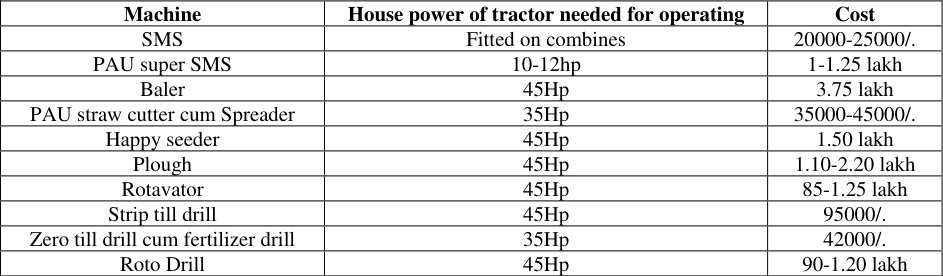 Table 1
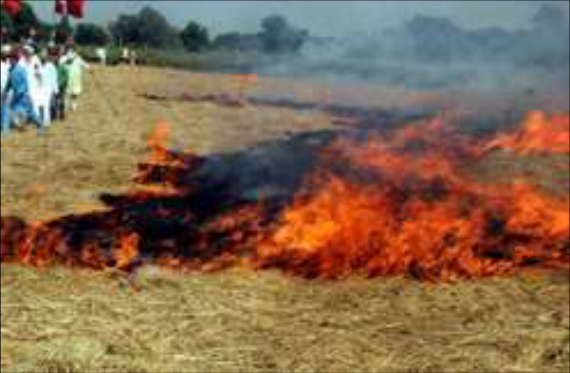 Figure 1
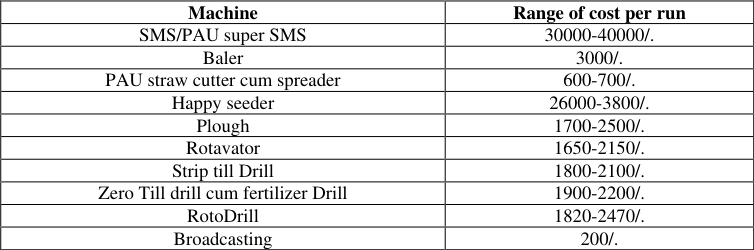 Table 2
Introduction
As we all know in the upcoming months of oct-nov, a major problem will be faced by farmers/ government will be stubble burning. As the time passes the government is introducing new rules and convinced farmers for not to burn crop residue. So what a farmer can do in this situation? Is they have any other solution rather than burning the crop residue in the field? If we ask this question to the government/ experts they will say yes, but if we ask same question to a farmer he will said no. Although many new technologies has been arrived. Farmer can use crop residue as mulching, for making NADEP, vermicompost, for feeding animals. He can also incorporate the residue in the soil with disc plough, plough, rotavator and can directly sow his crop by happy seeder, super seeder. But is they easily available for the farmer? A news reporter of India today, Dipu rai said that alone Punjab produces 180 lakh ton paddy and approximately 200lakh tons of stubble. Maximum stubble is burnt in UP (38%) followed by Haryana (26%) and to remove the plants which are previously grown and help the new plant to grow. Which is done Punjab (15%). National Green Tribunal (NGT) bans the burning of stubble. After the banning in year 2019 maximum cases of stubble burning are reported in M.P Followed by Punjab, and M.H.
Pros and cons of stubble burning:
According to Jacob grace (21 april2015) the farmers need by burning the crop residue, they also called it as "Prescribed Burn" It improves the health of field. It's most inexpensive method for removing stubble.it also helps to control weed and pest population. Stubble burning have a huge impact on the environment, human, and soil health. Air pollution is raising day by day. Residue burning leads to the loss of nutrients from soil carbon in soil. R.S.Yadav said that burning of crop residue release 149.24 million tons of CO2, 9 Million tons of SOX, 1.28 million tons of particulate matter and 0.07 million tons of black carbon. Decrease in availability of nutrients in soil. Reduce the soil aggregate stability. Respiratory diseases cough, asthma, bronchitis, eyes and skin diseases are more in the months of October-November. Vitull K Gupta, professor of medicine, Bathinda in 2016 said that 84.5% people reported irritation in eyes, 44.8% in nose and 45.5% in throat. It leads to release of soot and smoke, which causes the health problems in humans as well as in animals. Milk production is also less in these two months. Burning have a drastic effect on the soil health. Soil carbon decreases in soil with burning practice. Burning leads to the rise in temperature of soil and soil heats up which needs more water for irrigation. Institute for social and economic changes, Bangalore, estimated that people in rural Punjab spent 7.6 Crore every year on treating aliment caused by burning of crop residue. Apart from all above reasons there is a huge reason of spreading fire.
Reasons why farmers choose to burn stubble:
There are several reasons why a farmer burn crop residue in field. First of all it's a cheapest method to dispose paddy stubble from field only with the matchbox. Lack of machinery for disposing of stubble, if they are present they are costly. So, Majority of Farmers in Punjab, Haryana have less than 1 hectare of land and if they decide to sow next crop with modern machines, it will cost more than 4000 per acre. Farmers don't have proper knowledge about making compost or using it for nutrient management in soil. Northern plain are known as food bowl of India. Multiple cropping system is adopted in these areas. So the time between harvesting of one crop and sowing of next crop is very little, farmers have to sow next crop on time for good produce. Burning is the easiest way to remove the stubble from field. After harvesting of paddy the potato growers can't depend on the machines like happy seeder or super seeder. The moisture present in stubble makes hurdles in the sowing process. There is lack of state government involvement for dispose it in alternative ways. If a farmer try to remove his crop residue from field with the help of labor, in Punjab Haryana there is shortage of labor and in case labor is present, it is very expensive because labor costs rupees 400 per day. And one labor can't collect stubble from one acre. Large farm holders cannot adopt this technique. Water conservation law is the another issue in Punjab because according to this law farmers have to sow their crop at the same time which is given by the government. Thus, the farmer adopt the short duration varieties, by which they can harvest the crop on time before sowing date of wheat crop. Same timing of harvesting leads to the same timing for harvesting and cleaning of field. So the farmer have to burn the residue to clear the field as soon as possible. In table 1 we have seen that the cost for purchasing farm machines. The inputs is quite high. A small or marginal farmer can't purchase these machines. In Table 2 we can saw if farmers are supposed to use these machines, he would have to use a huge amount for a single run in his field. On other hand by burning the crop residue in field requires only rupee one for matchbox, and after removing the stubble broadcasting of seed requires on rupees 200.Which is affordable for every farmer. So we can clearly see that the farmer needs something in which he have to do minimum efforts and he can gain more. These are the main reasons for the stubble burning.
| Machine | Range of cost per run |
|---|---|
| SMS/PAU super SMS | 30000-40000/. |
| Baler | 3000/. |
| PAU straw cutter cum spreader | 600-700/. |
| Happy seeder | 26000-3800/. |
| Plough | 1700-2500/. |
| Rotavator | 1650-2150/. |
| Strip till Drill | 1800-2100/. |
| Zero Till drill cum fertilizer Drill | 1900-2200/. |
| RotoDrill | 1820-2470/. |
| Broadcasting | 200/. |
Table text extracted from the original PDF; superscript letters are shown inline. The original table image is below.
View original table image
| Machine | House power of tractor needed for operating | Cost |
|---|---|---|
| SMS | Fitted on combines | 20000-25000/. |
| PAU super SMS | 10-12hp | 1-1.25 lakh |
| Baler | 45Hp | 3.75 lakh |
| PAU straw cutter cum Spreader | 35Hp | 35000-45000/. |
| Happy seeder | 45Hp | 1.50 lakh |
| Plough | 45Hp | 1.10-2.20 lakh |
| Rotavator | 45Hp | 85-1.25 lakh |
| Strip till drill | 45Hp | 95000/. |
| Zero till drill cum fertilizer drill | 35Hp | 42000/. |
| Roto Drill | 45Hp | 90-1.20 lakh |
Table text extracted from the original PDF; superscript letters are shown inline. The original table image is below.
View original table image
Steps to be taken by government and Researchers: From the above all points we can said that "Just by banning of burning crop residue Government can't stop farmers from stubble burning. Government should take it seriously and provide the funds to the farmers. They should make strategies by which biofuel, biogas, compost, can be made commercially from stubble. Government should buy crop residue as they are buying grans from farmer. Government can provide bonus to the farmers who are not burning the stubble in fields. Machines should be less expensive. Researchers should develop the method by which the farmers can get maximum profit from crop as well as crop residue. School college students should start aware and give the demo to the farmers for using stubble in daily works or making compost or manure from it. Government should provide guides which educate the farmers for making stubble useful and making soil more fertile.
Conclusion
The farmers are burning crop residue because it's the cheapest method for removing crop residue. If they adopt any other method like making compost than a large scale farmer can't make it, because he have a huge amount of the crop residue in his field. If he use the new technologies like happy seeder, super seeder etc. than he should have to be financially strong. By banning of burning crop residue or not giving them the proper sources from which they can easily manage crop residue and can sow their proceeding crop timely is not the solution of the stubble burning. Everyone should take few steps to complete the demand of farmers, so that they can fulfill their family needs.
Figures and tables from the paper
References
14 in the original paper- Rai D. Punjab burned 13% less paddy straw this year while Haryana jumped by 16%. India today 2019.
- Koshy J, Vasudeva V. Punjab's burning problem. The Hindu 2019.
- Grace J. Why do Farmers burn their fields? Harvest Public Media 2015.
- Hardke J. Residue burning in field crops. Arkansas row crops 2017.
- Reddy J. Stubble burning reasons, Disadvantages, solution. Agri farming 2019.
- Yadav RS. A problem for the environment, Agriculture and humans. Down to earth 2019.
- Tiwari R. Air pollution due to crop burning set to fall this year. The Economics Times 2019.
- Kumar P, Joshi L. Pollution caused by Agricultural waste burning and possible alternates using crop stubble: A case study of Punjab. Knowledge system of societies for Adaptation and mitigation Impact of climate change 2013, 367-385.
- Agarwal S, Trivedi RC, Sengupta B. Air pollution due to burning of residues. Indian Journal of Air Pollution Control 2006;8(1):51-59.
- Kumar A. Why farmers are forced to choose stubble burning Over Happy Seeder. The Quint 2019.
- Haq Z. Why stubble burning in Haryana and Punjab Has intensified in last 10 years. Hindustan Times 2018.
- Jaidka M, Sharma M, Sandhu PS. Evaluation of Rice Residue Options In District Shaheed Bhagat Singh Nagar of Punjab_-A Survey. Agricultural Research journal 2020;57(3):358-362.
- Chabra AA. Despite large Promotion, Super SMS fails to check Stubble Burning Menace in Punjab. The India Express 2017.
- Aranha J. Solution to stubble Burning: Punjab Man Uses Straw To Make Fuel, Eco-Products!. The Better India 2019.