
Research article · 2020 · Full text
International Journal of Agriculture Extension and Social DevelopmentThe effect of winter wheat and re-crops on the growth, development and productivity of cotton
Volume 3(1) · Pages 55–57 · DOI: 10.33545/26180723.2020.v3.i1a.45 ↗
Research areasEngineering and Agricultural InnovationsEducation, Innovation and Language Studies
Abstract
Author-writtenThe article presents data from a field and laboratory experiment conducted on takyrodnyh soils and emergency conditions in southern Uzbekistan. The height of the breeder plant in the control was 84.0 cm, the number of boxes was 8.2 pieces, and in the experimental versions, the height of the plant was 82.0-90.1 cm, the number of boxes was 7.9-8.9 pieces. The density of cotton at the end of the growing season was 75.2-78.1 thousand ha. According to the density of standing of the hlobatnik, there was no difference between the options. The harvest of raw cotton in the control was 30.1 kg / ha, the highest yield of raw cotton was obtained after winter wheat with repeated crops of soybean, fodder peas, after winter wheat with repeated sowing of triticale + fodder peas-34.5-35.6 centners per hectare, and the lowest - after winter wheat with sowing corn for silage and in the control variant.
Summary
Source-checkedPlain-language reading of the full paper, prepared with AI and checked against the text. Each point links to the authors' own words.
Why it matters
- The southern region of Uzbekistan has high solar energy, enabling the cultivation of two to three crops per year, including grain, leguminous, and fodder crops. View evidence ↗
- Using repeated crops helps enrich the soil with organic matter, which is essential for maintaining and improving soil fertility. View evidence ↗
- Intensifying agricultural production through methods like improved seed production and the development of cotton crop rotation is considered an urgent need for the region. View evidence ↗
What they did
- Field and laboratory experiments were conducted between 2015 and 2018 at the Surkhandarya research station in Uzbekistan. View evidence ↗
- The experimental site featured heavily loamy, slightly saline soils with high carbonate content (8-10%) and low humus levels. View evidence ↗
- The study used a 1-hectare experimental plot divided into triplicate plots of 240 m² each. View evidence ↗
- The researchers used the Bukhara-102 medium fiber grade of cotton for the experiment. View evidence ↗
What they found
- Cotton plants grown after crops used for livestock feed showed increased height (85.5-86.9 cm) and more bolls (10.3-10.6 pcs) compared to the control (84.0 cm height, 9.6 bolls). View evidence ↗
- The greatest plant height (88.4-90.3 cm) and highest number of bolls (11.0-11.8 pcs) were achieved when cotton followed siderata crops. View evidence ↗
- The lowest plant height and fewest bolls occurred when cotton was grown after corn sown for silage. View evidence ↗
- There was no significant difference in plant standing density across the different crop rotation variants. View evidence ↗
- The highest raw cotton yield was 35.6 centners per hectare, achieved after winter wheat followed by triticale and fodder peas as sideral crops. View evidence ↗
- The yield decrease following corn is attributed to the crop's high nutrient extraction from the soil to produce silage. View evidence ↗
What it means
- The authors recommend sowing leguminous and cereal crops as repeated intermediate crops to maintain and improve the fertility of takyr-like soils in the Surkhandarya region. View evidence ↗
- Sideral crops were found to be more effective than crops harvested for green mass, increasing raw cotton yields by 4.1-5.6 centners per hectare over the control. View evidence ↗
Visual summary
3 visualsIllustrations explain the paper; charts are replotted from the paper's own table values.
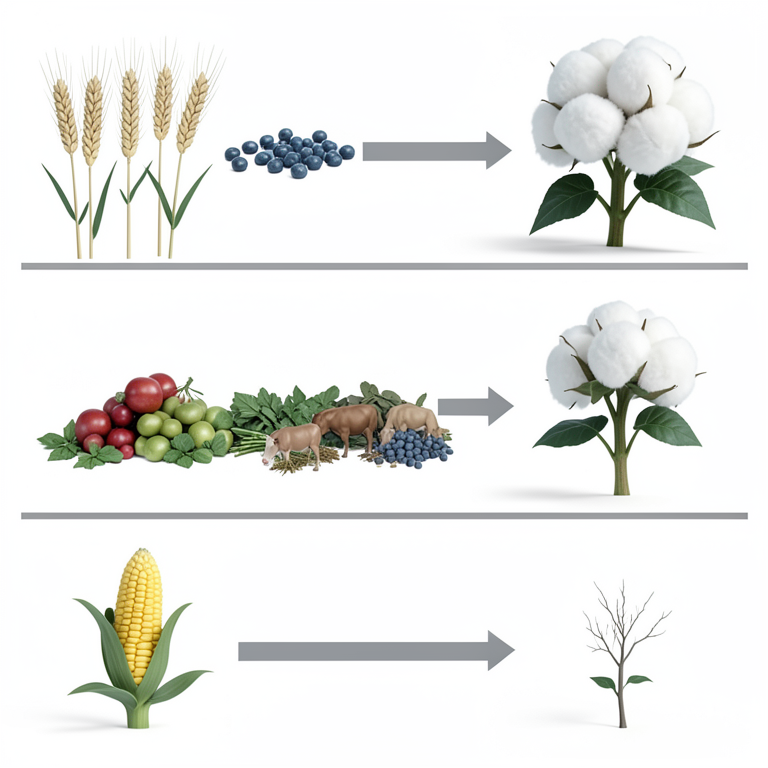
Comparison of Crop Precursors on Cotton Yield
AI-generated conceptual illustration (Winter wheat, triticale, peas, corn, and cotton plants). It explains the idea and does not show study data.
View source evidence ↗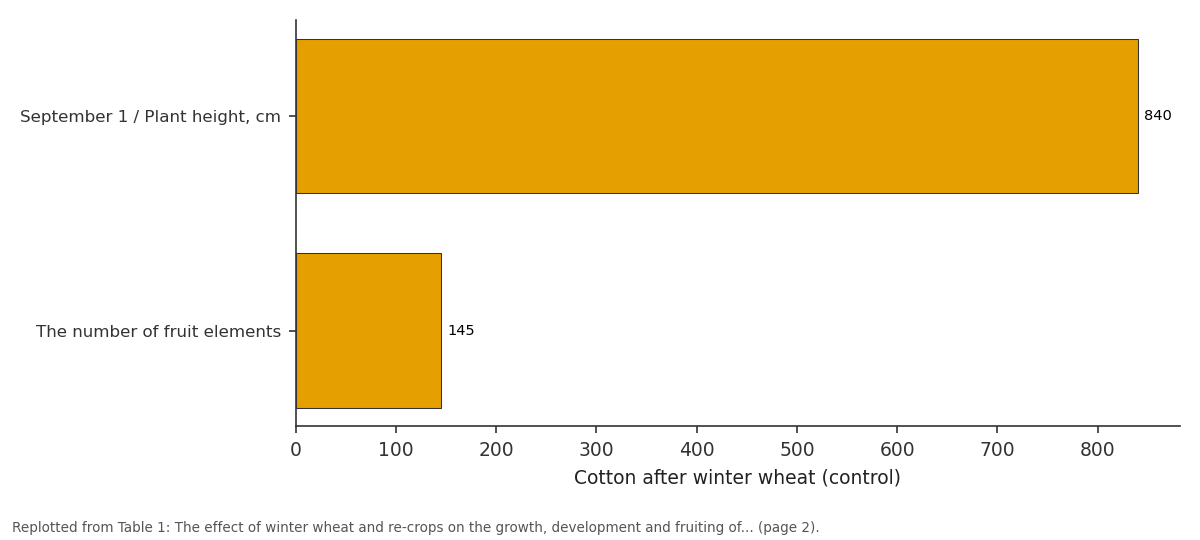
Cotton after winter wheat (control): September 1 / Plant... vs The number of fruit...
Replotted from Table 1 (page 2) of the original paper. Every bar is the paper's own table value.
View source evidence ↗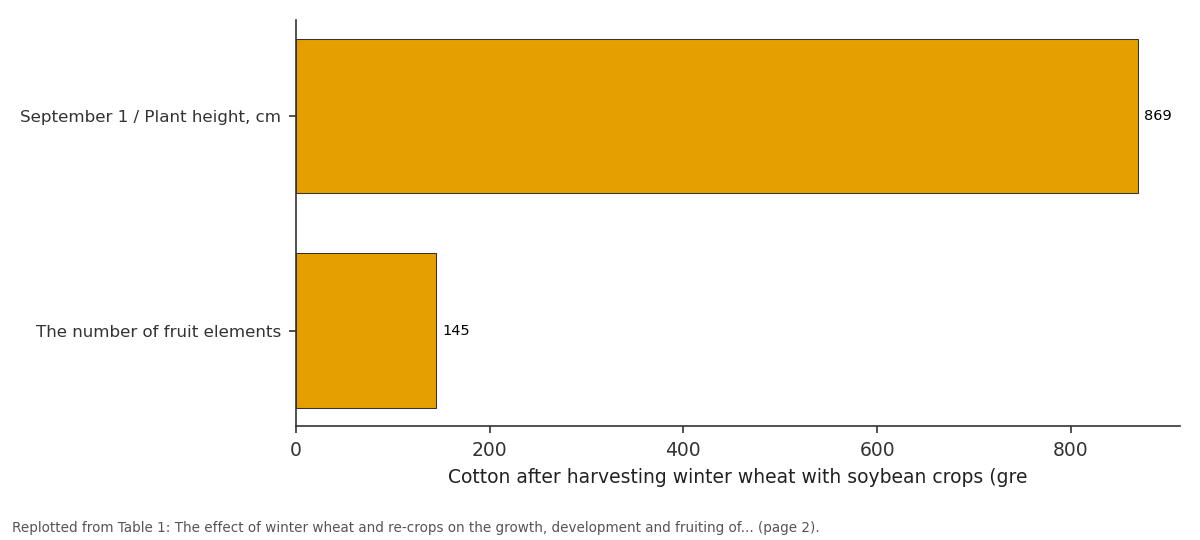
Cotton after harvesting winter wheat with...: September 1 / Plant... vs The number of fruit...
Replotted from Table 1 (page 2) of the original paper. Every bar is the paper's own table value.
View source evidence ↗Figures & tables
From the original paper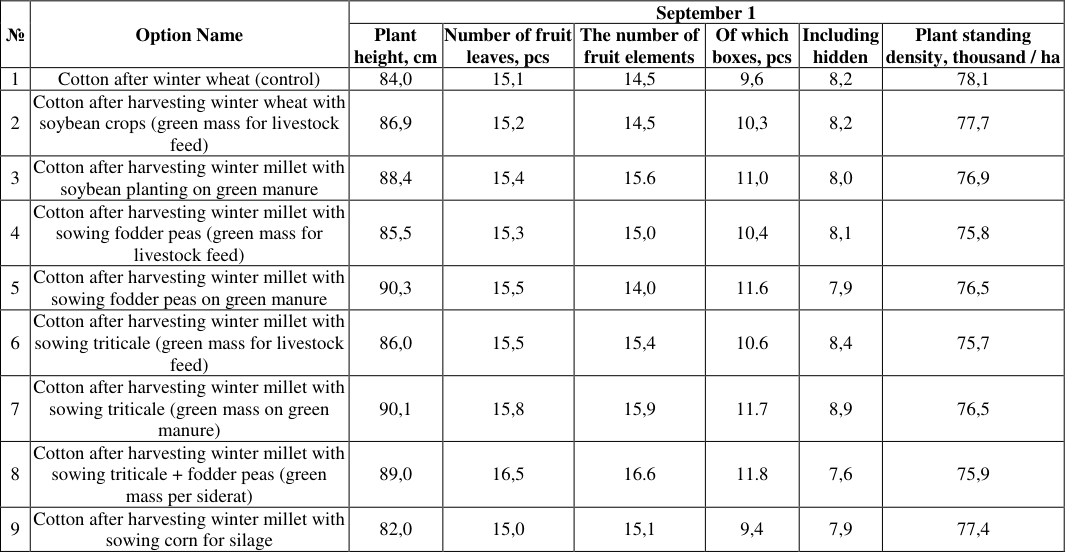 Table 1
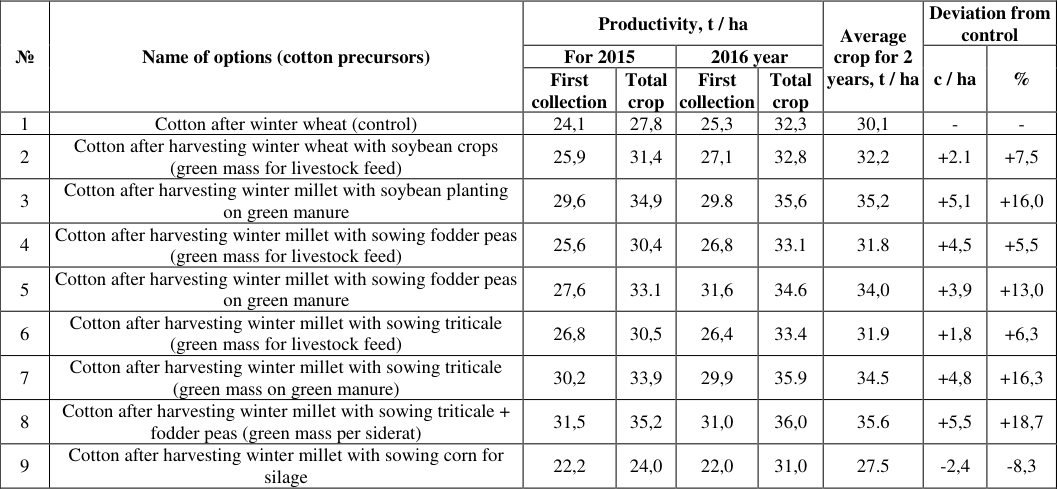 Table 2
Introduction
The President of the Republic of Uzbekistan Sh.M. Mirziyoyev pays great attention to the further development of agriculture in the country. Sown areas for repeated crops, in particular after harvesting winter wheat and sowing fodder crops, soil and climatic conditions in the south of Uzbekistan with very rich solar energy, which allows you to grow two or three crops of grain, leguminous and fodder crops a year. With this enrichment of the soil with organic matter, in turn, it contributes to the conservation and improvement of soil fertility. To solve this urgent problem, it is necessary to note the role of intensification of agricultural production, aimed at a general increase in the culture of agriculture, wide chemicalization, land reclamation, the effective use of irrigated arable land, improvement of selection and seed production, development of cotton crop rotation. Domestic and foreign scientists studied some issues of irrigated agriculture to obtain two or three crops in one year.
Material method
According to A.L. Toropkins (1952) on gray soil typical alfalfa soils of the first year in a layer of 0-40 cm 66.5 c / ha, the second year 113.0 c / ha and the third year 115.1 c / ha leaves root residues. F.V. Turgin (1964) notes that plants sown under crop rotation over the years provide useful microorganisms. Microorganisms convert difficultly accessible forms of nutrients into accessible forms, thereby increasing soil fertility. L.A. Spizhevskaya, M.Tadzhiev (1970) note that crop rotation crops reduce bulk density and increase soil water permeability and improve soil water-physical properties. A.F. Ustinovich (1987) [5] found that the optimal bulk soil mass for normal growth and development of cotton is 1.1-1.2 g / cm3, which ensures a high cotton yield. D.N. Pryanishnikov (1952) [3] established that organic crop residues have a significant effect on soil bulk density. M.A. Belousov and F.N. Ismailov (1960) proved that crop rotation after plowing reduces the bulk soil mass from 1.43 g / cm3 to 1.31 g / cm3. American scientist note that high bulk mass adversely affects soil aeration and plant roots cannot freely develop and stop growth, plant development. P.K. Ivanov, A.B. Hoodyak (1964) [2] noted that spike crops with root and crop residues leave 40-60 kg / ha of nitrogen, 35 kg / ha of phosphorus, and corn 65-80 kg / ha with nitrogen 20-25 kg / ha of phosphorus. B.M. Khalikov, F.B. Namazov (2016) [8] noted that winter wheat and second crops in the arable layer of the soil leave 65-70 kg / ha of root and crop residues and enrich the soil with nitrogen 45-50 kg / ha, and 20-25 kg / ha with phosphorus, thereby increasing soil fertility and harvest of raw cotton at 3.5-4.5 c / ha. Field experiments to study the effect of winter wheat and second crops sown after harvesting winter wheat on soil fertility and their aftereffect on cotton yield were carried out by methods developed at the Uzbek Cotton Research Institute (1976). Also, methods were used to conduct field experiments with cotton (2007) and the methods of "State variety testing of agricultural crops" (1981).
Main part
Field and laboratory studies were carried out in 2015-2018 in the experimental farm of the Surkhandarya research station of the research institute of selection, seed production and agricultural technology of cotton growing. After harvesting winter wheat, irrigation of repeated crops was carried out for high-quality soil cultivation. After ripening the land, the fields were twice loosened with chisel, then they were laid out, followed by sowing seeds of repeated and sideral crops. According to the mechanical composition, the soils of the experimental site are heavily loamy with close occurrence of groundwater (1.5-2.0 s), slightly saline, poorly supplied with humus and other nutrients, and rich in carbonates 10%). The experiments were carried out in triplicate. The area of one plot is 240 m2, 33.3 m long and 7.2 m wide, the total occupied area of the experimental plot is -1 ha. In the second half of October, winter wheat of Termez-5 variety was sown. After sowing, grooves were cut for irrigation, which provides friendly seedlings of winter wheat. Phenological observations were carried out before harvesting and where the plant height was 95.5-98.7 cm, the number of leaves was 5.4-5.7 pcs, the spike length was 14.5-15.3 cm, the weight of the spike was 1.2 g. the number of grains in one ear is 45-48 pcs. the weight of the grain in the water spike is 1.1 g. and the absolute weight of 1000 seeds is 48.5 g. Including the total number of stems per 1m2-498.5 pcs, of which the number of productive stems is 489 pcs.
The average grain yield of winter wheat is 69.8 c / ha, root and crop residues in the arable layer were 40.8 c / ha and in the under arable layer -2.4, and in the 0-50 cm soil layer-43.2 c / ha. Root crop residues in a layer of 0-50 cm soybeans amounted to 31.8 kg / ha, triticale-32.8 kg / ha, fodder peas 33.7 kg / ha and joint crops of fodder peas and triticale-51.5 kg / ha and corn -44.5 c / ha. The green mass of intermediate and sideral cultures in equestrian October and early November was crushed and plowed for plowing. The research results showed that sown after harvesting winter wheat, various legumes and grain crops differently affect the growth, development and fruiting of cotton (Table -1). The height of the plant in the experiment was seeded medium fiber grade of cotton Bukhara-102, the quality of the fiber meets all the requirements of the international standard. The height of the plant in the control was 84.0 cm, the number of bolls in one plant was 9.6 pcs, in variants where the green mass was used to feed livestock, respectively 85.5-86.9 cm and 10.3-10.6 pcs. The highest plant height is 88.4-90.3 cm and the largest number of boxes is 11.0-11.8 pcs. observed where cotton was grown after siderata (var 3,5,7,8). The smallest plant height and the smallest number of bolls were observed where cotton was grown after repeated sowing of corn in silage (var. 9). In terms of plant density, no significant difference was observed between the variants. Winter wheat and re-crops had a significant impact on the harvest of raw cotton (table 2). A relatively low yield of raw cotton was obtained in the control variant and cotton sowing after harvesting winter wheat with sowing corn for silage-27.5-30.1 c / ha. Harvest of raw cotton on options where green mass is used for livestock feed (var 2, 4, 6) -31,8-33,2 c / ha. This fact is explained by the fact that corn, when re-sown, forms a high yield of silage, however, it extracts more nutrients from the soil. The highest yield of raw cotton was obtained where cotton was grown after sideral varieties (var 3,5,7,8) -34,0-35,6 centners per hectare. The maximum yield of raw cotton in the experiment was 35.6 c / ha, where they were sown after winter wheat with sowing sidereal crops of triticale + fodder peas. In this embodiment, an increase in the yield of raw cotton was obtained compared with the control of 1.9-5.6 c / ha, and in the variant where cotton was grown after winter wheat with sowing as a second crop of corn, a decrease in the yield of raw cotton by 2 5 kg / ha or 8.5% relative to control.
| № | Name of options (cotton precursors) | Productivity, t / ha | — | — | — | Average crop for 2 years, t / ha | Deviation from control | — |
|---|---|---|---|---|---|---|---|---|
| For 2015 | 2016 year | c / ha | % | |||||
| First collection | Total crop | First collection | Total crop | |||||
| 1 | Cotton after winter wheat (control) | 24,1 | 27,8 | 25,3 | 32,3 | 30,1 | - | - |
| 2 | Cotton after harvesting winter wheat with soybean crops (green mass for livestock feed) | 25,9 | 31,4 | 27,1 | 32,8 | 32,2 | +2.1 | +7,5 |
| 3 | Cotton after harvesting winter millet with soybean planting on green manure | 29,6 | 34,9 | 29.8 | 35,6 | 35,2 | +5,1 | +16,0 |
| 4 | Cotton after harvesting winter millet with sowing fodder peas (green mass for livestock feed) | 25,6 | 30,4 | 26,8 | 33.1 | 31.8 | +4,5 | +5,5 |
| 5 | Cotton after harvesting winter millet with sowing fodder peas on green manure | 27,6 | 33.1 | 31,6 | 34.6 | 34,0 | +3,9 | +13,0 |
| 6 | Cotton after harvesting winter millet with sowing triticale (green mass for livestock feed) | 26,8 | 30,5 | 26,4 | 33.4 | 31.9 | +1,8 | +6,3 |
| 7 | Cotton after harvesting winter millet with sowing triticale (green mass on green manure) | 30,2 | 33,9 | 29,9 | 35.9 | 34.5 | +4,8 | +16,3 |
| 8 | Cotton after harvesting winter millet with sowing triticale + fodder peas (green mass per siderat) | 31,5 | 35,2 | 31,0 | 36,0 | 35.6 | +5,5 | +18,7 |
| 9 | Cotton after harvesting winter millet with sowing corn for silage | 22,2 | 24,0 | 22,0 | 31,0 | 27.5 | -2,4 | -8,3 |
Table text extracted from the original PDF; superscript letters are shown inline. The original table image is below.
View original table image
Conclusion
The best predecessors of cotton were winter wheat with repeated sowing of soybean, fodder peas, triticale + fodder peas, which contributed to an increase in the harvest of raw cotton by 1.6-2.2 c / ha. When sowing green manure crops after winter wheat (soybean, fodder peas, triticale, triticale + fodder peas), crop yields were also increased by 4.0-5.6 kg / ha or 13.0-18.7% compared control, To preserve and increase the soil fertility of takyr-like soils in Surkhandarya region after winter wheat, we recommend sowing of leguminous and cereal crops as repeated intermediate crops.
Sideral crops turned out to be more effective than intermediate crops from harvesting green mass; sideral crops increased raw cotton by 4.1-5.6 c / ha higher than control options.
Figures and tables from the paper
References
9 in the original paper- Belousov MA, Ismailov FI. The root torture of cotton. Cotton-Tashkent, Academy of Sciences of the Uzbek SSR. 1969; T-4:353 p.
- Ivanov PK, Khudyak AB. The influence of annual crops and some elements of soil fertility. // Zh. "Bulletin" of agricultural science, 1964; No. 8:18-19.
- Pryanishnikov DN. Izb. T-1, M, Kolos, 1952, 124 p.
- Spizhevsky LA, Tajiev M. Physical properties of the soil, the use of fertilizers and land reclamationTashkent; Mehnat, 1970, 162 p.
- Ustinovich AF. An integrated method of protecting cotton and related crops from pests, diseases and weeds. Tashkent, Agroprom of the Uzbek SSR, 1987, 133 pp.
- Toropkina AA. The influence of grass mixtures and alfalfa on soil fertility under irrigation // Journal of Soviet Agronomy, 1982, 6:51pp.
- Turchin FV. The conversion of nitrogen fertilizers in the soil and their development by plants. // J. Agrochemistry. 1964, 3:10-11.
- Khalikov BM. Namazov FB. Scientific basis of crop rotation in Uzbekistan. Tashkent, 2016, 116 p.
- Taylor HM, Gardner HR. Penetration of quotes on roots as influenced by dusk olensity, biostructure and strength of soie //soie science. 1963; 96:153-156.