
Research article · 2021 · Full text
International Journal of Statistics and Applied MathematicsDiscrete Erlang-truncated exponential distributions
Volume 6(1) · Pages 230–236 · DOI: 10.22271/maths.2021.v6.i1c.653 ↗
Research areasStatistical Distribution Estimation and ApplicationsProbabilistic and Robust Engineering DesignHydrology and Drought Analysis
Abstract
Author-writtenIn this paper, the discrete Erlang-truncated exponential distribution is defined by using the general approach of discretizing a continuous distribution while retaining its survival function. The statistical properties of the discrete Erlang-truncated exponential distribution such as the quantile function, moments, moment generating function, Rényi entropy and order statistics are calculated. The estimation of the parameters of the model is approached by the maximum likelihood (ML) method. The stress-strength parameter is obtained and estimated by using ML method.
Summary
Source-checkedPlain-language reading of the full paper, prepared with AI and checked against the text. Each point links to the authors' own words.
Why it matters
- Many research fields encounter variables that are naturally or practically discrete, such as when measuring the lifetime of a device in cycles or shocks rather than on a continuous scale. View evidence ↗
- While Geometric and Negative Binomial distributions are common discrete alternatives to Exponential and Gamma distributions, their monotonic hazard rate functions make them unsuitable for certain scenarios. View evidence ↗
- The Erlang-Truncated Exponential (ETE) distribution was developed as an extension of the standard one-parameter exponential distribution, created by mixing an Erlang distribution with a left-truncated one-parameter exponential distribution. View evidence ↗
The question
- The aim of the paper is to define the discrete Erlang-truncated exponential (DETE) distribution by discretizing the continuous ETE distribution while preserving its survival function. View evidence ↗
What they did
- The discretization process defines a discrete random variable Y as the floor of the continuous random variable X. View evidence ↗
- The DETE probability mass function (pmf) is derived by re-parameterizing the ETE distribution using parameters p and β. View evidence ↗
- The maximum likelihood (ML) method is used for parameter estimation, utilizing a log-likelihood function based on a random sample of size n. View evidence ↗
What they found
- The DETE distribution simplifies to the geometric distribution when the parameter β equals 1. View evidence ↗
- Using the ratio test, it was determined that the DETE distribution is monotone decreasing for all values of y. View evidence ↗
- The Rényi entropy of the DETE distribution matches that of the geometric distribution when β equals 1. View evidence ↗
What it means
- The authors successfully defined the DETE distribution and calculated its key statistical properties, including moments, entropy, and order statistics. View evidence ↗
Visual summary
1 visualsIllustrations explain the paper; they do not show study data.
Discretization Concept
AI-generated conceptual illustration (a mathematical probability distribution curve and a corresponding step function). It explains the idea and does not show study data.
View source evidence ↗Figures & tables
From the original paper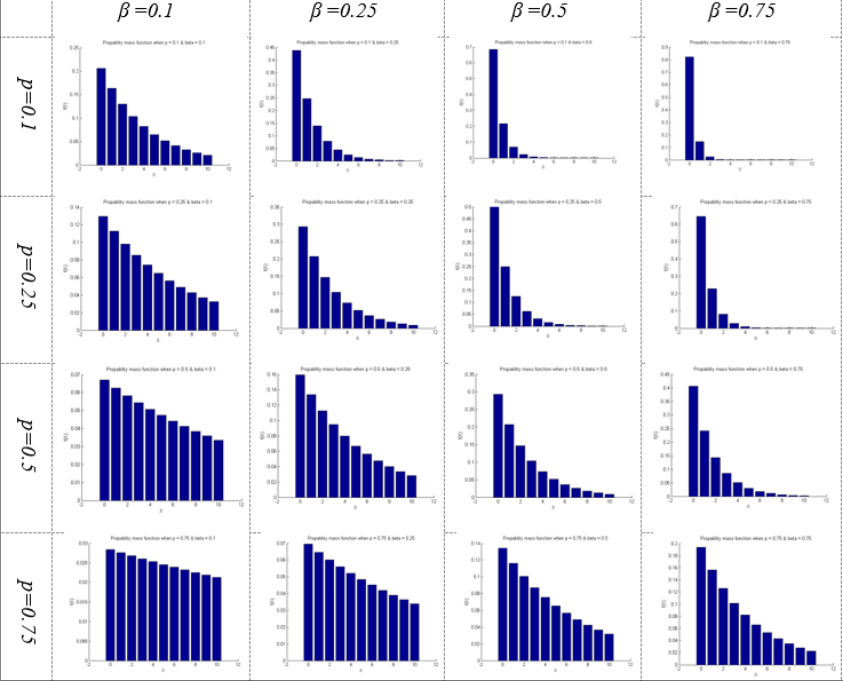 Figure 1
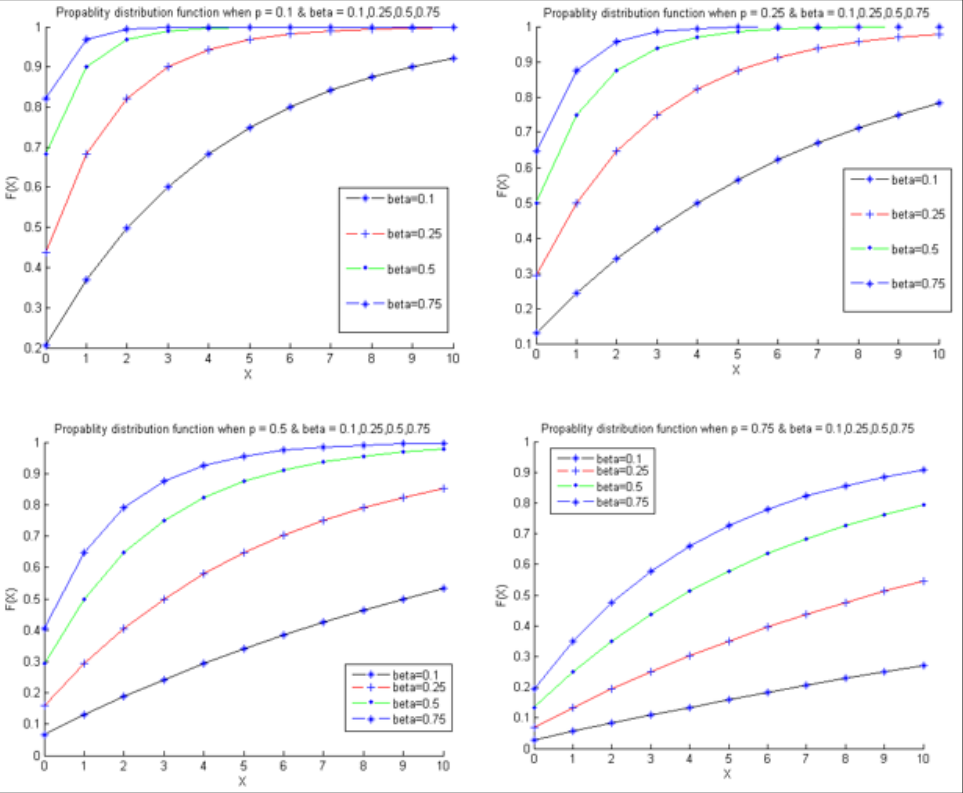 Figure 2
Introduction
Researchers in many fields regularly encounter variables that are discrete in nature or in practice. In life testing experiments, for example, it is sometimes impossible or inconvenient to measure the life length of a device on a continuous scale. For example, in case of an on/offswitching device, the lifetime of the switch is a discrete random variable. In many practical situations, reliability data are measured in terms of the number of runs, cycles or shocks the device sustains before it fails. In survival analysis, we may record the number of days of survival for lung cancer patients since therapy, or the times from remission to relapse are also usually recorded in number of days. In this context, the Geometric and Negative Binomial distributions are known discrete alternatives for the Exponential and Gamma distributions, respectively. It is well known that these discrete distributions have monotonic hazard rate functions and thus they are unsuitable for some situations. On the other hand counted data models such as Poisson, Geometric can only cater to positive integers along with zero values. Although much attention has been paid to deriving discrete models from positive continuous distributions, relatively less interest has been shown in discretizing continuous distributions defined on the whole set R, the few exceptions are the discrete Normal distribution introduced by Roy (2003) [14] . Chakraborty S. and Chakravarty D. (2011) [3] discussed properties and parameter estimation of discrete Gamma distribution. Nekoukhou, V. and Bidram, V. (2015) [12] studied the exponentiated discrete Weibull distribution. The discrete Logistic distribution interduced by Chakraborty and Charavarty (2016) [4] . Erlang-Truncated Exponential (ETE) distribution was originally introduced by El-Alosey (2007) as an extension of the standard one parameter exponential distribution. The (ETE) distribution results from the mixture of Erlang distribution and the left truncated oneparameter exponential distribution. The cumulative distribution function (cdf) F(x), and probability density function (pdf) f(x) of the (ETE) distribution are given by;
Respectively, where 𝛽 and 𝜆 are shape parameters.
The survival function of the ETE distribution is
Many studies have been made of the ETE distribution Mohsin (2009) [10] derived the recurrence relations for single and product moments for ETE distribution. Nasiru (2016) [11] studied a generalized Erlang-truncated Exponential Distribution which called the Kumaraswamy Erlang-truncated exponential distribution. Okorie et al. (2017) [13] studied properties and application to rainfall data of the Extended Erlang-Truncated Exponential distribution. Khongthip et al. (2018) [8] studied the discretization of weighted exponential distribution and its applications. Jimoh et al. (2019) [7] introduced a new distribution called the Gamma Log-logistic Erlang Truncated Exponential distribution. Jayakumar and Babu (2019) [6] introduced a discrete version of the additive Weibull geometric distribution. Ali et al. (2020) [1] introduced a new discrete Time Between Events control chart following discrete Weibull distribution, by derived the design of the proposed chart analytically and discussed numerically. Elbatal and Aldukeel (2021) [2] discussed the McDonald Erlang-truncated exponential distribution with three shape parameters. Sayyed et al. (2021) [15] studied the effect of inspection error on cumulative sum (CUSUM) control charts for controlling the parameters of a random variable under Erlang-truncated exponential distribution, also derived expression for the parameter of the CUSUM chart.
Discrete Erlang-Truncated Exponential distribution
Roy (2003) [14] first proposed the concept of discretization of a given continuous random variable. Given a continuous random variable X with survival function 𝑆 𝑋 (𝑥), a discrete random variable Y can be defined as equal to [X] that is floor of X that is largest integer less or equal to X. The probability mass function (pmf) P[Y = y] of Y is then given by
The pmf of the random variable Y thus defined may be viewed as discrete concentration (Roy (2003) [14] ) of the pdf of X. Using this concept, a two-parameter discrete probability distribution is proposed by discretizing the re-parameterized version of the twoparameter ETE (𝛽, 𝜆) given in (1). First re-parameterization of Erlang truncated-exponential distribution in ( 1) is done by taking 𝑝 = 𝑒 -(1-𝑒 -𝜆 ) and 𝛽, this lead us to the formula of the pmf of discrete Erlang-Truncated Exponential distribution (DETE), as follows: with corresponding cdf as:
When 𝛽 = 1 the geometric distribution is achieved. Discrete hazard rates arise in several common situations in reliability theory where clock time is not the best scale on which to describe lifetime. For example, in weapons reliability, the number of rounds fired until failure is more important than age in failure. This is the case also when a piece of equipment operates in cycles and the observation is the number of cycles successfully completed prior to failure.
Distributional properties
In this section, the statistical properties of the DETE distribution were derived.
Quantile function
The quantile of order 0 < 𝛾 < 1, can be obtained by inverting the cdf in eq (5) as 𝐹 𝑌 (𝑄) = 1 -𝑝 𝛽(𝑄+1)
Then 𝐹 -1 (𝛾) = min {𝑦 ∈ 𝑅: 𝐹(𝑦) ≥ 𝛾} 1 -𝑝 𝛽(𝑄+1) = 𝛾 Thus The quantile of order 𝛾 is
Further the median of DETE obtained by substituting 𝛾 = 1 2 in eq (7) as follows:
The moments
The mean of the DETE distribution is:
And the variance of the DETE distribution is given by:
The moment generating function
In this subsection, the moment generating function of a random variable Y having a the DETE distribution with parameters (β, p) was derived
Thus we can calculate the first moment (the mean) of the DETE distribution as
Monotonicity
By using the ration test we can find
Therefore, for the DETE distribution, the above expression is monotone decreasing for all y.
Maximum likelihood estimation
Let 𝒀 𝟏 , 𝒀 𝟐 , … , 𝒀 𝒏 be a random sample of size 𝒏 having the DETE distribution. The log-likelihood of the DETE distribution is
Further differentiating the log-likelihood of the DETE distribution in eq (8) partially with respect to the shape parameter β, and common scale parameter p, we get
The maximum likelihood estimator 𝛽 ̂ is the solution of the non-linear equation:
Entropy
Statistical entropy is a probabilistic measure of uncertainty or ignorance about the outcome of a random experiment and is a measure of reduction in that uncertainty. Various entropy and information indices exist, among them the Rényi entropy has been developed and used in many disciplines and context, the Rényi entropy is defined by
For a random variable Y having a pmf of the DETE distribution in eq (4), the Rényi entropy is
When 𝛽 = 1 the same result as the geometric distribution.
Order statistics
Order statistics are among the most fundamental tools in non-parametric statistics and inference. They enter the problems of estimation and hypothesis testing in a variety of ways. The aim of the present section is to establish some general relations regarding the DETE distribution. More precisely, let 𝐹 𝑖 (𝑦; 𝛽, 𝑝) and 𝑓 𝑖 (𝑦; 𝛽, 𝑝) be the cdf and pmf of the i-th order statistic of a random sample of size n from DETE (𝛽, 𝑝) distribution.
Using the binomial expansion for [1 -𝐹(𝑦; 𝛽, 𝑝)] 𝑛-𝑘 , we obtain the following result:
The corresponding pmf of the i-th order statistic 𝑓 𝑖 (𝑦; 𝛽, 𝑝) = 𝐹 𝑖 (𝑦; 𝛽, 𝑝) -𝐹 𝑖 (𝑦 -1; 𝛽, 𝑝) for an integer value of y, then it is given by
Where 𝑓 𝐷𝐸𝑇𝐸 (𝑦; 𝛽𝑙, 𝑝) is the pmf of the DETE distribution with parameters 𝛽𝑙 and 𝑝. Since 𝑓 𝑖 (𝑦; 𝛽, 𝑝) is a linear combination of a finite number of DETE(𝛽𝑙, 𝑝) distributions, we may obtain some properties of order statistics, such as their moments, from the corresponding DETE distribution. For example, the mean of the i-th order statistic is given by
Stress-strength parameter
The stress-strength parameter 𝑅 = 𝑃(𝑋 > 𝑌) is a measure of component reliability and its estimation problem when X and Y are independent and follow a specified common distribution has been discussed widely in the literature. Suppose that the random variable X is the strength of a component which is subjected to a random stress Y. Estimation of R when X and Y are independent and identically distributed following a well-known distribution has been considered in the literature. Many applications of the stress strength model, for its own nature, are related to engineering or military problems. There are also natural applications in Medicine or Psychology, which involve the comparison of two random variables, representing for example the effect of a specific drug or treatment administered to two groups, control and test. Almost all of these studies consider continuous distributions for X and Y, because many practical applications of the stress-strength model in engineering fields presuppose continuous quantitative data. A complete review is available in Kotz et al. (2003). However, in this regard, a relatively small amount of work is devoted to discrete or categorical data. Data may be discrete by nature. For example, the stress pattern in a step-stress accelerated life test can be treated as a discrete random variable of which the possible values can be obtained from all stress levels, and the corresponding probabilities can be obtained from the acting times of each stress levels. Moreover, the stress state of a component can be categorized based on the characteristic of external loads. For instance, the stress state of a mechanical component can be simply classified as state 1, state 2 and state 3, which correspond to low load, moderate load and heavy load, respectively. More generally, according to the change of external loads, the stress of a component can be categorized into arbitrary finite state: state 1, state 2, . . . , state m. The stress-strength parameter, in discrete case, is defined as
where 𝑓 𝑋 and 𝐹 𝑌 denote the pmf and cdf of the independent discrete random variables X and Y, respectively. Now, let X ∼ DETE (𝛽 1 , 𝑝)and Y ∼ DETE(𝛽 2 , 𝑝). Using Equations ( 4) and ( 5
Acknowledgement
AcknowledgmentsWe are very grateful to the handling Editor and the two anonymous reviewers for various constructive comments and suggestions that have greatly improved the presentation of the paper.
Figures and tables from the paper
References
15 in the original paper- Ali S, Zafar T, Shah I, Wang L. Cumulative Conforming Control Chart Assuming Discrete Weibull Distribution. IEEE Acess 2020;8:10123-10133.
- Elbatal I, Aldukeel A. On Erlang-Truncated Exponential Distribution: Theory and Application. Pakistan Journal of Statistics and Operation Research 2021:17:155-168.
- Chakraborty S, Chakravarty D. Discrete Gamma Distribution: Properties and parameter estimation. Journal of Communication in statistics-Theory and Methods 2011;41:3301-3324.
- Chakraborty S, Chakravarty D. A new discrete probability distribution with integer support on (-∞, ∞). Communication in Statistics-Theory and Methods 2016;45(2):492-505.
- El-Alosey AR. Random Sum of New Type of Mixtures of Distributions. International Journal of Statistics and Systems 2007;2(1):49-57.
- Jayakumar K, Babu MG. Discrete Additive Weibull Geometric Distribution. Journal of Statistical Theory and Applications 2019:18(1):33-45.
- Jimoh H, Oluyede AO, Manduku D, Makubate B. The Gamma Log-Logistic Erlang Truncated Exponential Distribution with Applications. Afrika Statistika 2019;14(4):2141-2164.
- Khongthip P, Patummasut M, Bodhisuwan W. The discrete weighted exponential distribution and its applications. Songklanakarin J Sci. Technol 2018;40(5):1105-1114.
- Kotz S, Lumelskii M, Pensky M. The Stress-Strength Model and its Generalizations: Theory and Applications. Work Scientific, New-York 2003.
- Mohsin M. Recurrence Relation for Single and Product Moments of Record Values from Erlang-truncated Exponential Distribution, World Applied Sciences Journal 2009;6(2):279-282.
- Nasiru S, Luguterah A, Iddrisu MM. Generalized Erlang-truncated Exponential Distribution, Advances and Applications in Statistics 2016:48(4):273-301.
- Nekoukhou V, Bidram V. The exponentiated discrete Weibull distribution. SORT (Statistics and Operations Research Transactions) 2015;39(1):127-146.
- Okoriea IE, Akpantab AC, Ohakwec J, Chikezieb DC. The Extended Erlang-Truncated Exponential distribution: properties and application to rainfall data. Heliyon 2017;3(2017):e00296.
- Roy D. The discrete normal distribution. Communications in Statistics -Theory and Methods 2003;32(10):1871-1883.
- Sayyed M, Sharma RM, Sayyed F. Effect of inspection error on CUSUM control charts for the Erlang-truncated exponential distribution. Life Cycle Reliability and Safety Engineering 2021;10:61-70.
Cited by 2
From OpenAlex, OpenCitations and reference lists read by Scinovex
- Discrete Erlang-2 distribution and its application to leukemia and COVID-19 ↗
Mohamed Ahmed Mosilhy · AIMS Mathematics · 2023
Via the survival discretization method, this research revealed a novel discrete one-parameter distribution known as the discrete Erlang-2 distribution (DE2). The new distribution has numerous surprising improvements over many conventional discrete distributions, particularly when analyzing excessively dispersed count data. Moments and moments-generating functions, a few descriptive measures (central tendency and dispersion), monotonicity of the probability mass function, and the hazard…
❝ 2PDF - Binomial-discrete Erlang-truncated exponential mixture and its application in cancer disease ↗
Alaa R. El-Alosey, Hussein Yousif Eledum · Scientific Reports · 2023
Among diseases, cancer exhibits the fastest global spread, presenting a substantial challenge for patients, their families, and the communities they belong to. This paper is devoted to modeling such a disease as a special case. A newly proposed distribution called the binomial-discrete Erlang-truncated exponential (BDETE) is introduced. The BDETE is a mixture of binomial distribution with the number of trials…
❝ 2PDF