
Research article · 2020 · Full text
International Journal of Veterinary Sciences and Animal HusbandryEffects of introvit A + WS on the prevention of fertility cows from infertility
Volume 5(4) · Pages 01–02
Research areasReproductive Physiology in LivestockGenetic and phenotypic traits in livestockAnimal Nutrition and Health
Abstract
Author-writtenThis article describes the diagnosis and diagnosis of alimentary infertility in the dairy cows, clinical signs, and blood.
Summary
Source-checkedPlain-language reading of the full paper, prepared with AI and checked against the text. Each point links to the authors' own words.
Why it matters
- In the Republic, livestock farms face economic losses due to vitamin and mineral metabolism diseases, which lead to reduced productivity and maternal infertility. View evidence ↗
- Poor nutrition can cause metabolic disturbances and morphological changes in cows, resulting in alimentary infertility. View evidence ↗
- Nutritional deficiencies are particularly harmful during the final two months of milking, and half of the cows undernourished in winter and spring fail to recover by summer. View evidence ↗
The question
- The study aimed to evaluate how the drug Introvit A + WS affects the prevention of infertility in productive cows. View evidence ↗
What they did
- The research was conducted at 'The Mustafakul polvon field' farm in the Samarkand region, using one experimental group and two control groups, each consisting of 5 cows identified with infertility. View evidence ↗
- The experimental group received a supplement of 50 g of monoculture phosphorus and 5 g of Introvit A + WS daily for 30 days. View evidence ↗
- The control group of cows received only their standard ration. View evidence ↗
- Blood samples were analyzed every 20 days for morphobiochemical indicators and the content of zinc, manganese, cobalt, and copper. View evidence ↗
What they found
- In the experimental group, the mean heart rate decreased from 74.5±2.5 to 65.4±2.4 beats per minute by the end of the study. View evidence ↗
- Abdominal wall movements in the experimental group increased from 5.5±0.5 to 10.4±0.8 times per 5 minutes, indicating normalized digestion. View evidence ↗
- Control group cows exhibited worsening clinical signs, including anemia, decreased appetite, and thinning of the skin coat around the lips and eyes. View evidence ↗
- In the control group, 2 out of 5 cows (40%) were fertilized when tested every 20 days. View evidence ↗
- In the experimental group, 4 out of 5 cows (80%) were fertilized when tested every 20 days. View evidence ↗
What it means
- The authors conclude that 30 days of Introvit A + WS administration improves clinical and blood indicators, prevents metabolic infertility, and increases the breeding percentage by 40%. View evidence ↗
Visual summary
1 visualsIllustrations explain the paper; they do not show study data.
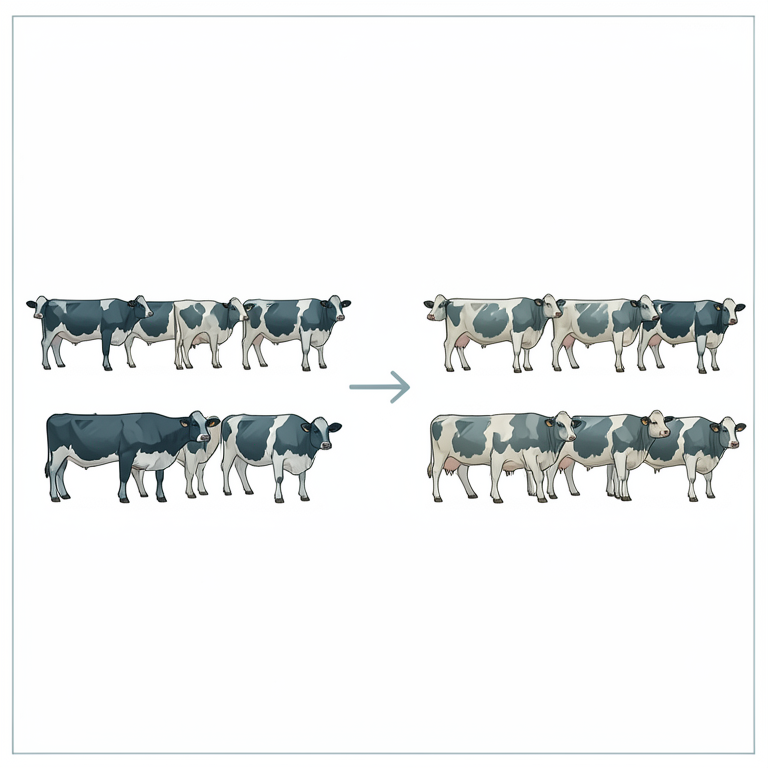
Fertilization Rate Comparison
AI-generated conceptual illustration (dairy cows). It explains the idea and does not show study data.
View source evidence ↗Introduction
A number of decrees and resolutions of our President outline important tasks aimed at further improving the availability of cheap and high-quality livestock products based on intensive development of livestock in the Republic. In particular, the strategy of development of Uzbekistan for 2017-2021 aims to increase the number of cattle by 3165 thousand heads by 2021, the number of sheep and goats by 4281 thousand heads and the number of poultry by 31,200,000. As a result, milk production is expected to reach 4177,000 tonnes, meat production -519,000, fish -90,000, honey -13.7,000 tonnes and eggs -4,100,000 tonnes. Micronutrients play a major role in non-communicable diseases of animals that hinder the effective solution of these problems. The economic losses of the cows in farms of the Republic are caused by increased nutritional losses due to diseases of vitamins and minerals metabolism, loss of productivity and nutritional value of livestock products, infertility of maternal animals, and birth of children with poor and vitality. Therefore, the study of the causes of the disease, the importance of alimentary factors at its origin, the development and implementation of effective methods of preventing early detection of mechanisms of disease development is one of the most urgent problems in the field of veterinary science and practice today. Insufficient nutrition of animals leads to disturbance of metabolism, functional and morphological changes in cows' genes and shortening (alimeter infertility). Inadequate nutrition has a negative effect, especially in the last two months of milking. Also, 50% of cows that are not fully nourished in winter and spring do not recover in summer. Therefore, calcium, phosphorus, carotene, protein and reserve alkalinity in cows and heifers should be monitored periodically, especially in winter and spring, to control the metabolism and regulation of nutrition in each household [1] . Avoid prolonged silage or silage-concentrate feeding to prevent alimentary infertility, ensure that hay and concentrate are sufficient in the diet, the fiber in the diet is 18% of its dry matter, and the phosphorus-calcium ratio is 1.5: 2. Required.
Purpose of the study
To study the effect of the drug Introvit A + WS on the prevention of infertility in productive cows.
The objectives of the study
To study the effect of Introvit A + WS, take into account peculiarities of infertility in productive cows, morphobiochemical indications of blood and fertilization of cows.
Object and subject of research
The studies were conducted on productive cows in cattle farms and analyzed the hemoglobin and erythrocyte content in their blood, and the basic nutritional patterns and ration structure were studied.
Methods and materials of investigation
In order to investigate the prevalence and causes of infertility in dairy cows in the farm "The Mustafakul polvon field" in Bulungir district, Samarkand region, organized the 1st experimental and 2 control groups of 5, in each of the five identified infertility cows. They are pre-trial and clinical trials every 10 days. Laboratory tests on blood samples and vaginal fluid were performed. Clinical studies revealed the general condition of the cow, obesity, appetite, mucous membrane, skin and skin cover, position of the limbs, genital lips, vagina and cervix, uterine horns and ovaries. The storage conditions and feeding of cows were analyzed, including microclimate in cows, floor condition, composition and nutritional status of the cows, laboratory analysis of the content of cows' nutrients. Dairy cows were given 50 g of monoculture phosphorus and 5 g of Introvit A + WS supplement feed in addition to the main diet within 30 days after the cow's birth to supplement the diet with vitamins, macro-and micronutrients. Milk cows in the second (control) group were fed only in the ration (HR). Cows in the experimental and control groups were tested once every 20 days prior to the start of the experiment and blood samples from them were analyzed for morphobiochemical performance and microelements content (copper, cobalt, manganese and zinc). By the end of the experiments, the clinical and physiological characteristics of milk cows in the experimental group did not differ significantly from the norm. In cows in the control group, they were unresponsive to external influences, decreased appetite and fluctuations, decreased rheumatism and contraction of the stomach, mucous membranes, anemia, thinning of skin coat around the eyes and lips, collars, and lasting pigmentation. Clinical signs of mineral and vitamin metabolism, such as swelling of the teeth, reduction of skin coating, reduction of horns and hooves i [4] .
Results and discussion
In dairy cows in the experimental group, the mean heart rate was 74.5±2.5 times per minute before starting the experiments, and at the end of the experiments it was 65.4±2.4 times, respiratory rate 27.6±2.3 times. , 3±2.5 times thinning and an increase in 5-min movement of the abdominal wall from 5.5±0.5 times to 10.4±0.8 times (8-12 times within 5 minutes). This suggests that the cows have normalized digestive processes. In the cows in the control group, the clinical performance was worsened by the end of the experiment, ie, 77.5±3.2 minutes per minute, respiratory rate increase by 27.6±3.2 times, and 5.6 minutes for the large abdominal wall movement. Reduction of ±0.5-fold, as well as clinical signs for myeloidosis was characteristic. While some morphobiochemical indicators of milk in the experimental cows were similar in all groups prior to initiation of the experiments, it was noted that in the control group, the cows in the control group worsened by the end of the experiments and in the cows in the experimental group. By the end of the experiment, the average number of red blood cells in the control cows was 0.51 million/µl, hemoglobin -3.2 g/l, glucose -0.19 mmol/l, total protein -2.4 g/l, alkaline reserve. A decrease of 1.6% was reported in the S02%. This may be explained by the fact that the morphobiochemical performance of blood in the cows in this group worsens until the end of lactation. Examining cows every 20 days, the experiments finally showed that 2 of the 5 cows were fertilized -100: 5X2 = 40%. Cows in the cows in the experimental group improved compared with baseline values, ranging from 4.9±1.5 million/μL in blood to 5.64±1.3 million/μg, and 88.5±1.17 g/mL. l to 1,06,8±2,15 g / l, glucose -1,77±0.08 mmol/l to 2,54±0,08 mmol/l, total protein -68,4±1, From 32 g/l to 74.1±0.86 g/l, an increase in alkaline reserves was 46.3±1.18% and from S02 to 48.9±1.18% S02. Improvement of some morphobiochemical parameters of blood within physiological norms can be explained by the fact that the drugs used have a positive effect on metabolism in cows. Every 20 days, cows insemination was tested by two groups of 100 cows, 100: 5X2 = 40%. Testing the insemination of cows every 20 days, the end of the experiments was 4 out of 5 cows that were 100: 5X4=80%. Keeping dairy cows all year-round and lacking to feed them can lead to increased vitamin and mineral metabolic disorders and infertility.
Conclusions
Conclusions
Improvement
of clinical-physiological status and morphobiochemical indicators of blood within 30 days of intravenous administration of intravenous A + WS in combination with intravenous feeds for 30 days in order to prevent infertility caused by metabolic disorders in dairy cows. provides. It also helps prevent infertility in cows and increase the percentage of breeding by 40%.
References
6 in the original paper- Kondrachin IP, Levchenko VI. Diagnostics and therapy vnutrennix bolezney jivotnyx. M.: OOO "AquariumPrint", 2005, S-652-653.
- Studentsov AP, Shipilov VS, Nikitin V.Ya. i dr. Veterinary obstetrics, gynecology and biotechnology. Moscow, Kolos, 2000.
- Urazaev NA, Nikitin VY, Kabysh AA. i dr. Endemic boots selskoxozyaystvenny jivotnyx. M.: Agropromizdat, 1990.
- Shipilov VS, Kopytin VK. Regulation of podsos and invasion polovyx organs u telok // Veterinary. 1986; 2:S41-42.
- Eshboev BM. Endemic microelementosis in animals. Monograph. «N.Doba» HT. Samarkand, 2009.
- Baymatov VN, Adamushkin VE, Hannanova AF. Changes in the clinical-biochemical methods J Vet. 2006; 8:45-47.