
Research article · 2021 · Full text
International Journal of Veterinary Sciences and Animal HusbandryComparative study of the digestibility of dry and raw food in dogs
Volume 6(2) · Pages 01–03 · DOI: 10.22271/veterinary.2021.v6.i2a.326 ↗
Research areasMuscle metabolism and nutritionDiet and metabolism studiesRabbits: Nutrition, Reproduction, Health
Abstract
Author-writtenThe present study aims to determine the digestibility of raw and dry food in pitbull dogs.The study involved 10 clinically healthy male dogs, matched in age and weight.Two digestibility experiments were performed, the first of which tested the digestibility of dry food, and the second experiment, the digestibility of raw food, which underwent HPP processing.To determine the digestibility coefficients of the two types of food during the experiments, the amount of food and excreted feces were daily controlled.We found significant differences in the chemical composition of the two types of food, as well as a higher digestibility coefficient of raw food.
Summary
Source-checkedPlain-language reading of the full paper, prepared with AI and checked against the text. Each point links to the authors' own words.
Why it matters
- Food digestibility is a key indicator of how many nutrients a dog can actually absorb from its intestines into the bloodstream. View evidence ↗
- Because it determines nutrient availability, digestibility is used as a standard criterion to evaluate the quality and nutritional value of dog food. View evidence ↗
- Heat treatment can negatively impact digestibility, leading some to recommend raw foods over dry extruded foods. View evidence ↗
The question
- The study aimed to compare the digestibility of dry extruded food versus raw food that had undergone High Pressure Processing (HPP). View evidence ↗
What they did
- The experiment used 10 adult pitbull dogs, matched for age (3.5 ± 0.5 years) and body weight (21.04 ± 1.39 kg). View evidence ↗
- Two in vivo experiments were conducted: one using low-price dry extruded food and another using HPP-processed raw chicken meat suitable for human consumption. View evidence ↗
- The digestibility coefficient was calculated based on the difference between the amount of food ingested and the amount of feces excreted. View evidence ↗
What they found
- The digestibility coefficient increased from 57.11 ± 9.14% (Day 0/dry food) to 91.64 ± 1.29% on Day 15 and 95.71 ± 1.16% on Day 45 of the raw food diet. View evidence ↗
- Fecal output decreased significantly over time on the raw food diet, with nearly 6 times less feces excreted by Day 45 (21.45 ± 5.84) compared to Day 0 (128.7 ± 27.42). View evidence ↗
- The digestibility of raw food on Day 45 (95.71 ± 1.16%) was 67.58% higher than that of the dry food (57.11 ± 9.14%). View evidence ↗
What it means
- The authors conclude that raw food has significantly higher digestibility coefficients compared to dry extruded food. View evidence ↗
- The authors found that switching to raw food led to a significant and sustained decrease in the amount of feces produced. View evidence ↗
Visual summary
2 visualsIllustrations explain the paper; charts are replotted from the paper's own table values.
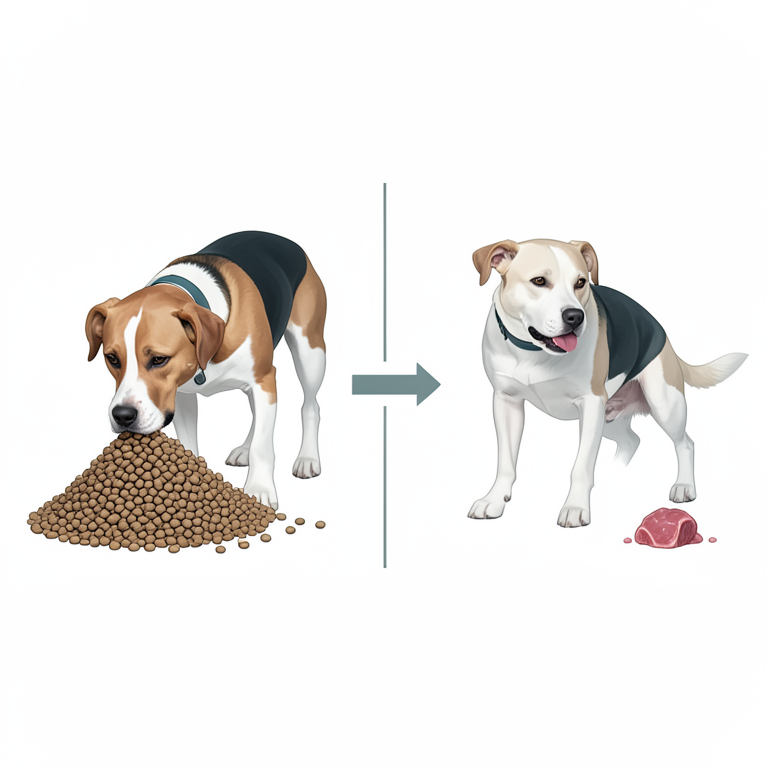
Digestibility and Fecal Output Trend
AI-generated conceptual illustration (domestic dogs). It explains the idea and does not show study data.
View source evidence ↗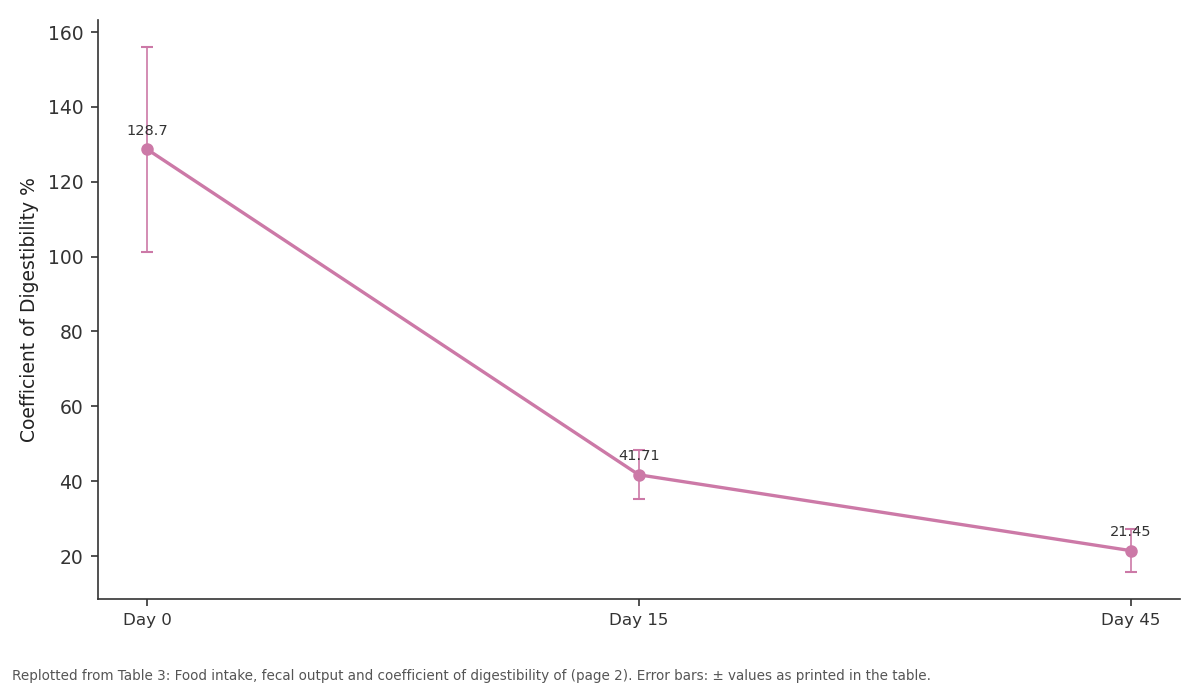
Fecal output: Day 0 vs Day 15 vs Day 45
Replotted from Table 3 (page 2) of the original paper. Every bar is the paper's own table value.
View source evidence ↗Figures & tables
From the original paper Table 1
 Table 2
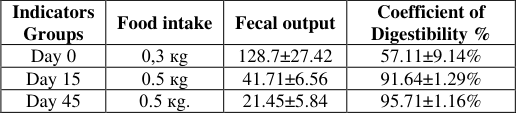 Table 3
Introduction
Food digestibility indicated the amount of nutrients that are available to the dog for absorption from the intestine into the bloodstream. Foods with better digestibility provided more absorbed nutrients than those with less digestibility. For this reason, digestibility was a criterion for the nutritional value and quality of food (Cargo-Froom et al. 2019) [5] . According to Khan et. al (2003) [16] the digestibility of food could be influenced by various factors, such as the type of food consumed, the composition, and the amount of different raw materials. Heat treatment was one of the factors that negatively affect digestibility. The low digestibility of dry extruded foods was one of the reasons why proponents of raw food eating in dogs recommend the raw foods because of their better digestibility (Freeman et al. 2013) [10] . A number of studies with carnivores had supported the claim of higher digestibility in raw foods (Kerr et al., 2013; Hamper et al., 2015; Iske et al., 2016) [14,11,13] . Other authors found low digestibility of dry foods of low price range compared to high class (Huber et al. 1986) [12] . According to Brambillasca et al. (2010) [3] the type of food consumed also determined the consistency of the excreted feces. Their results showed that the frequency of feeding did not affect the digestibility of nutrients, as well as the composition of the excreted feces. However, the quality of food had a beneficial effect on digestibility and the amount of feces excreted. The authors observed, the higher the quality of the food, the better the digestibility and the less the amount of feces. The digestibility and consistency of the excrements could be affected by the amount of fiber in the diet. Some authors have found an inverse proportionality between the amount of fiber and digestibility, namely with an increasing amount of fiber there was a decrease in digestibility. (Earle at al. 1998, Castrillo et al. 2001) [8,7] . Swanson et al. (2004) [19] investigated the relationship between digestibility and the type of raw materials. Foods with predominant raw materials of animal origin showed much better digestibility compared to those in which the amount of plant raw materials was higher. Also, dogs fed foods rich in animal raw materials showed better absorption of fats and proteins and excrete fewer feces compared to those fed foods produced mainly from plant products. The literature showed that animals fed raw foods usually excreted less feces than those that eat extruded foods (Kerr et al., 2012) [15] . The aim of present study was to compare dry extruded and raw food underwent HPP processing, in regard to their digestibility.
Material and Methods
For this purpose, we used 10 pitbull dogs that had completed their growth. The animals were matched by age, 3.5 ± 0.5 years, and body weight 21.04 ± 1.39 kg. All of them were regularly vaccinated and dewormed for internal and external parasites, but nevertheless, the feces of each of them were examined by the Füleborn method for the presence of nematodes and cestodes. At the beginning of the study, the health status of all dogs was determined by the methods of propaedeutics, and it was established that they were clinically healthy. During the experiments, the dogs were placed in individual cages, fed alone twice daily, and water was provided ad libitum. We performed the technical manipulations (clinical examinations) in accordance with the good clinical practice and in accordance with Ordinance № 20 of 01.11.2012 on the minimum requirements for protection and welfare of experimental animals and the requirements for the sites for their use, breeding and/or delivery [18] . Two in vivo digestibility experiments were performed. The first with dry extruded food low price range and the second experiment with raw food underwent HPP processing based on chicken meat, using only raw materials suitable for human consumption. The second experiment was conducted in two stages after the start of the fed raw food diet, on the 15th day and the 45th day, respectively. Food processing was performed with "AVURE AV-20M high pressure processing equipment" for microbiological reduction of food, with the following parameters cycle time for 3 minutes and a pressure of 6000 bar. Throughout the experiment, the raw food was stored from 0 to 4 0 C. The amount of dried food consumed was determined according to the recommended data for maintaining live weight, indicated on the label by the manufacturer. And this of raw food was determined based on the energy contained in 0.1 kg of food and the exchange weight of animals, using the formulas: MЕ=460 х W 0,75 MJ/day (Burger 1994) [4] where ME is metabolic energy, W is weight for one dog, and W 0,75 is an exchange weight. Х=ОЕн/ОЕх (Тodorov et al. 2010) [20] where Хthe amount of food in kg ОЕнthe energy needs of the animal in MJ OExthe energy value of food in MJ / kg Fecal samples were collected each day individually from each dog's cage. Gloves and hermetically sealed plastic bags were used for this purpose. After collection, the feces were weighed and the amount recorded in an individual diary for each of the dogs. An average sample of the total amount of faeces was formed, and the chemical analysis of the faeces was performed according to BDS -11374-86 [2] . The digestibility coefficient of food was determined by the difference between the ingested amount of food and the excreted feces, according to the formula (Khan et al. 2003) [16]
Statistical analysis
The data were analyzed using Microsoft Excel for Windows. Confidence between groups was calculated by Student t-test at P < 0.05.
Results and Discussion
The chemical composition of the dry and raw dog food used in the experiment was presented in Table 1. The analytical constituents of the dry extruded food were from the information provided on the label by the manufacturer. The raw food data were based on laboratory chemical analysis for 0.1 kg. food, after that they were recalculated to the dry matter. The table 1. showed that there were differences in the values of quality indicators of the two types of food. The visible difference was in the percentage of dry matter, which was determined by the amount of moisture depending on the technology used. Moisture in most brands of dry extruded foods varied between 6% and 10% (Case et al. 2011; FEDIAF. 2018) [6,9] . Significant differences were also observed in protein and fat content, which could be explained by the fact that the composition of dry foods usually includes a significant amount of cereals, low in protein (Moss, 1996) [17] , and the opposite in raw foods we had a high meat and meat products rich in protein and fat (Freeman et al. 2013) [10] . The values of fiber and ash were similar for both types of food. Table 2 presented the chemical composition of the studied pooled fecal samples of dogs fed dry and raw food. The data showed low levels of dry matter in the faeces of dogs fed dry food. The indicators of protein and fibre in the dry matter of the feces of dogs fed dry extruded food were higher than those fed raw food. These results could once again be explained by the fact that in dry extruded foods, the source of protein was largely of plant origin, which had lower digestibility than the animal protein ( Swanson et al. 2004) [19] . The large amount of raw materials of plant origin could be the reason for lower values of ash and higher content of fibre in the feces of dogs fed dry food.
| Type of sample | Dry matter, % | Protein, % | Fats, % | Fibre, % | Ash, % | Са, % | Р, % |
|---|---|---|---|---|---|---|---|
| Feces of dogs fed raw food | 48,43±0.16 | 19,61 ± 0.23 | 3,26 ± 0.09 | 7,23 ± 0.03 | 41,62 ± 0.01 | 8.76 ± 0.11 | 3.77 ± 0.03 |
| Feces of dogs fed dry food | 38.96±0.11 | 27,14 ± 0.35 | 1,63 ± 0.01 | 9,01 ± 0.15 | 31.99 ± 0.51 | 9.72 ± 0.01 | 4.53 ± 0.07 |
Table text extracted from the original PDF; superscript letters are shown inline. The original table image is below.
View original table image
The food intake and amount of feces were presented in Table 3. On the basis of data, the coefficients of digestibility in absolute values of dry food and raw food were calculated. The obtained results showed that the intake of dry matter (DM) in dry food was 270 grams, and that of raw food -152.05 grams. Regardless of the different amounts of DM, it was seen that the coefficients of digestibility were higher in raw food and on the 15th and 45th day of feeding. We found significant differences in the amount of feces, as on day 15 of the intake of raw food we had a statistically significant difference in the weight of feces, as their amount begins to decrease. This trend is maintained on day 45 of the diet, as we observed almost 6 times less feces excreted compared to day 0 (from 128.7 ± 27.42 to 21.45 ± 5.84). Smaller amounts of excreted feces in animals fed raw food were reported by other authors too (Kerr et al., 2012) [15] . Our results showed significantly higher digestibility of raw food (over 90%), both on day 15 and 45. The coefficient of digestibility of dry food was 57.11 ± 9.14%, and of raw food on day 45 was 95.71 ± 1.16%, which was increased by 67.58%. Our results were analogous to those of Huber et al.
(1986) [12] and Algya et al. (2018) [1] , which also established better digestibility in raw foods.
Conclusion
Despite the intake of more dry matter in the dry food, the amount of intake of protein and fats was less than the intake with the raw food. The amount of feces decreased significantly after starting to eat raw food, and this trend kept in dynamics.
The comparative study of the digestibility of dry and raw food showed significantly higher coefficients of digestibility of raw food.
References
19 in the original paper- Algya KM, Cross TL, Leuck KN, Kastner МК, Baba Т, Lye L et al. Apparent total tract macro-nutrient digestibility, serum chemistry, urinalysis, and fecal characteristics, metabolites and microbiota of adult dogs fed extruded, mildly cooked, and raw diets. J Anim Sci 2018;96:3670-3683.
- BDS 11374: Combined feed, protein concentrates and raw materials for them. Sampling rules and test methods 1986.
- Brambillasca S, Frederick P, Britos A, Repetto JL, Cajarville C. Digestibility, fecal characteristics, and plasma glucose and urea in dogs fed a commercial dog food once or three times daily. The Canadian veterinary journal. La revue vétérinaire canadienne 2010;51:190-4.
- Burger IH. Assessing the needs of companion animals. J. Nutr 1994;121:S18-S21
- Cargo-Froom C, Fan M, Pfeuti G, Pendlebury C, Shoveller A. Apparent and true digestibility of macro and micro nutrients in adult maintenance dog foods containing either a majority of animal or vegetable proteins, Journal of Animal Science 2019; 97(3):10101019, https://doi.org/10.1093/jas/skz001;
- Case L, Hayek M, Daristotle L, Raasch M. Canine and Feline Nutrition: A resource for companion animal professionals. 3rd ed. Missouri: Elsevier 2011. ISBN: 978-0-323-06619-8;
- Castrillo C, Vicente F, Guada JA. The effect of crude fibre on apparent digestibility and digestible energy content of extruded dog foods. J Anim Physiol Anim Nutr (Berl) 2001;85:231-236.
- Earle KE, Kienzle E, Optiz B, Smith PM, Maskell IE. Fiber affects digestibility of organic matter and energy in pet foods. J Nutr 1998;128:2798S-2800S.
- FEDIAF 2018. Pets in society. http://www.fediaf.org/;
- Freeman LM, Chandler ML, Hamper BA et al. Current knowledge about the risks and benefits of raw meatbased diets for dogs and cats. Journal of the American Veterinary Medical Association 2013;243(11):15491558. https://doi.org/10.2460/javma.243.11.1549;
- Hamper BA, Kirk CA, Bartges JW. Apparent nutrient digestibility of two raw diets in domestic kittens. Journal of Feline Medicine and Surgery, 2015;18(12):991-996. https://doi.org/10.1177/1098612X15605535.
- Huber TL, Wilson RC, McGarity SA. Variation in digestibility of dry foods with identical label guaranteed analysis. J Am Anim Hosp Assoc 1986;22:571-575.
- Iske CJ, Morris CL, Kappen KL. Influence of pork and pork by-products on macronutrient and energy digestibility and palatability in large exotic felids. Journal of Animal Science, 2016;94(9):3738-3745. https://doi.org/10.2527/jas.2016-0414;
- Kerr KR, Beloshapka AN Morris CL, Parsons CM, Burke SL, Utterback PL, Swanson KS. Evaluation of four raw meat diets using domestic cats, captive exotic felids, and cecoectomized roosters. Journal of Animal Science 2013;91(1):225-237 https://doi.org/10.2527/jas.20114835;
- Kerr KR, Vester-Boler BM, Morris CL, Liu KJ, Swanson KS. Apparent total tract energy and macronutrient digestibility and fecal fermentative end-product concentrations of domestic cats fed extruded, raw beefbased, and cooked beef-based diets. Journal of animal science 2012;90(2):515-522. https://doi.org/10.2527/jas.2010-3266;
- Khan A, Nisa M, Sarwar M. Techniques measuring digestibility for the nutritional evaluation of feeds. International Journal of Agriculture & Biology 2003;5(1):1560-8530/2003/05-1-91-94;
- Moss MO. Mycotoxic fungi, In: Eley, A.R. (Ed.), Microbial Food Poisoning, 2nd ed. Chapman & Hall, New York, NY 1996, 75-93; ISBN 978-1-4899-3121-4, 18. Ordinance № 20 of 01.11.2012 on the minimum requirements for protection and welfare of experimental animals and the requirements for the sites for their use, breeding and/or delivery.
- Swanson KS, Kuzmuk KN, Schook LB, Fahey GC Jr. Diet affects nutrient digestibility, hematology, and serum chemistry of senior and weanling dogs. J Anim Sci 2004;82:1713-1724.
- Todorov N, Atanasov A, Ilchev A, Ganchev G, Mihailova G, Girginov D et al. Practicum on nutrition of the animals 2010. ISBN 978-954-321-733-5.
Cited by 3
From OpenAlex, OpenCitations and reference lists read by Scinovex
- Fecal microbiota composition, serum metabolomics, and markers of inflammation in dogs fed a raw meat-based diet compared to those on a kibble diet ↗
K.M. Hiney, Lara A. Sypniewski, Udaya DeSilva, Adel Pezeshki, Pratyaydipta Rudra, Parniyan Goodarzi et al. · Frontiers in Veterinary Science · 2024
Introduction: Despite the potential health risks associated with feeding raw and non-traditional diets, the use of these diets in dogs is increasing, yet the health outcomes associated with these diets is not well understood. This study investigates the effect of feeding dogs a kibble or raw meat-based diets on fecal microbiota composition, serum metabolomics and inflammatory markers. Methods: = 28)…
❝ 16PDF - Current Evidence on Raw Meat Diets in Pets: A Natural Symbol, but a Nutritional Controversy ↗
Yang Lyu, Caimei Wu, Lian Li, Junning Pu · Animals · 2025
Feeding raw meat to cats and dogs has become a common practice in Western countries. Many pet owners cite their pets' wild carnivore ancestry and believe raw meat diets are healthier, citing higher nutritional value, a lack of processing, low-carbohydrate content, and/or the presence of whole ingredients. However, due to the risks associated with raw meat-based diets (e.g., microbial contamination,…
❝ 8PDF - Vantagens e desvantagens dos principais tipos de dietas para cães ↗
Bruna Beatriz Voos de Campos, Jessyca Caroline Rocha Ribas · Research Society and Development · 2021
O relacionamento entre seres humanos e cães estreitaram-se principalmente nos últimos anos em consequência houve um aumento no setor pet food, disponibilizando uma grande variedade de produtos. Com a alta variedade de alimentos disponíveis no mercado, a escolha do tipo de dieta torna-se um processo complexo e confuso. O objetivo da presente revisão bibliográfica é expor as características das principais…
❝ 4PDF