
Research article · 2021 · Full text
International Journal of Agriculture Extension and Social DevelopmentConceptualizing rural development in the twenty-first century
Volume 4(1) · Pages 18–23 · DOI: 10.33545/26180723.2021.v4.i1a.65 ↗
Research areasEntrepreneurship Studies and InfluencesDigitalization and Economic Development in AgricultureRural development and sustainability
Abstract
Author-writtenThe need to more accurately conceptualize the concept of rural development has increased during recent decades. This is largely the result of the absence of universally accepted definition of rural development, the absence of universally accepted theories of rural development and the growing interest to clearly theorize it, the persistent increase of rural poverty in developing and the need to formulate effective rural development policies that could address poverty in rural areas, but also because of the multifaceted ways in which rural development could be realized. Thus, the main objective of this paper is to offer a new definition or concept of rural development in the twenty-first century. To achieve this objective the study purely used secondary data. Thus, both theoretical and empirical literature deemed necessary to better understand the concept of rural development was rigorously reviewed. The review result shows that there is no universally accepted definition of rural development. The existing definitions and concepts of rural development have some conceptual gaps that needed to be revisited and conceptualized again in twenty first century. As a result, the concept of rural development is widely recognized in the literature as a disputed notion both in practice, policy, and theory. Thus, this study approaches the task of conceptualizing rural development by providing a conceptual definition that serves both academics and practitioners. Moreover, the study also proposed different mechanisms through which rural development can be realized and interlinked with recent concepts of development. Generally, the study concludes that emphasizing the need to supplement the theory behind the new rural development hypothesis with new definitions that help us to more precisely understand what is meant by rural development and how it could be realized, this study offers a new definition of rural development as a necessary step in that direction.
Summary
Source-checkedPlain-language reading of the full paper, prepared with AI and checked against the text. Each point links to the authors' own words.
Why it matters
- Rural areas house a disproportionate amount of the world's extreme poverty, with 70% of the extremely poor living in rural areas despite these populations making up only 45.3% of the total global population. View evidence ↗
- The poverty rate in rural areas (17%) is more than double that of urban areas (7%), indicating a significant disparity in living conditions. View evidence ↗
- There is an urgent need to better conceptualize rural development because there are currently no universally accepted definitions or theories to guide the process. View evidence ↗
The question
- The primary goal of this study is to propose a new definition and conceptual framework for rural development suitable for the twenty-first century. View evidence ↗
What they did
- The author conducted a rigorous review of existing theoretical and empirical secondary literature to analyze the current state of rural development concepts. View evidence ↗
What they found
- The term 'rural area' lacks a universal definition, with criteria varying significantly between different countries and even within the same country over time. View evidence ↗
- Early conceptualizations of rural development, such as the World Bank's 1975 view, focused narrowly on economic issues and increasing income via agricultural modernization. View evidence ↗
- Some theories, like those of Chambers (1987), viewed rural development as a narrow strategy specifically for empowering marginalized groups such as landless people and small-scale farmers. View evidence ↗
- The review indicates that rural development is a multidimensional concept that can be analyzed as a process, a strategy, a general concept, or a specific field of study. View evidence ↗
- Rural and urban economies are highly interdependent; improvements in rural areas benefit urban populations by enhancing food security and reducing problematic rural-to-urban migration. View evidence ↗
- Realizing rural development requires a holistic approach including community empowerment, infrastructure provision, and the integration of rural issues into urban policies (and vice versa). View evidence ↗
What it means
- The author concludes that rural development should be conceptualized as a sustainable process and strategy aimed at improving the well-being of all people across rural, semi-urban, and urban areas. View evidence ↗
Visual summary
1 visualsIllustrations explain the paper; they do not show study data.
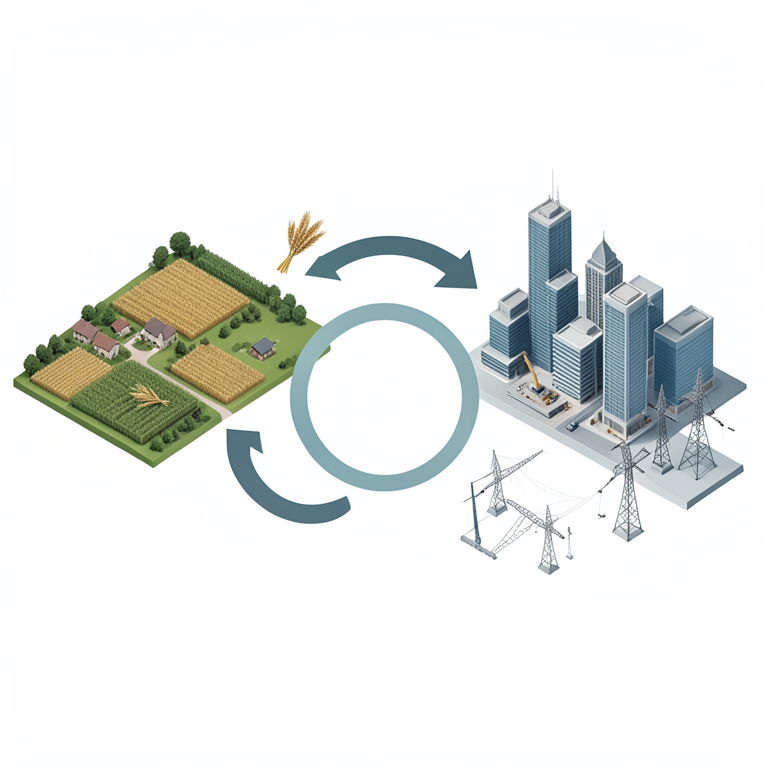
Rural-Urban Interdependence Loop
AI-generated conceptual illustration (A rural village and a modern city). It explains the idea and does not show study data.
View source evidence ↗Introduction
The purpose of this paper is to discuss how the concept of rural development could be conceptualized in the twentyfirst century. Over the past decades, poverty has been greatly reduced over the entire world except in the most of Sub Saharan African States. However, rural poverty in most of developing countries continues to persist high than urban poverty in most of developing countries. This situation exists despite half a century of rural development theories and approaches, and despite the global momentum built around the Millennium Development Goals between 2000 and 2015. This justifies the needed to revisit the existing theories of rural development and rural development policies, to re-theories it more clearly and to formulate appropriate development policies that address the problems that rural areas in developing countries are facing. This could only possible if the concept of rural development is appropriately conceptualized. This study is thus an attempt to address this gap. In the recent past, rural development has emerged in world politics. However, there is no universally accepted definition of rural areas and rural development so far. In this regard, it is widely recognized in the literature that rural development is a disputed notion both in practice, policy, and theory. Thus, it is conceptual sound and methodologically appropriate to define and conceptualize 'rural area' before defining and conceptualizing rural development.
There is no universally accepted definition of 'rural areas'. The concept of rural areas varies from country to country and also the definition may also vary from time to time in the same country. This is because different countries use different criteria to identify the rural area from urban areas. However, in many countries of the world, the areas commonly labeled as 'rural' share several common features that can distinguish them from urban areas which include occupation, population size, population density, labor market or settlement context, etc (Adisa, 2014, www.soas.ac.uk, Nd, Ekong, 2010) [4,9] . Over past decades many measures have been taken to address poverty across the world and much notable progress has been achieved in poverty reduction in most developing countries except in the SSAs. However, it remained high in rural areas of most developing countries. According to Global Food Policy Report (GFPR) (2019) [11] , a majority of the world's poor live in rural areas: rural populations account for 45.3 percent of the world's total population, but 70 percent of the world's extremely poor. The global poverty rate in rural areas is currently 17 percent, more than double the urban poverty rate of 7 percent. It is generally accepted that the conditions for them are worse than for their urban counterparts when measured by almost any www.extensionjournal.com development indicator, from extreme poverty to child mortality and access to electricity and sanitation (Food and Agricultural Organization of United Nations (FAO), 2020) [10] . This has profound implications for theories of rural development and policies of rural development. In this regard, it is argued that rural areas remain underserved compared to urban areas and face a wide array of challenges across the globe: rural areas struggle with the environmental crisis in China; the severe agrarian crisis in India, and acute shortage of jobs for the growing youth populations in Africa. And the gulf is widening, contributing to large-scale migration to urban areas. This situation exists despite half a century of rural development theories and approaches, and despite the global momentum built around the Millennium Development Goals between 2000 and 2015. Thus, without greater progress in rural development, it is unlikely that the new Sustainable Development Goals will be met. It is thus useful for rural development issues, policy and practices to take priority position in intellectual discourse among researchers and other stakeholders (Adisa, 2014) [4] . Thus, this study seeks to clearly define and conceptualize the concept of rural development in the twenty-first century. This study organized into three major sections. The first section discusses the 'rural' and rural development concept. The second presents about results and discussions. The last section present about the implication and conclusion. Finally, suggestions are offered on how rural development can be conceptualized in the 21st first century and how to enhance the rural development process in developing countries.
Rural Development
The first section of this paper presents how different scholars and institutions define and conceptualize 'rural areas'.
The concepts of rural areas
The definition of "rural" differs by country, though it is usually used in contrast to "urban". In other words, the term rural area does not have a universally accepted definition. As result, the definition of the rural area varies from country to country and even it also varies within the same country over time. In this regard, it argued that researchers, policy officials, and different institutions employ many definitions to differentiate rural from urban areas, which often leads to unnecessary confusion and unwanted mismatches in program eligibility (United States Department of Agricultural (USDA., 2019) [30] . Thus, the existence of multiple rural definitions reflects the reality that rural and urban are multidimensional concepts. Thus, the next paragraph presents how different scholars and institutions define and conceptualize rural areas. According to Adisa (2014) [4] , the term 'rural' does not have a conventional definition and the term rural evades consensual definition to the extent that even within some countries, there are deferring definitions of 'rural'. For instance, in Japan rural areas are classified based upon population size, showing an area other than "an area with over 5,000 people, which consists of each district with a population density of over 4,000 per square kilometer (JICA.GO.JP, Nd). In Nigeria, the 2006 Census classifies a rural area as having less than 20000 inhabitants (Adisa, 2014) [4] . In Canada, the Organization for Economic Cooperation and Development defines a "predominantly rural region" as having more than 50% of the population living in rural communities where a "rural community" has a population density of fewer than 150 people per square kilometer (Wikipedia). In the USA also the definition of the Census urban/rural definition is modified from decennial Census to Census; the most recent definition for Census 2000 defines urbanized areas by the population density of interrelated geographic units and adds a new designation of "urban clusters," which have a smaller total population than urbanized areas (2,500-49,999 versus ≥ 50,000, respectively). For both the 1990 and the 2000 definition, rurality is defined by exclusion (all areas not urban are rural) and for certain Census data products is additionally subdivided into the rural farm and rural non-farm, with the farm being those households who sold at least $1000 in agricultural products and rural nonfarm all else U.S. Bureau of Census (2000) as cited as in (Susan, et al., 2006 [29] and Health Resource and Service Administration (HRSA), 2020) [3] . As shown above, rural could be defined in varying contexts depending on where and what criteria are used in a particular state. This definition may not also apply in a uniform way to other countries. Using some sociologically idealized models of differentiation, Ekong (2010) [9] and, (www.soas.ac.uk, Nd) identified what was referred to as 'very general' differences in the rural-urban typology: Some of the features that indicated in the literature to define rural area include occupation (the area where a majority of the resident engaged in agriculture), less social differentiation (there are generally fewer social classes in rural areas than urban areas), lower population density (Population density and composition: number of inhabitants per unit area of land in rural communities is always smaller than for urban centers, rural populations also tend to be less heterogeneous than urban populations), less social and spatial mobility, and slow rate of social change. The above-mentioned features adopted to identify rural and urban typology, are extremities in the rural-urban divide and do not exclusively typify any real-life communities (Ekong, 2010) [9] . Besides, Adisa (2014) [4] argued that definitely, all the above listed items cannot be true for all rural areas around the world. However, they are mostly true for rural areas in developing countries. Ashley and Maxwell (2001) as cited as in (Adisa, 2014) [4] defines 'rural' as constituting a 'space where human settlement and infrastructure occupy only small patches of the landscape, most of which is dominated by fields, pastures, woods, water, mountains, and deserts'; but conceded that the term 'rural' is ambiguous and echoed IFAD (2001) submission that 'national distinctions between rural and urban are arbitrary and varied'. The above discussion on the concept of 'rural area' shows that, many definitions of "rural" are existing for national and provincial analysis in different countries of the world. Each definition discussed above emphasizes different criteria (population size, density, and context) and has different associated thresholds. Thus, definitions of "rural" differ in terms of criteria, thresholds, and size of building www.extensionjournal.com blocks. These differences may have impacts on rural research in this area; have implications for rural policy analysis, and inclusive development.
The Concepts of Rural Development
There is no universally accepted definition of rural development. As result, different scholars and institutions define and conceptualize it in different ways. In supporting this, it is argued that the definition of rural development has advanced through time as a result of changes in the perceived mechanisms and goals of development (Anríquez and Stamoulis, 2007) [1] . This implies that the concept of rural development is a dynamic which always subjected to change. According to the World Bank (1975), rural development was seen as purely an economic issue or raising the low levels of rural income through agricultural modernization. This definition clearly reflects rural development as a subset of development. This is because in the 1970s development was also viewed merely from the economic dimension or increase of income. Latter on the concepts of development and rural development continue to embrace other dimension in addition to economic growth. Nowadays development is broadly viewed as an overall improvement of the quality of life of a human being in terms of economic, social, economic, political, environmental, and administrative issues. Thus, the 1975 World Bank definition does not consider other important dimensions of development listed above at that time. Similarly, (Johnston, 1970) [13] argued that before the 1970s, rural development was seen to be synonymous with agricultural development. Specifically, he asserted that in the 1960s and early 1970s, intense industrialization was the main characteristic of the perceived development path. In this context he conceptualized rural development as precisely leading into that path: conceived rural development as basically a part of structural transformation characterized by diversification of the economy away from agriculture. This process is facilitated by rapid agricultural growth, at least initially, but leads ultimately to a significant decline in the share of agriculture to total employment and output and the proportion of the rural population to the total population. Later in the 1980s World Bank defined rural development, as a strategy designed to improve the economic and social life of the rural poor, which has since been variously defined. Similarly, it was also argued that during the 1970s, rural development is conceptualized based on equity considerations, the focus and definition of rural development turned to the provision of social services to the rural poor. Subsequently, the 1970's rural development as a concept has been highly related to the promotion of standards of living and as a precondition for reducing rural poverty (Johnston, 1970) [13] . More broadly, Kata (1986) [14] argued that rural development indicates the overall development of rural areas to improve the quality of life of the rural people. However, this definition of rural development has some conceptual gaps that will be discussed later in this paper under result and discussion part in details. Chambers (1987) [8] conceived rural development as a strategy to empower a specific group of people (particularly the marginalized group in rural areas like poor rural households, landless group of the community, and small scale farmers, to gain for themselves and their children more of what they want and need). In his words, it involves assisting the poorest among those who seek a livelihood in the rural areas to demand and control more of the benefits of rural development (Chambers, 1987) [8] . This definition clearly shows rural development as a narrow strategy that is designed to empower only the marginalized group of societies in rural areas. This definition or conception of rural development excluded how the strategy could also empower those better off in rural areas, semi urban and urban people or all human beings irrespective of the place they live in. Thus, rural development may be conceptualized as a broader strategy intended to favors all groups of people. In other words, it could be conceptualized as one of the strategies that intended is to improve the livelihood of all groups of society in general. Compare to some of the above-discussed concepts of rural development, (Madhu, 2000) [18] broadly defines rural development as an activity concerned with the improvement of spatial and socio-economic environments of rural areas to enhance the ability of the individuals to cater to and sustain their well-being. This definition also fails to consider how an activity considered to improve rural areas could also benefits urban areas and linked with it. Very recently, rural development is conceived as the process of improving the opportunities and well-being of rural people. Thus, it is a process of change in the characteristics of rural societies. This process includes agricultural development, it involves human development and social and environmental objectives, as opposed to just economic ones. Therefore, rural development encompasses health, education, and other social services. It also uses a multisector approach for promoting agriculture, extracting minerals, tourism, recreation, and niche manufacturing ((IFAD), 2016) [2] . This concept of rural development is more reflective of the concept of rural development than the above discussed concept of rural development. But also has conceptual gap discussed latter. More broadly, some scholars began to accept rural development as a subset of development. For instance, Singh (2009) [27] argued that the term rural development connotes the overall development of rural areas, intending to improve the quality of life of rural people. He also argued that rural development is a comprehensive and multidimensional concept, and encompasses the development of agriculture and allied activities; village and cottage industries; crafts, socio-economic infrastructure, community services, and facilities and, above all, the human resources in rural areas. Rather than other all the above discussed concepts of rural development, Singh (2009) [27] briefly conceptualized the term rural development as a process, a phenomenon, a strategy, and a discipline. ▪ As a process, rural development implies the engagement of individuals, communities, and nations in pursuit of their cherished goals over time.
▪
As a phenomenon, rural development is the result of interactions between various physical, technological, economic, socio-cultural, and institutional factors. ▪ As a strategy, rural development is designed to improve the economic and social well-being of a specific group of people, that is, the rural poor.
▪ As a discipline, it is multidisciplinary, representing an intersection of agricultural, social, behavioral, engineering, and management sciences.
In this regard, it is argued that this contemporary definition and concepts of rural development are recognized in the literature as, " the contemporary 'narratives', 'definitions' or 'prescriptions' concerning rural development characteristically tend to address everything that affects rural people and the quality of their life as entities and as integral members of the larger society and, indeed, the world" (Adisa, 2014) [4] . The above discussion clearly shows that the absence of universally accepted definition of rural development. In other words, there is no consensus among scholars on the definition or how to conceptualize rural development. The concept of rural development like the concept of development, the definition and concepts of rural development have been also continuously modified, changed and its dimensions also broadened in line with the change in concepts of development. The review result regarding to this clearly shows that the concept of rural development is multidimensional which can be viewed in different ways like as a concept, process, strategy, and field of studies. Furthermore, for a long time some scholars and institutions narrowly conceptualized rural development as purely an economic issue or raising the low levels of rural income through agricultural modernization. Nevertheless, nowadays it has been broadly considered as a subset of development which includes social, political, environmental, administrative issues in addition to economic issues and agricultural development. In supporting this, it is recently defined as the development that benefits rural populations; where development is understood as the sustained improvement of the population's standards of living or welfare (Singh, 2009) [27] and, (Anríquez, G. and Stamoulis, K., 2007) [1] .
Result and Discussion
As discussed above there is no universally accepted definition and conception of a rural area and rural development. Thus, the concept of rural development continues to be a contested concept in practice, policy, and theory. This have a profound implications on the qualities of research on the issues of rural development and their findings, rural policy analysis, ways of intervention for realizing rural development, rural poverty reduction, formulate and implement rural development policies, sustainable development and theories of rural development. All these issues clearly implicate and justify the importance of clearly conceptualizing rural development in the twenty first century and to propose how it could be realized. This is the main objectives that this study seeks to address. The aforementioned review result clearly shows that in 1960s and 1970s rural development was commonly conceived as an agricultural development or rising the income of rural areas through agricultural mechanization. This conception of rural development was criticized by many scholars and Institutions because it was considered as a very narrow concept of rural development. Then after, the concept of rural development haven been began to be broadly defined and conceptualized. This conception also has some conceptual gaps that needed to be revisited and reconsidered in academic arenas and policy discourses. Most of the above-discussed definition and concept of rural development has its limitations in defining or conceptualizing rural development. They come under critics in the following ways. ▪ First, in the 1960s and 1970s rural development was primarily conceived as merely raising the income of rural people through the modernization of agriculture. This definition excluded some other important issues that are needed for rural areas to develop and how it could be realized which other scholars considered latter on like the equity issues, sustainability issues, the environmental issues, and other important dimensions of development that is needed for rural areas to develop. ▪ Second, compare to those who conceived rural development as merely raising the income of rural people, it was also broadly seen as the development that benefits rural populations. It is considered an improvement of the spatial and socio-economic environment of rural areas to enhance the ability of the individuals to cater to and sustain their well-being. This conception of rural development considered other important elements considered in rural development like socio-economic and sustainability issues. However, this conception also has a conceptual gap. ▪ Third, those who consider rural development as a subset of development; where development is understood as the sustained improvement of the population's standards of living or welfare and define rural development as connotes overall development of rural areas, to improve the quality of life of rural people. In short, those who defined rural development as a process leading to sustainable improvement in the quality of life of rural people, especially the poor. Also have some conceptual gaps briefly discussed in the next paragraphs.
The [27] and, (Anríquez, G. and Stamoulis, K., 2007) [1] . Furthermore, it is theoretically and conceptually wrong to assume that one particular strategy or intervention designed to improve the overall qualities of life of either rural or urban people as it only favors one of them. This is because both rural and urban economies are highly interdependent may not be viewed separately. If properly managed improvement in rural areas not only benefits rural peoples as most of the above discussed concept of rural development revealed. It could also contribute to the improvements of quality of life of semi-urban and urban people (all peoples living in both rural and urban areas based up on how it is fairly distributed). Furthermore, if we also attempt to address the development challenges that either rural or urban people are facing, it is better to assume intervention in one area has a direct or indirect influence on others. Thus, it is better to consider it in decision making process. In this study, the concept of rural development is broadly conceptualized as an strategy which are intended to make a permanent or overall improvement in the living conditions of all segments of the societies in a sustainable manner (it may primarily improve the living conditions of rural people and then it could also improve the living condition of urban people). This could be achieved or realized through empowering the capacity of rural communities to improve their living conditions, considering rural people issues in urban development policy and vice versa, provision of different infrastructures that could improve their wellbeing, creating the mechanisms by which rural people diversify their livelihoods, providing alternative strategies or mechanisms that could reduce rural people heavily reliance on natural resources for their livelihoods which could harm the environment/ sustainable development, (e.g. through proper use of solar energy, improved cooking stove, tourism development, rural industrialization, etc.), minimizing the adverse effects that urban development could poses on rural development through regulation or policy intervention and improving the institutional capacity of local institutions working on the issues of rural people.
Implications and Conclusion
The provided definition of rural development allows the delimitation of the different elements and processes that exist in rural development. Such elements and processes, from a rural development approach, merge to produce goals that seek to improve a community's living conditions and quality of life both in rural and urban areas. Further, the offered conceptualization allows us to produce a typology that synthesizes the different forms and contexts in which rural development occurs in modern times. In this study, rural development is broadly viewed as a subset of development. Thus, it could be viewed mainly as a process and strategy. As a process, it could be conceived as the process of improving the opportunities and well-being of rural people, semi urban and urban people. As a strategy, it could be defined as one strategy designed to improve the economic and social well-being of all peoples in both rural and urban areas in a sustainable manner.
References
29 in the original paper- Anríquez G, Stamoulis K. Rural Development and Poverty Reduction: Is Agriculture Still the Key? ESA Working Paper No. 07-02 ESA Working Paper No. 0702 June 2007 www.fao.org/es/esaAgricultural Development Economics Division the Food and Agriculture Organization of 2007.
- IFAD) IF. Rural Development Report: Fostering inclusive rural transformation. Rome, Italy: Quantity 2016.
- Health Resource and Service Administration (HRSA) September. Retrieved 10 10, 2020, from Defining Rural Population 2020: https://www.hrsa.gov/ruralhealth/about-us/definition/index.html
- Adisa RS. Rural Development in the Twenty-First Century as a Global Necessity. Ilorin, Nigeria: University of Ilorin 2014.
- Alavi, Hamza, Temodar Shanin. Introduction to the Sociology of Developing Societies. London: Macmillan 1982.
- Bitstream S. Retrieved 10 shodhganga.inflibnet.ac.in › www.extensionjournal.com bitstream, 2020, from shodhganga. inflibnet.ac.in› bitstream: https://shodhganga.inflibnet.ac.in/bitstream /10603/95284/10/10_chapter%202.pdf
- Chambers R. Rural Development in India. England: Oxford University Press 1987.
- Ekong EE. Rural Sociology. Uyo: Dove Educational Publishers 2010, 380-382.
- Food and Agricultural Organization of the United Nations (FAO). A New Rural Development Paradigm for the 21st Century. OECD 2020. Available at http://www.fao.org/familyfarming/detail/en/c/1111188/.
- Global Food Policy Report (GFPR). Crises in Rural Areas Threatens Progress in Hunger, Poverty Reduction; Urgent Need for Rural Revitalization, Strong Policies, and Accountability. Washington, D.C. USA: International food policy research institute (IFPRI) 2019. Available at https://www.ifpri.org/newsrelease/2019-global-food-policy-report-crises-ruralareas-threatens-progress-hunger-poverty.
- Guinjoan E, Badia A, Tulla F. The new paradigm of rural development. Theoretical considerations and reconceptualization using the 'rural WEB'. De la Asociación de Geógrafos Españoles N.º 71 -2016, 495500.
- Johnston B. Agriculture and Structural Transformations in Developing Countries: A Survey of the Research. Journal of Economic Literature 1970;8(2):369-404.
- Kata S. Rural Development Principles and Policies and management. New Delhi: Sage Publication 1986.
- Knöbl, Wolfgang. Theories That Won't Pass Away: The Never-ending Story. In G. In Delanty, & EF Isin, Handbook of Historical Sociology 2003.
- Levy M. Social Patterns and Problems of Modernization. Englewood Cliffs: New Jersey: Prentice-Hall 1967.
- Lewis W. Arthour the Theory of Economic Growth. London: George Allen and Unwin Ltd 1955.
- Madhu IA. Rural Markets as a factor of Rural Development in N. Sukka Region Southeastern Nigeria. Unpublished Ph.D. Thesis, Department of Geography University Nigeria Nsukka 2000.
- MIT. The Objectives of United States Economic Assistance Programmes. Washington: Massachusetts Institute of Technology, Centre for International Studies 1957.
- Nd). Retrieved 2210 2020, from www.soas.ac.uk: https://www.soas.ac.uk/cedepdemos/000_P530_RD_K3736Demo/unit1/page_09.htm
- JICA. GO.JP. (Nd). Retrieved 10 21, 2020, from www.jica.go.jp/jica-ri/IFIC_and_JBICI: https://www.jica.go.jp/jica-ri/IFIC_and_JBICIStudies/english/publications/reports/study/topical/spd/p df/chapter4.pdf
- PN, RR. Notes on the Theory of the Big Push. In E. H.S., Economic Development for Latin America. International Economic Association Series. London. : Palgrave Macmillan 1961. Available at https://doi.org/10.1007/978-1-349-08449-4_3.
- Paul A. Dependency theory. In Mackenzie, the Encyclopedia of Empir 2016. DOI:10.1002/9781118455074.wbeoe242.
- Reyes EG. Four main theories of development: Modernization, Dependency, World System and Globalization. Nómadas. Revista Crítica de Ciencias Sociales y Jurídicas 04, 02 2001.
- Singh K. Rural Development, 3rd ed. New Delhi: Sage 2009.
- Smith T. The underdevelopment of development literature: the case of dependency theory. World Politics 1979;31(2): DOI:10.2307/2009944, 247-288.
- Susan A Hall, Jay S Kaufman, Thomas C Ricketts. Defining Urban and Rural Areas in U.S. Epidemiologic Studies. Journal of Urban Health 2006, 83(2). DOI: 10.1007/s11524-005-9016-3. Available at https://www.ncbi.nlm.nih.gov/pmc/articles/PMC25271 74/, 162-175.
- The United States Department of Agricultural (USDA. (2019, October 23). Economic Research Service. Retrieved 10 22, 2020, from https://www.ers.usda.gov/topics/rural-economypopulation/rural-classifications/what-is-rural/
- Webste A. Modernization Theory. An Introduction to the Sociology of Development. London 1990. https://doi.org/10.1007/978-1-349-20584-4_3: Palgrave.
- Wikipedia (N.D.). Retrieved 10 22, 2020, from https://en.wikipedia.org/wiki/Rural_area
Cited by 5
From OpenAlex, OpenCitations and reference lists read by Scinovex
- INVESTIGATING RURAL DEVELOPMENT: CONCEPTUAL FRAMEWORK AND FACTORS FOR PROMOTING IT ↗
Marius George Popa, Stelian Grasu, Ruxandra Madalina POPP · Journal of Financial Studies · 2024
Rural development is a multifaceted concept encompassing economic, social, cultural, and environmental dimensions. This paper explores the various factors involved in promoting rural development, with a focus on the outcome produced by the interplay between agriculture, infrastructure development, non-farm activities, social and cultural relations, education, environmental sustainability and government interventions. Drawing from scholarly literature and empirical evidence, it examines the…
❝ 3PDF - ОГЛЯД КОНЦЕПТУАЛЬНИХ ОСНОВ ТА МОДЕЛЕЙ СІЛЬСЬКОГО РОЗВИТКУ ↗
Наталія Михайлівна ПОХИЛЕНКО · Economic Synergy · 2023
У статті розглянуто відмінні соціальні та економічні умови міських та сільських територій. Вони створюють передумови зростання напруженості та формування диспропорцій, що послужило підґрунтям адміністративно-територіальної реформи в Україні у 2017-2019 рр. Визначено періодичність еволюції концептуальних основ сільського розвитку в країнах ЄС. Нині ключовими є концепції сталого, ендогенного та інклюзивного розвитку. Набір концепцій трансформувався в нову парадигму сільського розвитку. Основними її принципами…
❝ 1PDF - Role of Local Governments in Rural Development of Nigeria, A Case Study of Ekwusigo Local Government Area of Anambra State ↗
Ifeyinwa G. Ezeamama, Ofozoba Chinonso Anthony · British Journal of Marketing Studies · 2023
The study analyzed the role of Local Governments in rural development of Nigeria, a case study of Ekwusigo Local Government Area of Anambra State The objective of the study were to Evaluate the contribution of local government to agricultural development in Ekwusigo Local Government in Anambra State. Examine the role of local government on infrastructural development in Ekwusigo Local Government…
❝ 1PDF - RURAL DEVELOPMENT MODELS: THEORETICAL APPROACHES ↗
Şerife Koç · Kapadokya Akademik Bakış · 2026
Throughout history, rural areas have evolved from static spaces dedicated solely to agricultural production into multifaceted environments where economic, social, and environmental factors are intertwined. Against this backdrop, this study aims to examine the fundamental theoretical approaches informing literature in a systematic way. Indeed, the changing nature of rural areas has made it imperative to move away from one-dimensional models…
❝ 0PDF - INDUSTRIAL PARKS, A POSSIBLE TOOL FOR RURAL DEVELOPMENT ↗
Marius George POPA · Competitiveness of Agro-Food and Environmental Economy · 2023
The development of rural communities is a very important objective of the European Union and attracting investments in that areas is a good way to achieve the goal of having a sustained improvement of the population’s standards of living or welfare. Is the industrial park, as a generic definition of delimited areas that provide the infrastructure and the necessary services…
❝ 0PDF