
Research article · 2021 · Full text
International Journal of Agriculture Extension and Social DevelopmentCareer aspirations of undergraduate agriculture students of Odisha
Volume 4(1) · Pages 109–111 · DOI: 10.33545/26180723.2021.v4.i1b.75 ↗
Research areasLivestock Management and Performance ImprovementAgricultural Economics and PracticesAgricultural Innovations and Practices
Abstract
Author-writtenPicking a privilege and significant vocation way is vital for the young people of today. Everybody tries to accomplish something novel in their life. The current research was undertaken by selection of undergraduate agriculture students from three different colleges of different universities of Odisha which are Siksha ‘O' Anusandhan Deemed to be University (SOADU), Bhubaneswar, Odisha University of Agriculture and Technology (OUAT), Bhubaneswar and Centurion University of Technology and Management (CUTM), Gajapati to discover aspiration desires of Undergraduate Agriculture students. The research involved final year students of Undergraduate course of Agriculture i.e., B. Sc. (Hons.) Agriculture. Following enumeration strategy for examining, the research incorporated only final year Undergraduate Agriculture students (n=80). The research design undertaken for this research was “Ex-post-facto” and statistical tools were frequency, percentage and ranking. The research discoveries uncovered that the greater part of the students liked to get Govt. work not long after graduation followed by pressing together higher studies, for example doing M.Sc./Ph. D. Building up own agribusiness, to join Govt. administration in non-agriculture division, to fulfil parent's desire and to be a researcher in ICAR or SAU organizations were the additional goals there arranged by inclination. The least reaction was acquired for no other objective as it were. The research discoveries will be useful for higher agriculture educationists, agribusiness strategy producers and organizers to comprehend the nature and degree of profession yearnings and appropriately devise reasonable approaches and advance elective occupations.
Summary
Source-checkedPlain-language reading of the full paper, prepared with AI and checked against the text. Each point links to the authors' own words.
Why it matters
- Career aspiration is a critical decision for undergraduate students as it shapes their future life and lifestyle. View evidence ↗
- Modern agricultural education is complex and intensive, providing students with various professional opportunities. View evidence ↗
- Agricultural education often becomes the alternative ambition for science students who are unable to secure admission into medicine or engineering. View evidence ↗
The question
- The study aimed to investigate the mindsets and career aspirations of undergraduate agriculture students in Odisha. View evidence ↗
What they did
- The study sampled 80 B.Sc. (Ag) graduates who completed their degrees in 2018 and 2019. View evidence ↗
- Participants were selected from three institutions: 40 from the government-run College of Agriculture (OUAT) and 20 each from two private colleges. View evidence ↗
- The researchers used an ex-post-facto research design and analyzed data using frequency, percentage, and ranking. View evidence ↗
What they found
- The most preferred career path was becoming an officer in a State or Central Government Agriculture Department, chosen by 66.20% (n=53) of respondents. View evidence ↗
- Pursuing higher studies was the second most popular aspiration, cited by 15.00% (n=12) of the students. View evidence ↗
- Establishing their own agricultural business was the third preference, selected by 8.80% (n=7) of respondents. View evidence ↗
- Joining government services in non-agricultural departments was the fourth preference, chosen by 3.80% (n=3) of students. View evidence ↗
- Satisfying parents' wishes and becoming an agricultural scientist in ICAR or SAU institutions were tied for fifth place, each at 2.50% (n=2). View evidence ↗
- The lowest response was from students who reported having no other goal, accounting for 1.20% (n=1) of the sample. View evidence ↗
- Students generally avoid agricultural entrepreneurship due to perceived high risk and uncertainty, despite government efforts to promote it. View evidence ↗
What it means
- The authors suggest that the research can help introduce elective professions in agriculture to counter the public fixation on only making children officers or researchers. View evidence ↗
Figures & tables
From the original paper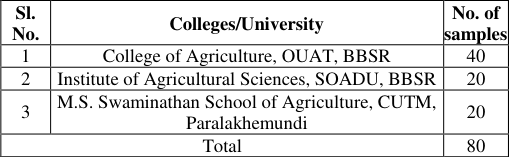 Table 1
 Table 2
Introduction
Career aspiration is a way that an individual wishes to continue to design his/her future life and way of life. It is one of the crucial choices that everybody, particularly an Undergraduate student, needs to make. Aspiration goal can be characterized as the decision of a task or calling for which one goes through explicit schooling and preparing throughout some undefined time frame and scale-up his/her abilities in terms of information and abilities needed for a specific work. It consequently alludes to the decision and inclination of a person for looking for a task/work in the wake of finishing their schooling. Education on Agriculture today has gotten profoundly mind boggling and concentrated, and offer numerous chances to design and pick assortment of profession by its beneficiaries. Numerous agricultural colleges/schools offer a wide scope of degree courses, and they can pick them relying on their expectation and expert yearnings. Because of its expert and vocation possible saw by the adolescent, agriculture education is practically the upcoming ambitions of those science students who come up short to get admission to course like medicine and engineering. The individuals who look for admission in agricultural Universities/Colleges in this manner establish the pool from which the nation will determine the required work power for most piece of the agriculture area either as instructors, specialists/researcher as well as extension workers in the near future. Students likewise search out colleges/universities that are notable for that most significant order or exchange. Mcglynn (2007) [1] saw that the vast majority of the students are concerned with the amount of payment/salary. Then again, there are a few students in the society who seek it as their dreams. Domenic and Jones (2007) [2] reported that career aspirations can be affected by gender, financial status and family uphold. As per Patton and Creed (2007) [3] , the career goals of youths have been seen as critical determinates of both short term educational and long term aspiration decisions. Furthermore, they have likewise been respected as significant aspiration persuasive variables which are influential of later career achievement levels. The present study entitled "Career Aspirations of Undergraduate Agriculture Students of Odisha" was undertaken with the intention to study the mind-sets of agricultural graduates having different career aspirations. www.extensionjournal.com project. The present research study comes within the purview of survey research mainly up "ex-post facto". College of Agriculture, Bhubaneswar among the three colleges of the Govt. undertaking university i.e., Orissa University of Agriculture and Technology, Bhubaneswar and two colleges namely Faculty of Agricultural sciences of Siksha 'O' Anusandhan deemed to be university, Bhubaneswar and M.S. Swaminathan school of Agriculture of Centurion university, Gajapati among four privately running universities were selected randomly for the purpose of the study were purposefully selected for the study. The no. of respondents of the study confined to 80 numbers B.Sc. (Ag) graduates pass from the selected colleges during the year 2018 and 2019. 40 respondents are selected from the Government running agriculture college i.e., College of Agriculture of OUAT, Bhubaneswar and 40 respondents, 20 each from the two privately running agriculture colleges purposefully (Table -1). Pilot study, Preparation and pretesting of interview schedule, Pretesting of interview schedule, interviews from farmers and Processing of data had been undergone in this study. The statistical tools used in the study were frequency calculation, percentage and ranking.
Results and Discussion
After passing +2 science examinations, the students prefer different technical and non-technical study to build their future career. In the present scenario there is high demand of students to study agricultural science. In the present study an attempt has been made to find out the career aspirations of the final year agriculture students to give their preference for studying agricultural science to build their future career plan and occupation for livelihood security in the society. The motive behind studying agriculture depicted in the table-2. There is no other goal 1 1.20 6
The data in the above table reviled that majority (66.20%) of agricultural graduates wanted to become Govt. officer in agricultural department which ranked 1 st followed by to go for higher studies (15.00%), to establish own agriculture business (8.80%), to join Govt. service in non-agricultural department (3.80%), to satisfy parent's wish and to be an scientist in ICAR or SAU institutions (2.5%) each which ranked 2 nd , 3 rd , 4 th , 5 th respectively in order of preference. The lowest response was obtained for no other goal (1.20%) only and ranked 6 th . It was observed that most of the respondents preferred to get Govt. job soon after graduation for which they preferred to become officers in agricultural department. At the same time many of the students are aspired to go for higher studies in various master's discipline followed by PHD studies to become scientist/faculties in different ICAR & SAU institutions. It was also observed that very few students preferred to establish their own enterprise in agriculture and allied sector. Though Govt. is giving much emphasis to promote entrepreneurial activities in agriculture and allied sectors but due to high risk and uncertainty for the success of the enterprise students do not prefer to be an entrepreneur, therefore majority of students preferred to join in Govt. services. The findings of the study are in line with the findings of Prasanna (2018) [4] .
Conclusion
It was found that most of the respondents preferred to get Govt. job soon after graduation for which they preferred to become officers in agricultural department. At the same time many of the students are aspired to go for higher studies in various master's discipline followed by PHD studies to become scientist/faculties in different ICAR & SAU institutions. It was also observed that very few students preferred to establish their own enterprise in agriculture and allied sector.
Application of research
Generally parents so also the children are very much enthusiastic about their career and they prefer to have a good career. The research will be applicable to the incumbent students who aspire to pursue higher agriculture education from State Agriculture Universities (SAUs) and Indian Council of Agriculture Research (ICAR) Deemed to be Universities (e.g. IARI, NDRI, IVRI, CIFE etc.) and many other agriculture institutions in the country. The research will give options in contrast to the general public's reasoning and insights about future aspiration goals as the greater part of them are fixated in making their children designated officers or researchers by introducing elective profession in agriculture area.
Figures and tables from the paper
| Sl. No. | Colleges/University | No. of samples |
|---|---|---|
| 1 | College of Agriculture, OUAT, BBSR | 40 |
| 2 | Institute of Agricultural Sciences, SOADU, BBSR | 20 |
| 3 | M.S. Swaminathan School of Agriculture, CUTM, Paralakhemundi | 20 |
| Total | 80 |
Table text extracted from the original PDF; superscript letters are shown inline. The original table image is below.
View original table image
| Sl. No. | Statements | Frequency (f) | Percentage (%) | Rank |
|---|---|---|---|---|
| 1 | To become an officer in State Govt./Central Govt. Agriculture Dept. | 53 | 66.20 | 1 |
| 2 | To join in Govt. Services in Non – Agriculture Dept. | 03 | 3.80 | 4 |
| 3 | To go for higher studies | 12 | 15.00 | 2 |
| 4 | To satisfy your parents’ wish | 02 | 2.50 | 5 |
| 5 | To establish own agriculture business | 07 | 8.80 | 3 |
| 6 | To become an Agriculture Scientist in ICAR or in SAU Institutions | 02 | 2.50 | 5 |
| 7 | There is no other goal | 1 | 1.20 | 6 |
Table text extracted from the original PDF; superscript letters are shown inline. The original table image is below.
View original table image
References
4 in the original paper- Mcglynn AP. The Hispanic Outlook in Higher Education 2007;18(4):44-45.
- Domenico DM, Jones KH. Journal of Family and Consumer Science Education 2007;25(1):24-33.
- Patton W, Creed P. Journal of Career Development 2007;34(2):127-148.
- Prasanna PL. Gender Comparative Analysis of Agriculture and Allied Activities in Adapa District of Andhra Pradesh (Doctoral dissertation) 2018.
Cited by 3
From OpenAlex, OpenCitations and reference lists read by Scinovex
- Career preferences and determinants of career choices among undergraduate and postgraduate students of Indira Gandhi Krishi Vishwavidyalaya, Raipur, Chhattisgarh
Bhukya Thirupathi, Hulas Pathak · International Journal of Research in Agronomy · 2026
Agricultural education in India has diversified career pathways for graduates well beyond conventional government employment, yet empirical evidence on how undergraduate (UG) and postgraduate (PG) students of State Agricultural Universities perceive and prioritise these pathways remains limited, particularly in Chhattisgarh. The present study examined the career preferences of UG and PG students of Indira Gandhi Krishi Vishwavidyalaya (IGKV), Raipur, and identified the factors and persons influencing their career decisions. A descriptive research design was adopted, and 300 respondents (150 UG
- ATTITUDE AND ASPIRATION OF UNDERGRADUATE AGRICULTURAL STUDENTS ↗
Sandhya S. Chaudhary, J. K. Patel, K. N. Raval · Gujarat Journal of Extension Education · 2023
Agricultural education forms the foundation for the development of requisite manpower for research, education, training and transfer of technology to the field and extension activities throughout the country. Six colleges of Sardarkrushinagar Dantiwada Agricultural University were selected for the study. List of final year students of all colleges were obtained and among them total 150 students were randomly selected for…
❝ 0PDF - Perceptions of Fisheries Professionals with Reference to Change in Minimum Qualification for Agricultural Research Services ↗
Suchismita Prusty, Arpita Sharma · Asian Journal of Agricultural Extension Economics & Sociology · 2021
A study is done with the objective of assessing perceptions of fisheries professionals with reference to revised notification of minimum qualification being Ph.D. for Agricultural Research Service (ARS). Information has been collected from 50 Masters and 50 Doctorate fisheries professionals/students of ICAR-CIFE, Mumbai, using an online Google form and adopting quantitative and qualitative methods. Non parametric Mann Whitney U test…
❝ 0PDF