
Research article · 2020 · Full text
International Journal of Veterinary Sciences and Animal HusbandryEffect of heavy metals on food mobilization of honeybees
Volume 5(5) · Pages 09–11
Research areasBee Products Chemical AnalysisInsect and Pesticide ResearchPlant and animal studies
Abstract
Author-writtenBees and their products selectively accumulate some metals. Tissues of bees and perg accumulate cadmium and copper, propolis - zinc, honey and wax - cobalt. The task of our research was to identify the behavioral responses of bees to high concentrations of heavy metals. The article presents the results of the mobilization activity of feeding bees with the addition of heavy metals to sugar syrup, as well as the effect of heavy metals on food mobilization of bees. In model experiments using a feeder, with an increase in the concentration of heavy metals in the sugar syrup, the duration of feeding decreases. According to the results of the research, it was clarified that the aversive reaction of bees to heavy metals in the killing order is the following series: cadmium > lead > strontium > cobalt > zinc.
Summary
Source-checkedPlain-language reading of the full paper, prepared with AI and checked against the text. Each point links to the authors' own words.
Why it matters
- Beekeeping products can become contaminated with toxic substances via the atmosphere or through trophic chains moving from soil to plants and then to bees. View evidence ↗
- Researching this contamination is important because polluted beekeeping products can harm both the bees in the hive and human health. View evidence ↗
- Previous research has not sufficiently addressed how bees behave when encountering high concentrations of heavy metals in plants. View evidence ↗
The question
- The study aimed to evaluate the behavioral reactions of bees and the duration of their feeding based on the concentration of heavy metals present in the food. View evidence ↗
What they did
- The experiment was conducted at the Tashkent State Agrarian University apiary, using 20 bee families selected from a total of 100. View evidence ↗
- Feeding duration was measured using a transparent organic glass chamber containing a petri dish of sugar syrup. View evidence ↗
- The researchers tested five heavy metals (zinc, lead, cadmium, cobalt, and strontium) at concentrations ranging from 0.0001% to 10%, compared against a control of 50% sugar syrup without additives. View evidence ↗
What they found
- Increasing the concentration of any of the tested heavy metals led to a decrease in the duration of feed consumption by the bees. View evidence ↗
- Cadmium was highly aversive; feeding stopped entirely at a 1.0% concentration, while at 0.0001% concentration, the average ingestion duration was 175 seconds. View evidence ↗
- Lead consumption only stopped at a 10% concentration, and the duration of lead ingestion was 10 times longer than that of cadmium. View evidence ↗
- At a 10% concentration, zinc allowed the longest feeding duration (42 ± 4.0 s), followed by cobalt (10 ± 2.0 s) and strontium (8 ± 3.0 s). View evidence ↗
- Feed intake duration for zinc concentrations was 32% higher than for cobalt and 34% higher than for strontium. View evidence ↗
What it means
- The authors conclude that high concentrations of heavy metals in plants trigger an aversive reaction in bees, which may limit the amount of these metals that enter bee bodies and beekeeping products. View evidence ↗
- The authors established a hierarchy of aversive reactions to heavy metals, with cadmium being the most aversive and zinc the least: cadmium > lead > strontium > cobalt > zinc. View evidence ↗
Visual summary
1 visualsIllustrations explain the paper; they do not show study data.
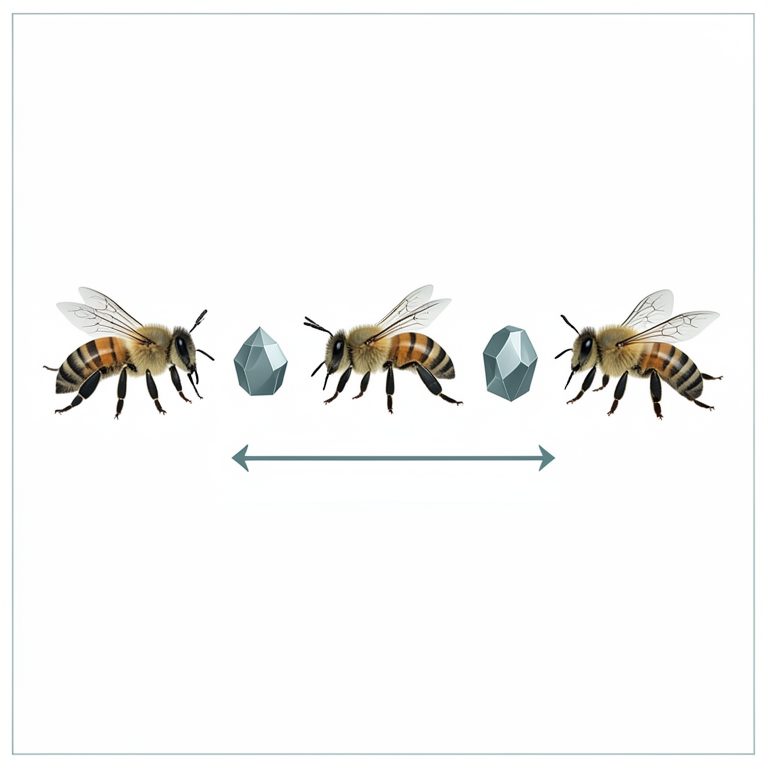
Aversiveness Hierarchy
AI-generated conceptual illustration (honeybees (Apis mellifera)). It explains the idea and does not show study data.
View source evidence ↗Figures & tables
From the original paper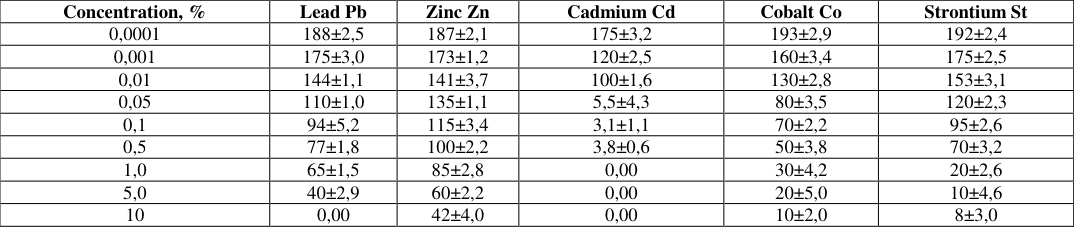 Table 1
Introduction
The amount of contaminants in beekeeping products is primarily due to the state of the environment at the apiary locations and the peculiarities of the applied technological processes [2] . Beekeeping products are contaminated with toxic substances not only from the atmosphere, but also through trophic bonds from the soil through plants to bees [1,3] . Interest in researching this process is due to the fact that polluted beekeeping products not only harm hive residents, but also pose a threat to human health [11,10] . Honey and beekeeping products have the ability to accumulate dangerous substances in order to human health in the soil, plants, water and air. This is one of the main factors causing beekeeping problems [4,7] . Currently, researchers pay great attention to the issue of the migration of heavy metals along the chain of soil -plant -bee bodies -bee melt -beekeeping products [8] . Heavy metals with high toxicity accumulate in soil, plants, spread along trophic chains and pose a significant threat to not only humans, but also honey bees [6] . In the results of the scientific researches, it can be said that the content of heavy metals in inflorescences of honeybees is several times lower than in the soil on which they grow, and in the body of bees -slightly less than in plants [9] . Most of them accumulate in products that do not pass through the body of bees (propolis, pollen), and less -in products processed by bees (honey, perga), and the accumulation of toxic elements in wax occurs already outside the body of bees [12,13] . However, these researches do not take into account the behavioral responses of bees to high concentrations of heavy metals in plants. The number of bees present on the sugar syrup feeder decreases dramatically with the addition of high concentrations of heavy metals [11] .
The purpose of the research: Evaluate behavioral reactions and duration of feeding by bees depending on the concentration of heavy metals in it.
Research methodology:
The research was carried out in experimental conditions on the apiary of Tashkent State Agrarian University. There were 100 bee families on the apiary. For the experiment, we selected 20 bee families. The duration of fodder intake was recorded by means of a device, which is a chamber of transparent organic glass, inside which a petri dish with a solution of sugar syrup is placed. The top of the camera is removable. A hole is made in the side wall through which one bee can pass. When the bees came up, it was kept open until 10 individuals appeared in the chamber.
Closing the entrance, the countdown of the time during which the bees consumed syrup began. After the last bee left the feeder, the end time of the feed was detected and the upper part of the chamber was opened, from where the bees flew freely. As ecotoxicants added to the syrup, heavy metals were used: zinc, lead, cadmium, cobalt, strontium. With each of these substances, syrup was prepared in several concentrations: 0.0001; 0,001; 0,01; 0,05; 0,1; 0,5; 1,0; 5,0; 10% (picture 3). The control was 50% sugar syrup without additives (picture 1,2). The duration of consumption of sugar syrup 219.8 ± 4.3 seconds. All variants were tested in 3-4 repetitions. Obtained data are statistically processed by method of paired comparisons according to Stuadent's criterion [5] .
Results: With an increase in the concentration of all researching heavy metals, a natural decrease in the duration of feed consumption by bees is seen. However, different elements cause different reactions. Behavioral responses of bees to high concentrations of heavy metals are shown in Table 1. The results of research indicate that the consumption of sugar syrup with the addition of cadmium by bees stops at 1.0%nom, and the duration of ingestion of food is on average 175 s. with 0.0001% -syrup, lead -stops at 10% -content, the duration of ingestion of lead is 10 times more than cadmium. This suggests that the behavioral response of bees and the reduction in feed intake from cadmium concentrations is higher than lead, strontium, cobalt and zinc. Average duration of feed intake with addition of 0.0001% strontium concentration is 4% more than lead, 5% more than zinc, 17% more than cadmium and 1% less than cobalt. At the same time, when strontium is added, the intake of feed lasts 8 ± 3.0 s even at a 10% concentration, and the intake of lead and cadmium at the same concentration absolutely ceases to eat. But by adding zinc, the feed intake lasts 42 ± 4.0 s even at 10% concentration, and cobalt additions at the same concentration reduce the food intake process to 10 ± 2.0 s, and strontium to 8 ± 3.0 s. Feed intake from zinc concentrations is 32% more than cobalt, and 34% more than strontium.
| Concentration, % | Lead Pb | Zinc Zn | Cadmium Cd | Cobalt Co | Strontium St |
|---|---|---|---|---|---|
| 0,0001 | 188±2,5 | 187±2,1 | 175±3,2 | 193±2,9 | 192±2,4 |
| 0,001 | 175±3,0 | 173±1,2 | 120±2,5 | 160±3,4 | 175±2,5 |
| 0,01 | 144±1,1 | 141±3,7 | 100±1,6 | 130±2,8 | 153±3,1 |
| 0,05 | 110±1,0 | 135±1,1 | 5,5±4,3 | 80±3,5 | 120±2,3 |
| 0,1 | 94±5,2 | 115±3,4 | 3,1±1,1 | 70±2,2 | 95±2,6 |
| 0,5 | 77±1,8 | 100±2,2 | 3,8±0,6 | 50±3,8 | 70±3,2 |
| 1,0 | 65±1,5 | 85±2,8 | 0,00 | 30±4,2 | 20±2,6 |
| 5,0 | 40±2,9 | 60±2,2 | 0,00 | 20±5,0 | 10±4,6 |
| 10 | 0,00 | 42±4,0 | 0,00 | 10±2,0 | 8±3,0 |
Table text extracted from the original PDF; superscript letters are shown inline. The original table image is below.
View original table image
Picture 1, 2: Measurement of dry weight of sugar syrup Picture 3: 10% cadmium concentration in 50% sugar syrup
Conclusions
Thus, in model experiments using a feeder, it was shown that with an increase in the concentration of heavy metals in the sugar syrup, the duration of feeding bees decreases. The correlation between the concentration of heavy metals added to the sugar syrup and the duration of ingestion of fodder by the bees suggests that significant concentrations of these substances in the plants cause an aversive reaction of the bees, which allows only partial ingress of heavy metals into beekeeping products and bee bodies. The aversive reaction of bees to heavy metals in the killing order is the following series: cadmium > lead > strontium > cobalt > zinc.
References
13 in the original paper- Burmistrova LA, Rusakova TM, Lisunova AS, Repnikov LV. Features of the accumulation of toxic elements by individual beekeeping products. Materials of the international scientific and practical conference on beekeeping. Novosibirsk 2008, 63-65.
- Engel MST. The taxonomy of recent and fossil honeybees (Hymenoptera: Apidae; Apis). J Hymenoptera Res 1999, 165-196.
- Eskova EK. Content of heavy metals in soil, bees and their products. Journal of Beekeeping, 2001, №4.
- Ellis JD, Munn PA. The worldwide health status of honey bees. Bee World 2005;86:88-101.
- Glanz Stenton. Medical and biological statistics. M 1999.
- Codes LG, Bychkova NV. Migration of heavy metals in beekeeping products. Journal of Beekeeping 2001, № 4.
- Oldroyd, Wongsiri S. Asian Honey Bees. Biology, Conservation and Human Interactions. Harvard University Press, Cambridge, Massachusetts 2006, 13-35.
- Pashayan S.A. Properties of heavy metals migration. Journal of Beekeeping 2006, №9.
- Ruttner F. Biogeography and taxonomy of honeybees, Springer-Verlag, Berlin. Sanpa 1988.
- Tuktarov VR. Issues of ecology and pollution of beekeeping products. Apitherapy today. With a biological pharmacy -in the 21st century. Materials of the International Scientific Conference -UFA 2000, 125127.
- Khomutov AE, Yagin VV, Khomutov DA. The duration of fodder intake by bees depending on the concentration of heavy metals and insecticides in it. Journal of Beekeeping 2015, №9.
- Kuldasheva FKh. Accumulation of heavy metals in the body of honey bees. The American Journal of Agriculture and Biomedical Engineering 2020, №7.
- Kuldasheva FKh. Comparative assessment of honey bees in Uzbekistan. International Multidisciplinary Conference "Scientific research results in pandemic conditions (COVID-19)". Proceedings of the Conference (June, 2020). Primedia E-launch LLC, Shawnee, USA. July 2020.