
Research article · 2021 · Full text
International Journal of Geography Geology and EnvironmentEnvironmental problems from brick manufacturing and its impact on workers: A Study on some selected brick kilns in Berhampore C.D. block, West Bengal
Volume 3(1) · Pages 01–05
Research areasHealthcare and Environmental Waste Management
Abstract
Author-writtenIn developing countries brick is the most important building materials or units. Brick manufacturing is an ancient practiced all over the world. It is a pre -dominantly rural industry with brick making units belonging to small industrial sector. Brick kilns are increasing day by day due to population growth as well as urbanization. Workers are the integral part of man power resources in these recognized sectors but the unfortunately the workers here suffer a salient agony. Air pollution and land pollution are both the most consequences due to brick manufacturing. This research paper is based on primary and secondary data sources. Four Brick Kilns are observed for the same research in Berhampore C.D. Block, Murshidabad. The present study examines the environmental problems and its associated impacts on workers. This paper is also discussing and starched some solutions and recommendations regarding the abolish problems associated with brick manufacturing phenomenon.
Summary
Source-checkedPlain-language reading of the full paper, prepared with AI and checked against the text. Each point links to the authors' own words.
Why it matters
- Bricks are among the most critical building materials used in developing countries. View evidence ↗
- The number of brick kilns is growing steadily, driven by urbanization and population growth. View evidence ↗
- Brick manufacturing is associated with significant air and land pollution. View evidence ↗
The question
- The study aims to examine environmental problems caused by brick manufacturing and how these problems impact the workers. View evidence ↗
What they did
- The research was conducted by observing four selected brick kilns in the Berhampore C.D. Block of Murshidabad, West Bengal. View evidence ↗
- Primary data was gathered using field surveys and structured questionnaires. View evidence ↗
- Worker satisfaction was measured using a Satisfaction Index (SI) calculated as the difference between satisfied and dissatisfied respondents divided by the total number of respondents. View evidence ↗
What they found
- Out of 191 surveyed workers, 128 were male and 63 were female. View evidence ↗
- On average, 21.65% of the labor force in the studied brick kilns consists of child laborers. View evidence ↗
- Long working hours led to muscular pain in 23.65% of male and 16.43% of female workers. View evidence ↗
- Air pollution contributed to various health issues: skin disease (10.32% and 6.23%), heart disease (12.25% male, 9.23% female), and respiratory problems/asthma (15.24% and 8.21%). View evidence ↗
- Workers reported high dissatisfaction with wages (SI -0.37) and child labor (SI -0.47), while they were moderately satisfied with infrastructure (SI 0.57). View evidence ↗
What it means
- The authors recommend using advanced technological tools and equipment to reduce air pollution from brick kilns. View evidence ↗
- The authors state that the government must promote rules and regulations to control child labor in the industry. View evidence ↗
Visual summary
2 visualsIllustrations explain the paper; charts are replotted from the paper's own table values.
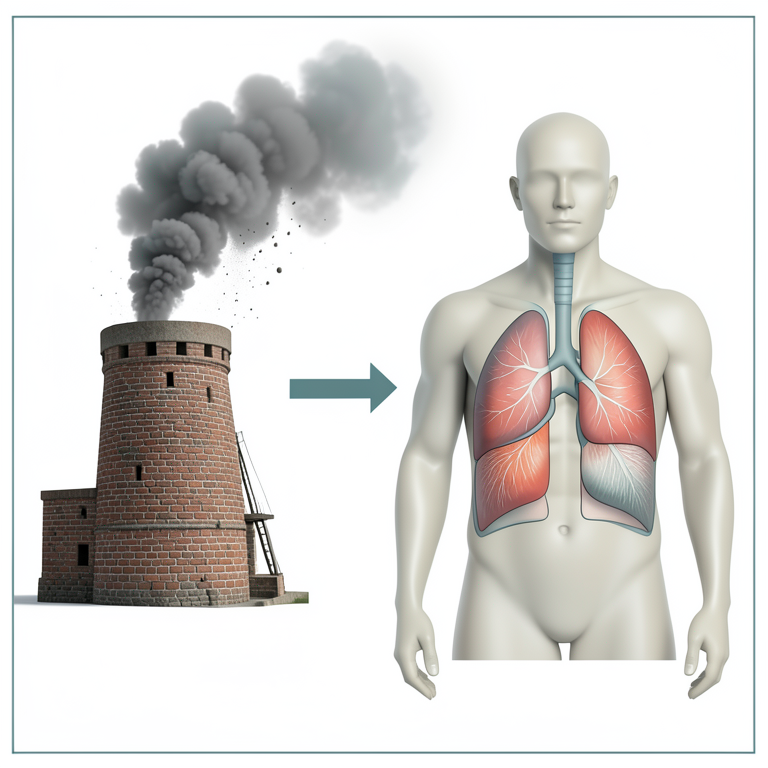
Environmental-Health Link
AI-generated conceptual illustration (Brick kilns and adult human workers). It explains the idea and does not show study data.
View source evidence ↗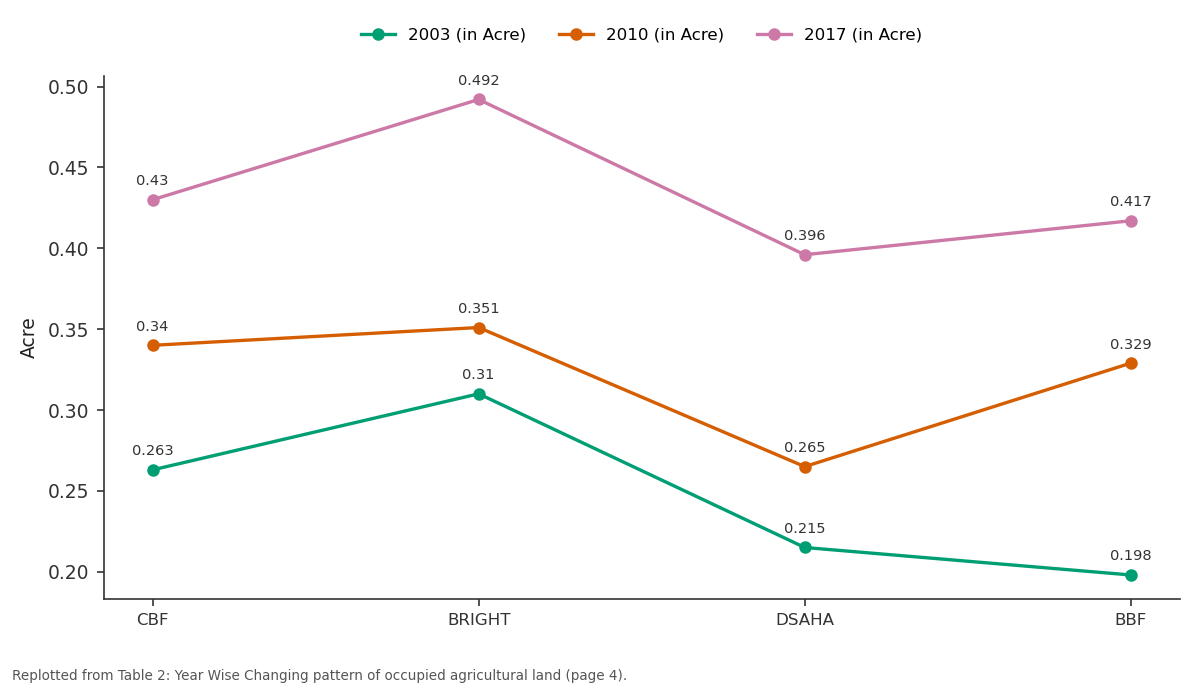
2003 (in Acre) and 2010 (in Acre) and more: CBF vs BRIGHT vs DSAHA vs BBF
Replotted from Table 2 (page 4) of the original paper. Every bar is the paper's own table value.
View source evidence ↗Figures & tables
From the original paper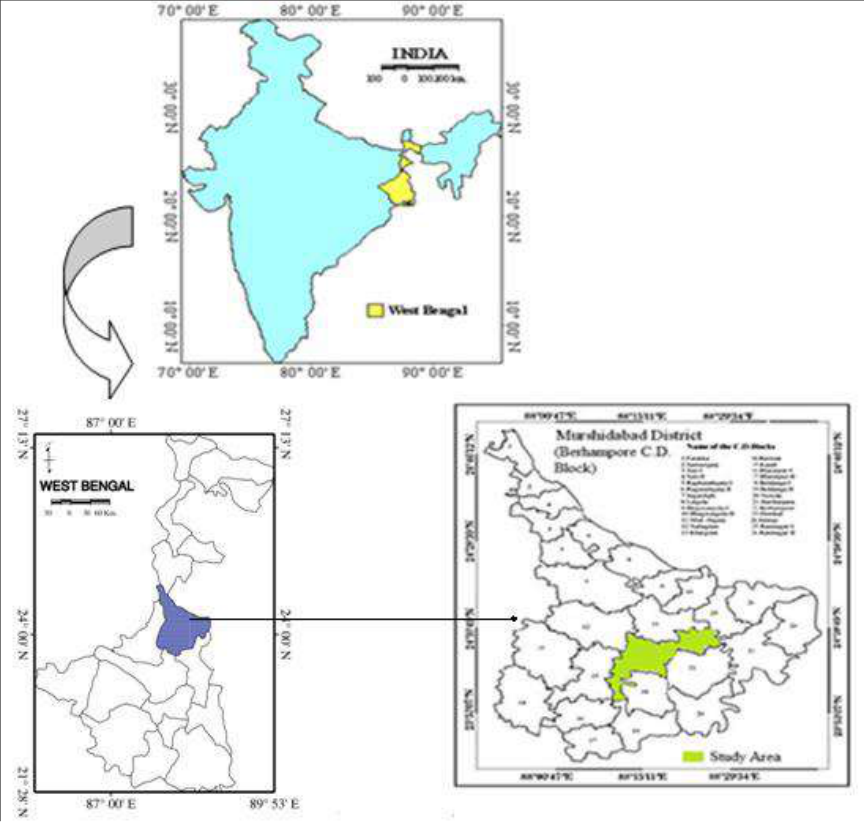 Figure 1
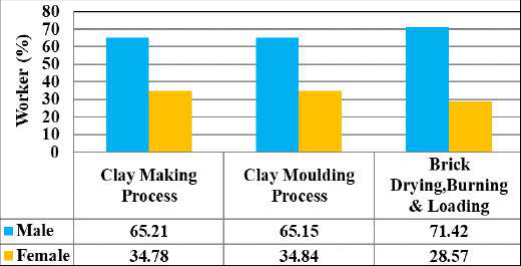 Figure 2
 Table 1
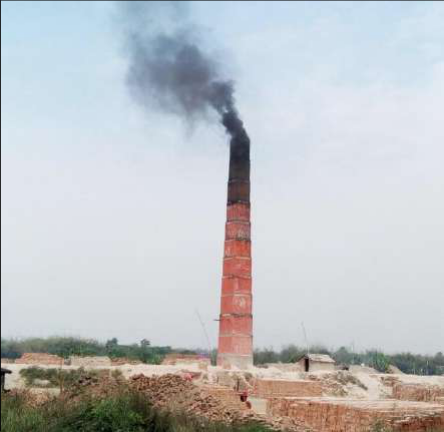 Figure 4
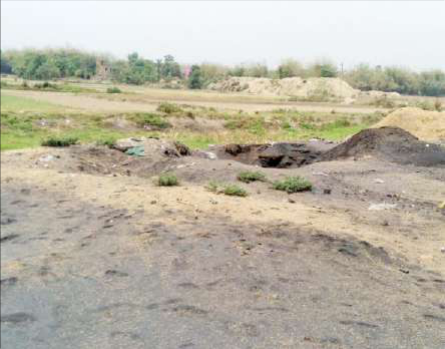 Figure 5
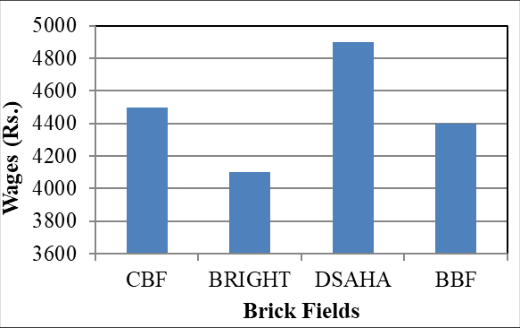 Figure 3
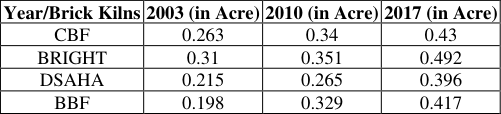 Table 2
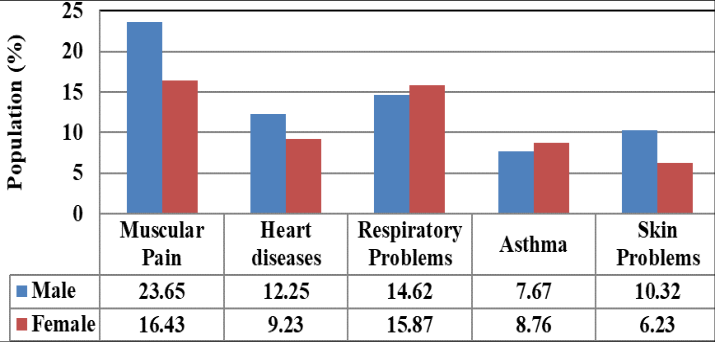 Figure 6
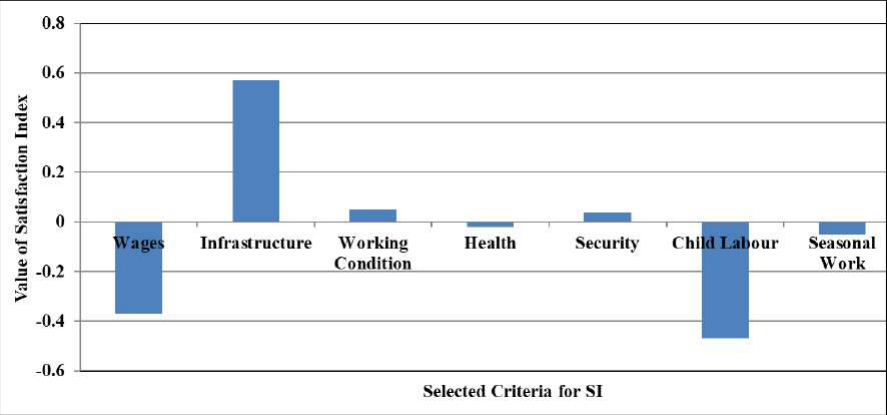 Figure 7
Introduction
Brick manufacturing is an ancient phenomenon in rural India as well as all over the world. It is most well-liked construction materials for thousands of years. In recent trends the demand of bricks is growing in the developing country especially in India. Brick manufacturing in India is a sector associated with infrastructure development and it's have huge contribution for increasing the Gross Domestic Product (GDP) in India. Employments are generating for people of this country due to soar of brick kilns. It is a predominantly rural industry and belongs to small and industrial sector. Brick kilns are soaring day by day due to population growth as well as urbanization. The owner of brick kilns is too much interested to expand their business area with high grade of brick making. Workers are the important part of man power resources in brick manufacturing. As a negative outcomes of brick manufacturing found environmental pollution in that premises. Air pollution and land pollution are both the most consequences due to brick manufacturing. According to India country report the brick kilns emits toxic gases and suspended particulate matter which affects on workers. Besides, the associated people who are living nearer the brick manufacturing premises also are affected with environmental problems in concern area.
Objectives
The entire research is developed through the selection of following objectives; ▪ To find out the environmental pollution from brick manufacturing. ▪ To assess the impact of the problems on the workers engaged with brick kilns. ▪ To measure the health status of the working people who are affected from brick manufacturing. ▪ To ensure some solutions and recommendations to abolish such environmental problems regarding with brick kilns.
Research Area
Research Area
Results and Discussions Distribution of workers according to working process in Brick kilns
In Berhampore C.D. block four brick manufacturing are selected for present study. Surveyed total number of workers are 191 among them male workers are 128 and female workers are 63. Here, male population concentration is high than the female population. In fig 2 according to working process it is observed that males and females both are engaged with clay making process, clay molding process, brick drying, burning and loading. So, the percentage of male workers who are engaged with clay making process; clay molding process; brick drying, burning and loading are 65.21 percent, 65.15 percent, 71.42 percent respectively. In terms of female workers, the percentage of clay making process is 34.78 percent, for clay molding process is 34.84 percent and for brick drying, burning and loading is 28.57 percent.
Source: Field Survey, 2017
Wages of Workers in Brick Manufacturing
Wages of Workers in Brick Manufacturing
Land Pollution
In surrounded area of brick manufacturing, there are observed that the good quality of agriculture land is damaged due to covering the coal dust and ashes in that area. Large quantities of waste materials created from brick kilns is also a matter of concern. As the consequence of land pollution it is cleared that the productivity of agricultural land is declining day by day. Most of the waste materials are fly ash, boiler ash and stone dust.
Land Cutting Problems
The good quality of soil is used for making the high qualities of bricks. So, the owner of brick manufacturing tried to bring good qualities of soil form the river side region. Here, Bhagirathi river basin area is chosen for the soil. So, Soil erosion is seen due to increasing the land cutting activity gradually. The land cuttings also affects on the Bhagirathi River. The siltation of Bhagirathi River is the progressive way. Even sometimes, the good agricultural lands are used for brick kiln purpose and also affected by this process. It converts the agricultural land to fallow land due to entire removal of topsoil.
Reduction of agricultural land:
The table 2 explains a massive portion of agricultural land is deducted surrounded by brick kilns because farmers give preference to brick-kilns rather than growing agricultural crops, because brick kiln owners offer much more money than they can earn from agriculture. Hence, they had forced to cultivators to give the agricultural land for expanding their manufacturing area. The owner of brick kilns wants the surrounded land with four or five years lease and they will pay the money with installment method to the farmers. The diagram (fig. 6) showing the total land occupied through yearly changing of the pattern. From the year of 2003 to 2017 the net area each brick kiln is increased day by day. The increasing area of brick kilns from 2003 to 2017, in CBF it is 0.167 Acre, for BRIGHT it is 0.182 Acre, for DSAHA it is 0.181 Acre and for BBF it is 0.219 Acre. The highest changing pattern of total land occupied is identified in BBF brick field. Health Problems of the workers in brick kilns Fig 6 shows as the field survey and interview results identified that most of the workers are affected by the health problems in the brick kilns. From the study it is cleared that 23.65 percent male and 16.43 percent female workers are affected by muscular pain in knees, legs, heaps and hands due to long duration working activity. As the outcome of air pollution found the various type of diseases among the workers like skin disease, heart disease, respiratory problems, asthma etc. The percentage of affection from skin disease is 10.32 percent and 6.23 percent; from heart disease it is 12.25 percent for male and female 9.23 percent; the percentage of Respiratory problems and Asthma are 15.24 and 8.21 respectively. Hence, local residents are also facing the problems due to the affect of air pollution.
| Year/Brick Kilns | 2003 (in Acre) | 2010 (in Acre) | 2017 (in Acre) |
|---|---|---|---|
| CBF | 0.263 | 0.34 | 0.43 |
| BRIGHT | 0.31 | 0.351 | 0.492 |
| DSAHA | 0.215 | 0.265 | 0.396 |
| BBF | 0.198 | 0.329 | 0.417 |
Table text extracted from the original PDF; superscript letters are shown inline. The original table image is below.
View original table image
Conclusion with Recommendations
It is clearly visible that gradually reducing the agricultural land resources and soil erosion due to land cutting problems. Also, it is seen as degrading air quality due to chemical and toxic substances emission from the Brick kilns. Solid brick wastes leads to the contamination of soil, water, air and organic world. Many workers are affected with unfavorable health conditions that are associated with brick manufacturing. Child labour is found there. Low labour cost and per capita income reflects the poverty and economic insecurity. It should be measured to reduce the air pollution from brick kilns using high technological tools and equipment. Owner should try to reduce the wastage materials and conservation of good quality agricultural land associated with brick kilns. The Agriculture and Land Reforms Department should come frontward to put off land degradation and environmental pollution in brick kiln factories. It should be ensured the good quality of life with confirmation of life insurance for workers and arrangement the sufficient wages for man and women workers. Government has to be promoted a rules and regulations for controlling the child labour from brick kilns. Local Government body should visit in brick kilns to reduce the environmental problems as well as social economic problems.
Figures and tables from the paper
| Name of the brick fields | Clay making Process Wages in Rs. /Month) | Clay Molding Process (Wages in Rs./1000 bricks) | Drying and Transportation (Wages in Rs./1000 bricks) |
|---|---|---|---|
| CBF | 4500 | 300 | 700 |
| BRIGHT | 4100 | 350 | 650 |
| DSAHA | 4900 | 370 | 750 |
| BBF | 4400 | 340 | 720 |
Table text extracted from the original PDF; superscript letters are shown inline. The original table image is below.
View original table image
References
10 in the original paper- Pariyar S, Das T, Ferdous T. Environment and Health Impact for Brick Kilns in Kathmandu Valley, International Journal of Scientific & Technology Research 2013;2(5):84-187.
- Darain K, Rahman A, Ahsan A, Islam A, Yousuf B. Brick Manufacturing Practice in Bangladesh: A Review of Energy Efficacy and Air Pollution Scenarios, Journal of Hydrology and Environment Research. 2013;1(1):60-70.
- Rana M, Das A. Causes and Consequences of Child work in Brick Field: A Study on the Selected Brick Fields in Char Bhadrasan under Faridpur District, IOSR Journal of Business and Management 2014;16(3):1426.
- Gonzalez G, Islas H. Experimental study of the firing of the red clay bricks using liquefied petroleum gas, Journal of Scientific and Industrial Research 2014;73(1):661-666.
- Das B. Impact of In-Bed and On-Bank Soil Cutting by Brick Fields on Moribund Deltaic Rivers: A Study of Nadia River in West Bengal, The NEHU Journal 2014;12(2):101-111.
- Motalib M, Lasco R, Pacardo E, Rebancos C, Dizon A. Health Impact of Air Pollution on Dhaka City by Different Technologies Brick Kilns, International Journal of Technology Enhancements and Emerging Engineering Research 2015;3(5):127-133.
- Das R. Land Degradation in Terms of Environmental Cost Due to the Emergence and Development of Brick Kilns -A Study On Khejuri CD Blocks Over Coastal Medinipur in West Bengal, International Journal of Science and Research 2015;4(2):1942-1952.
- Prasad M, Nayak S, Mudey A, Dhande N, Chandrakar D. Assessment of Health Status of the Brick Industry Workers in Wardha District, Journal of Academia and Industrial Research 2016;5(1):1-4.
- Roy S, Roy S. Child Labour: A Case Study of Child Labourers in the Select Brick Fields of North 24 Parganas, The Academic Journal of Goenka College of Commerce and Business Administration. 2016;1(1):113.
- Das S, Hasan M, Akhter R, Huque S, Shahriar. Socioeconomic conditions and health hazards of brick field workers: A case study of Mymensingh brick industrial area of Bangladesh, Journal of Public Health and Epidemiology 2017;9(7):198-205.