
Research article · 2020 · Full text
International Journal of Veterinary Sciences and Animal HusbandryChange in the number of formed elements and indicators of natural blood resistance in Holstein cows when feeding them with various bulk feeds
Volume 5(1) · Pages 01–03
Research areasEngineering and Agricultural Innovations
Abstract
Author-writtenIn the article, the authors cite data obtained by studying the influence of diet types on the factors of the body's natural resistance of imported Holstein cows from abroad to the new climatic and feed conditions of Uzbekistan. The results show that the hay-type diet used in their feeding leads to an increase in blood cells and a more intensive increase in the indices of humoral and cellular factors, and natural resistance in the body of adaptive livestock.
Summary
Source-checkedPlain-language reading of the full paper, prepared with AI and checked against the text. Each point links to the authors' own words.
Why it matters
- High-productivity Holstein cows are imported into Uzbekistan to improve the availability of high-quality dairy products. View evidence ↗
- The sharp difference between Uzbekistan's climate and feed conditions and the cows' original environment can cause functional disruptions, reducing productivity and product quality. View evidence ↗
- Analyzing blood indices provides an objective way to assess how an organism is functioning while adapting to adverse environmental factors. View evidence ↗
The question
- The study aimed to evaluate the adaptive characteristics of German-born Holstein cows imported to the Samarkand region when fed different types of voluminous feeds. View evidence ↗
What they did
- The control group was fed a silo-type diet, while the experimental group received silage-type diets (referred to as hay-type/haylage in results). View evidence ↗
- Researchers measured morpho-biochemical and immunological blood parameters, including neutrophil phagocytic activity using Staphylococcus aureus and serum bactericidal activity using Escherichia coli. View evidence ↗
What they found
- Cows in the experimental group had a higher average red blood cell count (6.6 ± 0.14 million/mm3) compared to the control group (6.1 ± 0.27 million/mm3), representing a 7.6% increase. View evidence ↗
- Leukocyte counts were similar between both groups, averaging 8.4 ± 0.41 thousand/mm3. View evidence ↗
What it means
- The authors conclude that a hay-type diet increases morphological indicators and enhances both humoral and cellular factors of natural resistance in imported Holstein cows in Uzbekistan. View evidence ↗
- These improvements in blood and resistance indicators characterize the cows' successful adaptation to the region's new climatic and feed conditions. View evidence ↗
Visual summary
2 visualsIllustrations explain the paper; charts are replotted from the paper's own table values.
Experimental Grouping
AI-generated conceptual illustration (Holstein cows). It explains the idea and does not show study data.
View source evidence ↗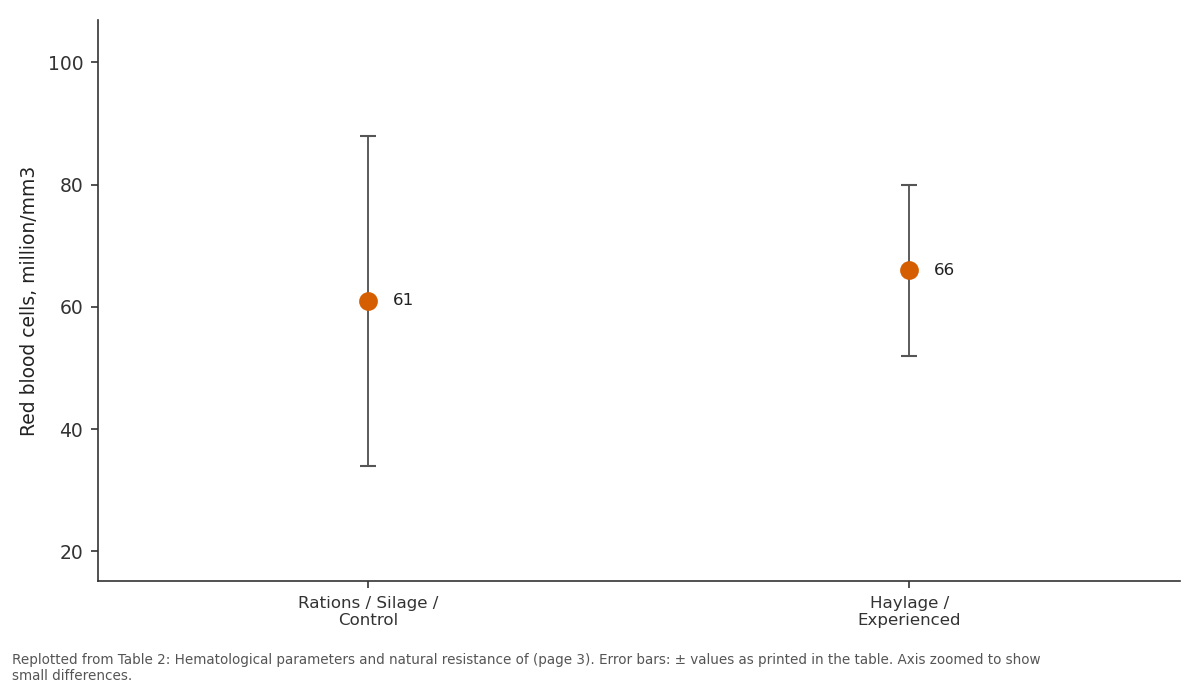
Red blood cells, million/mm3: Rations / Silage /... vs Haylage / Experienced
Replotted from Table 2 (page 3) of the original paper. Every bar is the paper's own table value.
View source evidence ↗Figures & tables
From the original paper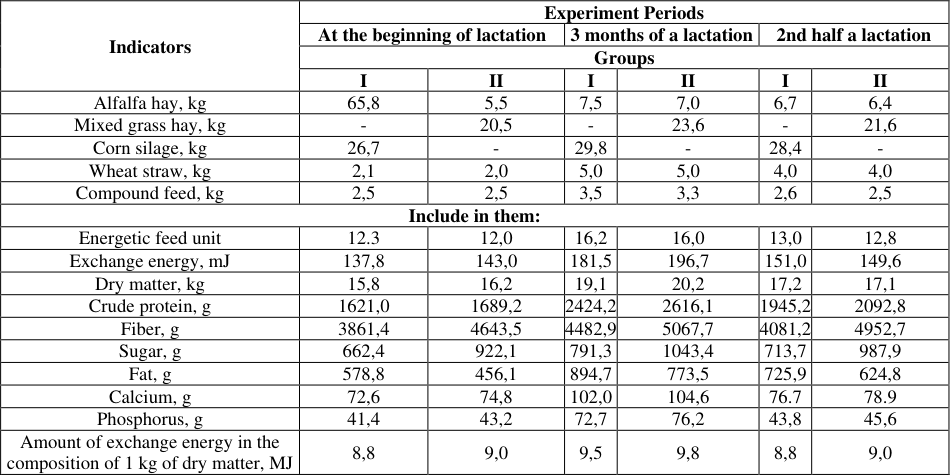 Table 1
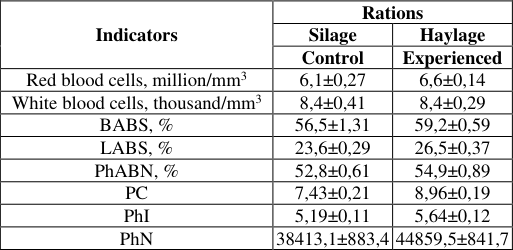 Table 2
Introduction
In recent years, in order to provide the population of Uzbekistan with high-grade and highquality dairy food products, high-productivity Holstein cows are imported from abroad. However, Uzbekistan in its feed and climatic conditions differs sharply from those conditions where it was grown and formed as a breed. Under the influence of these factors in the tissues, organs, and sometimes in the whole organism, the imported animals undergo functional change and disruption, leading to a decrease in productivity and a deterioration in the quality of the resulting product. This is the result of a change in the main metabolism (protein, carbohydrate, lipid and mineral), which is accompanied by violations of their adaptive ability and a decrease in the body's resistance to the latter [1, 2, 3,] . As known, during the adaptation period, the animal's body is able to independently regulate all physiological processes and the internal environment of the body at the level of physiological norms using blood fluids (blood, lymph, cerebrospinal fluid). Blood with plasmatic and blastomatic substances is the main indicator that reveals metabolism occurring in the body [5,6] . Therefore, the study of blood indices is an objective method for assessing the functional state of an organism in the conditions of its adaptation to adverse environmental factors [7,8] . In this regard, it is considered very relevant to identify the characteristics of metabolic processes, in particular, from the supply of protein components of the body, when feeding imported rations to silage and hay-type diets, i.e., consisting of silage and haylage rations. As known, the proteins of feed fed into the blood are not only plastic material in the animal's body, but also energetic. A change in their content leads to a violation of homeostasis and specific resistance. Organism [2] . Thus, the study of the adaptive features of highly productive animal breeds brought to Uzbekistan from abroad is currently a rather urgent problem.
The aim of this study: Is to study the adaptive characteristics of Holstein cows of German generation imported from Germany to the farms of the Samarkand region, when feeding their diets consisting of voluminous feeds of various types. To solve the goal, it was necessary to solve the following tasks; The study of morphological and biochemical blood parameters of animals during various periods of their lactation.
Determine the state of natural resistance of their body when feeding rations containing various volumes of voluminous feed (silage and haylage).
Material and Research Methods
The studies were carried out at the "Chortut" dairy complex in the Pasdargom district of the Samarkand region. The object of the research was cows at the age of 4.0-4.5 years of blackmotley Holstein breed of German generation. Formed 2 groups of 6 animals in each, by age, live weight, productivity and physiological condition of the animals were analogues. The experiments continued during the lactation period in accordance with the methodology developed by V.N. Viktorov et al. [4] . The first group served as a control, and were fed with a silo type of diet, and the second-the experimental group was fed with silage types of diets [7,8] . When conducting monitoring of the physiological and biochemical state of imported cows, normalized feeding of experimental animals was organized using the method of groups-periods [8] . Experimental animals were fed complete diets, but they differed in the set of feeds. However, in terms of nutrient content and biological value, they were the same and corresponded to the norms of the reference guide recommended by RAA [6 a] . Morpho-biochemical and immunological parameters of blood (and blood serum) were studied according to the method recommended by Kondrakhin and others [6] .
The study of the morphological and biochemical composition of blood, indicators of natural resistance of experimental animals was carried out by the general accepted methods, all digital data were processed by statistical methods [7] .
Nonspecific immunity factors-the phagocytic activity of leukocytes and neutrophils was determined by Althausen (Staphylococcus aureus was used). Smears were stained according to Romanovsky-Giemsa [12] . The bactericidal activity of blood serum was determined by O. V. Bukharin, based on the ability of the latter to carry out lysis of the broth culture, which was used as a 24-hour culture of Escherichia coli [4] . The phagocytic index, the number and capacity of blood serum were determined by the formula by calculation methods. Research results. In the natural and climatic zones of the Samarkand region in dairy complexes for feeding cows, the silo type of diet with the content of up to 53.0% of corn silage in the diet is most often used. As practice shows, this type of feeding does not always allow highly productive animals to fully realize their genetic potential for milk production. Thus, in order to find out what type of feeding has the most favorable effect on the animal organism and contributes to their better acclimatization to the extreme conditions of the Samarkand region, studies were conducted to study the morphological and biochemical parameters of blood and the body's natural resistance to German-born cows. So, as the changes occurring in the body of animals under the influence of external and internal factors, are always reflected in the morphological and biochemical parameters of the blood. A full-fledged feeding fully ensures the constancy of the internal environment of the body.
In order to accurately establish the effect of the fed set of feeds on milk productivity and its quality, a complete feeding of experimental cows was organized. The composition and nutritional value of the diets used are shown in table No. 1. As the table shows, the diets of the control and experimental groups of animals in terms of nutrient content and their biological value in all lactation periods were the same. The energy feed units and the amount of dry matter in the diets of the compared groups were also the same. However, in terms of the content of exchange energy and crude protein, the rations of the experimental group had advantages in comparison with silo types of diets. The increase in the diet of metabolic energy and crude protein, in our opinion, was completely dependent on the crude fiber content found in the composition of haylage.
When studying the dynamics of morphological and biochemical blood parameters during the adaptation of imported animals, it was found that the number of red blood cells in cows consuming silage-type diets imported from abroad averaged 6.1 ± 0.27 million/mm 3 , i.e. although they were at the level of physiological norms, but was at the lowest level. And the blood counts of animals of the experimental group were high and amounted to an average of 6.6 ± 0.14 million/mm 3 , or, was higher by 7.6%. The leukocyte counts in the compared groups were the same and averaged 8.4 ± 0.41 thousand/mm 3 .
In our opinion, this indicates that imported cows that received a silage type of diet in comparison with haylage, were practically in a state of deep climatic, technological and feed stress during the adaptation period (table 2). The correctness of our opinion is subject to the data obtained in the study of indicators of the formation of statuses of the natural resistance of their body. A study of the characteristics of the formation of natural resistance of the cow organism showed that the degree of BABS of Holstein cows imported from European countries, which are in the process of acclimatization to the conditions of the Samarkand region, changed depending on the type of diet for feeding cows.
| Indicators | Rations | — |
|---|---|---|
| Silage | Haylage | |
| Control | Experienced | |
| Red blood cells, million/mm3 | 6,1±0,27 | 6,6±0,14 |
| White blood cells, thousand/mm3 | 8,4±0,41 | 8,4±0,29 |
| BABS, % | 56,5±1,31 | 59,2±0,59 |
| LABS, % | 23,6±0,29 | 26,5±0,37 |
| PhABN, % | 52,8±0,61 | 54,9±0,89 |
| PC | 7,43±0,21 | 8,96±0,19 |
| PhI | 5,19±0,11 | 5,64±0,12 |
| PhN | 38413,1±883,4 | 44859,5±841,7 |
Table text extracted from the original PDF; superscript letters are shown inline. The original table image is below.
View original table image
We found that with the hay-type diet, in adaptable cows, the formation of natural resistance was more intense and BABS was at a higher level and the lag in this indicator amounted to 30.07% in the control group and 4.80 in the experimental group % respectively. It is known that the enzyme lysozyme (acetylmuramidase) is found in almost all organs and tissues of animals. Its content in the blood serum of cows correlates with bactericidal activity. Lysozyme stimulates phagocytosis of neutrophils and macrophages, as well as antibody synthesis. The serum lysozyme activity (LABS) in the control group of imported animals was within the physiological norm, and in the experimental group was higher than the control group by 12.3%
The general immunity of animals to an adverse factor in the external and internal environment is due to the immunobiological reactivity of the body. It is known that nonspecific protective factors of an organism are determined by genetic factors and can be expressed with different strengths depending on the physiological state of animals, seasons, feeding conditions and keeping. The most important factor in the cellular defense system of the body is the opsonophagocytic reaction of leukocytes [10,13] . As a result of the studies, it was found that the phagocytic activity of blood neutrophils (PhABN) in the experimental group was higher compared to the control group by 4.0%. Thus, with the hay-type diet, the process of adaptation of imported livestock was more intensive. Such a high PhABN is due to the fact that the phagocytic capacity (PC), phagocytic index (PhI) and phagocytic number (PhN) in the process of adaptation in animals of the experimental group of cows increased.
Conclusion
Feeding imported Holstein cows, of a hay-type diet in extreme conditions of Uzbekistan, led to an increase in morphological indicators, as well as a more intensive increase in the indicators of humoral and cellular factors of natural resistance in their body. And this, characterizes their adaptation to the new climatic and feed conditions of the region.
Figures and tables from the paper
| Indicators | Experiment Periods | — | — | — | — | — |
|---|---|---|---|---|---|---|
| At the beginning of lactation | 3 months of a lactation | 2nd half a lactation | ||||
| Groups | ||||||
| I | II | I | II | I | II | |
| Alfalfa hay, kg | 65,8 | 5,5 | 7,5 | 7,0 | 6,7 | 6,4 |
| Mixed grass hay, kg | - | 20,5 | - | 23,6 | - | 21,6 |
| Corn silage, kg | 26,7 | - | 29,8 | - | 28,4 | - |
| Wheat straw, kg | 2,1 | 2,0 | 5,0 | 5,0 | 4,0 | 4,0 |
| Compound feed, kg | 2,5 | 2,5 | 3,5 | 3,3 | 2,6 | 2,5 |
| Include in them: | ||||||
| Energetic feed unit | 12.3 | 12,0 | 16,2 | 16,0 | 13,0 | 12,8 |
| Exchange energy, mJ | 137,8 | 143,0 | 181,5 | 196,7 | 151,0 | 149,6 |
| Dry matter, kg | 15,8 | 16,2 | 19,1 | 20,2 | 17,2 | 17,1 |
| Crude protein, g | 1621,0 | 1689,2 | 2424,2 | 2616,1 | 1945,2 | 2092,8 |
| Fiber, g | 3861,4 | 4643,5 | 4482,9 | 5067,7 | 4081,2 | 4952,7 |
| Sugar, g | 662,4 | 922,1 | 791,3 | 1043,4 | 713,7 | 987,9 |
| Fat, g | 578,8 | 456,1 | 894,7 | 773,5 | 725,9 | 624,8 |
| Calcium, g | 72,6 | 74,8 | 102,0 | 104,6 | 76.7 | 78.9 |
| Phosphorus, g | 41,4 | 43,2 | 72,7 | 76,2 | 43,8 | 45,6 |
| Amount of exchange energy in the composition of 1 kg of dry matter, MJ | 8,8 | 9,0 | 9,5 | 9,8 | 8,8 | 9,0 |
Table text extracted from the original PDF; superscript letters are shown inline. The original table image is below.
View original table image
References
14 in the original paper- Alyoshina MN. Technological properties of milk of Saanen goats of the Dutch and domestic populations. Sheep. Goats. Woolen. 2013; 4:23-25.
- Antsibor TA. The effect of full and inferior feeding of mother cows on the immune status of newborn calves. // Dissertation abstract of Candidate of biological sciences. Saratov, 2006, 20.
- Bukharin OV. Lysozyme and its role in biology and medicine // Collection of articles of the International scientific and practical conference Innovation in the modern world, Moscow, 2015, 33-37.
- Viktorov PI. Methodology and organization of livestock experiments //-M. Agropromizdat, 1991, 38-65.
- Vinnikov NT. Veterinary laboratory diagnostics. //FGOUVPO Saratov GAU, 2003.
- Kalashnikov AP, Scheglov VV. others. Norms and diets of feeding agricultural animals. Reference publication. M. Agropromizdat, 2003, 476.
- Kondrakhin IP. Clinical laboratory diagnostic in veterinary science. Reference publication/Kurilov NV, Malakhov AG et al. -M: Agropromizdat, 1985, 51-257.
- Merkuryev EK. Genetics with the basics of biometrics. / Shangin-Berezovsky GV. -Kolos M, 1983, 400.
- Ovsyannikov NI. Experimental work in animal husbandry. -M. Kolos, 1976, 28-48.
- Tkachenko TE. Adaptive reaction of cattle to the influence of various environmental factors. Kostroma: KSU, 2003, 124.
- Hojamov JN. Ways to increase milk production of different cows and pedigree cows. Dissertation abstract of Doctor of Philosophy (PhD) in Agricultural Sciences. Samarkand, 2019, 30.
- Belyaeva NB. Humoral factors of natural resistance of Ayrshire cows in connection with their genetic selection differences. // Collection of scientific papers MVA. Modern breeding methods in industrial animal husbandry. Moscow, 1985, 25-28.
- Vasilisin VV, Sokolov VV, Mistyukova ON et al. Morpho -biochemical blood parameters during cattle adaptation in the conditions of the experimental station of the AllUkrainian State Agricultural University named after K.D. Glinka//Materials of International Scientific-practical conference. Voronezh: VGAU, 2010, 276.
- Karamaev VS, Asonova LV, Grigoriev VS. Features adaptation of Holstein cows to the conditions of the Middle Volga. //Materials of International Scientific and practical conference. Samara: SSAA, 2010, 77-80.