
Research article · 2021 · Full text
International Journal of Statistics and Applied MathematicsAnalysis of fluid flow through channels with slip Boundary: Mathematical study
Volume 6(1) · Pages 134–137
Research areasRheology and Fluid Dynamics StudiesFluid Dynamics and Turbulent FlowsFluid Dynamics and Thin Films
Abstract
Author-writtenIn this paper, we present explanatory solutions for transient flow of Newtonian fluid through miniature channels with Navier slip limit. The induction of the arrangements depends on Fourier arrangement development in space. We at that point research the impact of the slip boundaries on the marvels of the transient flow and show the transient weight field and speed profile at different moments of time.
Summary
Source-checkedPlain-language reading of the full paper, prepared with AI and checked against the text. Each point links to the authors' own words.
Why it matters
- Practical applications of these microflow systems include energy conversion devices, organic sensing, and medication delivery frameworks. View evidence ↗
The question
- The study aims to provide explanatory solutions for the transient flow of Newtonian fluids through miniature channels using the Navier slip boundary condition. View evidence ↗
- The researchers seek to investigate how slip boundaries affect transient flow, specifically examining the velocity profile and transient pressure field over time. View evidence ↗
What they did
- The mathematical model focuses on the transient progression of incompressible Newtonian liquids within rectangular miniature cylinders. View evidence ↗
- The methodology employs Fourier arrangements and Bessel functions in space to derive exact mathematical solutions. View evidence ↗
- The fluid flow is modeled as being driven by a pressure gradient (weight field) that is expressed as a Fourier series. View evidence ↗
- The analysis is simplified by applying Navier slip conditions to a single quadrant of the rectangular cross-section due to axial symmetry. View evidence ↗
What they found
- The velocity field was demonstrated using a specific case where the pressure gradient is 5sin(0.2t), with dimensions a=b=1, slip length l=0.1, viscosity μ=1.1, and density p=30. View evidence ↗
- The researchers successfully mapped the speed profile across the cross-sectional area for a pressure gradient of 5sin(0.2t). View evidence ↗
What it means
- The authors conclude that they have provided an exact mathematical solution for the transient flow of incompressible Newtonian fluids in rectangular miniature tubes under Navier slip conditions. View evidence ↗
Visual summary
1 visualsIllustrations explain the paper; they do not show study data.
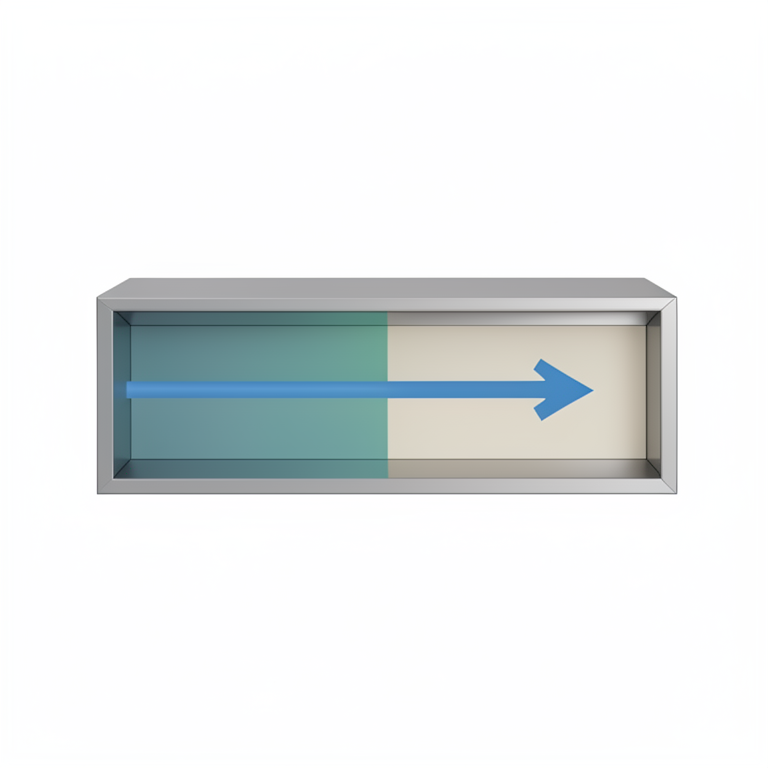
Rectangular Channel Geometry
AI-generated conceptual illustration (a rectangular microchannel cross-section containing a Newtonian liquid). It explains the idea and does not show study data.
View source evidence ↗Figures & tables
From the original paper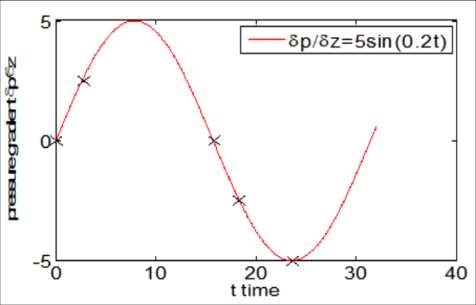 Figure 1
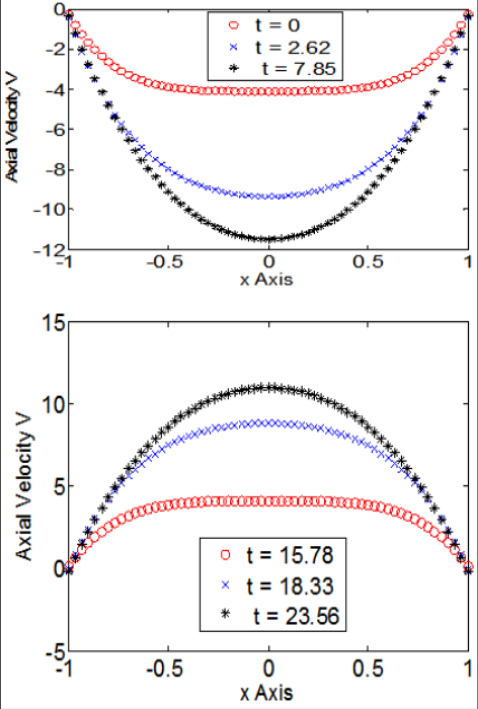 Figure 2
 Figure 3
Introduction
In the last ten years, one of the significant examination centers worldwide has been around the investigation of materials at miniature and nanoscales (Wu, et al., 2008) [3] . The advances here have prompted the improvement of many designing gadgets and frameworks in microscale and nanoscale. These gadgets and frameworks typically include liquid course through microchannel, alluded to as micro flows (Bourlon et al., 2007; Huang et al., 2007; Wu, 2008) [1][2][3] . Application models incorporate medication conveyance frameworks Su and organic detecting and energy change gadgets. As the practical attributes of the framework relies upon the stream conduct of liquid in the framework, the investigation of miniature streams is drawing in increasingly more consideration from the examination networks to infer a superior comprehension of the system of microflows and grow better models (Wu and Wiwatanapataphee, 2008) [3] . The administering field conditions for the progression of incompressible Newtonian liquids are the incompressible coherence condition and the Navier-Feeds conditions. Likewise, a limit condition must be forced on the field conditions. The no-slip condition is generally utilized. Be that as it may, it is a theory instead of a condition reasoned from material science standard, and accordingly its legitimacy has been constantly bantered in the logical writing Wu and Wiwatanapataphee, (2008) [3] . Shifts confirmations of slip stream of a liquid on a strong surface have been accounted for. For instance, contemplated the progression of polymer arrangements in permeable media and demonstrated that the evident thickness of the liquids close to the divider is lower than that in the mass and thus the liquids can display the marvel of obvious slip on the divider. Different examinations have been made to contemplate stream issues of Newtonian and non-Newtonian liquids with Navier slip limit condition (Lee et al., 2007; Yousif and Melka, 1997) [2] . A few endeavors have likewise been made to infer elective formulae for the assurance of the slip length Yang and Zhu, (2006) [4] . Albeit accurate and mathematical answers for different stream issues of Newtonian liquids under the no-slip presumption have been acquired and are accessible in writing Wu. B, not many precise answers for the slip case are accessible in writing. As of late, some consistent state and transient slip answers for the courses through a line, a channel and an annulus have been acquired, (Yang, K.Q. Zhu, 2006) [4] . As of late, Wu et al. contemplated pressure angle driven transient progressions of incompressible Newtonian fluids in miniature annuals under a Navier slip limit condition.
They utilize Fourier arrangement as expected and Bessel capacities in space to discover careful arrangements Wu and Wiwatanapataphee, (2008) [3] . In this paper, we present another outcome for the transient progression of Newtonian liquids in rectangular miniature cylinders with a slip limit condition. The remainder of the paper is coordinated as follows. In the accompanying segment, we initially characterize the issue and afterward present its numerical definition. In Area 3, we present the new answer for the speed field and show its variety with time and its profile over the channel cross-segment.
I. Problem Description and Mathematical Formulation
We consider the flow of an incompressible Newtonian fluid through a rectangular miniature cylinder with the z-axis being the pivotal way. The differential conditions overseeing the flow incorporate the coherence condition and the Navier-Stirs conditions as follows Which gives rise to
As the flow is horizontal, 𝑔 3 = 𝑔 𝑧 = 0, and hence eq. (ii) becomes p(
In this work, we consider the liquid stream driven by the weight field with a pressure angle q(t) which can be communicated by a Fourier arrangement, to be specific
[𝑎 𝑛 𝑐𝑜𝑠 𝑐𝑜𝑠 (𝑛𝜔𝑡) + 𝑏 𝑛 𝑠𝑖𝑛 𝑠𝑖𝑛 (𝑛𝜔𝑡) ] (iii) As the issue is pivotally symmetric, we just need to think about a quadrant of the cross-segment in the calculation. By applying the Navier slip conditions in the primary quadrant of the rectangular cross segment, as in the paper by Wu et al., (2008) [3] for each time t, we have Through lengthy derivation we obtain the following exact solution for eq. (v) Subject to conditions γ; To demonstrate the velocity field, we present results for the case 𝜕𝑝 𝜕𝑧 = 𝑏 1 𝑠𝑖𝑛 (𝜔𝑡) with 𝑏 1 = 5. 𝑎 = 𝑏 = 1 and l = 0.1, ω = 0.2 for μ = 1.1 and p = 30. Fig. 1 shows the variation of the driving pressure gradient in one cycle fig. 2 shows the variation of axial velocity along the x-axis at varies instants of times.
Conclusion
In this paper we present a careful solution for transient flow of incompressible Newtonian fluid in rectangular miniature tube with a Navier slip condition on the limit. We likewise show the speed profile in the cross area for the instance of ∂p/∂z = 5sin(0.2t).
Figures and tables from the paper
References
4 in the original paper- Bourlon B, Wong J, Miko C. Nanoscale probe for fluidic and ionic transport, Nature Nanotechnology 2007;2(2):104.
- Huang H, Lee TS, Shu C. Lattice Boltzmann method simulation gas slip flow in long micro tubes, International Journal of Numerical Methods for Heat & Fluid Flow 2007;17(5, 6):587.
- Wu YH, Wiwatanapataphee B. Maobin Hu, Pressure-driven transient flows of Newtonian fluids through microtubes with slip boundary, Physica A. 2008;387:5979-5990.
- Yang SP, Zhu KQ. Analytical solutions for squeeze flow of Bingham fluid with Navier slip condition, Journal of NonNewtonian Fluid Mechanics 2006;138(2, 3):173.