
Research article · 2021 · Full text
International Journal of Statistics and Applied MathematicsRatio-product estimator in stratified double sampling based on coefficient of skewness of the auxiliary variable
Volume 6(1) · Pages 24–28 · DOI: 10.22271/maths.2021.v6.i1a.630 ↗
Research areasSurvey Sampling and Estimation Techniques
Abstract
Author-writtenIn this paper, a ratio-product estimator for estimating the population mean of the study variable based on the population coefficient of skewness of the auxiliary variable is suggested in stratified double sampling. Asymptotic optimum estimator and its approximate bias and variance expressions are derived. Properties of the suggested estimator are studied with some known existing estimators identified as special members of this class of estimators. Analytical and numerical investigations showed that the suggested estimator is more efficient than the conventional regression estimator of mean in stratified double sampling and existing estimators of its class in stratified double sampling. Analysis and evaluation are presented.
Summary
Source-checkedPlain-language reading of the full paper, prepared with AI and checked against the text. Each point links to the authors' own words.
Why it matters
- Classical ratio and product estimators are widely used in fields such as economics, agriculture, and forestry, but they generally offer efficiency similar to linear regression. View evidence ↗
- Because of the efficiency limits of classical estimators, statisticians seek modified ratio and product estimators to provide more efficient alternatives for estimating population means. View evidence ↗
- The coefficient of skewness is a useful auxiliary variable because it is robust against outliers and typically correlates strongly with population mean and variance. View evidence ↗
The question
- The study aims to propose and evaluate a new ratio-product estimator for the population mean in stratified double sampling, utilizing the population coefficient of skewness of an auxiliary variable. View evidence ↗
What they did
- The authors used the large sample approximation (LASAP) method to derive the variance estimator for the proposed ratio-product estimator. View evidence ↗
- The performance of the suggested estimator was empirically tested using a specific dataset adapted from previous literature. View evidence ↗
What they found
- Numerical results indicate that the suggested estimator is 40% more efficient than the conventional regression estimator in stratified double sampling. View evidence ↗
- In the empirical test, the suggested estimator (𝓎̅̂𝑝𝑟) achieved a variance of 4015.8967 and a percent relative efficiency (PRE) of 234.6973, compared to the regression estimator's variance of 4823.9761 and PRE of 195.3844. View evidence ↗
- The study found that the optimality condition for the new estimator was satisfied, confirming its superior efficiency over the regression estimator. View evidence ↗
What it means
- The authors conclude that the new ratio-product estimator is a preferred practical choice because it provides more precise and consistent parameter estimates than existing methods. View evidence ↗
- The authors state that the suggested estimator is more efficient than both the regression estimator and the traditional ratio estimator in stratified double sampling. View evidence ↗
Visual summary
1 visualsIllustrations explain the paper; charts are replotted from the paper's own table values.
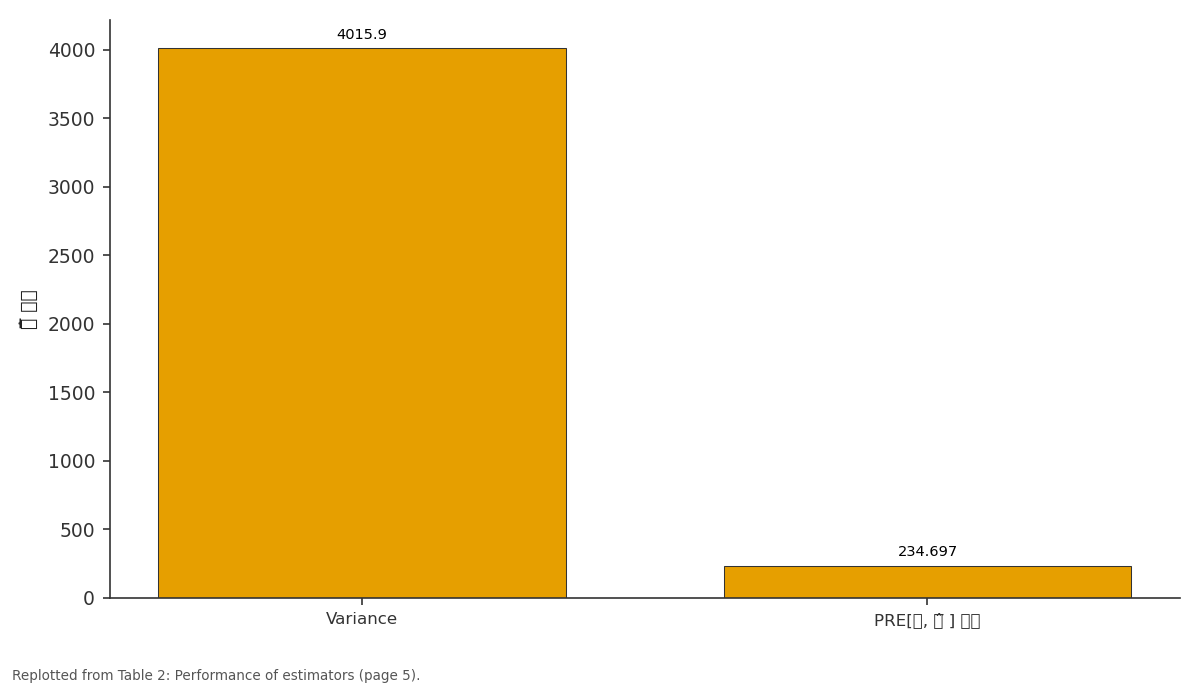
𝓎̅̂ 𝑝𝑟: Variance vs PRE[𝛟, 𝔂̅̂ ] 𝐝𝐬
Replotted from Table 2 (page 5) of the original paper. Every bar is the paper's own table value.
View source evidence ↗Figures & tables
From the original paper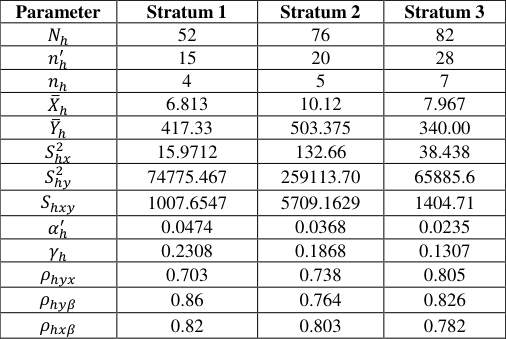 Table 1
 Table 2
Introduction
The ratio estimation is gaining increased relevance in Statistical Estimation Theory compared to the regression estimation because of its improved precision in estimating the population or subpopulation parameters. But the regression estimator, in spite of its lower practicability, seems to be holding a unique position due to its sound theoretical basis. The classical ratio and product estimators, even though considered to be more useful in many practical situations in fields like Agriculture, Forestry, Economics and population studies, have roughly equal efficiencies with those of the linear regression. This limitation has prompted most survey Statisticians to carry out research towards the modification of the existing ratio, product or classes of ratio and product estimators of the population mean in survey sampling to provide better alternatives and improve efficiency. The authors who have proposed improved estimators include [1][2][3][4][5][6][7][8][9][10][11][12][13][14][15][16][17][18][19][20] . In this paper, based on [21] , a new ratio-product estimator for estimating the population mean of the study variable using the population coefficient of skewness of the auxiliary variable is suggested in stratified double sampling. The choice is obvious; coefficient of skewness and its functions are unaffected by extreme values or the presence of outliers. Further, it has always strong correlation with other population parameters like the mean and variance.
Basic notations and definitions
Consider a finite population 𝑈 = (𝑈 1, 𝑈 2 , … , 𝑈 𝑁 ) of size (𝑁). Let (𝑋) and (Υ) denote the auxiliary and study variables taking values 𝑋 𝑖 𝑎𝑛𝑑 𝑌 𝑖 respectively on the 𝑖-th unit 𝑈 𝑖 (𝑖 = 1, 2, … , 𝑁) of the population. The theory of double sampling for stratification was first given by [22] . The population is stratified into 𝐻 strata such that the ℎ-th stratum consists of 𝑁 ℎ units and ∑ 𝑁 ℎ
= 𝑛. From the 𝑁 ℎ units a preliminary large sample of 𝑛 ℎ ′ units is drawn using simple random sampling without replacement (SRSWOR) and the auxiliary variable 𝑥 ℎ𝑖 is measured only. A subsample of 𝑛 ℎ is then selected from the given preliminary large sample of 𝑛 ℎ ′ units by SRSWOR and both the study variable 𝑦 ℎ𝑖 and the auxiliary variable 𝑥 ℎ𝑖 are measured. In this study, it is assumed that the second sample is drawn independently of the first, so that the 𝑛 ℎ does not depend on the 𝑛 ℎ ′ except for the assumption 𝑛 ℎ ≤ 𝑛 ℎ ′ .
, denote the first phase sample mean and variance respectively for the auxiliary variable. Similarly, let,
, 𝑦 ̅ ℎ = , where the parameters above are defined as: 𝑦 ̅ ℎ is the second phase sample stratum mean of the study variable 𝑌 ̅ ℎ is the second phase population stratum mean of the study variable 𝑥̅ ℎ ′ is the first phase sample stratum mean of the auxiliary variable 𝑥̅ ℎ is the second phase sample stratum mean of the auxiliary variable 𝑋 ̅ ℎ is the second phase population stratum mean of the auxiliary variable 𝑠 ℎ𝑥 ′2 is the first phase sample stratum variance of the auxiliary variable 𝑠 ℎ𝑥 2 is the second phase sample stratum variance of the auxiliary variable 𝑆 ℎ𝑥 2 is the second phase population stratum variance of the auxiliary variable 𝛽 1ℎ ′ (𝑥) is the first phase sample coefficient of skewness of the auxiliary variable 𝛽 1ℎ (𝑥) is the second phase sample coefficient of skewness of the auxiliary variable Β 1ℎ (𝑥) is the second phase population coefficient of skewness of the auxiliary variable 𝐶 ℎ𝑥 2 is the coefficient of variation of the auxiliary variable 𝐶 ℎ𝑦 2 is the coefficient of variation of the auxiliary variable 𝜌 ℎ𝑥𝑦 is the correlation coefficient between the auxiliary variable and the study variable. 𝜌 ℎ𝑦𝛽 is the correlation coefficient between the mean of the study variable and coefficient of skewness of the auxiliary variable.
The suggested estimator
Proposed a separate ratio-product estimator of mean using known values of the population mean of the auxiliary variable in stratified random sampling as given by the following [21] :
Where 𝜉 ℎ is a real constant to be determined in such away that minimizes 𝓎 ̅ ̂𝑣𝑠 . Motivated by [21] , a new separate ratio-product estimator of mean using known values of the population coefficient of skewness of the auxiliary variable is suggested in stratified double sampling as follows:
Variance estimation for the suggested estimator
This section derives the estimator of variance for the suggested estimator using the large sample approximation (LASAP) method.
Expressing (2) in terms of the e's [that is substituting (3-5) in ( 2)] gives:
Taking Taylor's series expansion of (1 + 𝑒 ℎ𝛽 ) -1 and (1 + 𝑒 ℎ𝛽 ′ ) -1 gives
Substituting ( 8) and ( 9) in (7) and retaining terms to the first order of approximation gives:
Taking expectation of both sides of (10) gives the biased of 𝓎 ̅ ̂𝑝𝑟 as:
Squaring both sides of (10) and retaining terms to the first order of approximation gives:
Taking expectation of both sides of (11) gives the variance of 𝓎 ̅ ̂𝑝𝑟 as:
The 𝑉 ̂(𝓎 ̅ ̂𝑝𝑟 )in ( 12) is minimized when
Substituting the value of 𝜉 ℎ,𝑜𝑝𝑡 in (13) for 𝜉 ℎ in (2) gives the asymptotically optimum estimator (𝐴𝑂𝐸) of mean (𝑌 ̅ ) in stratified double sampling as:
Similarly, substituting the value of 𝜉 ℎ,𝑜𝑝𝑡 in (13) for 𝜉 ℎ in (12) gives the variance of an asymptotically optimum estimator (𝐴𝑂𝐸) 𝓎 ̅ ̂𝑝𝑟,𝑜𝑝𝑡 (or minimum variance of 𝓎 ̅ ̂𝑝𝑟 as:
Properties of the suggested estimator
This section studies the properties of the suggested estimator and identifies some special members of its family and derives their biased and variance expressions under certain prescribed conditions.
i) Property 1: When 𝜉 ℎ = 1; then the suggested estimator in (2) reduces to a separate ratio estimator defined by:
Where 𝑅 ̂ℎ = 𝑦 ̅ ℎ 𝛽 1ℎ (𝑥) ⁄ ; 𝛽 1ℎ (𝑥) ≠ 0 is the estimate of the ratio 𝑅 ℎ = 𝑌 ̅ ℎ 𝐵 1ℎ (𝑥) ⁄ ; 𝐵 1ℎ (𝑥) ≠ 0 of the hth stratum in the population. This estimator is only efficient if the variables are strongly positively correlated [21] .
ii) Property 2: When 𝜉 ℎ = 0; then the suggested estimator in (2) reduces to a separate product estimator defined by:
Where 𝑃 ̂ℎ = 𝑦 ̅ ℎ 𝛽 1ℎ (𝑥) is the estimate of the product 𝑃 ℎ = 𝑌 ̅ ℎ 𝐵 1ℎ (𝑥) of the hth stratum in the population. This estimator will often be used if the two variables are supposed to be strongly negatively correlated [21] .
iii) Property 3: When 𝜉 ℎ = -1; then the suggested estimator in (2) reduces to an estimator of the form:
Remarks
Following from properties (1-3); it is observed that at the same optimum condition (that is 𝜉 ℎ,𝑜𝑝𝑡 = {(1 + 𝜏 ℎ ) 2 ⁄ }), every identified member of the suggested class of estimators (𝓎 ̅ ̂𝑝𝑟1 -𝓎 ̅ ̂𝑝𝑟3 ) has equal optimal efficiency with variance estimator as given by:
Analytical study 4.1 Efficiency comparisons
This section compares the efficiency of the suggested estimator with the regression estimator of mean in stratified double sampling designated as the global estimator in this paper. The variance of the conventional regression estimator of mean in stratified double sampling (𝓎 ̅ ̂𝑅𝐸𝐺 ) is defined by [23] as:
The suggested estimator (𝓎 ̅ ̂𝑝𝑟 ) would be more efficient than the regression estimator (𝓎 ̅ ̂𝑅𝐸𝐺 ) if and only if:
So that the optimality condition is:
When the optimality condition is satisfied, the suggested estimator is more efficient than the regression estimator.
The percent relative efficiency (𝑷𝑹𝑬)
The percent relative efficiency (𝑃𝑅𝐸) of an estimator 𝜙 with respect to the conventional unbiased estimator of mean in stratified double sampling (𝓎 ̅ ̂𝑑𝑠 ) is defined by: 𝑃𝑅𝐸(𝜙, 𝓎 ̅ ̂𝑑𝑠 ) = 𝑉(𝓎 ̅ ̂𝑑𝑠 )
The variance of the conventional unbiased estimator of mean in stratified double sampling (𝓎 ̅ ̂𝑑𝑠 ) is defined by [23] as:
Empirical study
To judge the relative performances of the suggested estimator over the regression estimator, data set from [24] given in table 1 was considered.
Numerical results for the efficiency comparisons, shows that:
Therefore since the optimality condition is satisfied in accordance with section 4.1, it is concluded that the new estimator is more efficient than the regression estimator in stratified double sampling. Numerical results for the percent relative efficiency (PREs) in table 2 reveals that the suggested estimator 𝓎 ̅ ̂𝑝𝑟 has 135 percent gains in efficiency while the conventional regression estimator in stratified double sampling 𝓎 ̅ ̂𝑅𝐸𝐺 has 95 percent gains in efficiency; this shows that the suggested estimator 𝓎 ̅ ̂𝑑𝑠 is 40 percent more efficient than the regression estimator in stratified double sampling 𝓎 ̅ ̂𝑅𝐸𝐺 . This means that in using the suggested estimator 𝓎 ̅ ̂𝑝𝑟 one will have 40 percent efficiency gain over the regression estimator in stratified double sampling 𝓎 ̅ ̂𝑅𝐸𝐺 .
Table 1: Data set adapted from [24] Parameter
Conclusion
This study introduces a new ratio-product estimator for estimating the population mean of the study variable based on the population coefficient of skewness of the auxiliary variable in stratified double sampling. The bias and variance expressions for the suggested estimator have been derived under large sample approximation. Asymptotic optimum estimator and its approximate bias and variance expressions are equally derived. Properties of the suggested estimator are studied with some known existing estimators identified as special members of this class of estimators. Analytical and numerical results showed that the suggested estimator 𝓎 ̅ ̂𝑝𝑟 , is more efficient than the regression estimator 𝓎 ̅ ̂𝑅𝐸𝐺 and by extension than the traditional ratio estimator in stratified double sampling (since the regression estimator 𝓎 ̅ ̂𝑅𝐸𝐺 is always more efficient than the ratio estimator [23,25] ).
It is observed that the new estimator 𝓎 ̅ ̂𝑝𝑟 , is very attractive and should be preferred in practice as it provides consistent and more precise parameter estimates than existing estimators in stratified double sampling.
References
21 in the original paper- Singh HP, Tailor R. Use of known correlation coefficient in estimating the finite population mean. Statistics in Transition 2003;6(4):555-560.
- Kadilar C, Cingi H. An improvement in estimating the population mean by using the correlation coefficient. Hacettepe Journal of Mathematics and Statistics 2006;35(1):103-109.
- Sharma B, Tailor R. A new ratio-cum-dual to ratio estimator of finite population mean in simple random sampling. Global Journal of Science 2010;10(1):27-31.
- Diana G, Giordan M, Perri PF. An improved class of estimators for the population mean, Statistical methods and Applications 2011;20:123-140.
- Swain AKPC. On classes of modified ratio type and regression-cum-ratio type estimators in sample surveys using two auxiliary variables. Statistics in Transition-New Series 2012;13(3):473-494.
- Choudhary S, Singh BK. A class of chain ratio-cum-dual to ratio type estimator with two auxiliary characters under double sampling in sample surveys. Statistics in Transition-New Series 2012;13(3):519-536.
- Subramani J, Kumarapandiyan G. A class of almost unbiased modified ratio estimators for population mean with known population parameters. Elixir Statistics 2012;44:7411-7415.
- Singh HP, Solanki RS. Improved estimation of population mean in simple random sampling using information on auxiliary attribute, Applied Mathematics and Computation 2012;218(15):7798-7812.
- Clement EP. Improved Family of Ratio Estimators of Finite Population Variance in Stratified Random Sampling. Biostatistics and Biometrics Open Access Journal 2018a;5(2):555-659. DOI:10.19080/BBOAJ.2018.04.555659.
- Haq A, Shabbir J. Improved family of ratio estimators in simple and stratified random Sampling, Communications in Statistics-Theory and Methods 2013;42(5):782-799.
- Shittu OI, Adepoju KA. On the efficiency of modified ratio estimator based on linear combination of kurtosis, median and quartile deviation. International Journal of Modern Mathematics Sciences 2014;11(2):103-107.
- Clement EP. An Improved Ratio Estimator for Population Mean in Stratified Random Sampling. European Journal of Statistics and Probability 2016;4(4):12-17.
- Gupta S, Shabbir J. On the improvement in estimating the population mean in simple random sampling, Journal of Applied Statistics 2008;35(5):59-566.
- Solanki RS, Singh HP, Rathour A. An alternative estimator for estimating the finite population mean using auxiliary information in sample surveys. ISRN Probability and Statistics 2012. Article ID 657682, doi:10.5402/2012/657682.
- Khare BB, Sinha RR. Combined class of estimators for ratio and product of two population means in presence of nonresponse. International Journal of Statistics and Economics 2012;8(12):12-20.
- Clement EP, Enang EI. On the Efficiency of Ratio Estimator over the Regression Estimator, Communication in Statistics: Theory and Methods 2017;46(11):5357-5367.
- Enang EI, Clement EP. An efficient class of calibration Ratio Estimators of Domain Mean in Survey Sampling, Communication in Mathematics and Statistics 2020. DOI: 10.1007/s40304-018-00174-z.
- Vishwakarma GK, Singh HP, Singh S. A family of estimators of population mean using multi-auxiliary variate and poststratification. Nonlinear Analysis: Modelling and Control 2010;15(2):233-253.
- Neyman J. Contribution to the theory of sampling human populations. Journal of American Statistical Association 1938;33:101-116.
- Cochran WG. Sampling Techniques, 3rd edition, New York: Wiley 1977.
- Rao JNK. On double sampling for stratification and analytical surveys Biometrika 1973;60:125-133.
Cited by 2
From OpenAlex, OpenCitations and reference lists read by Scinovex
- On the Use of Inverse Exponentiation to Improve the Efficiency of Calibration Estimators in Stratified Double Sampling ↗
Etebong P. Clement, Ekaette Inyang Enang · International Journal of Statistical Sciences · 2024
This study introduces the concept of inverse exponentiation in formulating calibration weights in stratified double sampling and proposes a more improved calibration estimator based on Koyuncu and Kadilar (2014) calibration estimator. The variance of the proposed logarithmic calibration estimator has been derived under large sample approximation. Calibration asymptotic optimum estimator and its approximate variance estimator are derived for the proposed…
❝ 0PDF - On Efficient Ratio Estimation of Population Mean by Multivariate Calibration Weightings in Double Sampling for Stratification ↗
Etebong P. Clement, Idorenyin O. Etukudoh, Khalid Ul Islam Rather, Victoria M. Akpan · Journal of Modern Applied Statistical Methods · 2023
This study proposed a new ratio estimator for estimating population mean in stratified double sampling using the principle of multivariate calibration weightings. The bias and Mean Square Error (MSE) expressions for the proposed estimator are obtained under large sample approximation. Analytical results showed that under certain prescribed conditions, the new estimator is more efficient than all related existing estimators under…
❝ 0PDF