
Research article · 2020 · Full text
International Journal of Veterinary Sciences and Animal HusbandryEvaluation of malted Njigari sorghum cultivar (Sorghum bicolor (L) Moench) as a replacement of maize on the performance, carcass characteristics and internal organ weights of weaner rabbit
Volume 5(6) · Pages 50–54
Research areasRabbits: Nutrition, Reproduction, HealthAgriculture and Rural Development Research
Abstract
Author-writtenThirty (30) weaner rabbits of mixed breeds and sexes were used to evaluate the effect of malted njigari sorghum cultivar as a replacement of maize on the growth performance, carcass characteristics, internal organ weights and economics of production. The weaner rabbits were randomly allotted to five treatment groups of six rabbits per treatment. The dietary treatments were replicated three times with each replicate having two (2) weaner rabbits. The weaner rabbits were fed five diets compounded using malted njigari sorghum cultivar (MNSC) to replace maize in diets at 0, 25, 50, 75 and 100% as. There were no significant (P>0.05) difference in the parameter evaluated for growth performance, carcass characteristics and organ weights. Feed cost/ kg significantly (P
Summary
Source-checkedPlain-language reading of the full paper, prepared with AI and checked against the text. Each point links to the authors' own words.
Why it matters
- Rabbit production is promoted in developing countries as a way to address shortages in animal protein consumption. View evidence ↗
- The growth of rabbit production is hindered by the high cost of energy and protein feed sources, caused by competition between human and livestock needs. View evidence ↗
- Sorghum is a potential feed alternative, but its use is limited by tannins, which can reduce livestock performance and feed utilization. View evidence ↗
The question
- The study aimed to evaluate how replacing maize with malted njigari sorghum cultivar affects the growth, carcass traits, organ weights, and production costs of weaner rabbits. View evidence ↗
What they did
- Thirty weaner rabbits of mixed breeds and sexes were randomly assigned to five dietary treatments, with six rabbits per treatment (two per replicate). View evidence ↗
- The experimental diets replaced maize with malted njigari sorghum cultivar (MNSC) at levels of 0%, 25%, 50%, 75%, and 100%. View evidence ↗
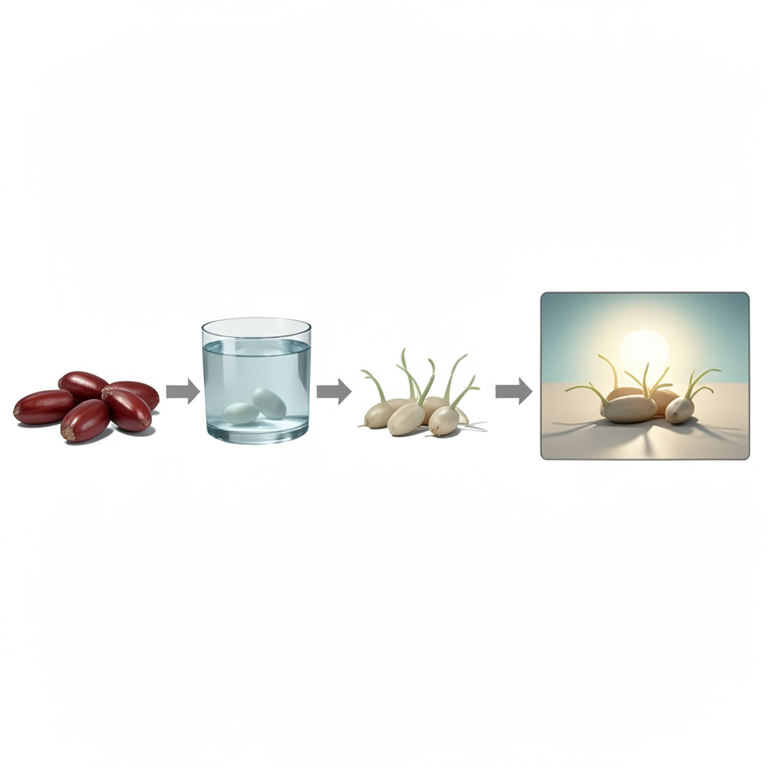
- The njigari sorghum was malted by soaking the grains for 24 hours and then arresting germination after another 24 hours by sun-drying. View evidence ↗
What they found
- Malting reduced the tannin content of njigari sorghum from 3.41 mg/100g in the un-malted version to 2.00 mg/100g. View evidence ↗
- There were no significant differences in growth performance; final body weights ranged from 1318.22g (T2) to 1366.48g (T5), and average daily weight gains ranged from 14.45g (T2) to 15.22g (T5). View evidence ↗
- Replacing maize with MNSC significantly reduced feed costs, dropping from N140.67/kg in the control group (0%) to N80.54/kg at the 100% replacement level. View evidence ↗
- The replacement levels of MNSC did not significantly affect carcass characteristics, with dressing percentages ranging between 64.25% and 66.45%. View evidence ↗
- Internal organ weights were not significantly influenced by the inclusion of malted njigari sorghum. View evidence ↗
What it means
- The authors concluded that malted njigari sorghum is a viable substitute for maize in weaner rabbit diets. View evidence ↗
- The study recommends that rabbit farmers, nutritionists, and the feed milling industry adopt malted sorghum as a feed ingredient. View evidence ↗
Visual summary
3 visualsIllustrations explain the paper; charts are replotted from the paper's own table values.
The Malting Process and Tannin Reduction
AI-generated conceptual illustration (Njigari sorghum grains). It explains the idea and does not show study data.
View source evidence ↗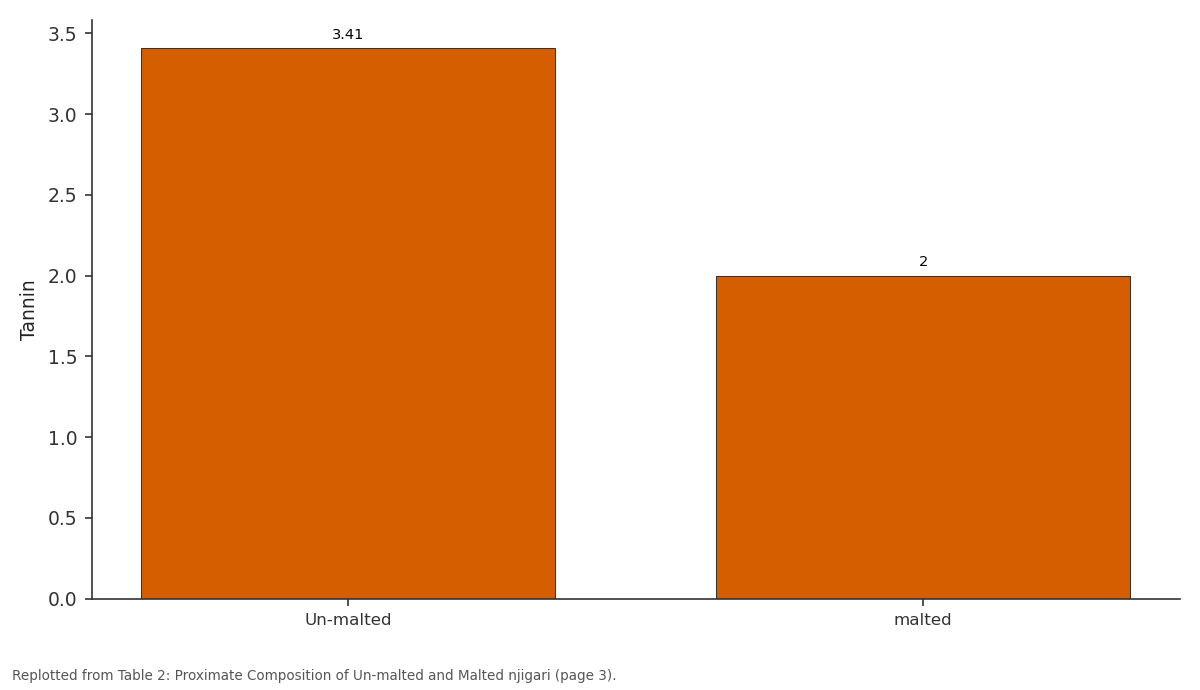
Tannin: Un-malted vs malted
Replotted from Table 2 (page 3) of the original paper. Every bar is the paper's own table value.
View source evidence ↗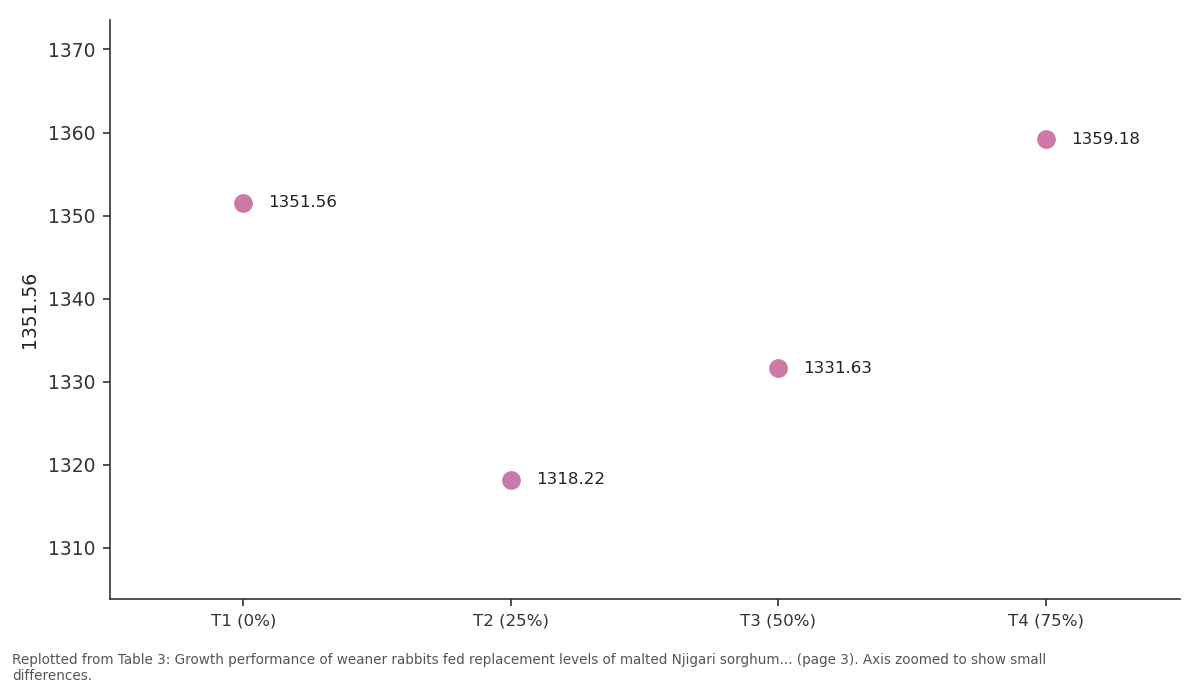
1351.56: T1 (0%) vs T2 (25%) vs T3 (50%) vs T4 (75%)
Replotted from Table 3 (page 3) of the original paper. Every bar is the paper's own table value.
View source evidence ↗Figures & tables
From the original paper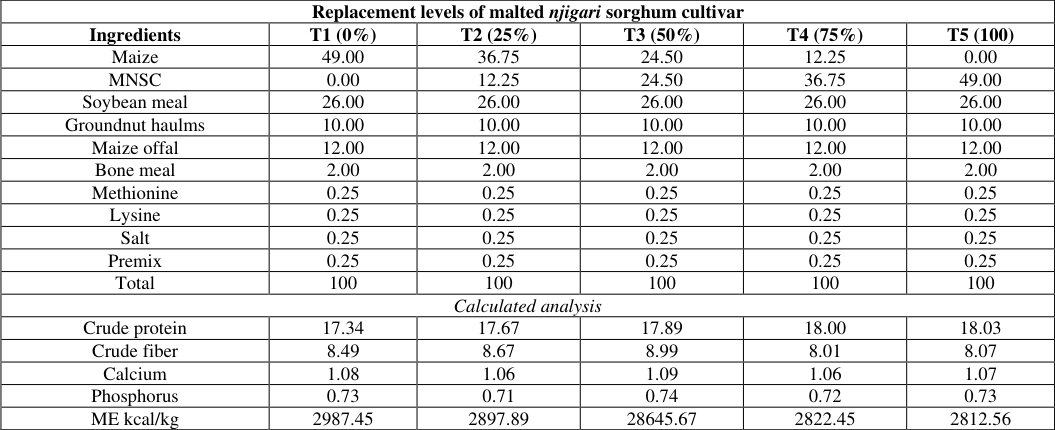 Table 1
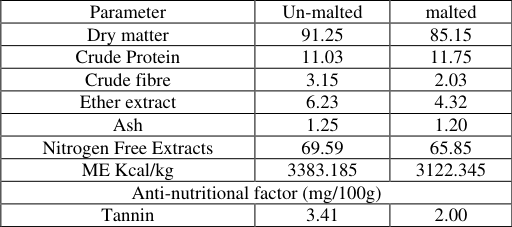 Table 2
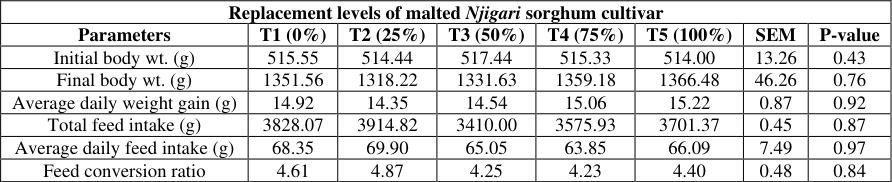 Table 3
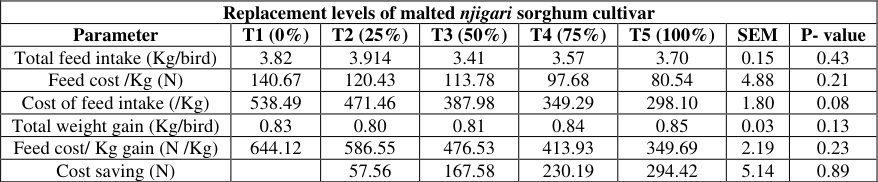 Table 4
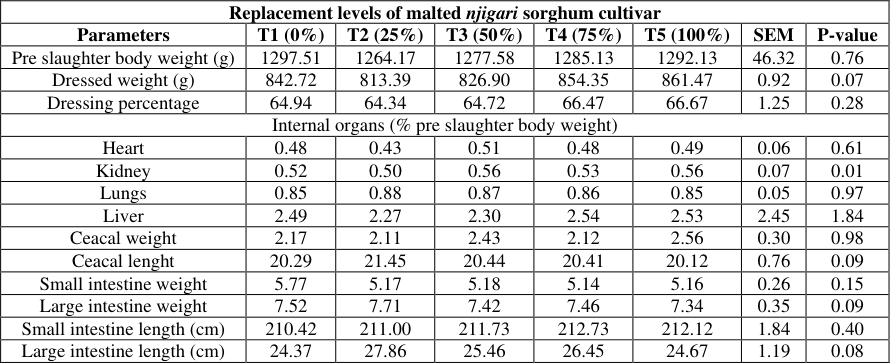 Table 2
Introduction
Rabbit production has been advocated a means of bridging the deficiencies of animal protein consumption in developing countries (Omole et al., 2007 and Wafar et al., 2018) [12,20] . The advantages of rabbit production over other livestock are anchored on low capital investment and space requirement, short gestation period, rapid growth rate, prolificacy and ability to utilize low quality feedstuff (Olumo et al., 2019) [11] . Over the years, rabbit production has not been fully harnessed in most developing countries. This has been attributed to high cost of feedstuff especially energy and protein sources which is as a result of competition between man and his livestock. Maize is one of the major feed ingredients used as a source of energy in rabbit r production. However, its production in Nigeria is not sufficient for both human consumption and as animal feed ingredient (Adegbola and Okonkwo, 2002) [3] . Several studies have been conducted in Nigeria in an effort to substitute maize with cheaper and available ingredient so as to reduce cost and over dependence on maize in rabbit production (Abubaker et al., 2006, Yakubu et al., 2008 and Yakubu et al., 2017) [1,19,16] . One of such ingredients is sorghum. The plant can thrive well even in areas with limited moisture. There is therefore opportunity to expand the cultivation of this crop. Sorghum cultivar such as Ugandan sekedo (Kyarisiima et al., 2005) [7] , masakwa (Yakubu et al., 2008) [19] have used in livestock feeding. Yakubu et al. (2008) [19] reported that sorghum is cheaper than maize confirming earlier finding of FAO, (1996) that the cost of sorghum is always 5% lower than maize. The use of sorghum cultivar is limited due to the presences of polyphenolic substances (tannin) which have reported to lower feed utilization and performance of livestock (Kyarisiima et al., 2005) [7] . Various methods have been used to reduce tannin contents in sorghum. Among these methods, malting has proven to increase crude protein, lysine and also reduces tannin contains (Sluis, 2008 and Yakubu et al., 2008) [19] . The use of malted njigari sorghum cultivar in replacing maize of rabbit production has not been documented. This study was therefore designed to evaluate the effect of malted njigari sorghum cultivar as a replacement of maize on the growth performance, carcass characteristics, internal organ weights and economics of production.
Materials and Methods
Materials and Methods
Location of the study
The study was carried out in Yola, Adamawa State. Yola is located at latitude 7° 11' North and Longitude 11° 14' East and at an elevation of 364m above sea level in the north eastern part of Nigeria. Average relative humidity is within the ranges of 30 -50% with a minimum as low as 10% in February to March and a maximum of about 90% in August. The maximum temperature can reach 38 0 C particularly in April, while minimum temperature can be as low as 18 0 C (Adebayo, 1999) [2] .
Processing of njigari sorghum cultivar Njigari sorghum cultivar was purchased at Jimeta agro products market where it is readily available. Malting procedure was adopted using the modified methods describe by Yakubu et al., (2008) [19] . The njigari sorghum grain was soaked for 24hrs in water after which it was drained and spread on a concrete floor. A polythene material was used to cover the grain to preserve moisture. Germination was arrested after 24hrs by spreading the grain under the sun to dry.
Experimental animals, their management and design Thirty (30) weaner rabbits sourced within the study area were used for the study. They were allotted to the five dietary treatments of six rabbits per treatment i.e two rabbits per replicate in a completely randomize design. Each replicate was housed in cage measuring fitted with feeder and drinker. The experimental animals were dewormed using ivomectin at 0.30ml/kg. Five diets were compounded using malted njigari sorghum cultivar (MNSC) to replace maize in diets at 0, 25, 50, 75 and 100% as shown in Table 1.
| Replacement levels of malted njigari sorghum cultivar | — | — | — | — | — |
|---|---|---|---|---|---|
| Ingredients | T1 (0%) | T2 (25%) | T3 (50%) | T4 (75%) | T5 (100) |
| Maize | 49.00 | 36.75 | 24.50 | 12.25 | 0.00 |
| MNSC | 0.00 | 12.25 | 24.50 | 36.75 | 49.00 |
| Soybean meal | 26.00 | 26.00 | 26.00 | 26.00 | 26.00 |
| Groundnut haulms | 10.00 | 10.00 | 10.00 | 10.00 | 10.00 |
| Maize offal | 12.00 | 12.00 | 12.00 | 12.00 | 12.00 |
| Bone meal | 2.00 | 2.00 | 2.00 | 2.00 | 2.00 |
| Methionine | 0.25 | 0.25 | 0.25 | 0.25 | 0.25 |
| Lysine | 0.25 | 0.25 | 0.25 | 0.25 | 0.25 |
| Salt | 0.25 | 0.25 | 0.25 | 0.25 | 0.25 |
| Premix | 0.25 | 0.25 | 0.25 | 0.25 | 0.25 |
| Total | 100 | 100 | 100 | 100 | 100 |
| Calculated analysis | |||||
| Crude protein | 17.34 | 17.67 | 17.89 | 18.00 | 18.03 |
| Crude fiber | 8.49 | 8.67 | 8.99 | 8.01 | 8.07 |
| Calcium | 1.08 | 1.06 | 1.09 | 1.06 | 1.07 |
| Phosphorus | 0.73 | 0.71 | 0.74 | 0.72 | 0.73 |
| ME kcal/kg | 2987.45 | 2897.89 | 28645.67 | 2822.45 | 2812.56 |
Table text extracted from the original PDF; superscript letters are shown inline. The original table image is below.
View original table image
Data collection Growth performance measurements
Feed intake was determined as the difference between the quantity of feed offered and feed leftover. Similarly, total body weight gain was determined as the difference between the final body weight and initial body weight recorded at the beginning of experiment. Feed conversion ratio was calculated the ratio of feed intake to weight gain.
Economics of production Carcass and internal organs evaluation
At the end of the experiment, one rabbit was randomly selected from each replicate for carcass and internal organs evaluation according to the method described by Yakubu and Wafar, (2014) [17] . The rabbits were weighed individually, slaughtered and de-pelted completely to obtain pelt weight. The internal organs were removed carefully and weighed. The internal organs were expressed as percentages of their live bodyweight. The dressing percentage was calculated as a ratio of carcass weight and live weight multiplied by 100.
Laboratory analysis
The proximate and composition of un-malted and malted njigari sorghum cultivar were determined according to methods described by AOAC (1990) [4] .
Statistical analysis
All data was subjected to analysis of variance using statistical package for social sciences (SPSS) software. significant difference between means were separated using Duncan's multiple range test option the same software.
Results and Discussion
Results and Discussion
Proximate composition and tannin content of un-malted and malted njigari sorghum cultivar
The proximate composition and tannin content of un-malted and malted njigari sorghum cultivar are shown in Table 2. The crude protein (CP) content were 11.03 and 11.75 % for un-malted and malted njigari sorghum cultivar. Malted njigari sorghum cultivar produced the highest CP of 11.75% while un-mated recorded 11.03%. Un-malted njigari sorghum cultivar had the highest crude protein compared to the malted njigari cultivar. However, there was there decreased in the crude fibre content after malting. The tannin content of un-malted and malted njigari showed that malted njigari recorded lower value of 2.00mg/100g while malted had 3.41mg/100mg. The study showed that malting improved the nutrient and reduced the ME and tannin content. This result confirms the findings of Yakubu et al. (2009) [15] who reported improved in nutrient composition and reduction of tannin content when high tannin sorghum was subjected to malting. The result of the study confirmed the finding of Shayo et al., (2001) [15] that germination or malting is an effective method in improving the nutritional and functional qualities of sorghum. Growth performance of weaner rabbits fed replacement levels of malted njigari sorghum cultivar The growth performance of weaner rabbits fed replacement levels of malted njigari sorghum cultivar for maize is presented in the Table 2. No significant differences (P>0.05) was recorded for the parameter evaluated. The final body weight (FBW) and average daily weight gain (ADWG) were between the ranges of 1318.22g/rabbit in T2 to 1366.48 in T5 and 14.45g in T2 to 15.22g in T5, respectively. Similarly, feed conversion ratio was similar across replacement levels. However, the replacement levels of MSC for maize in the diets of weaner rabbit did not influenced the palatability of the diets. This account for the uniformity in the feed intake across the dietary treatments. Similar result was reported by Yakubu et al. (2008) [19] when they fed partially germinated masakwa sorghum cultivar to weaner rabbits. The average daily feed intake (ADFI) recorded however, were higher than 55.50 -65.46g/rabbit/day reported by Doma et al. (1999) [5] , 50.57 -60.67g/rabbit/day reported by Abubakar et al. (2006) [1] and 30.95 -33.40g/rabbit/day reported by Yakubu et al. (2008) [19] . Higher ADFI recorded in this study could be attributed to the processing method employed and the sorghum cultivar. Yakubu et al, 2009 [15] soaked masakwa sorghum cultivar in water for 6hours and germination was arrested after 12hrs by spreading the grain in the sun to dry while in this study, njigari sorghum cultivar was soaked for 24hours and germination was arrested after 24 hours. In regard to the cultivar, red sorghum and masakwa have been reported to contain high tannin (Murriu et al., 2002 and Yakubu et al., 2009) [9,15] . This suggest that duration and time of germination employed in this study reduce the tannin contain of the MSC thereby increase the palatability. Tannins have reported to impaired feed intake due to its astringent properties (Ogbu et al., 2015) [10] . Economic analysis of feeding weaner rabbits with Njigari sorghum cultivar the economic analysis of feeding weaner rabbits with Njigari sorghum cultivar is shown in Table 3. Feed cost/ kg significantly (P<0.05) reduced from N140.67 /kg in T1 (0%) to N80.54 /kg in T5 (100%) replacement level MNSC. Feed cost /kg gain (N/gain) was observed to higher in the maize based diet (control). This could be attributed to the relative cheaper price of sorghum than maize as reported by Abubakar et al., (2006) [1] . to the relative cheaper price of sorghum than maize as reported by Abubakar et al. (2006) [1] . Yakubu et al., 2008 [19] reported similar finding when broiler when weaner rabbits were fed partial replacement of malted Masakwa sorghum cultivar. Carcass characteristics and internal organ weights of weaner rabbits fed replacement levels of malted Njigari sorghum cultivar Table 4 shows the result of carcass characteristics and internal organ weights of weaner rabbit fed replacement levels of malted Njigari sorghum cultivar. There was no significant influence by the levels of replace for all the parameters measured. (P>0.05). the dressing percentage range from 64.25 -66.45%. The dressing percentage recorded in this study were higher than that of Oteken and Igene, (2006) [13] , 50.70 -58.50% by Memieth et al. (2004) and 41-00 -47.00% by Yakubu et al. (2008) [19] . These variation in the dressing percentage could be attributed to age of slaughter and differences in the test diet. Oteken and Igene, (2006) [13] reported that dressing percentages were significantly affected by age of slaughter when they reported lower values of dressing percentage for rabbits slaughtered at 10 weeks compared to those slaughtered at 16 and 23 weeks respectively. Replacement levels of MNSC did not significantly (P>0.05) influenced internal organ weights. Yakubu et al., (2008) [19] also reported a similar result. The organs such as liver and kidney that are known to be involved detoxification were similar across the dietary treatments. This suggests that MNSC is safe for feeding rabbit.
| Replacement levels of malted njigari sorghum cultivar | — | — | — | — | — | — | — |
|---|---|---|---|---|---|---|---|
| Parameters | T1 (0%) | T2 (25%) | T3 (50%) | T4 (75%) | T5 (100%) | SEM | P-value |
| Pre slaughter body weight (g) | 1297.51 | 1264.17 | 1277.58 | 1285.13 | 1292.13 | 46.32 | 0.76 |
| Dressed weight (g) | 842.72 | 813.39 | 826.90 | 854.35 | 861.47 | 0.92 | 0.07 |
| Dressing percentage | 64.94 | 64.34 | 64.72 | 66.47 | 66.67 | 1.25 | 0.28 |
| Internal organs (% pre slaughter body weight) | |||||||
| Heart | 0.48 | 0.43 | 0.51 | 0.48 | 0.49 | 0.06 | 0.61 |
| Kidney | 0.52 | 0.50 | 0.56 | 0.53 | 0.56 | 0.07 | 0.01 |
| Lungs | 0.85 | 0.88 | 0.87 | 0.86 | 0.85 | 0.05 | 0.97 |
| Liver | 2.49 | 2.27 | 2.30 | 2.54 | 2.53 | 2.45 | 1.84 |
| Ceacal weight | 2.17 | 2.11 | 2.43 | 2.12 | 2.56 | 0.30 | 0.98 |
| Ceacal lenght | 20.29 | 21.45 | 20.44 | 20.41 | 20.12 | 0.76 | 0.09 |
| Small intestine weight | 5.77 | 5.17 | 5.18 | 5.14 | 5.16 | 0.26 | 0.15 |
| Large intestine weight | 7.52 | 7.71 | 7.42 | 7.46 | 7.34 | 0.35 | 0.09 |
| Small intestine length (cm) | 210.42 | 211.00 | 211.73 | 212.73 | 212.12 | 1.84 | 0.40 |
| Large intestine length (cm) | 24.37 | 27.86 | 25.46 | 26.45 | 24.67 | 1.19 | 0.08 |
Table text extracted from the original PDF; superscript letters are shown inline. The original table image is below.
View original table image
| Replacement levels of malted njigari sorghum cultivar | — | — | — | — | — | — | — |
|---|---|---|---|---|---|---|---|
| Parameter | T1 (0%) | T2 (25%) | T3 (50%) | T4 (75%) | T5 (100%) | SEM | P- value |
| Total feed intake (Kg/bird) | 3.82 | 3.914 | 3.41 | 3.57 | 3.70 | 0.15 | 0.43 |
| Feed cost /Kg (N) | 140.67 | 120.43 | 113.78 | 97.68 | 80.54 | 4.88 | 0.21 |
| Cost of feed intake (/Kg) | 538.49 | 471.46 | 387.98 | 349.29 | 298.10 | 1.80 | 0.08 |
| Total weight gain (Kg/bird) | 0.83 | 0.80 | 0.81 | 0.84 | 0.85 | 0.03 | 0.13 |
| Feed cost/ Kg gain (N /Kg) | 644.12 | 586.55 | 476.53 | 413.93 | 349.69 | 2.19 | 0.23 |
| Cost saving (N) | 57.56 | 167.58 | 230.19 | 294.42 | 5.14 | 0.89 |
Table text extracted from the original PDF; superscript letters are shown inline. The original table image is below.
View original table image
| Replacement levels of malted Njigari sorghum cultivar | — | — | — | — | — | — | — |
|---|---|---|---|---|---|---|---|
| Parameters | T1 (0%) | T2 (25%) | T3 (50%) | T4 (75%) | T5 (100%) | SEM | P-value |
| Initial body wt. (g) | 515.55 | 514.44 | 517.44 | 515.33 | 514.00 | 13.26 | 0.43 |
| Final body wt. (g) | 1351.56 | 1318.22 | 1331.63 | 1359.18 | 1366.48 | 46.26 | 0.76 |
| Average daily weight gain (g) | 14.92 | 14.35 | 14.54 | 15.06 | 15.22 | 0.87 | 0.92 |
| Total feed intake (g) | 3828.07 | 3914.82 | 3410.00 | 3575.93 | 3701.37 | 0.45 | 0.87 |
| Average daily feed intake (g) | 68.35 | 69.90 | 65.05 | 63.85 | 66.09 | 7.49 | 0.97 |
| Feed conversion ratio | 4.61 | 4.87 | 4.25 | 4.23 | 4.40 | 0.48 | 0.84 |
Table text extracted from the original PDF; superscript letters are shown inline. The original table image is below.
View original table image
| Parameter | Un-malted | malted |
|---|---|---|
| Dry matter | 91.25 | 85.15 |
| Crude Protein | 11.03 | 11.75 |
| Crude fibre | 3.15 | 2.03 |
| Ether extract | 6.23 | 4.32 |
| Ash | 1.25 | 1.20 |
| Nitrogen Free Extracts | 69.59 | 65.85 |
| ME Kcal/kg | 3383.185 | 3122.345 |
| Anti-nutritional factor (mg/100g) | ||
| Tannin | 3.41 | 2.00 |
Table text extracted from the original PDF; superscript letters are shown inline. The original table image is below.
View original table image
Conclusion
The study showed that the inclusion of malted njigari sorghum in weaner rabbit diet did not adversely affect growth performance, carcass characteristics, internal organ weights but increases economics of production. It could be concluded that malted njigari sorghum can be used to substitute maize in the diets of weaner rabbits. It is therefore recommended that rabbit farmer, animal nutritionist and feed milling industry can use malted sorghum cultivar as feed ingredient.
References
20 in the original paper- Abubakar M, Dass UD, Kalla DJU, Ngele MB, August CID. Effects of dietary replacement of maize with malted or unmalted sorghum on the performance of weaner rabbits. Livestock Research for Rural Development 2006;18(5):23-28.
- Adebayo AA. Climate II. In: Adamawa State in Maps. Edit; (A. A. Adebayo and A. L. Tukur). Paracleate publishers, Yola, Nigeria Nigeria, 1999.
- Adegbola TA, Okonkwo JC. Nutrient intake growth rate of rabbits fed varying levels of cassava leaf meal. Nigerian Journal of Animal Production 2002;22(4):5254.
- AOAC. Official Methods of Analysis, 15th edition. Association of the official Analytical Chemists, Washington DC, 1990.
- Doma UD, Adegbola TA, Mamgbose AM. Utilization of cowpea shell and maize cobs in the diets of rabbits. Tropical Journal of Animal Science 1999;2(1):27-32.
- FAO. World Sorghum and Millet Economics: Facts, trends and outlook. International Crop Research Institute for Semi -Arid tropics and Food and Agriculture, 1996.
- Kyarisiima CC, Okot MW, Svinus B. Use of Wood ash extracts and germination to improve the feeding value of Uganda Sekedo sorghum (Sorghum bicolor for broiler chick. Animal Feed Science Technology 2005;120:67-77.
- Memieth F, Radnai L, Sipos I. Composition of Carcass traits and meat quality of Hyplus hybrid, purebred Pannon white rabbits and their crossbreds. 8 th world rabbits and congress plubia city, Mexico, 2004, 321-436.
- Muriu JI, Njoku-Njiru EN, Tuitock JK, Nanua JN. Evaluation of sorghum bicolar as replacement for maize in the diets of growing rabbits. Asian -Australian Journal of Animal Science 2002;15:565-569.
- Ogbu NN, Ogbu CC, Korie AU. Growth Performance of Broiler Chickens Fed Raw and Processed Pigeon Pea (CajanusCajan) Seed Meal. Journal Animal Science Advances 2015;5(7):1350-1356.
- Olomu JM, Bamiko MA, Olomu EB. Rabbit Production and Nutrition A Jachem Publication, 2019, 9.
- Omole AJ, Adejuyigbe A, Ajayi FT, Fapohund JB. Nutrive value of Stylosanthes guianensis and Lablab purpurens as sole feed for growing feed. African Journal of biotechnology 2007;6(18):2127-73.
- Oteken IT, Igene JO. Effect of diet types and slaghter ages on carcass characteris of domestic rabbits in humid southern Nigeria. Palistan Journal of Nutrition 2006;5(1):1-5.
- Pauzenga U. Feeding parent stock. Zootech characteristics of weaning rabbits fed graded level. International Journal of Agriculture 1985;34:22-25.
- Shayo NB, Laswai HS, Tiisewa BPM, Nako SAM, Gidamis AB, Njoki P. Evaluation of nutritive value and functional qualities of Sorghum subjected to different traditional methods. International Journal of Food and Nutrition 2001;52:117-126.
- Yakubu B, Mbahi TF, Bako MI, Antyev M. Effects of Dietary Levels of Enzyme (Maxigrain®) Supplemented Yam peel Meal on Performance and Carcass characteristics of Weaner Rabbits. Global Journal of Agricultural Sciences 2017;16:11-16.
- Yakubu B, Wafar RJ. Effects of Processing Methods of Leptadenia hastata on Growth Performance, Nutrient Digestibility and Carcass Characteristics of Weaner Rabbits. IOSR Journal of Agriculture and veterinary Science 2014;7(1):53-58
- Yakubu B, Oyawoye EO, Adegbola TA, Yusuf HB. Evaluation of processing methods of Masakwa Sorghum (Sorghum bicolor (L.) Moench Cultivar in the diets of broiler chickens. Journal of League of Researchers in Nigeria 2009;10(2):35-43.
- Yakubu B, Yusuf HB, Obeka EA, Gworgwor ZA, Yuguda BM et al Evaluation of Partially Germinated Masakwa Sorghum cultivar (Sorghum bicolor) as Replacement for Maize in the Diets of Growing Rabbits. Nigerian Journal of Tropical Agriculture 2008;10:59-65.
- Wafar RJ, Yakubu B, Yusuf HB, Antyev M. Effect of Feeding Raw and Differently Processed Kapok (Ceiba pentandra) Seed Meal on the Growth Performance and Carcass Characteristics of Weaner Rabbits. Nigerian Journal of Animal Science 2018;20(2):258-270.