
Research article · 2021 · Full text
International Journal of Statistics and Applied MathematicsThe weighted Exponentiated inverted exponential distribution
Volume 6(1) · Pages 45–50
Research areasStatistical Distribution Estimation and ApplicationsBayesian Methods and Mixture ModelsProbabilistic and Robust Engineering Design
Abstract
Author-writtenThis paper introduces the Weighted Exponentiated Inverted Exponential distribution as a modification of the Exponentiated Inverted Exponential distribution. Its various basic statistical properties were explicitly derived and the method of maximum likelihood estimation was used in estimating the model parameters. The model was applied to a real life data sets and its performance was assessed with respect to existing distribution using the log-likelihood and Akaike Information Criteria as basis for judgment.
Summary
Source-checkedPlain-language reading of the full paper, prepared with AI and checked against the text. Each point links to the authors' own words.
Why it matters
- Weighted distributions are useful across various real-world fields, including reliability, ecology, and medicine. View evidence ↗
- These distributions help adjust observed event probabilities and address problems related to data interpretation and model specification. View evidence ↗
- The Exponentiated Inverted Exponential distribution (EIED) was previously developed by adding a shape parameter to the Inverted Exponential distribution. View evidence ↗
The question
- The authors aim to introduce and study the Weighted Exponentiated Inverted Exponential (WEIE) distribution as a modification of the EIED. View evidence ↗
What they did
- The researchers derived the basic statistical properties of the WEIE distribution and used maximum likelihood estimation (MLE) to estimate its parameters. View evidence ↗
- The model's performance was evaluated against the EIED using the Akaike Information Criterion (AIC) and log-likelihood. View evidence ↗
- The model was tested using a real-life dataset consisting of the waiting times (in minutes) of 100 bank customers. View evidence ↗
What they found
- The hazard function of the WEIE distribution can take on decreasing or unimodal (inverted bathtub) shapes. View evidence ↗
- Because of its hazard function shapes, the WEIE distribution is suitable for modeling phenomena with decreasing or unimodal failure rates. View evidence ↗
- The competing EIED model for the same dataset had a log-likelihood of -336.558 and an AIC of 677.117. View evidence ↗
- The WEIE distribution provided a better fit for the bank customer data than the EIED, as evidenced by its higher log-likelihood and lower AIC. View evidence ↗
What it means
- The authors conclude that the WEIE distribution was successfully derived and is a competitive model that outperforms the EIED in the provided real-life application. View evidence ↗
Visual summary
2 visualsIllustrations explain the paper; charts are replotted from the paper's own table values.
Hazard Function Shapes
AI-generated conceptual illustration (mathematical probability curves on a coordinate plane). It explains the idea and does not show study data.
View source evidence ↗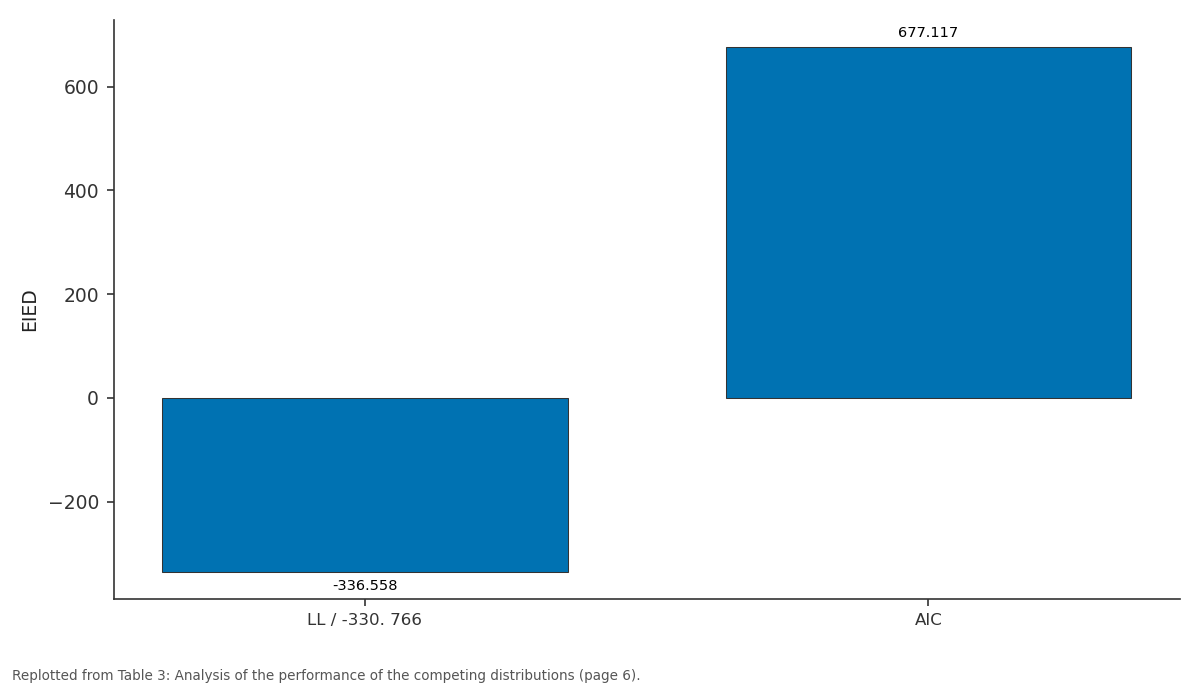
EIED: LL / -330. 766 vs AIC
Replotted from Table 3 (page 6) of the original paper. Every bar is the paper's own table value.
View source evidence ↗Figures & tables
From the original paper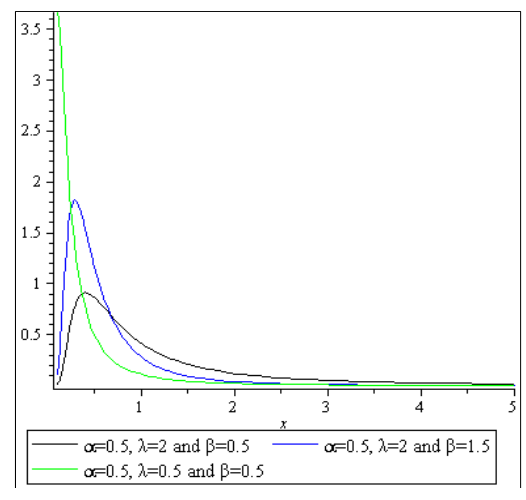 Figure 1
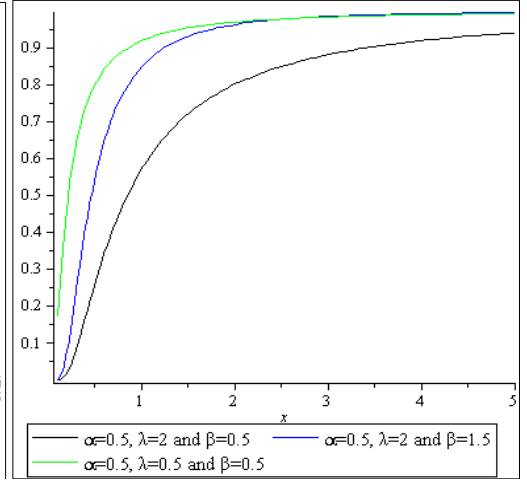 Figure 2
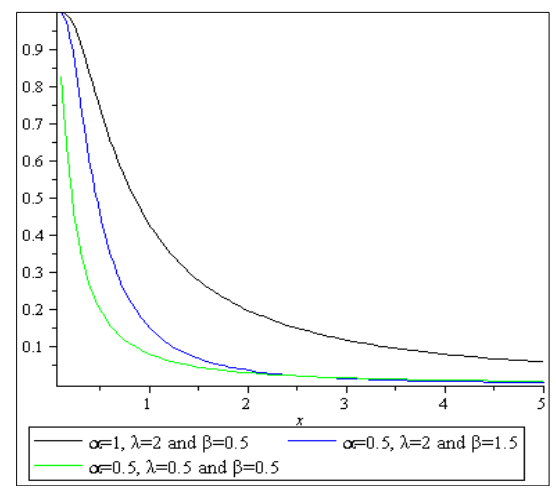 Figure 3
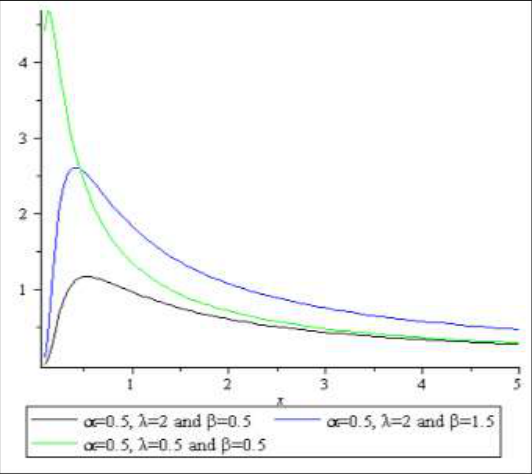 Figure 4
 Table 2
 Table 1
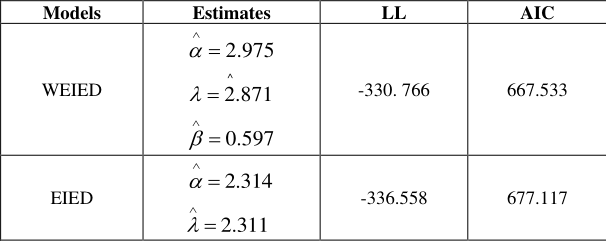 Table 3
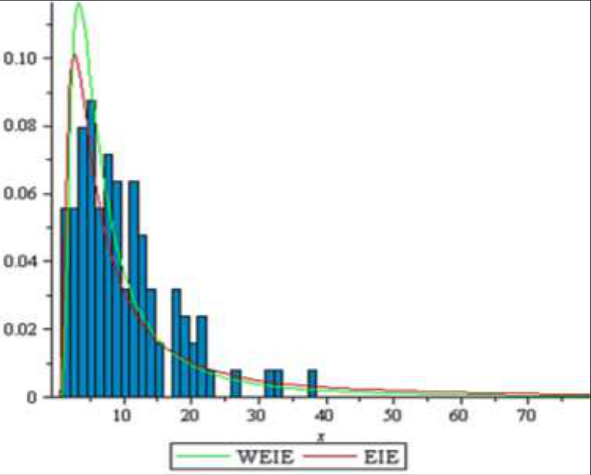 Figure 1
Introduction
The weighted distributions are applied in many fields of real life such as medicine, ecology, reliability and so on. This distribution was first introduced by (Fisher 1934) [5] to model ascertainment bias, weighted distributions were later formalized in a unifying theory by (Rao 1965) [8] . Weighted distributions are used to adjust the probabilities of the events as observed and recorded. It also provides appropriate approach to dealing with model specification and data interpretation problem. The weighted distribution is referred to as length biased distribution when the weight function is the length of the units. There are several weighted distributions in literature. For instance, (Mahdavi, 2015) [6] proposed new classes of weighted distributions by absorbing exponential distribution in Azzalini's method also (Nasiru, 2015) [7] proposed a new generalization of the Weibull distribution based on a modified weighted version of (Azzalini's, 1985). (Fatima & Ahmad, 2017) [4] proposed and studied new family of distribution called Exponentiated Inverted Exponential distribution (EIED) by introducing a shape parameter to Inverted Exponential distribution (IED). The Probability density function (pdf) of the Exponentiated Inverted distribution is given by 2 ; 0, , 0
The corresponding cumulative density function (cdf) is given by
In this paper however, a weighted version of the Exponentiated Inverted distribution is introduced and studied. In section 2, the densities of the Weighted Exponentiated Inverted Exponential (WEIE) distribution are derived with its various statistical properties, in section 3, an application to a real life data set is provided.
The weighted Exponentiated inverted exponential distribution
Let X denote a non-negative continues random variable, considering the weight function
and pdf of the two-parameter Exponentiated Inverted Exponential distribution as given in Eqn. (1), therefore, the pdf of the Weighted Exponentiated Inverted Exponential distribution is derived as
Insert equation ( 7) into (3) and fx as defined in (1)
Equation ( 8) is the pdf of the Weighted Exponentiated Inverted Exponential distribution. Its associated CDF is obtained as follows:
Where and are shape parameters and is the scale parameter Theorem: Let X denote a continuous random variable, then the pdf of the weighted Exponentiated Inverted Exponential distribution as derived in Equation ( 8) is a valid pdf.
Proof: For the pdf to be valid, it suffices that;
Possible plots for the pdf and cdf of the Weighted Exponentiated Inverted Exponential distribution at varied parameter values are as shown in Figure 1 & 2.
Reliability analysis Survival function:
The Survival function is given by:
And the hazard function is: From Figure 4, it can be seen that the hazard function of the Weighted Exponentiated Inverted Exponential Distribution exhibits unimodal (inverted bathtub) and decreasing shapes. This implies that the WEIE distribution can be used to describe or model real life phenomena with unimodal or decreasing failure rates.
Distribution of order statistics
Let 12 , ,..., n x x x denote random samples from a cdf and pdf distributed according to the Weighted Exponentiated Inverted Exponential Distribution, the pdf of the kth order statistics from the Weighted Exponentiated Inverted Exponential Distribution is derived from:
Therefore, the pdf of the kth order statistics the Weighted Exponentiated Inverted Exponential Distribution is:
The distribution of minimum and maximum order statistics for the Weighted Exponentiated Inverted Exponential Distribution is:
Moments of weighted Exponentiated inverted exponential distribution
If X follows the WEIED with parameters , and then rth moment of X is given as
The mean, variance, coefficient of variation and coefficient of Skewness were obtained from the rth moment as follows:
Moment generating function of WEIE distribution
Following (Cordeiro, 2011) [3] the expression for moment generating function is given as
Parameter estimation of WEIE distribution
Let 1 2 , ,... n X X X denote random samples drawn from the Weighted Exponentiated Inverted Exponential distribution with parameters as defined in equation (8). Using the method of Maximum Likelihood Estimation (MLE), the likelihood function L is given by:
Let log-likelihood function be denoted by l , therefore 1 1
(1 ) ln( ) n( 1) ln( ) ( 2) ln(x ) ln( (1 ))
Differentiating l with respect to respectively gives 1 (1 )
and solving the resulting nonlinear equations gives the Maximum Likelihood Estimates of parameters , and
Application to data sets
For illustration purposes, real life application of the Weighted Exponentiated Inverted Exponential Distribution is provided. The performance of the WEIE distribution was compared with that of the Exponentiated Inverted Exponential distribution using loglikelihood and Akaike Information Criterion as selection criteria. The distribution that corresponds to the highest log-likelihood value and lowest AIC value is selected as the best for the data set used.
Data set I:
The first data set has been previously used by Alqallaf et al. (2015) [1] the data set represents waiting time (in minutes) before service of 100 bank customers. .9, 8.9, 9.5, 9.6, 9.7, 9.8, 10.7, 10.9, 11.0, 11.0, 11.1, 11.2, 11.2, 11.5, 11.9, 12.4, 12.5, 12.9, 13.0, 13.1, 13.3, 13.6, 13.7, 13.9, 14. Remark: From Table 3, the WEIE distribution has the highest log-likelihood value and the lowest AIC value, therefore, it can be concluded that it fits the data set better than the Exponentiated Inverted Exponential distribution.
Conclusion
The Weighted Exponentiated Inverted Exponential distribution has been successfully derived. The model has unimodal (inverted bathtub) and decreasing shapes (depending on the value of the parameters). Explicit expressions for its basic statistical properties have been successfully derived. The model exhibits unimodal and decreasing failure rates, this implies that the model can be used to describe and model real life phenomena with unimodal or decreasing failure rates. For the real life application provided, the Weighted Exponentiated Inverted Exponential distribution performs better than the Exponentiated Inverted Exponential distribution; it is however a good and competitive model.
Figures and tables from the paper
References
8 in the original paper- Alqallaf F, Ghitany ME, Agostinelli C. Weighted Exponential Distribution: Different Methods of Estimations, Applied Mathematics and Information Sciences 2015;9(3):1167-1173.
- Azzalini A. A class of distributions which includes the normal ones. Scandinavian Journal of Statistics 1985;12:171-178.
- Cordeiro GM. The generalized inverse Weibull distribution 2011, 2014. http://doi.org/10.1007/s00362-009-0271-3.
- Fatima K, Ahmad SP. The Exponentiated Inverted Exponential Distribution 2017;05(01).
- Fisher RA. The effects of methods of ascertainment upon the estimation of frequencies. Annals of Eugenics 1934:6:13-25.
- Mahdavi A. Two Weighted Distributions Generated by Exponential Distribution 2015;9(1):1-12.
- Nasiru S. Another weighted weibull distribution from Azzalini's family 2015;11(9):134-144.
- Rao CR. On discrete distributions arising out of methods of ascertainment. In Classical and Contagious Discrete Distributions. G.P. Patil (ed.), Pergamon Press and Statistical Publishing Society, Calcutta 1965, 320-33.
Cited by 2
From OpenAlex, OpenCitations and reference lists read by Scinovex
- The Length-Biased Weighted Exponentiated Inverted Exponential Distribution: Properties and Estimation ↗
Marwa Salama, El-Sayed A. El-Sherpieny, Abd-eltawab Abd-elaziz · Computational Journal of Mathematical and statistical Sciences · 2023
This paper introduces the length-biased weighted exponentiated inverted exponential distribution with sub models. The basic statistical properties are derived such as mean, mode, variance, reliability functions, moment generating function, characteristic function and order statistic distribution. Furthermore, maximum likelihood estimators of distribution parameters are obtained under censored Type I. Numerical study is applied. Variance-covariance matrix is obtained and Confidence intervals are…
❝ 16PDF - Modified exponentiated inverted exponential distribution with applications to life time dataset ↗
Arun Kumar Chaudhary, Lal Babu Sah Telee · NCC Journal · 2022
In this article, we have introduced a new probability distribution called Modified Exponentiated Inverted Exponential (MEIE) Distribution. The introduced model is right tailed increasing- decreasing hazard rate function. We have discussed some statistical properties like probability density function, cumulative distribution function, survival function and hazard rate function etc. Model parameters are estimated via Maximum Likelihood, Least Squares, and Cramer-Von Mises…
❝ 0PDF