
Research article · 2020 · Full text
International Journal of Statistics and Applied MathematicsMental health burden during COVID-19 pandemic: A survey on university students of Bangladesh
Volume 5(6) · Pages 138–141
Research areasCOVID-19 and Mental Health
Abstract
Author-writtenThe purpose of the study was to access the mental health burden and anxiety of University Students in Bangladesh. An online survey was conducted among students from different universities in Bangladesh. There were 558 students from different universities who completed the online survey on different social media from 5 July to 20 July 2020. The descriptive results display that, 49.3% of students were female and 50.7% of students were male. The chi-square test was performed to explore the association between demographic and COVID-19 related variables with the anxiety level of the students. The results demonstrate that the association between the gender of the students and their anxiety level on COVID-19 is significant (p-value
Summary
Source-checkedPlain-language reading of the full paper, prepared with AI and checked against the text. Each point links to the authors' own words.
Why it matters
- The COVID-19 pandemic has caused widespread public panic and mental stress across 213 countries. View evidence ↗
- In Bangladesh, high population density and developing status made it difficult to maintain precautions like social distancing, which impacted the population's mental health. View evidence ↗
The question
- The study aimed to assess the anxiety and mental health burden experienced by university students in Bangladesh. View evidence ↗
What they did
- An online survey was conducted from July 5 to July 20, 2020, with 558 university students from various institutions in Bangladesh participating via social media. View evidence ↗
What they found
- Among the students, 45.3% reported moderate anxiety, 34.1% reported normal anxiety, and 20.6% reported severe anxiety regarding COVID-19. View evidence ↗
- There was a significant association between gender and anxiety levels (p-value < 0.00), with females showing higher rates of moderate (49.8%) and severe (24.0%) anxiety compared to males. View evidence ↗
- The ability to maintain a daily routine was significantly associated with anxiety (p = 0.00); students unable to maintain their routine had higher severe anxiety (23.8%) than those who could (10.1%). View evidence ↗
- Insufficient internet service was significantly associated with higher anxiety (p = 0.006), with 26.8% of those without sufficient service reporting severe anxiety compared to 16% of those with sufficient service. View evidence ↗
- Facing problems with online activities from home was significantly associated with anxiety (p = 0.00), with 24.7% of those facing problems reporting severe anxiety. View evidence ↗
- The frequency of viewing COVID-19 reports was significantly associated with anxiety (p = 0.001), with those who 'always' viewed reports showing higher severe anxiety (24.3%) than those who viewed them 'sometimes' (18.1%). View evidence ↗
- Age was not significantly associated with anxiety levels (p = 0.23). View evidence ↗
What it means
- The authors concluded that various demographic factors and COVID-19 related variables are significantly associated with the anxiety levels of university students in Bangladesh. View evidence ↗
- The authors recommend that individuals be cautious about the news they believe and limit their exposure to social media to manage stress. View evidence ↗
Figures & tables
From the original paper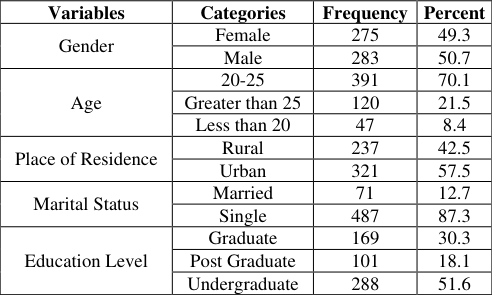 Table 1
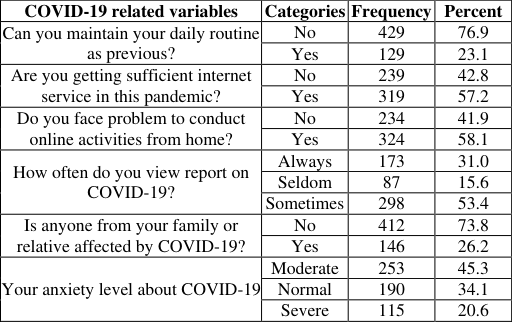 Table 2
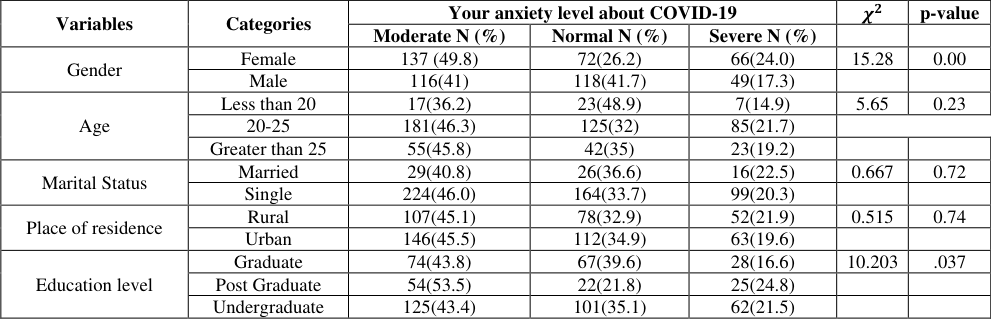 Table 3
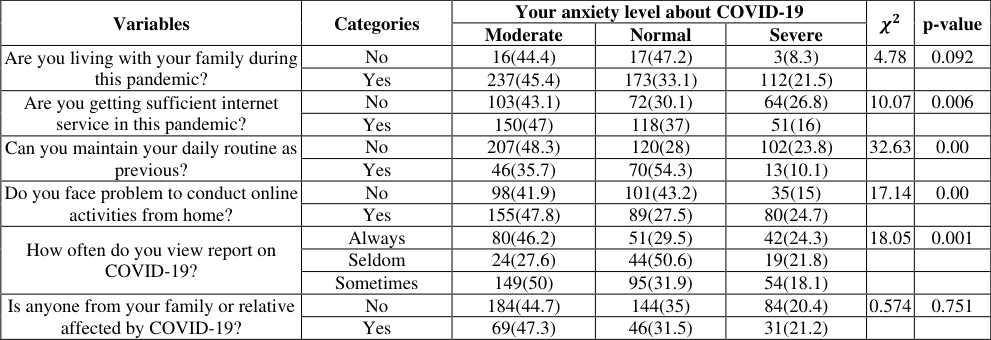 Table 4
Introduction
On March 8, with three confirmed cases, Bangladesh became a part of the worldwide pandemic of coronavirus disease 2019(COVID-19) caused by severe acute respiratory syndrome coronavirus-2(SARS-CoV-2) (WIKIPEDIA, 2020). People of 213 countries have already affected by the COVID-19 pandemic with an acute number of confirmed cases and deaths and have instigated public panic and mental stress (Huang & Zhao, 2020). By August 10, 2020, a total of 260,507cases were confirmed in mainland Bangladesh, and 3438 patients have died. Around the world, 213 countries and territories have reported a total of 20,072,673 confirmed cases of coronavirus COVID-19 with 734,812 death cases originated from Wuhan, China (Worldometer, 2020) [4] . In South Asia, After India and Pakistan, Bangladesh has become the third most affected country and 15 most affected countries in the world. Yet there are no approved antiviral drugs to control the existence of this virus. Though Russia has announced they have finished clinical trials of vaccine (Sputnik-V) on human bodies and the results have proven the effectiveness of the medications but we exactly don't know when they will officially sell it (Aljazeera, 2020) [6] . Moreover, Bangladesh is a third grade developing and densely populated country so several times precautions against this novel virus like social distance, home office, lockdown procedures etc. can't be possible to maintain. It has also impacted on the mental health of the people of Bangladesh. This web-based research will help to know the potential influencing factors of the mental stress of the people of Bangladesh during this pandemic and probable suggestion for stress management.
Causes of stress due to pandemic
After reading several articles, newspaper, webbased news and watching television news we marked 5 powerful force, leading to stress in the interim period of this pandemic. Unknown stressor: Undoubtedly, we are passing a very stressful time, particularly since we are not aware of stressor. It is totally new, we didn't get minimum time for preparation and adaption, there is no available antidotes or vaccine, and we don't know how to deal with it (Vinkers, et al., 2020) [19] .
Government has decreed some actions of social distancing, lockdown,business shutdown but we are not used to with it. Moreover, it hampers our regular life and generates additional psychological stress (Kloet, Holsber, & Joels, 2005) [15] . Job insecurity: Approximately 3.6 million people of Bangladesh working in garments industry (The Asia Foundation, 2012) [1] . After a few days of lock-down period Bangladesh government has allowed garments factories to start their production by ensuring social distancing measure with 50% workforce. So, other 50% workers have already lost their job. Again, RMG owners didn't fulfil their commitment to provide workers, 60% of their gross wages (Haque & Uddin, 2020) [12] . Rubana Huq, president of Bangladesh Garments Manufacturers and Exporters Association (BGMEA) has warned that as a large amount of orders were cancelled due to COVID-19 there is a possible to lose job more than 2 million RMG workers. This is a common scene for most of the private industries in Bangladesh who deals in foreign countries (Hossain, 2020) [13] . Medical inability: In Bangladesh there is a shortage of appropriate number of medical facilitiesdoctors, nurses, and medical staff. As per WHO, the ratio between doctor and patient is 5.26: 10,000 that is only before Bhutan in South Asia. After 2 months suffering from corona virus only 25% doctors and 60% medical staff got PPE (Personal Protective Equipment) (team, 2020) [17] . In Bangladesh maximum number of confirmed cases are from Narayanganj and Dhaka. But on 8 April Dr. Samsuddoha Sanchay of Narayanganj 300 bed Hospital said they are still not prepared to fight corona virus and they will need 20 more days to establish 10 bed ICU at the hospital (Badal, 2020) [9] . This is not only happening in Narayanganj but also all over the country. Stress to maintain precaution: 27.09% people here totally illiterate (macrotrends, 2018) [1] . The other 73.91% are not properly manifested by education even they still aiding prejudice. In rural areas and little amount in urban, maximum people don't maintain precaution measures and people who are trying to maintain it they have to suffer from comedic words. Economic infeasibility: on 25 march, Bangladesh government has announced 10 days lockdown and it has been continued more than 2 months. So, several new types of incidents have been occurredlay off workers, providing 60% of gross salary, non-paid vacation and so on (Anwar, Nasrullah, & Hosen, 2020) [7] . Around 13 % of people have become unemployed (The Daily Star, 2020). Middle class, Lower, lower middle class and daily earners are suffering most because either they have no works or limited works especially while nobody knows when the sufferings will end up.
Methods
To avoid the blowout of Severe Acute Respiratory Syndrome Coronavirus 2 (SARS-CoV-2), this study used a web-based survey based on the Internet through the Facebook, Whats App and Imo social medias and the total respondents were 558. The Bangladeshi people normally use Facebook, Whats App and Imo for communicating with each other. In this internet-based survey, the questionnaires were sent to the respondent's social media account. The questionnaires were written on Google Form. The respondents just clicked on the given link and filled the form. After completing the answers, the respondents submitted the forms which were automatically stored on Google Spread Sheet. The questionnaires were designed with respondent's demographic variables (Age, gender, Education level, Place of residence, marital status) and COVID-19 related variables. Then the collected data was finally analyzed by using Statistical Package for Social Science (SPSS, Version 20.0). The results were processed with Microsoft Office 2013.
Results and Discussion
The response rate was 90%. The data collection was held from 5 July to 20 July 2020. The analyzed results are discussed below.
Demographic Information
The study was conducted to study the demographic characteristics. The survey was conducted to know the association between the anxiety level of students on COVID-19 and the demographic variables. The Table 3 showed that, the gender and the anxiety level of the students are significantly associated, which implies that, the anxiety level differs by gender.
| Variables | Categories | Your anxiety level about COVID-19 | — | — | 𝝌𝟐 | p-value |
|---|---|---|---|---|---|---|
| Moderate N (%) | Normal N (%) | Severe N (%) | ||||
| Gender | Female | 137 (49.8) | 72(26.2) | 66(24.0) | 15.28 | 0.00 |
| Male | 116(41) | 118(41.7) | 49(17.3) | |||
| Age | Less than 20 | 17(36.2) | 23(48.9) | 7(14.9) | 5.65 | 0.23 |
| 20-25 | 181(46.3) | 125(32) | 85(21.7) | |||
| Greater than 25 | 55(45.8) | 42(35) | 23(19.2) | |||
| Marital Status | Married | 29(40.8) | 26(36.6) | 16(22.5) | 0.667 | 0.72 |
| Single | 224(46.0) | 164(33.7) | 99(20.3) | |||
| Place of residence | Rural | 107(45.1) | 78(32.9) | 52(21.9) | 0.515 | 0.74 |
| Urban | 146(45.5) | 112(34.9) | 63(19.6) | |||
| Education level | Graduate | 74(43.8) | 67(39.6) | 28(16.6) | 10.203 | .037 |
| Post Graduate | 54(53.5) | 22(21.8) | 25(24.8) | |||
| Undergraduate | 125(43.4) | 101(35.1) | 62(21.5) |
Table text extracted from the original PDF; superscript letters are shown inline. The original table image is below.
View original table image
Association between Anxiety level and Demographic variables
The association between, age of the students and their anxiety level is insignificant, which may conclude that, age of students do not create any matter to their anxiety level.
Similarly, marital status and place of residence showed no association with anxiety level of the students on COVID-19.
The results also showing that, the association between education level of students and their anxiety level on COVID-19 is significant. It refers that, the anxiety level differs by their education level. The Table 4 showed the association between the COVID-19 related variables and anxiety level of the students. The results imply that, the student's allotment to access internet, performing activities from home and their maintaining their daily routine are significantly associated with their level of anxiety. From the results, it is clear that, the students who get had access to the internet, who could do their daily activities from home and who were able to maintain the daily routine were supposed to have normal a anxiety level on COVID-19.
| Variables | Categories | Your anxiety level about COVID-19 | — | — | 𝝌𝟐 | p-value |
|---|---|---|---|---|---|---|
| Moderate | Normal | Severe | ||||
| Are you living with your family during this pandemic? | No | 16(44.4) | 17(47.2) | 3(8.3) | 4.78 | 0.092 |
| Yes | 237(45.4) | 173(33.1) | 112(21.5) | |||
| Are you getting sufficient internet service in this pandemic? | No | 103(43.1) | 72(30.1) | 64(26.8) | 10.07 | 0.006 |
| Yes | 150(47) | 118(37) | 51(16) | |||
| Can you maintain your daily routine as previous? | No | 207(48.3) | 120(28) | 102(23.8) | 32.63 | 0.00 |
| Yes | 46(35.7) | 70(54.3) | 13(10.1) | |||
| Do you face problem to conduct online activities from home? | No | 98(41.9) | 101(43.2) | 35(15) | 17.14 | 0.00 |
| Yes | 155(47.8) | 89(27.5) | 80(24.7) | |||
| How often do you view report on COVID-19? | Always | 80(46.2) | 51(29.5) | 42(24.3) | 18.05 | 0.001 |
| Seldom | 24(27.6) | 44(50.6) | 19(21.8) | |||
| Sometimes | 149(50) | 95(31.9) | 54(18.1) | |||
| Is anyone from your family or relative affected by COVID-19? | No | 184(44.7) | 144(35) | 84(20.4) | 0.574 | 0.751 |
| Yes | 69(47.3) | 46(31.5) | 31(21.2) |
Table text extracted from the original PDF; superscript letters are shown inline. The original table image is below.
View original table image
Association between Anxiety level and COVID-19 related variables
Association between Anxiety level and COVID-19 related variables
Suggestions due to pandemic stress management
First of all, we have to accept that things that are not in our control. Though it is difficult but the most effective way to overcome stress (Blessing Health System, 2020) [10] . Secondly, we must conscious to believe any news on the topic and limit to use media exposure especially social media. Because several types of news are unfurled on social media where a little thing is true (Arruda, 2020) [8] . Yes, off course, it is important to be informed but if we continuously search more and more information about it, there is a possibility to getting mixed information, so source of news must be considered.
Thirdly, we should be mindful as this is an effective way to mitigate anxiety or stress of unknown fear (LAWTON, 2020) [16] . Always be remembered, other people should not be hampered by us. Make a regular habit to follow the WHO precautions and guidelines. Fourthly, think positive, we think this is the most powerful weapon to solve any problem. Whatever salutation is, we should pay off the good things. Fifthly, spend time with family, friends, relatives, neighbors and so on. By all, what is happening with us, it can be said that we are passing the most critical time in our life and the output is anxiety, stress and fear. Talking over phone, Skype or Face Time with family, friends or relatives always relax us and can help to bring out from our fear (University Of lowa Stead Family Children's Hospital, 2020) [1] . We should take benefit of this situation by spending time with family, talking to them, playing games, watching movies, sharing launch in table that were not previously possible. Sixthly, find time for ourselves so that we can do our favorite things. Maybe it is gardening, reading book, making crafts, sewing cloths, decorate room, cooking, doing art, writing (story, novel, rhyme, dairy etc.) and so on that gives us peace. Peaceful works always reduced our stress. Finally, doing prayer or medication, as a means of return to spirit. Even, physicians prescribe medications for specific stress problem (Dr. Sabria, 2020) [11] .
Truly, there is no specific method to solve stress problem but several techniques can be occupied to lessen it. We are trying to identify the most effective method besides these, numerus methods are available in the website.
Conclusion
The aim of this study has been to contact the problems regarding mental health and anxiety levels of university students in Bangladesh. The study has been completed through online so that the students remain safe from all the possibilities of being affected by COVID-19. The study found significant association between different demographic and COVID-19 related variables with anxiety levels of students.
The suggestions that are given to the students to stay home and safe so that the COVID-19 does not spread extensively.
Figures and tables from the paper
| Variables | Categories | Frequency | Percent |
|---|---|---|---|
| Gender | Female | 275 | 49.3 |
| Male | 283 | 50.7 | |
| Age | 20-25 | 391 | 70.1 |
| Greater than 25 | 120 | 21.5 | |
| Less than 20 | 47 | 8.4 | |
| Place of Residence | Rural | 237 | 42.5 |
| Urban | 321 | 57.5 | |
| Marital Status | Married | 71 | 12.7 |
| Single | 487 | 87.3 | |
| Education Level | Graduate | 169 | 30.3 |
| Post Graduate | 101 | 18.1 | |
| Undergraduate | 288 | 51.6 |
Table text extracted from the original PDF; superscript letters are shown inline. The original table image is below.
View original table image
| COVID-19 related variables | Categories | Frequency | Percent |
|---|---|---|---|
| Can you maintain your daily routine as previous? | No | 429 | 76.9 |
| Yes | 129 | 23.1 | |
| Are you getting sufficient internet service in this pandemic? | No | 239 | 42.8 |
| Yes | 319 | 57.2 | |
| Do you face problem to conduct online activities from home? | No | 234 | 41.9 |
| Yes | 324 | 58.1 | |
| How often do you view report on COVID-19? | Always | 173 | 31.0 |
| Seldom | 87 | 15.6 | |
| Sometimes | 298 | 53.4 | |
| Is anyone from your family or relative affected by COVID-19? | No | 412 | 73.8 |
| Yes | 146 | 26.2 | |
| Your anxiety level about COVID-19 | Moderate | 253 | 45.3 |
| Normal | 190 | 34.1 | |
| Severe | 115 | 20.6 |
Table text extracted from the original PDF; superscript letters are shown inline. The original table image is below.
View original table image
References
11 in the original paper- Badal HR 2020. UNB. Retrieved from https://unb.com.bd/category/Special/hospitals-innarayanganj-not-ready-yet-for-corona-battle/50031
- Blessing Health System 2020. Retrieved from https://www.blessinghealth.org/treatments/general-tipsdealing-COVID-19-stress
- Dr. Sabria SA 2020. Retrieved from Choc Childrens: https://blog.chocchildrens.org/mindfulness-andmeditation-practical-tools-to-reduce-stress-duringCOVID19/
- Haque A, Uddin J 2020. Retrieved from THE Business Standard: https://tbsnews.net/economy/rmg/jobinsecurity-sparks-protests-rmg-plunges-quicksand-78142
- Hossain A 2020. BBC Bengali. Retrieved from BBC: https://www.bbc.com/news/world-asia-52417822
- Huang Y, Zhao N 2020. Chinese mental health burden during the COVID-19 pandemic. ELSEVIER, 3. Retrieved from www.elsevier.com/locate/ajp
- Kloet ER, Holsber F, Joels M 2005. Stress and the brain: from adaptation to disease. Nature Reviews Neuroscience, 6, 463-475. Retrieved from https://www.nature.com/articles/nrn1683
- Lawton B 2020. Retrieved from Alexandria Living: https://alexandrialivingmagazine.com/healthwellness/coronavirus-stress-how-to-reduce-stressCOVID-19-tips/
- Team UB 2020. Retrieved from UNDP Bangladesh: https://www.bd.undp.org/content/bangladesh/en/home/sto ries/a-reality-check-for-bangladesh-s-healthcaresystem.html
- University of lowa Stead Family Children's Hospital. 2020. Retrieved from https://uichildrens.org/healthlibrary/managing-stress-during-coronavirus-COVID-19outbreak
- Vinkers CH, Amelsvoort TV, Bisson JI, Branchi I, Cryan JF, Domschke K et al. Stress resilience during the coronavirus pandemic. Elsevier 2020;35:12-16.