
Research article · 2016 · Full text
International Journal of Statistics and Applied MathematicsA cable connected satellites system non-linear oscillation and the main resonance
Volume 1(4) · Pages 57–61
Research areasSpacecraft Dynamics and ControlSpace Satellite Systems and ControlGeomagnetism and Paleomagnetism Studies
Abstract
Author-writtenWe study about the non-linear Oscillation of a system of two-Cable connected artificial satellites under several influences of general nature like magnetic force of the earth solar radiation pressure and shadow of the earth and the case of main resonance the cable is light flexible inelastic and non conducting in nature. We applied B.K.M. method for analysis of the motion of the system concerned we investigate the system moves like a dumbbell Satellite with stationary amplitude.
Summary
Source-checkedPlain-language reading of the full paper, prepared with AI and checked against the text. Each point links to the authors' own words.
Why it matters
- The study examines the non-linear oscillation of two artificial satellites connected by a cable, considering external factors such as Earth's magnetic force, solar radiation pressure, and the Earth's shadow. View evidence ↗
- The cable connecting the satellites is modeled as being light, flexible, inelastic, and non-conducting. View evidence ↗
The question
- The research aims to analyze the non-linear oscillation of the cable-connected satellite system, specifically focusing on the case of main resonance. View evidence ↗
What they did
- The authors used the B.K.M. method to analyze the motion of the satellite system. View evidence ↗
- The analysis assumes that the orbital eccentricity is a small quantity of the first order infinitesimal. View evidence ↗
- To solve the equation of motion, the authors sought a first-approximation solution where the displacement is represented as a cosine function of the true anomaly and a phase angle. View evidence ↗
What they found
- The system of equations describing the motion is found to be in conical form, meaning it possesses a first integral (a constant of motion). View evidence ↗
- The authors found that obtaining algebraic solutions for the final equations of motion was very difficult, which prevented the drawing of integral curves. View evidence ↗
What it means
- The authors conclude that the system's motion in the planes is non-evolutional, resulting in the system moving like a dumbbell satellite with a stationary amplitude. View evidence ↗
- A limitation of the study is the inability to provide algebraic solutions or integral curves due to the complexity of the equations. View evidence ↗
Visual summary
1 visualsIllustrations explain the paper; they do not show study data.
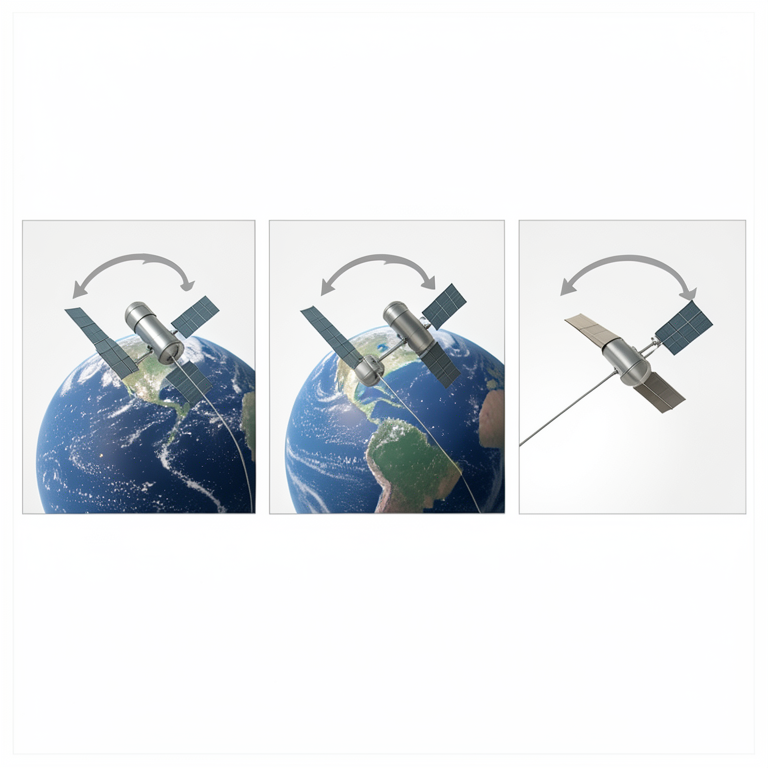
Dumbbell Satellite Model
AI-generated conceptual illustration (two artificial satellites connected by a thin cable orbiting Earth). It explains the idea and does not show study data.
View source evidence ↗Introduction
Beletsky (1965) and Beletsky and Novikova(1969) studied the motion of a system of two cable-connected satellites in the central gravitational field of force relative to its center of mass. This study assumed that the two satellites are moving in the plane of the center of mass. Singh and Demin (1972) and Singh (1973) investigated the problem in two and three dimensional cases. Das et al. (1976) studied the effect of magnetic force on the motion of a system of two cable-connected satellites in orbit. Sinha and Singh (1987) studied effect of solar radiation pressure on the motion and stability of the system of two inter connected satellites when their center of mass moves in circular orbit.Again, Sinha and Singh (1988) could generalize the above problem by considering the center of mass of the system moving in elliptical orbit. Beletsky and Levin (1993) studied dynamics of space tether's systems. Kurpa et al. (2000) explained about a new concept of space flight for tethered satellite systems. Again Kurpa et al. (2006) studied about modelling, dynamics and control of tethered satellite systems. Sharma and Narayan (2001) studied nonlinear oscillation of inter connected satellite system under the combined influence of the solar radiation pressure and dissipative forces of general nature. Again Sharma and Narayan (2002) investigated effect of solar radiation pressure on the motion and stability of inter connected satellites system in orbit. Singh et al. (2001) studied non-linear effects on the motion and stability of an inter connected satellites system orbiting around an oblate Earth. Celled and Sidorenko (2008) studied some properties of dumb-bell satellite altitude dynamics. Umar (2013) explained development of satellite technology and its impact on social life. Kumar and Srivastava (2006) studied evolutional and non-evolutional motion of a system of two cable-connected artificial satellites under some perturbative forces. Kumar and Prasad (2015) studied aboutnon -linear planer oscillation of a cableconnected satellites system and nonresonance. Kumar and Kumar (2016) studied equilibrium positions of a cable-connected satellites system under several influences. Kumar (2018) studied liberation points of a cableconnected satellites system under the influence of solar radiation pressure, earth's magnetic field, shadow of the earth and air resistance: circular orbit. Kumar and Bhattacharya [4] studied the stability of equilibrium positions of two cable-connected satellites under the influence of solar radiation pressure, earth's oblateness and earth's magnetic field. Kumar and Srivastava [5] obtained the equations of motion of a system of two cable-connected artificial satellites under the influence of some perturbative forces. Kumar et al. [6] studied the boundary of motion of a system of two cableconnected satellites under some.
Treatment of the problem
We write equation of small oscillation of the system about the equilibrium position as:-
Condition of Constant for equatorial orbit is given by
Assuming the eccentricity to be a small quantity of the first order infinitesimal the equation of the motion (1) can be written as:
Since the non-linearity is sufficiently weak so we get:
Hence we get from (3) on using (4) and neglecting terms containing e 2 and the highest power of a To study the phenomenon of main resonance and to solve the equation of motion we applying B.K.M. Method. Assuming e to be a small parameter, the solution in the first approximation of the equation of motion (3.2.5) can be sought in the form:-
Where amplitude a and phase θ must satisfy the system ay ordinary differential equations
Where A 1 (a,θ) and B 1 (a,θ) are periodic solutions periodic with respect to θ of the system of partial differential equations given below:-
Where, 𝑓 0 (𝑣, 𝜂, 𝜂 ′ , 𝜂 ′′ ) is obtained by using ( 6) on the R.H. side of ( 5) in the form:-
Putting the value of 𝑓 0 (𝑣, 𝜂, 𝜂 ′ , 𝜂 ′′ ) from ( 8) on the R.H. side of (7) under the integral sign and integrating, we get:-
i.e (𝑛 -1) The particular solution periodic with respect to 𝜃 of the system of equations ( 10) can be easily obtained as:- .… (13) The system of equations ( 13) may be written as Clearly, the system of equations ( 13) is in conical form and hence it has a first integral of the form:-
Which reduces the problem to quadrative and here C o ' is the constant of integration. The stationary regions of the amplitude a and phase 𝜃 are given by equating the R.H. side of equations ( 13 Actually, it is very difficult to get the algebraic solutions of (16). Hence integral curves are not drawn.
Conclusion
We have studied the non-linear osccilation of system of two satellites connected by cable under several influence of general nature. differential equation of motion of the system is obtained we apply B.K.M. Metod to solve the equation. the algebraic solution opf the equation is not possible hence we do not get the integral curves at the main resonance we assume that eccentricity of the orbit is a very small parameter but eccentricity which not equal to zero. In fact motion of the system in the whole planes will be non-evoluational. As a result of which we conclude that the system will always moves like a dumbbell satellites with stationary amplitude.
References
13 in the original paper- Das SK, Bhattacharya PK, Singh RB. Effect of magnetic force on the motion of a system of two cable-connected satellites in orbit, Proceedings of National Academy of Sciences India 1976;46(A):287-299.
- Khan A, Goel N. Chaotic motion in problem of dumb-bell satellite, International of Journal Contemporary Mathematical Sciences 2011;6:299-307.
- Kumar S, Bhattacharya PK. Stability of equilibrium positions of two cable-connected satellites. Proc. Workshop on Sp. Dyn. And Celes. Mech., Muz., India, Eds. K. B. Bhatnagar and B. Ishwar, 71-74. [17] Singh, R. B. (1973), Three -dimensional motion of a system of two cable -connected satellites in orbit, Astronautica Acta 1995;18:301-308.
- Sinha SK, Singh RB. Effect of solar radiation pressure on the motion and stability of the system of two inter connected satellites when their centre of mass moves in circular orbit, Astrophysics and Space Science 1987;129:233-245.
- Sinha SK, Singh RB. Effect of solar radiation pressure on the motion and stability of the system of two inter connected satellites when their centre of mass moves in elliptical orbit, Astrophysics and Space Science 1988;140:49-54.
- Singh BM, Narayan A, Singh RB. Non-linear effect on the motion and stability of an inter connected satellites system orbiting around an oblate earth, Proceedings of National Academy of Sciences India 2001;71:225-235.
- Umar BN. Development of satellite technology and its impact on social life, Journal of Information Engineering and Applications 2013;3(10):13-17.
- Kumar S, Prasad JD. Non -linear planer oscillation of a cable -connected satellites system and non -resonance, Indian Journal of Theoretical Physics, Kolkata, India 2015;63(1,2):01-14.
- Kumar S, Kumar S. Equilibrium positions of a cable-connected satellites system under several influences, International Journal of Astronomy and Astrophysics, China 2016;06:288-292.
- Kumar S. Libration points of a cable -connected satellites system under the influence of solar radiation pressure, earth's magnetic field, shadow of the earth and air resistance: circular orbit, Journal of Physical Science, Midnapur, India 2018;23:165-170.
- Kurpa M, Kuha A, Poth W, Schagrl M, Stiendl A, Steiner W et al. Tethered satellite systems: A new concept of space flight, European Journal of Mechanics, A solid 2000;19:S145-S164.
- Kurpa M, Poth W, Sxhagerl M, Stendl A, Steiner W, Troger H et al. Modelling, dynamics and control of tethered satellite systems, Non-linear Dynamics 2006, 73-96.
- Kumar RK, Singh NK. Motion and stability of two interconnected satellites system in circular orbit of centre of mass IJMM 2010;3:1:4-54.