
Research article · 2020 · Full text
International Journal of Statistics and Applied MathematicsExploring conceptualisation of polynomials
Volume 5(5) · Pages 108–110
Research areasDiverse scientific research topicsReligion and Sociopolitical Dynamics in NigeriaStatistics Education and Methodologies
Abstract
Author-writtenPresent study was intended to explore the conceptual understanding of polynomials among respondents. 400 respondents were selected with due representation of gender. All respondents were selected from 10th standard of Government and private schools of Shopian District. Whole data was selected by using Random Sampling Technique (RST). The Polynomial test developed by Herl and Jain (2016) was used for data collection. The collected data was analysed to statistical treatment by using Mean, S. D and independent ‘t’ test. The results exposed that three exists significant differences between male and female respondents on their conceptual understanding polynomials (P
Summary
Source-checkedPlain-language reading of the full paper, prepared with AI and checked against the text. Each point links to the authors' own words.
Why it matters
- Since the 1960s, mathematics education has shifted toward a structural approach to improve teaching through accurate mathematical definitions and deduction. View evidence ↗
- Despite structural reforms, students frequently continue to struggle with formal mathematical definitions. View evidence ↗
- In the Indian education system, polynomials are taught to first-grade high school students following their study of numbers and functions. View evidence ↗
The question
- The study aims to explore and compare the conceptual understanding of polynomials between male and female students. View evidence ↗
What they did
- The research was conducted in the Shopian district of Jammu and Kashmir, involving 400 students from the 10th class. View evidence ↗
- A random sampling technique was used to select 400 students aged 14-18 years, ensuring gender representation. View evidence ↗
- Data was collected using a standardized polynomial test developed by Herl and Jain in 2016. View evidence ↗
- The researchers analyzed the data using mean, standard deviation (SD), and independent t-tests. View evidence ↗
What they found
- Male secondary school students achieved a higher mean score (M=18.70, SD=2.23) on the polynomial test compared to female students (M=12.14, SD=2.86). View evidence ↗
- The difference between the two groups was statistically significant at the 0.01 confidence level, with a t-value of 5.91. View evidence ↗
- The results indicate a significant difference (P<0.01) in the conceptual understanding of polynomials, with males demonstrating a higher level of understanding than females. View evidence ↗
What it means
- The authors conclude that gender has a significant impact on the level of conceptual understanding of polynomials among the students studied. View evidence ↗
Figures & tables
From the original paper Table 1
 Table 1
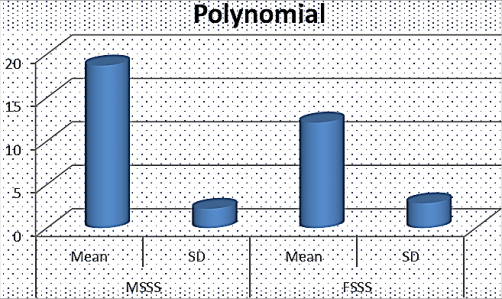 Figure 1
Introduction
Mathematics education, owing to reformation in mathematics in 1960s, has been based upon a structural approach. Therefore, it was thought that formulating mathematical definitions and deductive could be made accurately, which may improve mathematical teaching. However, it was seen that students continue to have their old usual difficulties in formal definitions (Tall 1988). According to Cornu (1991), teaching of most mathematical concepts generally does not start on virgin areas. Before learning any concept, students have daily experiences about that concept, such as certain intuitions, ideas, images, knowledge and colloquial meanings of used terms. This accumulation that students have beforehand, that is, conceptions, are so-called spontaneous conceptions. These concepts do not disappear during formal teaching, going in a circle with newly gained information, becoming current and being adapted to student's individual conceptions. In Indian education system, the teaching of polynomials concept is carried out in high school first grade classes after teaching numbers and function subjects. Goals for teaching polynomials concept are arranged in order as: to be able to comprehending fundamental concepts about polynomials, to make operations about polynomials, to understand factoring polynomials, to make operations about factoring polynomials, to comprehend rational expressions and equations and to make applications in rational expressions and equations. However gender variation has been observed in the same domain. In context to same, large number of researchers has reported gender inequalities are existing in the field of modern concepts of mathematics. Notable among them are; Cassell, London (1996) [1] , Hiebert, J., Lefevre, P. (2012) [2] , Hull, R. (2012) [3] , Kluwer, Dordrecht (1991) [4] , Lawrence Erlbaum Associates, Hillsdale (1986) [5] and Pergamon Press, Oxford (1988) [6] . Keeping in view, the investigator intended to explore the inclination of male and female students towards conceptualisation polynomials. The detailed statement of the problem is as under:
Research Problem
The statement of the research problem is as under:
Exploring Conceptualisation of Polynomials 1.2 Objectives
The objectives of the present study are as under: 1. To explore the conceptual understanding of polynomials among male and female students.
Hypothesis
Following hypothesis has been framed for the present study: 1. There exists no significant difference between male and female students on their conceptual understanding of polynomials
Operational Definition
The operational definitions of terms and variables are as under:
1. Polynomials: Conceptualisation of the polynomials in the present study refers the set of score obtained by the respondents on polynomials test standardised by Herl and Jain (2016).
Male and female students:
In the present study, male and female students refers dichotomy of the respondents made on the basis of their sex.
Delimitations of the Study
The present study will be delimited Shopian district of Union Territory of Jammu and Kashmir. The study was delimited to 400 respondents of 10 th class only.
Methodology
The present study was carried with the help of descriptive research method. The parameters involved in methodology and procedure are as under:
Sample
The sample for the present study consists of 400 respondents with due representation of gender. The age groups of the subjects were ranged 14-18 years. Whole data was selected by using Random Sampling Technique (RST) from 10 th standard of selected schools. The below mentioned table indicates the precise explanation of sample:
Test used
The Polynomial test developed by Herl and Jain (2016) was used for data collection.
Statistical treatment
The collected data was put to suitable statistical treatment by using descriptive and inferential techniques. The detailed procedure of statistical treatment is analysed as under:
Table 1.2: Showing the significance of difference between dimension-XIII (Limit and Continuity) of Modern Mathematical
Table 1.2: Showing the significance of difference between dimension-XIII (Limit and Continuity) of Modern Mathematical
Variable
Variable
MSSS FSSS 't' value
MSSS FSSS 't' value
Polynomial
Mean SD Mean SD 5.91@@@ 18.70 2.23 12.14 2.86 Index • MSSS= Male Secondary school students • FSSS=Female Secondary school students • @@@=Significant at 0.01 level of confidence
Discussion
The results presented in table 1. (Please consult table 1.1, Fig. 1.1) gives information about the comparative analysis of the male and female secondary school students on the conceptual understanding of polynomials. As per the perusal of the obtained the mean score of male secondary school students is higher (M=18.70, SD=2.23) then the mean score of female secondary school students (M=12.14, SD=2.86). When the both groups were comparatively analysed, the 't' value came out to be significant at 0.01 level of confidence (5.91> table value at 0.01 level). Thus, from the above reported results, it can be inferred that male secondary school students hold high conceptual understanding of polynomials as compared to female secondary school students.
| Variable | MSSS | — | FSSS | — | ‘t’ value |
|---|---|---|---|---|---|
| Polynomial | Mean | SD | Mean | SD | 5.91@@@ |
| 18.70 | 2.23 | 12.14 | 2.86 |
Table text extracted from the original PDF; superscript letters are shown inline. The original table image is below.
View original table image
| Category | MS | FS |
|---|---|---|
| Sample | 200 | 200 |
| Total= 400 |
Table text extracted from the original PDF; superscript letters are shown inline. The original table image is below.
View original table image
Ho: "There exists no significant difference between male and female students on their conceptual understanding polynomials." ……………….Rejected
Rejected
The results are carried in consonance of the host of the researchers like; Cassell, London (1996) [1] , Hiebert, J., Lefevre, P. (2012) [2] , Hull, R. (2012) [3] , Kluwer, Dordrecht (1991) [4] , Lawrence Erlbaum Associates, Hillsdale (1986) [5] and Pergamon Press, Oxford (1988) [6] .
Conclusions of the study
It the present study it was inferred that there exits significant difference between male and female students on their conceptual understanding polynomials. Male respondents were seen with high level their conceptual understanding polynomials as compared to female students. Hence the investigator can inferred that the impact of gender is significant on the level of their conceptual understanding polynomials.
References
11 in the original paper- Giorgi, A.: Sketch of a psychological phenomenological method. In: Giorgi A (ed.) Phenomenology and Psychological Research, Duquesne University Press 1996, 31-28.
- Hiebert J, Lefevre P. Conceptual and procedural knowledge in mathematics: An introductory analysis. In: Hiebert J. (ed.) Conceptual and Procedural Knowledge: The Case of Mathematics 2012, 1-27.
- Hull R. Describing non-institutionalized male rape. Unpublished Master's Dissertation. Rand Afrikaans University Lincoln YS, Guba EG: Naturalistic Inquiry. Sage Publications 2012, 2003.
- Kluwer Dordrecht. Creswell JW: Qualitative Inquiry and Research Design: Choosing Among Five Traditions. Sage Publications 1991, 21-68.
- Lawrence Erlbaum Associates, Hillsdale Hoffmann WA: Being an adolescent suicide survivor. A CollageFacilitated Phenomenological Approach. Unpublished Doctoral Dissertation. Rand Afrikaans University 1986.
- Pergamon Press, Oxford Taalman L. Integrated Calculus. Calculus with Precalculus and Algebra. Houghton Mifflin Company, Boston Tall D: Concept image and concept definition. International Journal of Creative Research 1988;12(13):28-23.
- Pittsburgh Hiebert J, Carpenter T. Learning and teaching with understanding. In: Grouws D. (ed.) Handbook of Research on Mathematics Teaching and Learning 1985, 65-97.
- Sowden S, Keeves JP. Analysis of evidence in humanistic studies. In: Keeves JP. (eds.) Educational Research, Methodology and Measurement: An International Handbook 1985, 513-527.
- Tall D, Vinner S. Concept image and concept definition in mathematics with particular reference to limits and continuity. International Journal of Creative Research 2012;12(13):28-23.
- Thoker AA. Conceptualisation of Polynomials. International Journal of Analytical Research 2012; 12(13):28-23.
- Thousand Oaks, Çetiner Z, Kavcar M, Yıldız Y. Lise Matematik 1 Ders Kitabı. Devlet Kitapları, Istanbul Denzin NK: Triangulation. In: Keeves JP. (ed.) Educational Research, Methodology, and Measurement. An International Handbook 1998-2003, 511-513.