
Research article · 2018 · Full text
International Journal of Statistics and Applied MathematicsNew approach to almost periodicity in to pological dynamics
Volume 3(3) · Pages 268–269
Research areasAdvanced Mathematical Modeling in EngineeringSpectral Theory in Mathematical PhysicsStability and Controllability of Differential Equations
Abstract
Author-writtenIn this short paper we try to concerned with vector valued functions but for our first considerations, we restrict our attention to complex valued function of real variables Furthermore, we assume that all function considered in this section are continuous and make no further note of the matter. We want to make some basic observations before we proceed and for this we first define almost periodic function due to Bochner [1].
Summary
Source-checkedPlain-language reading of the full paper, prepared with AI and checked against the text. Each point links to the authors' own words.
Why it matters
- The study focuses on vector-valued functions, specifically restricting initial considerations to complex-valued functions of real variables. View evidence ↗
- Almost periodic functions are designed to serve as a generalization of standard periodic functions. View evidence ↗
The question
- The author aims to establish basic observations regarding almost periodic functions using the definitions provided by Bochner. View evidence ↗
What they did
- The author defines a function as almost periodic if every sequence has a subsequence that converges uniformly on the real line in a linear space. View evidence ↗
- The 'hull' of an almost periodic function is defined as the set of functions resulting from uniform translation sequences. View evidence ↗
- The author utilizes Bochner's translation function, defined as the supremum of the difference between a function and its translate over all real numbers. View evidence ↗
What they found
- A function is almost periodic if and only if its corresponding translation function is also almost periodic. View evidence ↗
- Periodic functions are confirmed to satisfy the definition of almost periodic functions. View evidence ↗
- Uniformly almost periodic families are characterized by being both uniformly bounded and equicontinuous. View evidence ↗
- The hull of a function is compact in the uniform norm if and only if the function itself is almost periodic. View evidence ↗
- For any almost periodic function, the hull of any function within its own hull is identical to the original hull. View evidence ↗
What it means
- The author concludes that the properties of uniformly almost periodic families are essential for future discussions regarding differential equations. View evidence ↗
Visual summary
1 visualsIllustrations explain the paper; they do not show study data.
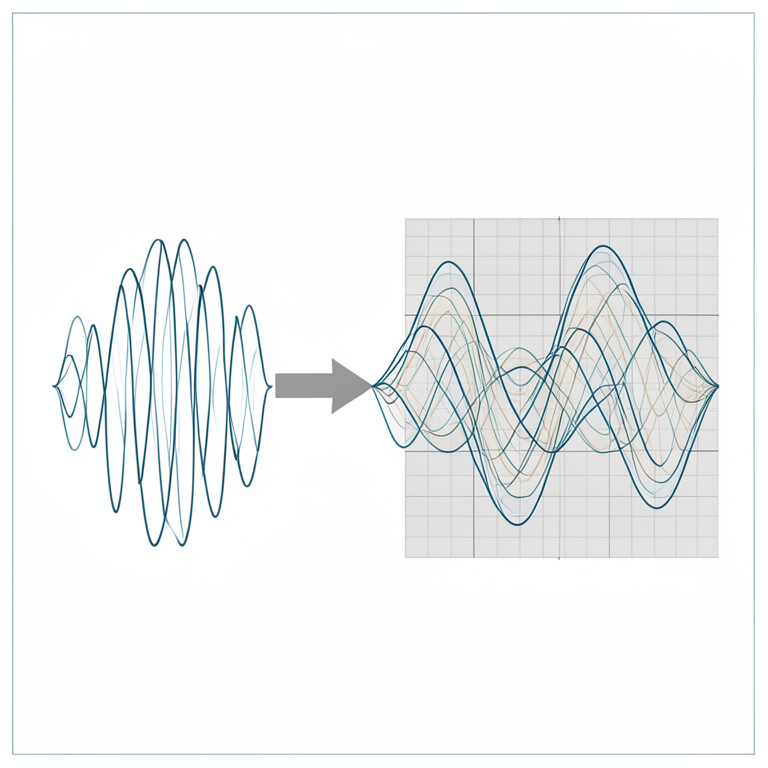
Generalization of Periodicity
AI-generated conceptual illustration (mathematical wave functions on a coordinate plane). It explains the idea and does not show study data.
View source evidence ↗Introduction Basic Definitions
A functions f: R ⟶ X is almost periodic if from every sequence {S n } there is a subsequence {α n } (avoiding the necessity for double subscripts when taking subsequences) such that the sequence {f(t + {f(t+α n )} in linear space X converges uniformly on the real line R. The sequence {α n } will be denoted byt α in the sequel and T α f=g means that g(t)=lim f(t+ α n ) and is written only when the limit exists, where T designates translation operator, The hull of almost periodic function is defined as H (f)={g: there exists a sequence α with Tαf uniformly} in order to talk about uniformly almost periodic family it is convenient to introduce Bochner's Translation function For an almost perodic function we express number V f (τ) = sup. {∥ f(t + τ) -f(t) ∥ for all t ∈ R} consequently. A family ℱ of almost periodic function on a linear space is said to be uniformly almost periodic family if it is bounded and if for a preassigned number ∈> 0. Then T (f, ∈) =∩ 𝑇(𝑓, ∈) is relatively dense and includes on interval about 0. Now we wish to enumerate the following important results on Bochner's translation function which will be frequently used in the sequel [2]
almost periodic where the first three result hold trivially and (iv) follows from the fact:
and consequenlty (v) immediately follows.
Main Results
We will want to make some basic observation before we peoceed. Almost periodic functions are intended to be generalization of periodic functions in some sense. It is clear that the periodic functions satisfy the deficnition of an almost periodic funtion in the sense of Bochner. Indeed, if f has period τ, then from the given sequene {s n } we may select a subseqence {α} such that {α n (mod. σ)} converges to σ 0. Then lim 𝑓(𝑡 + 𝛼 𝑛 ) = 𝑓(𝑓 + α 0 ). Thus the almost periodicity of f for periodic f is a statement about the compactness of A = {f τ : f τ (𝑡) = 𝑓(𝑡 + τ)} in the space of continuous function with the uniform norm. for general almost periodic functions we replace compactness by pre-compactness or by A having compact closure.
The concept of uniformly almost periodic family includes the notion of uniformly boundedness and equicontinuity. In fact all uniformly almost periodic families are uniformly bounded and equinuiformly continuous, that is ∥ f ∥ sup ∥ f(t) ∥< 𝑀 𝑓𝑜𝑟 𝑎𝑙𝑙 𝑓 ∈ ℱ where M depends only on the family, and there is a δ > 0𝑠𝑜 𝑡ℎ𝑎𝑡 ∥ 𝑓(x) -f(y) ∥<∈ 𝐹f whenever lx-yl<𝛿. Families with these two properties are pre-compact in the topology of uniform convergent on compacta of R [3] . This fact will be used in almost every argument in our later discussion on differential equation, so that it needs precision. Let {f n } be a sequence of functions from R to C such that there is a number M for which ∥f n ∥≤ M for all n and for a preassigned number ∈> 0 however small there corresponds 𝛿 > 0 such that 1f n (x) -f n (y)1 ∈ for all n whenever 1x -y1 < 𝛿. Then there is a subsequence which converges uniformly on every compact subset of R.
Theorem 1: H (f) is compact in uniform norm if and only if f is almost periodic.
Proof: Let us assume that H(f) is compact. Then it is sequentially compact, that is, given a sequence {s n } there is a subsequence α = {α n } such that Tαf exists uniformly on R. Hence f is almost periodic. Conversely, let f be almost periodic and {σ n } is a sequence from H(f) then we pick s n such that ∥ f(t + s n ) -σ n (t) ∥< 1/𝑛. We can find a subsequence of {s n } so that Tαf exists uniformly. Let β be a subsequence of {n} so that β and α are common subsequences, then f(t + αn) -σ βn (t) → 0 so that σ βn → Tαf. Since we are considering H (f) as a metric space we observe that the compactness is equivalent to the fact that the set of translates {f(t+τ)} for τϵ R is totally bounded These remarks prove the following theorem which is adopted by Von Neumann as the definition.
Theorem 2:
The function f is almost periodic if and only if for ever ϵ >, there are numbers a 1 , a 2 ......................, a n and a function n(t) from R to {1,2..............n} such that ∥ f(t + a n τ) ∥<∈ for all t and τ.
Proof: If α is given with Tα g=h uniformly g∈ H(f), then select a subsequence β so that ∥ f(t + β n ) -g(t + α n ) ∥< 1/𝑛. If follows that Tβf = h so that h ∈ H(f). Thus H (g) ⊆ H(f). On the other hand, if Tαf=g then ∥ f(t + α n ) -g(t) ∥→ 0 so making the change of variable τ + α n → s, one has ∥ f(s)g(s -α n ) ∥→ 0, i. e. , T -α g = f.
References
3 in the original paper- Bochner S. A new approach to almost periodicity Mathematics 1962, 8:(2039-2043)
- Cardineanu C. Almost periodic function. Interscience Publication New York, 1968.
- Sell GR. Non autonomous differential equations and to pological dynamics, 1967.