
Research article · 2020 · Full text
International Journal of Advanced Biochemistry ResearchStudy of serum alkaline phosphatase in chronic kidney disease
Volume 4(2) · Pages 20–23 · DOI: 10.33545/26174693.2020.v4.i2a.51 ↗
Research areasPancreatitis Pathology and TreatmentAlkaline Phosphatase Research StudiesLiver Disease Diagnosis and Treatment
Abstract
Author-writtenIntroduction: Chronic kidney disease (CKD) now a day becomes an emerging condition with increasing morbidity and mortality. CKD associated with disturbances in alkaline phosphatase levels significantly alters in stage 4 and 5. Serum ALP levels have been shown to have a promoting effect on vascular calcification. So, correlation of ALP with renal failure is also well established.Aim: To compare the level of serum ALP, urea and creatinine among the CKD patients and healthy controls.Materials and method: About 50 CKD patients in stage 4 & 5 in dialysis unit and 50 healthy subjects between the age group 30-60 yrs were included in this study carried out from May2018 to January2020 at Noor hospital and IIMSR Medical College, Warudi, Maharashtra. Serum level of ALP, urea and creatinine were measured by fully autoanalyzer. Statistical analysis is done by minitab version 17 software.Results and conclusion: The results are presented as a mean ±SD and ‘P’ values of less than 0.05% is considered as significant. In our study ALP, urea and creatinine are increased in stage 4 and 5 CKD patients.
Summary
Source-checkedPlain-language reading of the full paper, prepared with AI and checked against the text. Each point links to the authors' own words.
Why it matters
- Chronic kidney disease (CKD) is a global health issue characterized by a progressive loss of kidney function and high risks of cardiovascular disease and death. View evidence ↗
- Serum alkaline phosphatase (ALP) is believed to promote vascular calcification via the pyrophosphate pathway, linking it to renal failure. View evidence ↗
- CKD is staged by estimated glomerular filtration rate (eGFR), with complications becoming more frequent in stages 3, 4, and 5. View evidence ↗
The question
- The study aimed to compare serum levels of ALP, urea, and creatinine between patients with CKD and healthy control subjects. View evidence ↗
What they did
- The study included 50 patients with advanced CKD (stages 4 and 5) aged 35-60 years and 50 age-matched healthy controls. View evidence ↗
- The research was conducted between April 2018 and December 2019 at Noor Hospital and IIMSR Medical College in Maharashtra, India. View evidence ↗
- Serum levels of urea, creatinine, and ALP were measured using an Erba EM200 fully automated analyzer with Erba diagnostic kits. View evidence ↗
- Data analysis was performed using Minitab version 17, employing Student's t-tests to compare means between the two groups. View evidence ↗
What they found
- Serum urea levels were significantly higher in CKD patients (76.41±13.23 mg/dl) compared to controls (28.88±5.49 mg/dl), with p < 0.001. View evidence ↗
- Serum creatinine levels were significantly elevated in CKD patients (4.032±1.18 mg/dl) versus controls (0.83±0.21 mg/dl), with p < 0.001. View evidence ↗
- Serum ALP levels were significantly higher in CKD patients (431±29±237.11 U/L) than in controls (80.18±0.74 U/L), with p < 0.01. View evidence ↗
- The eGFR was significantly lower in CKD patients (15.66±6.3 ml/min/1.73m2) compared to controls (92.6 ±24.6 ml/min/1.73m2), with p < 0.01. View evidence ↗
- There was no significant difference in age between the CKD patient group (47.20±5.42) and the control group (47.29±4.75). View evidence ↗
What it means
- The authors suggest that clinicians can use serum ALP as a risk assessment tool to identify patients at higher risk for mortality and progression to end-stage renal disease. View evidence ↗
- The authors recommend further research into novel ALP inhibitors to determine if suppressing vascular smooth muscle cell calcification can reduce morbidity and mortality in CKD and cardiovascular disease. View evidence ↗
Visual summary
3 visualsIllustrations explain the paper; charts are replotted from the paper's own table values.
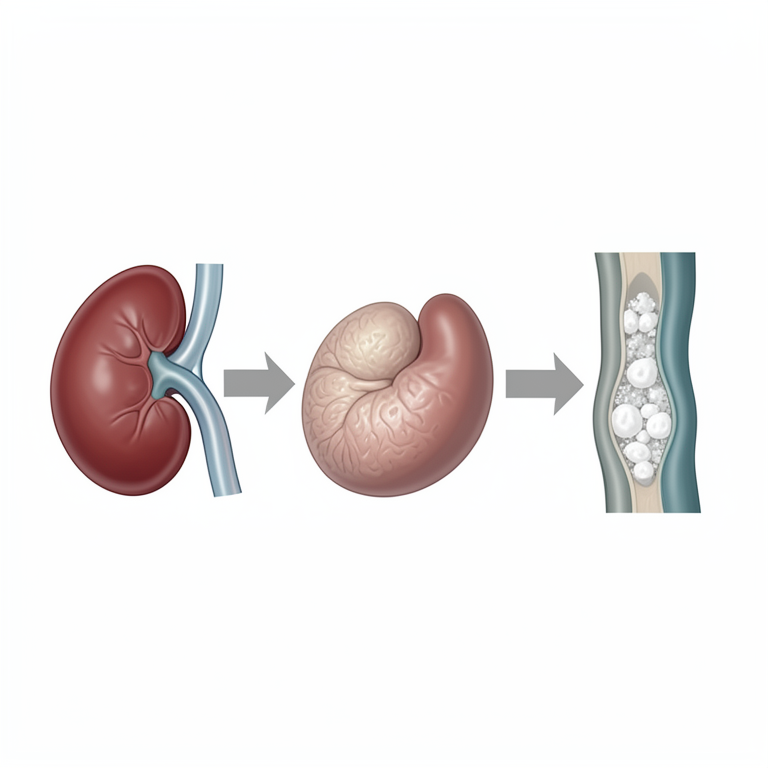
ALP and CKD Progression
AI-generated conceptual illustration (human kidneys and blood vessels). It explains the idea and does not show study data.
View source evidence ↗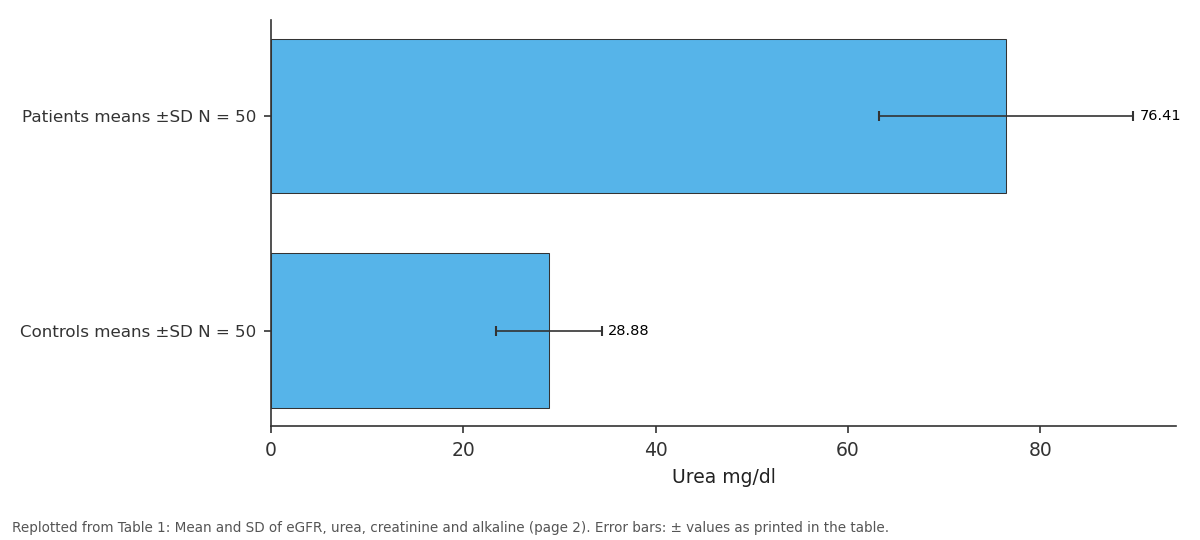
Urea mg/dl: Patients means ±SD N =... vs Controls means ±SD N =...
Replotted from Table 1 (page 2) of the original paper. Every bar is the paper's own table value.
View source evidence ↗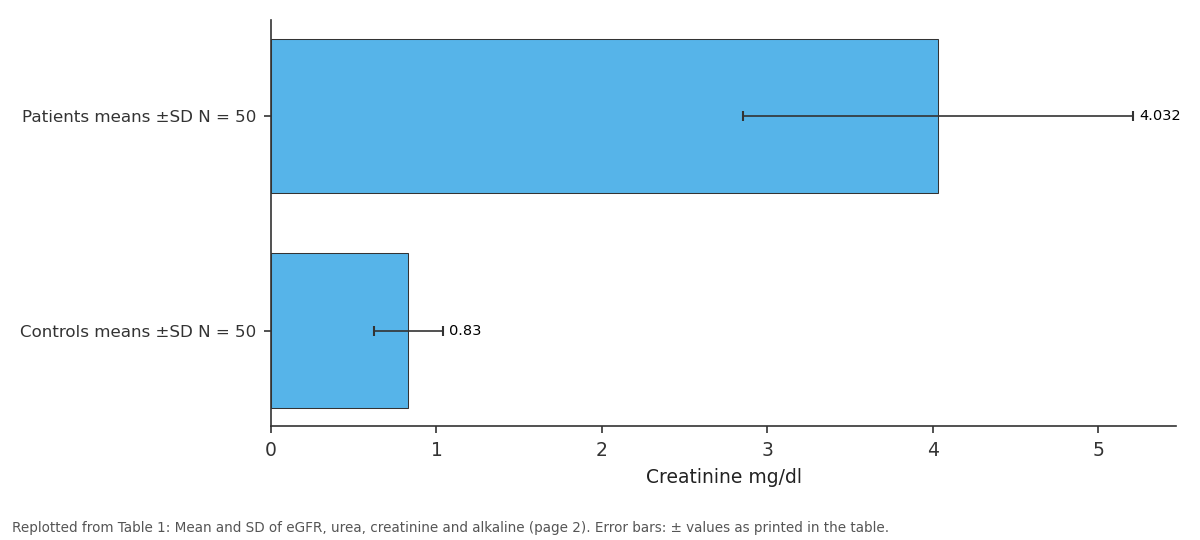
Creatinine mg/dl: Patients means ±SD N =... vs Controls means ±SD N =...
Replotted from Table 1 (page 2) of the original paper. Every bar is the paper's own table value.
View source evidence ↗Figures & tables
From the original paper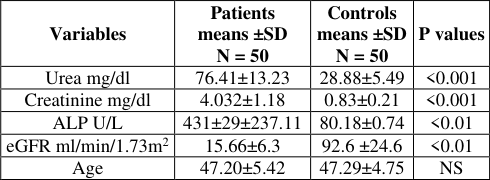 Table 1
Introduction
Chronic kidney disease (CKD) is a worldwide public health problem with increasing prevalence and potentially lethal adverse outcomes like progressive loss of kidney function, cardiovascular disease and premature death. According to the kidney Disease Outcomes Quality Initiative (KDOQI) of the National Kidney Foundation (NKF) defines CKD as either kidney damage or a glomerular filtration rate (GFR) <60ml/min/1.73m 2 for 3 or more months with pathological abnormalities or damage, including abnormalities in blood or urine tests [1] . CKD is now recognized as a major medical problem worldwide. The Global Burden of Disease (GBD) study ranked CKD 17 th among the cause of death globally (age standardized annual death rate of 19.2 deaths per 100000 populations). In India, GBD 2015 ranks CKD as the eighth leading cause of death. Death due to renal failure constituted 2.9% of all deaths in 2010-13 among 15-69 years old, an increase of 50% from 2001-03 [2] . In patients with CKD including those undergoing hemodialysis therapy or predialysis CKD stages (1-5) various abnormalities related to mineral and bone disorders with certain enzyme defects have been implicated as novel risk factors of mortality [3] . Serum ALP levels have been shown to have a promoting effect on vascular calcification through the pyrophosphate pathway. In addition to the directly toxic effects of the contrast agent, disturbances in renal blood flow, vasoconstriction of renal vessels, oxidative stress, free radical damage and endothelial dysfunction are thought to be major mechanisms in the development of kidney disease [4] . CKD consists of a wide spectrum of conditions associated with a progressive decline in kidney functions and abnormal glomerular filtration rate (GFR). According to the recent guidelines of the National Kidney Foundation is classified into1-5 stages based on estimated GFR (eGFR).In stage 1 & 2 no symptoms associated with decreasing eGFR. In stage 3, 4 and 5 complications are more common [5] . Disturbance in mineral metabolism and bone disease are common complications of CKD. CKD affects about 5-10% of the world population and the expected incidence is approximately 5-8% every year [1] . Elevated ALP is associated with increased mortality in patients with predialysis CKD. Low ALP appears to be associated with short term mortality [6] . Serum ALP increases in patient with CKD and high turnover bone disease. Several mechanism link ALP to inflammation. Circulating ALP correlates well with circulating CRP and ALP has been suggesting as a component of hepatic acute phase reactant. Higher ALP has been associated with increased mortality and coronary calcification in dialysis patients. The ubiquitous expression of ALP and its involvement in several pathophysiological processes with CKD & CVD. Circulating ALP is better predictor of incident fractures in dialysis patients than bone mineral density. Circulating ALP is a robust and independent risk marker for CVD, mortality in the general population and in CKD [7] . Studies conducted in the general population and in the CKD patients have shown independent associations between ALP and an increased risk of cardiovascular events, hospitalization and death, higher ALP levels are associated with an increased risk of all-cause mortality end stage renal disease (ESRD) [5] . Exclusion criteria: CKD patients those who are on peritoneal dialysis. Exclusion of patients with earlier stages of CKD with eGFR estimated ≥ 60 ml/min/1.73m 2. Who had albumin urea and other structure abnormalities. Statistical analysis was done by Minitab version 17 software. Student 't' test was applied to compare the difference between the two means. The serum parameters in all cases had been measured using fully automated Erba 200 routine chemistry analyzer with commercial kits (Erba diagnostics) Estimated GFR was calculated in each cases by the formula. Equation from the modification of diet in Renal Disease study eGFR---ml/min/1.73m 2 = 1.86 ˣ PCr -1.154 ˣage-0.203 multiplied by 0.742.
Material and Methods
Material and Methods
Results
In this study characteristics were summarized according to quarantiles of ALP levels and presented as number percentage for continuous variables with a normal distribution. The reported P values are two -sided and reported as significant at <0.05 for all analyses. For those with a skewed distribution. Differences across quartiles were assessed using analysis of variance and chi-squared tests for continuous and categorical variables respectively. All analyses were conducted using minitab version 17.
Discussion
Serum ALP is a membrane anchored ectoenzymes that catalyzes the hydrolysis of organic pyrophosphate, which has been shown to be a protective factor for vascular integrity. It has been proposed that ALP may play a role in the pathophysiology of renal dysfunction patients with CKD had relatively higher ALP levels with statistical significance.
The vasculopathic effect of ALP was initially shown in dialysis patients. Vascular calcification is one of the major contributors to atherosclerosis, which leads to vascular hardening, ageing and final significant vascular event.
Upregulation of serum ALP levels has been observed in vessels with medical calcification, which supports the mediator role of ALP [4] . Leibovitch et al., proposed serum ALP levels have been established as a marker of renal damage. Several studies have reported that the urinary ALP levels may predict early detection of diabetic nephropathy, even with a normal serum creatinine levels. Thus, the serum ALP levels may predict subclinical renal damage [8] . Historically, ALP level has only been considered a surrogate of bone metabolism in patients with CKD and ESRD. ALP is derived from various tissues but is mostly concentrated in the liver, biliary duct, bone and placenta. Tissue nonspecific ALP inactivates pyrophosphate an endogenous inhibitors of hydroxyapatite formation, resulting in medical arterial vascular calcification. Under conditions such as hypertension, ageing, diabetes and CKD, vascular cells undergo osteoblastic differentiation and express several bone associated proteins, including ALP. Subsequently, this differentiation leads to mineralization of the endothelium, arterial stiffening and vascular calcification, arterial stiffness might contribute to the progression of CKD. Elevated ALP levels are associated with an increased risk of ESRD and all cause in CKD patients. These findings, along with previous studies suggest that, clinicians may use ALP as a risk assessments tool to identify patients with higher risk for mortality and/or progression to CKD [9] . Recently emerging evidence from large-scale cohort studies suggests that serum ALP levels are associated with higher risk for mortality not only in the general population but also in CKD patients [6] . However, in CKD patients, renal osteodystrophy could result in a significant increase in the bone isoenzyme of ALP contributing to high serum ALP level. In fact, higher ALP has been associated with increased mortality in predialysis CKD as well as patients on maintenance hemodialysis [5] . In our study, the serum ALP levels were significantly higher in CKD patients with or without end stage renal disease. (ESRD). Human ALP is produced by tissue nonspecific liver, intestinal and placental type enzymes. A number of studies have provided evidence that, a portion of ALP human kidney is of intestinal type [10] .
Recent studies have shown that, non-dialysis dependent CKD populations, higher ALP levels are associated with increased risk for all-cause mortality. In kidney diseases Improving Global Outcomes recommended that ALP measured annually in patients with CKD stage 4 and 5.
Higher ALP levels are independently associated with an increased risk for end stage renal disease and death in those with CKD stage 3 and 4. We evaluated the relationship between ALP and CKD for late stage [11] . High serum ALP is associated with increased mortality. An analysis of Dialysis Outcomes and Practices Patterns Study (DOPPS) database found that elevated serum ALP in hemodialysis patients were associated with higher risk of hospitalization and death.
To summarize this study brings significant increase in ALP levels in CKD. All these parameters were found in worse with increase in the stage of CKD highlighting the higher risk of lethal complications secondary to impaired metabolism with poorer renal function [1] . Serum ALP levels are commonly elevated in CKD and dialysis patients. The osteoblast is a prominent source of ALP. As hyperparathyroidism and high turnover bone disease are common is a dialysis patient. A potential mechanism for this increased mortality in vascular calcification. Pyrophosphate in the arterial wall is a potent inhibitor of vascular calcification. By hydrolyzing pyrophosphate, ALP can promote vascular calcification. In addition to vascular calcification, there are other potential mechanisms that may mediate the associations of serum ALP increased might be associated with inflammation. These data suggest that, elevated serum ALP levels might reflect not only altered bone mineral metabolism but also an atherogenic milieu and inflammation. So ALP not only merely a marker of bone mineral metabolism. Higher ALP levels had poorer nutritional status, lower muscle mass and inflammation and thus were more likely to be susceptible to severe infections [12] . Elevated ALP levels are associated with higher risk of adverse clinical outcomes mortality, cardiovascular events, hospitalization. Mortality in dialysis patients suggests their potential value as a treatment target. Further studies are needed to determine if interventions that lower pre ESRD. ALP levels can reduce mortality after dialysis initiation.
Conclusion
Elevated ALP is associated with increased mortality in patients with dialysis CKD. Circulating ALP is better predictor of incident fractures in dialysis patients than bone mineral density. Circulating ALP is a robust and independent risk marker for CVD, mortality in the general population and in CKD. We suggest that, clinician may use ALP as a risk assessment tool to identify patient with higher risk for mortality and end stage renal disease progression. These abnormalities start in early stages of CKD and worse with disease progression, so understanding of the pathophysiological consequences of the same and planning management strategies to prevent disease progression.
Given the prognostic importance of ALP, it may serve as a target for the treatment of hemodialysis patients, further research may be done for the role of novel ALP inhibitors that suppress vascular smooth muscle cell calcification in reducing mortality and morbidity in CKD and CVD.
Figures and tables from the paper
References
12 in the original paper- Freethi R, Velayutha Raj A, Kalavathy Ponniraivan, Rasheed Khan M, Sundhararajan A, Venkatesan. Study of serum levels of calcium, phosphorus and alkaline phosphatase in chronic kidney disease. International Journal of Medical Research & Health Sciences 2016;5:3:49-56.
- www.thelancet.com/lancetgh 2017;5. Comment uncovering the rising kidney failure deaths in India.
- Csaba Kovesdy P, Vitalie Ureche, Jun Lu L, Kamyar Kalantar-Zadeh. Outcome predictability of serum alkaline phosphatase in men with pre-dialysis CKD. Nephrol Dial Transplant 2010;25:3003-3011.
- Ahmet Karabulut, Irfan Sahin, Ilhan Ilker Avci, Ertugrul Okuyan, Zeki Dogan, Bulent Uzunlar, Mahmut Cakmak, Muhammet Gurdogan. Impact of serum alkaline phosphatase level on the pathophysiologic mechanism of contrast-induced nephropathy. Kardiol Pol 2014;72(10):977-982.
- Lopamudra Ray, Sunil Kumar Nanda, Anirban Chatterjee, Rajlaxmi Sarangi, Satyaki Ganguly. A comparative study of serum aminotransferases in chronic kidney disease with and without end-stage renal disease: Need for new reference ranges. International Journal of Applied and Basic Medical Research 2015;5 (1):31-35.
- Jin-Gang Zhua, Ben-Chung Chengb, Wen-Chin Lee B, Lung-Chih Li B, Chih-Hsiung Lee B, Gang Longa JinBor Chen. Serum Alkaline Phosphatase Levels are Not Associated with Increased Death Risk in Prevalent Hemodialysis Patients: 5-Year Experience in a Single Hemodialysis Center. Kidney Blood Press Res 2016;41:498-506.
- Mathias Haarhausa BC, Dean Gilhamd, Ewelina Kulikowskid, Per Magnussonb, Kamyar KalantarZadehe FG. Pharmacologic epigenetic modulators of alkaline phosphatase in chronic kidney disease. Novel therapeutic approaches in nephrology and hypertension. 2020;29(1):4-15.
- Leibovitch I, Ben-Chaim J, Ramon J, Goldwasser B. Increased serum alkaline phosphatase activity: A possible indicator of renal damage. J Clin Lab Anal 1991;5:406-409.
- Sankar Navaneethan, Jonathan Taliercio. Chronic kidney disease, elevated serum alkaline phosphatase, end-stage renal disease nephrology, Urology & Nephrology / Nephrology 2014.
- David Alpers H, Katherine Deschryver-kecskemeti, Carol Goodwin L, Carol Tindira A, Herschel Harter, Eduardo Slatopolsky. Intestinal Alkaline Phosphatase in Patients With Chronic Renal Failure. Gastroenterology 1986;94:62-7.
- Jonathan Taliercio J, Jesse Schold D, James Simon F, Susana Arrigain, Anne Tang, Georges Saab MD, Joseph Nally V Jr, Sankar Navaneethan D. Prognostic Importance of Serum Alkaline Phosphatase in CKD Stages 3-4 in a Clinical Population. Am J Kidney Dis 2013;62(4):703-710.
- Sriharsha Damera, Kalani Raphael L, Bradley Baird C, Alfred Cheung K, Tom Greene, Srinivasan Beddhu. Serum alkaline phosphatase levels associate with elevated serum C-reactive protein in chronic kidney disease. Kidney International 2011;79:228-233.