
Research article · 2017 · Full text
International Journal of Statistics and Applied MathematicsA study on certain types of multi-level continuous sampling plans (CSPs) and its operating procedures
Volume 2(6) · Pages 303–306
Research areasAdvanced Statistical Process MonitoringIndustrial Vision Systems and Defect DetectionQuality and Safety in Healthcare
Abstract
Author-writtenSampling plans are commonly used in manufacturing industries and government firm for controlling the quality of shipments of components, supplies, raw materials and final products. This paper furnish various kinds of continuous sampling plans and its operating procedures. The implementation of single- and multi-level continuous sampling plans, such as CSP-1, CSP-2, CSP-T, CSP-V, CSP - M and CSP-F (Markov chain modal) which provides for alternating sequences of 100%inspection which contain some differences due to the implementation and the theoretical foundation among them.
Summary
Source-checkedPlain-language reading of the full paper, prepared with AI and checked against the text. Each point links to the authors' own words.
Why it matters
- Sampling plans are essential tools used by government firms and manufacturing industries to maintain the quality of raw materials, components, and final products. View evidence ↗
- Continuous sampling plans (CSPs) are specifically designed for environments where production is continuous, distinguishing them from traditional lot-by-lot acceptance sampling. View evidence ↗
- CSPs provide an alternative approach to quality control in cases where grouping products into lots is not favorable. View evidence ↗
The question
- The aim of this paper is to provide a detailed overview of various types of continuous sampling plans and their respective operating procedures. View evidence ↗
What they did
- The paper examines several single- and multi-level plans, including CSP-1, CSP-2, CSP-T, CSP-V, CSP-M, and the Markov chain model CSP-F, all of which utilize alternating sequences of 100% inspection. View evidence ↗
- The fundamental parameters used to define these continuous sampling plans are the sampling frequency (f) and the clearing number (i). View evidence ↗
What they found
- In the CSP-1 plan, 100% inspection is performed until 'i' consecutive units are defect-free, after which the process switches to sampling one out of every X units. View evidence ↗
- Under CSP-1, if a defect is found during the sampling phase, the system immediately reverts to 100% inspection until another 'i' consecutive units are found to be defect-free. View evidence ↗
- In the CSP-C procedure, sampling continues at fraction 'f' until a total of 'c+1' non-conforming units are identified, triggering a return to 100% inspection. View evidence ↗
- The CSP-T plan utilizes multiple levels of inspection; for example, level 2 involves inspecting a reduced fraction of f/2 of the units. View evidence ↗
What it means
- The author concludes that while CSP-1, CSP-2, CSP-C, CSP-M, and CSP-T all serve as multi-level continuous sampling plans, they differ significantly in their theoretical foundations, operating procedures, and performance. View evidence ↗
Visual summary
1 visualsIllustrations explain the paper; they do not show study data.
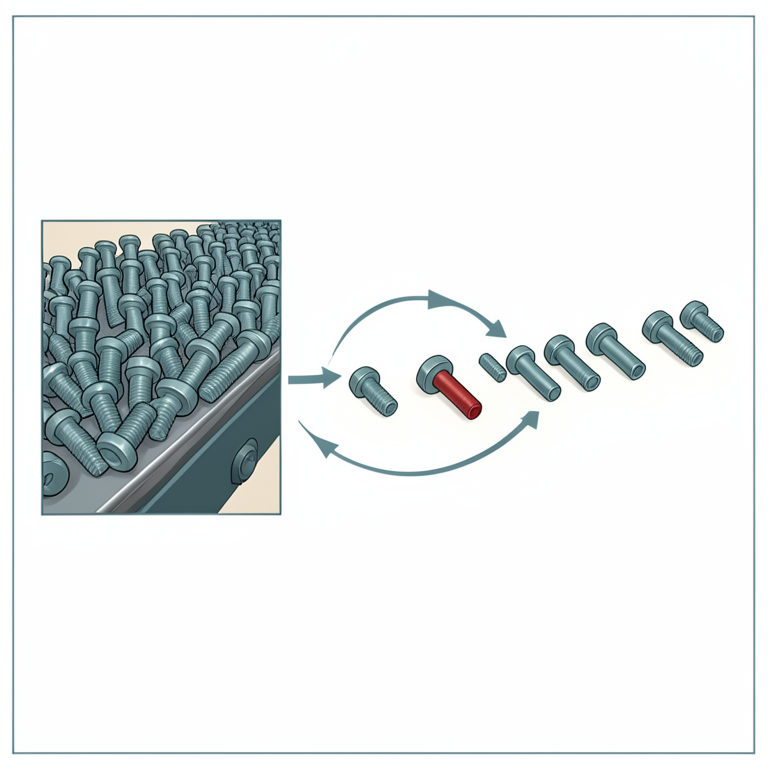
CSP-1 Operational Cycle
AI-generated conceptual illustration (industrial manufactured metal bolts on a conveyor belt). It explains the idea and does not show study data.
View source evidence ↗Introduction
Acceptance Sampling Plans are introduced mainly to accept or reject the lots of completed products in that period the concept of Continuous Sampling Plans was first introduced by H.F. Dodge. Continuous sampling plans are used where production is continuous and it is differ from lot-by-lot acceptance sampling plans. Lot acceptance sampling plans are used to test the units and submitted for evaluation against certain hypotheses. From a manufacturing perspective, it provide a check on a company's quality control processes. Most Lot acceptance sampling plans samples of a product are bring out in lots. In typical sampling a hypotheses of the sample makes up the precedent by which the process is judged. That is the samples are accepted or rejected on the basis of the set forth hypothesis. If a process has been tested plentiful, then the lot or unit is accepted and passed on to customer. But the quality control is not adequate; sampling will prevent unacceptable products from manufacturer. Accept or reject a lot or unit is synonymous with not rejecting or rejecting the null hypothesis in the hypothesis test. Because grouping into lots is not always favor, continuous sampling as outlined below, takes a quiet different approach to quality control in manufacturing. Dodge (1943) [6] has introduced the concept of continuous sampling, that continuous sampling plan is called as CSP-1. The plan provides the mathematical rationale and rules of operation for CSP-1 continuous sampling plan and it is used where product flow is continuous and not easily grouped in lots. Two parameters exist for continuous sampling. One of the frequency is f and the second is the clearing number i. The frequency f is defined by a number such as 1/20, 1/30, or 1/X. The clearing number (i) are 30 or 60. A company checks all of its product until 100% inspection of i number of units and found to be defect free. After 100% inspection of i number of units are found to be mistake free then 100% inspection is discontinue, and one out of every X number of units is checked. The sampling continues until a defect is found. After finding a defect the cycle repeats itself until 100% of i number of units has been found to be free of defect. At this point the sample 1/X will begin again. The Execution of a continuous sampling plan is simple and it can be carried in 3 steps. 1. All i data are Inspect. 2. If Shortcoming are not found, randomly sample fraction f of data and check again for defects. 3. Whenever a Shortcoming is found, correct the fault and repeat step 1.
There are two parameters are consider when executing a continuous sample. All other important measurements for continuous sample planning can be develop from those two parameters. The relevant measures for continuous sampling plans are average outgoing quality and average fraction inspection etc. i = Clearance number for short-run CSP -1 plan p -The probability of a unit crop by the process being nonconforming (or) the incoming fraction defective. Pa (p) -The probability of acceptance during sampling point when the submitted quality is p.
Operating Procedure of CSP-1
In Single level continuous sampling plan Dodge (1943) [6] has two procedures, namely procedure A and procedure B. Procedure A presumes a continuous flow individual units and procedure B is applicable to a product of continuous flow of sub-lots.
Procedure-A
At the outset, inspect 100% of the unit consecutively as produced and continue such inspection until iunits in succession are found clear of defects. When iunits in succession are found clear of defects, discontinue 100% inspection and inspect only a fraction f of the units selecting individual sample units one at a time from the flows of product in such a manner it assures an unbiased sample. If a sample unit is found defective, revert immediately to a 100% inspection of succeeding units and continue until again i units in succession are found clear of defects as in paragraph (a). Correct or replace all defective units found with good units.
Procedure-B
At the outset, start inspection 100% of the unit in a sub lot and continue such inspection unit i inspected units in succession are found clear of defects. When i units in succession are found clear of defects, discontinue sub-inspection and inspect only a fraction f of the units from each of the sub lots, selecting the sample units in such a way as in represent the sub lot. If a sample units is found defective, start a 100% inspection of the reminder of the sub lot and continue the 100% inspection until again i inspected units in succession are found clear of defects, as in paragraph (a) extending such inspection into succeeding sub lots if necessary. If 100% inspection extends into one or more succeeding sub lots and if the units inspected exceeds a fraction f of the units in the sub lot, accept without further inspection and if it is less than f inspect additional units from the same sub lot to make up the sample equal to a fraction f of the number of units in the sub lot. Correct or replace all defective units found with good units.
The CSP-1 plan is defined by two parameters, f and i which can be changed at will and in general i is an integer and f is a fraction, 0<f<1. The average fraction of total production, Pa (p), accepted or passed on a sampling basis is given by
Specify f= sampling frequency, i = clearing interval Begin 100 % inspection. After i units in succession have been found without a defective, start sampling procedure. Randomly inspect a fraction of the units. When a defective is found, continue sampling for k successive sample units. Dodge (1943) [6] followed the power series approach to derive performance measures whereas Lieberman and Solomon (1955) [9] followed Markov-Chain methods. Roberts (1955) defined the states for CSP-1 and derived AOQ by solving the resulting Markov-Chain of CSP-1 for equilibrium probabilities of the states.
Conditions for Application
There is continuous flow of units from the production process and units are offered for inspection one by one in the order of production. The process is producing or capable of production materials whose process quality level is stable. Sample space, equipments, and work force are provided at or near the site of inspection to permit rapid 100% inspection when required. The inspection is relatively easy and quick, eg. or Visual inspection or automatic inspection. The inspection is non-destructive since the procedure incorporates 100% screening. The sampling procedures can apply to defective units, defect (individual or classes).
Continuous sampling plans are applicable to situations where there is continuous flow of products and these products are submitted for inspection in the order of production.
Operating Procedure of CSP-2
At the outset, inspect 100% of the units consecutively as produced and continue such inspection until i units in succession are found clear of defects. When I units in succession are found clear of defects discontinue 100% inspection and inspect only a fraction of the units, selecting individual sampling units one at a time from the flow of product in such a manner it assures an unbiased sample. When a defect is found continue the sampling but keep count the no. of units inspected after finding the defect. If a defect is found in the next k or less units inspection is reverted to 100% inspection and if no defect is found in the next k sample units continue the sampling units till the next defect is found, then repeat the same procedure starting from the beginning of the same paragraph. CSP-2 plan has been designated with three parameter I, f and k the minimum number of conforming units required between any two non-conforming units. Here we consider k=i so that the number of parameters is reduced to two. The Average fraction of total production accepted on a sampling basis is
Operating Procedure of CSP-C
Step 1: At the outset, inspect 100% of the units consecutively in the order of production and continue the inspection until i units in succession arefound conforming.
Step 2: When i units in succession are found conforming, discontinue 100% inspection and inspect only a fraction f (51/n) of the units, selecting individual units one at a time from the ōw of the product in such a manner as to ensure an unbiased sample, and continue the sampling inspection until a total of (c+1) non-conforming sampled units havebeen found. Step 3: When the number of non-conforming sampled units reaches c+1, discontinue the sampling inspection and revert to 100% inspection of units as per Step 1. Step 4: Correct or replace all non-conforming units found with conforming units.
Kandasamy & Govindaraju (1991) [2] proposed the following performance measures and derived them by following approach.
The Operating Characteristic (OC) function giving the average fraction of total production accepted on a sampling basis is given by
The average outgoing quality (AOQ) is given by
The procedure is as follows Specify f= sampling frequency i= clearing interval Begin 100% inspection After i units in succession have been found without a defective, start sampling procedure. Randomly inspect a fraction of the units. When a defective is found, continue sampling for k successive sample units.
If no defective is found in the i samples, continue sampling on a normal basis. IF a defective is found in the i samples, revert 100% inspection immediately.
Operating Procedure of CSP-M
1. Specify the clearing interval i, the initial sampling frequency f, and the maximum number of inspection levels k0 2. Set k = 1 and begin 100% inspection. 3. After i units in succession have been found without a defective, start at a rate of fk. 4. If I sampled units are found free of defects, increase k by one and go to step 3. However, k must not ex-ceed k0, that is k £ k0. 5. If a defective is found, decrease k by one and go to step 3.
The Operating Characteristic (OC) function giving the average fraction of total production accepted on a sampling basis is given by
The average outgoing quality (AOQ) is given by
The procedure is as follows Specify f= sampling frequency i= clearing interval Begin 100% inspection After i units in succession have been found without a defective, start sampling procedure. Randomly inspect a fraction of the units. When a defective is found, continue sampling for k successive sample units.
If no defective is found in the k samples, continue sampling on a normal basis. IF a defective is found in the k samples, revert 100% inspection immediately.
Operating Procedure of CSP-T
The operating procedure of the CSP-T plan is given below.
Step1: The procedure starts with 100% inspection of units in the order of production.
(i) If the first i consecutive units are found non-conforming discontinue 100% inspection and switch to sampling inspection at level 2, where only a pre-specified fraction f/2 of the units are inspected. (ii) Otherwise, continue 100% inspection until any run of i successive units found non-conforming and then proceed to sampling inspection at level 1, where only a prespecified fraction f of the units are inspected.
Step2: If the sampling inspection is in level 1, then continue the inspection until a non-conforming unit is found. When this occurs revert immediately to 100% inspection and then continue as in Step1.
Step3: If the sampling inspection is in level 2 or level 3, then continue the inspection until a non-conforming unit is found. When this occurs revert immediately to 100% inspection and then;
(i) If the first i consecutive units are found conforming then discontinue 100% inspection and switch to sampling inspection at level 3, where a pre-specified fraction f/4 of the units are inspected. (ii) Otherwise, continue as in Step 1(ii).
Step4: Replace or correct all the non-conforming units found with conforming units. CSP-T plan with its parameters are i, f, and k. Where k = i this sampling plan. The average fraction of total production, Pa (p), accepted or passed on a sampling basis is given as: The Average fraction of total production accepted on a sampling basis is
The procedure is as follows Specify f= sampling frequency i= clearing interval Begin 100% inspection
Conclusion
Acceptance sampling is the technique which deals with the procedure in which decisions to accept or reject the lots or process are based on the examination of samples. The work presented in this paper mainly relates to the Multi-level continuous sampling plans namely CSP-1, CSP-2, CSP-C, CSP-M and CSP-T contain some differences due to the performance, operating procedures and the theoretical foundation among them.
References
10 in the original paper- Balamurali S, Govindaraju K. Modified Tightened TwoLevel Continuous Sampling Plans. Journal of Applied Statistics. 2000; 27:397-409.
- Balamurali S, Kalyanasundaram M, Chi-Hyuck Jun. Generalized CSP-(c1-c2) sampling plan for continuous production processes. International Journal of Reliability, Quality and Safety Engineering. 2005; 12(2):75-93.
- Balamurali S, Chi-Hyuck Jun. Modified CSP-T Sampling Procedures for Continuous Production Processes, Quality Technology & Quantitative Management. 2004; 1(2):175-188.
- Chung-Ho Chen, Min-Tsai Lai. Minimum Average Fraction inspected for CSP-M Plan, Tamkang Journal of Science and Engineering. 2006; 9(2):151-154.
- Dodge HF. A Sampling Inspection Plan for Continuous Production, the Annals of Mathematical Statistics. 1943; 14:264-279.
- Dodge HF, Torrey MN. Additional continuous sampling Inspection plans, Industrial Quality Control. 1951; 7:712.
- Lieberman GJ, Solomon H. Multi-level continuous sampling plans. The Annals of Mathematical Statistics. 1955; 26:686-704.
- Schilling EG. Acceptance Sampling in Quality Control, Marcel Dekker, Inc, 1982.
- Montgomery DC. Introduction to statistical quality control", 2 nd edition, John Wiley & sons, Inc., New York, 1991.
- Stephens KS. How to Perform Continuous ampling (CSP), 2nd edn. 1995,2.