
Research article · 2019 · Full text
International Journal of Statistics and Applied MathematicsLimited failure censored life test sampling plan in half logistic distribution
Volume 4(3) · Pages 11–13
Research areasAdvanced Statistical Process MonitoringReliability and Maintenance OptimizationTechnology Assessment and Management
Abstract
Author-writtenThe random life time of a product in a submitted lot for acceptance or otherwise is assumed to follow Half Logistic distribution. The decision making process is based on the inspection of a sample of items for their lifetimes taken from the lot. Such a sample is divided into groups to develop a group sampling plan with a mechanism of terminating life testing process as soon as the first failure in each group is noticed. The criterion for accepting the submitted lot is proposed.
Summary
Source-checkedPlain-language reading of the full paper, prepared with AI and checked against the text. Each point links to the authors' own words.
Why it matters
- Reliability Sampling Plans are used in acceptance sampling to make decisions about product quality based on the measured lifetime of the products. View evidence ↗
- Traditional sampling plans typically focus on determining the minimum number of items to test and an acceptance number for failures within a set termination time. View evidence ↗
- The Limited Failure Censored Life Test Sampling Plan (LFCLTSP) is an alternative methodology to traditional reliability sampling plans. View evidence ↗
The question
- The aim of this research is to develop a Limited Failure Censored Life Test Sampling Plan (LFCLTSP) specifically for the Half Logistic distribution. View evidence ↗
What they did
- The proposed plan uses a group sampling approach where the testing process for a group is terminated as soon as the first failure occurs. View evidence ↗
What they found
- The authors find that the LFCLTSP consistently results in smaller values for m, meaning fewer items need to be subjected to life testing compared to other plans. View evidence ↗
- The illustrative example demonstrates that the plan can reach a rejection decision using only a fraction of the groups (three out of six), reducing experimental costs and product destruction. View evidence ↗
What it means
- The authors conclude that the LFCLTSP provides a strong and efficient method for making lot acceptance decisions. View evidence ↗
Figures & tables
From the original paper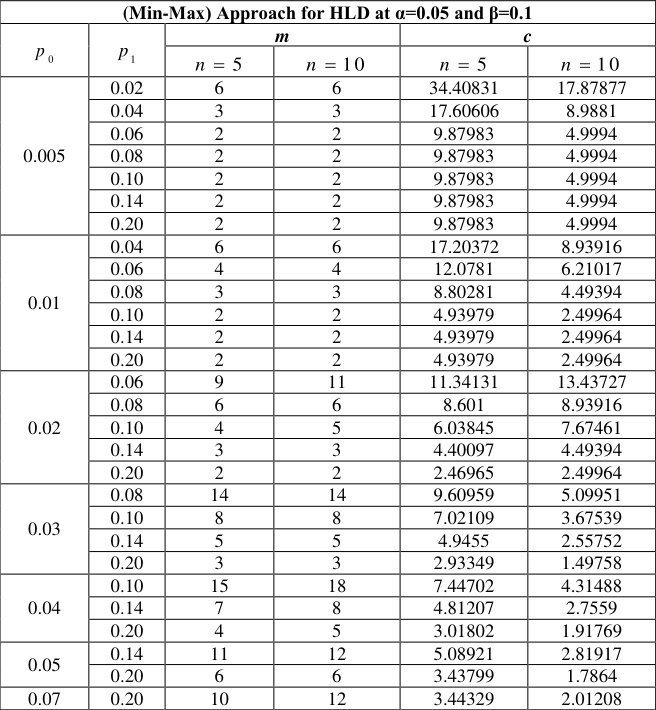 Table 1
Introduction
Acceptance sampling is concerned with inspection and decision making regarding products. If the quality of a product is measured through the life time, sampling plans to determine acceptability of a product with respect to life time are called Reliability Sampling Plans. When the life time random variable is assumed to follow a specific continuous probability distribution, sampling plans are developed by various researchers covering a wide spectrum of probability models. Most of these works are referred in a recent article by Kantam and Ravikumar (2016) [2] . In all these works, given the termination time of a life test, the construction of the sampling plan consists of determining the minimum number of sample items that are to be life-tested and the acceptance number beyond which the observed failures out of the life-tested items of the sample lead to rejection of the submitted lot, conditioned on pre specified producer's and consumer's risks. Deviating from the methodology of these works, Kantam and Ravikumar (2016) [2] proposed a new sampling plan called Limited Failure Censored Life Test Sampling Plan (LFCLTSP). Similar work is done by Srinivasarao et al. (2018) [5] for Dagum distribution. In fact LFCLTSP is an alternative criterion to what is proposed by Jun et al. (2006) [1] . Also the probability model considered by Jun et al. (2006) [1] is the Weibull distribution whereas the probability model considered in Kantam and Ravikumar (2016) [2] is Burr Type X distribution both are popular life testing models. This scheme of life testing and termination process is named by some researchers as Sudden Death Testing (for example Pascual and Meeker -1998; Jun et al. (2006)) [4,1] . 'Limited failure censored life tests' is the name proposed by Wu et al. (2001) [6] . In the present paper, LFCLTSP is developed for the probability model Half Logistic distribution on lines of Kantam and Ravikumar (2016) [2] . Construction of LFCLTSP for Half Logistic distribution is presented in Section -2. The results are explained by an example in Section -3.
The proposed sampling plan
Let the limited failure censored sample - 1 2 , , ..., m Y Y Y which are m first order statistics in m independent random samples of size n each. If Z denotes the maximum of 1 2 , , ..., m Y Y Y it may also be viewed as the total test time/experimental time as opined by Kantam and Srinivasa Rao (2004) [3] .
Hence, larger realised value of Z can be considered as an indication that the products in the submitted lot have longer life prompting one to consider the lot as a good lot for acceptability. In other words "" Z cL can be taken as a criterion of acceptance of the lot. Thus Kantam and Ravikumar (2016) [2] proposed following decision rule.
The fraction non-conforming or unreliability is expressed by
If 𝑝 is given, the corresponding L is obtained from
The cdf of least of 1 2 , , ..., n X X X is given by
(1 ) ( ) 1 1 ( ) Therefore, m can be obtained by the smallest integer satisfying (2.13). The acceptability constant c can be obtained from the equality case in either of the expressions (2.11), (2.12). We have tabulated the values of m and c analytically determined for the selected combinations of 𝑝 0 , 𝑝 1 and is presented in Table 1. The values of m obtained by LFCLTSP can be seen to be consistently smaller, thus this sampling plan indicating less number of items to be put to life test. . i.e., 185 < 191.769, the lot is to be rejected. From this example, we see that our approach reached the decision of rejecting the lot by conducting limited failure censored life test for only three groups of 10 items each, resulting in low cost of experimentation and lower number of destructions. More over it may be recalled that Z are defined as . That is acceptance decision of LFCLTSP is considered and gives a stronger conclusion with this illustration.
| (Min-Max) Approach for HLD at α=0.05 and β=0.1 | — | — | — | — | — |
|---|---|---|---|---|---|
| p 0 | p 1 | m | c | ||
| n 5 | n 10 | n 5 | n 10 | ||
| 0.005 | 0.02 | 6 | 6 | 34.40831 | 17.87877 |
| 0.04 | 3 | 3 | 17.60606 | 8.9881 | |
| 0.06 | 2 | 2 | 9.87983 | 4.9994 | |
| 0.08 | 2 | 2 | 9.87983 | 4.9994 | |
| 0.10 | 2 | 2 | 9.87983 | 4.9994 | |
| 0.14 | 2 | 2 | 9.87983 | 4.9994 | |
| 0.20 | 2 | 2 | 9.87983 | 4.9994 | |
| 0.01 | 0.04 | 6 | 6 | 17.20372 | 8.93916 |
| 0.06 | 4 | 4 | 12.0781 | 6.21017 | |
| 0.08 | 3 | 3 | 8.80281 | 4.49394 | |
| 0.10 | 2 | 2 | 4.93979 | 2.49964 | |
| 0.14 | 2 | 2 | 4.93979 | 2.49964 | |
| 0.20 | 2 | 2 | 4.93979 | 2.49964 | |
| 0.02 | 0.06 | 9 | 11 | 11.34131 | 13.43727 |
| 0.08 | 6 | 6 | 8.601 | 8.93916 | |
| 0.10 | 4 | 5 | 6.03845 | 7.67461 | |
| 0.14 | 3 | 3 | 4.40097 | 4.49394 | |
| 0.20 | 2 | 2 | 2.46965 | 2.49964 | |
| 0.03 | 0.08 | 14 | 14 | 9.60959 | 5.09951 |
| 0.10 | 8 | 8 | 7.02109 | 3.67539 | |
| 0.14 | 5 | 5 | 4.9455 | 2.55752 | |
| 0.20 | 3 | 3 | 2.93349 | 1.49758 | |
| 0.04 | 0.10 | 15 | 18 | 7.44702 | 4.31488 |
| 0.14 | 7 | 8 | 4.81207 | 2.7559 | |
| 0.20 | 4 | 5 | 3.01802 | 1.91769 | |
| 0.05 | 0.14 | 11 | 12 | 5.08921 | 2.81917 |
| 0.20 | 6 | 6 | 3.43799 | 1.7864 | |
| 0.07 | 0.20 | 10 | 12 | 3.44329 | 2.01208 |
Table text extracted from the original PDF; superscript letters are shown inline. The original table image is below.
View original table image
References
6 in the original paper- Jun Ch-H, Balamurali S, Lee SH. Variables Sampling Plans for Weibull Distributed Lifetimes under Sudden Death Testing. IEEE Transactions on Reliability. 2006; 55(1):53-58.
- Kantam RRL, Ravikumar MS. Limited Failure Censored Life Test Sampling Plan in Burr Type X Distribution. Journal of Modern Applied Statistical Methods. 2016; 15(2):428-454.
- Kantam RRL, Srinivasa Rao G. A Note on Savings in Experimental Time under Type II Censoring. Economic Quality Control. 2004; 19(1):91-95.
- Pascual FG, Meeker WQ. The Modified Sudden Death Test: Planning life tests with a limited number of test positions. Journal of Testing and Evaluation. 1998; 26(5):434-443.
- Srinivasa Rao B, Sricharani P, Ravikumar MS. Limited Failure Censored Life Test Sampling Plan in Dagum Distribution. American Journal of Applied Mathematics and Statistics. 2018; 6(5):181-185.
- Wu J-W, Tsai T-R, Ouyang L-Y. Limited FailureCensored Life Test for the Weibull Distribution. IEEE Transactions on Reliability. 2001; 50(1):107-111.