
Research article · 2019 · Full text
International Journal of Statistics and Applied MathematicsAnalysis of a fishery model with a depensation term
Volume 4(2) · Pages 44–49
Research areasMathematical and Theoretical Epidemiology and Ecology ModelsEvolutionary Game Theory and CooperationEvolution and Genetic Dynamics
Abstract
Author-writtenWe formulate a mathematical fishery model with over-fishing induced Allee effect and stock dependent harvesting, since fish populations when reduced to low densities experience reduced rates of survival and reproduction. The model takes the form of a set of differential equations in which the population growth equation has a depensation term. The other two equations describe the evolution of the fishing mortality E and the market price p. Aggregation is performed to reduce the model from a system of three equations to a system of two equations. Analysis of the model yields four points of equilibria. Local stability analysis is done for the equilibria points with zero harvesting.
Summary
Source-checkedPlain-language reading of the full paper, prepared with AI and checked against the text. Each point links to the authors' own words.
Why it matters
- Fish populations can suffer from reduced survival and reproduction rates when their density becomes too low. View evidence ↗
- The Allee effect describes a phenomenon where over-fishing can cause fish populations to persist at dangerously low densities. View evidence ↗
- Traditional logistic growth models are limited because they do not account for the possibility of population extinction. View evidence ↗
The question
- The authors aim to create a continuous-time mathematical model that tracks fish population evolution considering the Allee effect, fishing mortality, and market price. View evidence ↗
What they did
- To simplify the analysis, the authors used aggregation to reduce the three-equation system to two equations, assuming market prices adjust faster than fish stocks and fishing effort. View evidence ↗
- The stability of the model's equilibrium points was analyzed by linearizing the system and examining the trace and determinant of the resulting Jacobian matrix. View evidence ↗
What they found
- The analysis of the aggregated model identified four distinct equilibrium points. View evidence ↗
- Adding the depensation term to the growth equation introduced an additional equilibrium point (T, 0) that was not present in previous models. View evidence ↗
What it means
- The authors conclude that the interior equilibrium point (n*, E*) is the most critical for predicting whether a fishery will face extinction or achieve sustainable harvesting. View evidence ↗
- The authors indicate that further analysis is needed to examine the model's behavior across varying values of the threshold population T. View evidence ↗
Visual summary
1 visualsIllustrations explain the paper; they do not show study data.
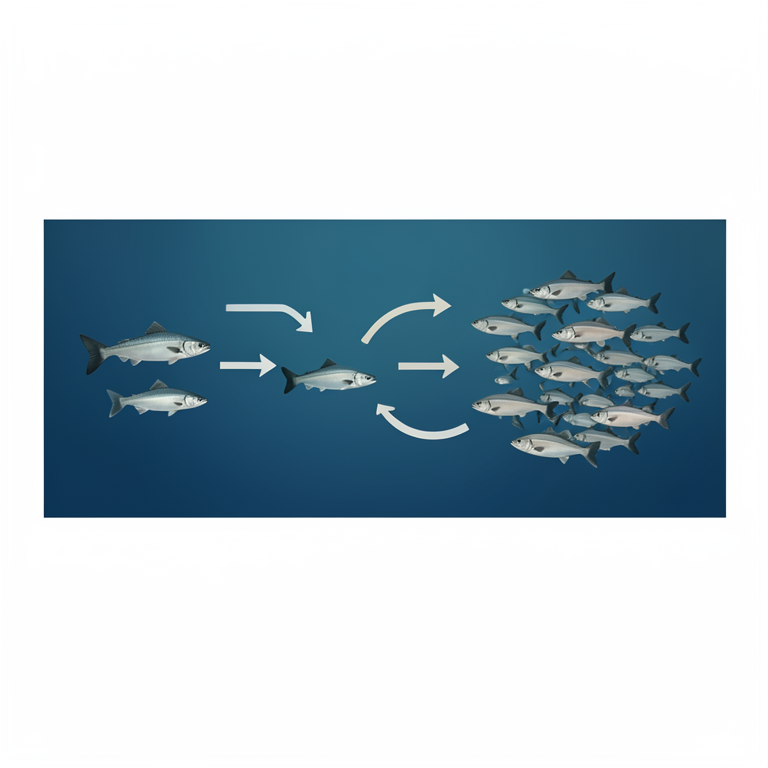
Equilibrium State Map
AI-generated conceptual illustration (Atlantic cod in a marine environment). It explains the idea and does not show study data.
View source evidence ↗Introduction
In population dynamics, the growth of a population can be described if the functional behavior of the rate of growth is known. Single species population models have been considered in several forms, see for instance [2,3,4,6,12] , involving ordinary differential equations, delay differential equations and the discrete maps. Most often, logistic equation is used with an assumption that reducing density results in the same or higher per capita growth which implies that populations are resilient and recover rapidly when factors causing the decline are removed. Fish populations exhibit social co-operation behaviourism which provides individuals a greater chance of survival and reproduction as the density increases, whereas when reduced to low densities, they experience reduced survival and reproduction rates. Over-fishing can cause the population of a fishery to persist at low densities, this is attributed to a phenomena known as the Allee effect in population dynamics. Allee effect is defined as " a positive relationships between component of individual fitness and either numbers or density of conspecifics", Allee effect therefore produces a positive density dependence in which fitness increases with increasing density, see for instance [1,11,24] . Bio-economics mainly considers the exploitation of renewable resources from the point of control theory see for instance [10,13] , focussing on the existence of the maximum sustainable yield (MSY), which is the maximum proportion that can be removed from the stock over time without causing population decline below the optimum level. This theory however is not necessarily the best management see for instance [15] , since the long run consumption profile does not coincide with that of utility maximization. MSY policy only takes into consideration the benefits of resource exploitation but completely disregards the cost of operation of resource exploitation.
Earlier Fishery models
Fish population models have been considered in numerous works with interest in fishery management in consideration due to the ecological effects of harvesting, see for instance [10] . Many fishery models takes into account two state variables; n (t), the resource measured in Kg per unit area and E (t), fishing mortality. Earlier contributions had models which read as
Where f(n) and h(n,E) are the growth and harvesting functions respectively, p the price of a unit resource c, the cost per unit of harvesting the resource and β an adjustment parameter. In [23] a time continuous model is considered while in [7] a time discrete version is considered. Mathematical models such as in Equation (1) consider two equations; the first equation represents the variation with time of the fishery resource density which is due to the natural growth and harvesting. The second equation describes the time variation of the number of firms involved in resource exploitation which is assumed to increase when the exploitation is rentable and conversely. Reference is also made to the fishery models in [21] . The fishery was assumed to grow logistically with f(n) taking the form
With r the intrinsic growth rate and K, the carrying capacity in the first Equation of (1). Harvesting is according to Type 1 functional response commonly known as the Schaefer function where H (n,E) = qnE, With q, a positive constant called capturability or catchability. In [18] , the same variables are considered but with an addition of the third equation describing the nonlinear variation in market price. Several models have been also been considered of fish population with effects of over-fishing and with Allee effect,
For y > 0, 0 < T < K, where r, T and K are the parameters of a given fish population whose population is denoted by y (t) and E (t) is the fishing effort is considered in [8] while
where 0 < a < 1 denote the Allee effect, n(t) the fish population at time t and f the fishing rate, is considered in [12] .
In this paper, we formulate a continuous time mathematical model of a fishery describing the evolution of the fish population that exhibits Allee effect, the fishing mortality and the market price. In the real world ecological habitats, the model can reflect a telescoping of effects which influence the population. Since, in a real ecological habitat, there is a complexity of time evolutions of the natural populations due to the nonlinearity of the biological growth functions and the ecological complexity of interactions among species accompanied with resource exploitation for economic benefits. A traditional, continuous time model of an open access considered in cases above, based on the logistic net growth, does not allow for extinction see for instance [11] . Existence of fish populations at low population levels hence a risk of extinction or even eventual extinction has been reported, see for instance [9, 16] . A growth function with a depensation term, is thus more plausible to examine the existence of such populations at this unstable population level states.
The model Equation
The study of the population dynamics at the unstable population level states is the main concern coupled with harvesting that is driven by the market price. The most feasible model to study this variables is thus:
With the variables and parameters having the same meaning and sense as in [18] , though with the equation in population having a different derivation. If n (t) is the population of the fish species at the time t, then the rate of change of the population n˙ = birth -death + Migration Is the conservation equation for the population. If we consider the simplest form of the conservation equation, then we have n˙ = bn (t)dn (t), (5) Equivalent to
Where r = b-d is a constant intrinsic growth rate. Such a population growth exhibited by (6), may be valid within a very short period of time but cannot persist forever, since r changes with n (t) due to population limiting factors like food supply and oxygen levels occasioned by intraspecific interactions. If r:= r (n) is now considered to be dependent on n(t), such that r(n) is a decreasing linear function of n(t) supposedly given by
When equation ( 7) is brought into equation ( 6), we obtain
where K is the limiting population referred to as the carrying capacity. When n > K, ˙n < 0 and the population decreases since the members of the species compete with each other for limited resources whereas if n < K, n >˙ 0 and the population grows approaching K. Since existence of fish population at low levels is a phenomena in fisheries and even extinction of species a reality in several ecological habitats, a change of the sign of r to negative and replacing the carrying capacity K with a threshold population T gives us the equation;
In this equation, if n (t) < T, the population dies out whilst when n (t) > T, the population explodes. The decay of the population explains the failure of the species to benefit from social cooperative behaviourism like enhanced reproduction and predator surveillance. The rapid growth in population is occasioned by positive population density factors where the species enjoys high reproduction rates and enhanced predator surveillance but since the population cannot explode uncontrollably, we consider a model equation with both threshold population T and the carrying capacity K. An equation to describe such growth dynamics is
Taking into account the fishing mortality, we represent this with the equation h(n, E) = qn E where q is a catchability constant and nE is the fish biomass harvested due to the fishing effort E see for instance [22] . The complete equation with a depensation term now takes the form
The Equation (11) together with the equation in harvesting and in market price as seen in [18] constitutes the model which reads;
Equilibrium points 3.1 Aggregation
The model in Equation ( 12) can be reduced to a model of two equations through aggregation whereby We consider that the market price evolves comparatively faster than the fish stock and the fishing effort since suppliers adjust to the market prices and the fishery conditions in order to avoid loses and recoup their investment and make profit. Appropriate aggregation enables the reduction of the model to a system of two differential equations, See for instance [22] and [24] . The price in the harvesting effort is replaced with the nontrivial equilibrium values p: = p * . p * , which solves p˙ = αp (A -p -qnE) = 0 (13) To obtain
Such that the second equation now becomes
We take β = 1, which is a maximum value in the range 0 ≤ β ≤ 1 and may occur when the environmental conditions and harvesting are favorable for stock growth in the fishery. This aggregation makes us obtain;
A system of two differential equations.
Equilibrium points
Equilibrium points for the system in Equation ( 16) are the n-nullclines and the E-nullclines with
Where (n * , E * ) are the interior points that are solutions of the system
Whose equilibrium points can be denoted by E 1 , E 2 , E 3
Local stability analysis
To analyse the stability of the equilibrium points of ( 16), we linearise the system about the equilibrium points and study the trace and determinant of the matrix of linearisation, as various parameters are varied. The matrix of linearisation defines a linear map which is the best linear approximation of the function near the equilibrium point and it gives information about the local behaviour of the function. We consider the equilibrium points where the harvesting is zero. Equation ( 16) can be expressed as
, , , , : , At E0 the Jacobian matrix is Whose eigenvalues are: -r and -c. Since both are negative, the equilibrium point E0 is a stable equilibrium point. At E1,
, then J(K,0) is a stable equilibrium point, for both eigenvalues are negative but if Aq c K , then J(K,0) is a saddle point since one eigenvalue is negative and the other positive. At the equilibrium E 2 , the Jacobian matrix is given by
, then J (T,0) is unstable since both eigenvalues are positive.
Discussion and Conclusion
We have presented a fishery model with a depensation term which addresses the dynamics at the unstable threshold population levels T. Analysis of the model through aggregation and determination of equilibrium solutions yields four equilibrium points
It is observed that inclusion of the depensation term in the growth equation yields one more equilibrium point (n 1 , E 1 ) = (T, 0) not earlier obtained in [18] . Local stability analysis performed on the equilibria shows that (n 0 , E 0 ) = (0, 0) is a stable equilibrium point. Any population having a value close to zero will move to zero in time even in the absence of harvesting. This is trivial since the absence of fish population implies no harvesting can be done and this state is stable. The equilibrium (n 1 , E 1 ) = (T, 0) is a either a saddle or unstable depending on the values of the parameters c, A, q and T. Though in both cases, this equilibrium point is unstable. In the absence of harvesting population close to T will decay towards zero or grow logistically to the carrying capacity in case of other perturbation other than human harvesting. This is feasible since human harvesting is not the only cause mortality. The equilibrium (n 2 ,E 2 ) = (K,0) is either a saddle or stable, in most ecological habitants, this equilibrium will be stable since in the absence of human harvesting, the populations beyond the carrying capacity decays towards carrying capacity whereas those populations below the carrying capacity but above the threshold population will grow towards the carrying capacity in time.
The equilibrium points here discussed poses minimal economic activity for the fishery but fisheries for recreational benefits like sport fishing may be addressed by these long term behaviour. The equilibrium (n 3 , E 3 ) = (n * , E * ) is of most concern to both economists and conservationists since its analysis will give the behaviour real prediction of extinction or sustainable harvesting. This analysis shall be performed at varying values of of the threshold population T.
References
23 in the original paper- Allee WC. The social life of Animals, William Heinemann, London, 1938.
- Arne E, Frode S, Olsen F, Ola F. Harvest Functions: The Norwegian Bottom Trawl Cod Fisheries. Marine Resource Economics. 2003; 18:81-93.
- Arino O et al. Delay differential equations and Applications in single species dynamics, Springer, Berlin. 2006; 20:477-517.
- Auger P, Mchich R, Nadia R, Kooi BW. Effects of market price on the dynamics of a spatial model: Over exploited fishery / Traditional fishery. Ecological complexity, 2009.
- Auger P, Arnould D. A model of a fishery with fish stock involving delay equations, Phil. Trans. Royal Society, 2009, 367.
- Barbier EB, Strand L, Sathirathai S. Do open access conditions affect the valuation of an externality? Estimating the welfare effects of mangrove-fishery linkages, Env. Resour. Econ. 2002; 21:343-367.
- Bailey Steinworth et al. Modelling of a fish population and the effects of overfishing, Project report, James Madison University, Virginia USA, 2010.
- Boyce WE, Diprima CR. Elementary Differential Equations and Boundary Value Problems, 8 th (ed), John Wiley and Sons Inc, New York, 2005.
- Bapan Ghosh et al. Relationships between exploitation, oscillation, MSY and extinction, Mathematical Biosciences. 2014; 256:1-9.
- Courchamp F, Berec L, Gascoigne J. Allee effects, Oxford University press, Oxford, 2008.
- Corinne Wentworth et al. Optimum Harvesting Models for Fishery Populations, Project report, St. Mary's College of Maryland, USA, 2011.
- Clark CW. Mathematical Bio-economics: The optimal Management of renewable resources, 2nd (Ed), Wiley, New York, 1990.
- Elaydi SN, Sacker J. Population models with Allee effects: A new model, Journal of Biological dynamics, Archived paper, 2009.
- Kar TK, Matsuda H. Sustainable Management of a Fishery with a strong Allee effect, Trends in Applied Sciences Research. 2007; 2(4):271-283.
- Lafrance JT. Linear demand functions in theory and practice, Journal of Economic theory. 1985; 37:147-166.
- Mackey MC. Commodity price fluctuations: Price dependent delays and nonlinearities as explanatory factors, Journal of Economic theory. 1989; 48:498-509.
- Makwata H et al. Stability Bifurcation Analysis of a fishery model with nonlinear variation in Market Price, 2018.
- JD. Mathematical Biology, Springer Verlag, Berlin, 1993.
- Mchich R, Auger PM, Bravo de la parra R, Raissi N. Dynamics of a fishery on two fishing zones with fish stock dependent migrations: aggregation and control, Ecological modeling. 2002; 158(2):51-62
- Poggiale JC, Auger P. Aggregation and Emergence in Systems of Ordinary Differential Equations, Math. Comput. Modelling, 1998; 27(4):1-21.
- Schaefer MB. Some considerations of population dynamics and economics in relation to the management of the commercial marine fisheries, J. Fish Res. Board Canada. 1957; 14:669-681
- Smith VL. On models of commercial fishing, Political Economy. 1969; 77(2):181-192.
- Stephens PA, Sutherland WJ, Freckleton RP. What is Allee effect? Oikos. 1999; 87(1):185-190.
Cited by 1
From OpenAlex, OpenCitations and reference lists read by Scinovex
- Factors influencing the dynamics of a collapsed blue swimmer crab (Portunus armatus) population and its lack of recovery ↗
Rachel Marks, S. Alex Hesp, Ainslie M. Denham, Neil R. Loneragan, Danielle Johnston, Norman G. Hall · Fisheries Research · 2021
❝ 17