
Research article · 2017 · Full text
International Journal of Statistics and Applied MathematicsHydromagnetic heat and mass transfer flow with time dependent suction and porous medium in rotating system
Volume 2(6) · Pages 161–171
Research areasNanofluid Flow and Heat TransferHeat and Mass Transfer in Porous MediaHeat Transfer and Optimization
Abstract
Author-writtenIn the present paper free convection and mass transfer effects in the unsteady flow of an incompressible, electrically conducting, viscous liquid in a porous medium past an infinite porous vertical plate with time dependent suction in a rotating system in the presence of uniform magnetic field applied perpendicular to the flow region is studied. The effects of magnetic parameter, rotation parameter, Grashof number, heat source parameter, Prandtl number, permeability parameter, modified Grashof number and Schmidt number or primary velocity and secondary velocity for cooling case and the effects of the above stated parameters on primary velocity and secondary velocity for cooling case and the effects of the above stated parameters on primary velocity and secondary velocity for heating case are discussed with the help of graphs while the effects of these parameters on skin-friction are discussed with the help of graphs while the effects of these parameters on skin-friction are discussed with the help of tables. The rate of heat transfer and the rate of mass transfer are also discussed with the help of tables.
Summary
Source-checkedPlain-language reading of the full paper, prepared with AI and checked against the text. Each point links to the authors' own words.
Why it matters
- Free convection problems are significant due to their role in nuclear reactors, powder transformers, and atmospheric and oceanic circulations. View evidence ↗
- The study focuses on the unsteady flow of an incompressible, electrically conducting, viscous liquid in a porous medium past an infinite porous vertical plate with time-dependent suction in a rotating system under a uniform magnetic field. View evidence ↗
The question
- The research aims to determine how parameters such as the magnetic parameter, rotation parameter, Grashof number, and Prandtl number affect primary and secondary velocities in both cooling and heating cases. View evidence ↗
What they did
- The problem is formulated using a Cartesian coordinate system (x, y, z) to model the oscillatory flow of a viscous liquid past an infinite vertical porous plate with a constant heat source. View evidence ↗
- The mathematical analysis ignores the Hall effect, buoyancy force, polarization effect, induced magnetic field, and field perturbation effects. View evidence ↗
- The study uses specific Prandtl numbers to represent different fluids, with Pr = 0.71 for air and Pr = 11.4 for water. View evidence ↗
What they found
- The rate of mass transfer decreases as the Schmidt number (Sc) increases, but increases as n or time (t) increase. View evidence ↗
Visual summary
1 visualsIllustrations explain the paper; charts are replotted from the paper's own table values.
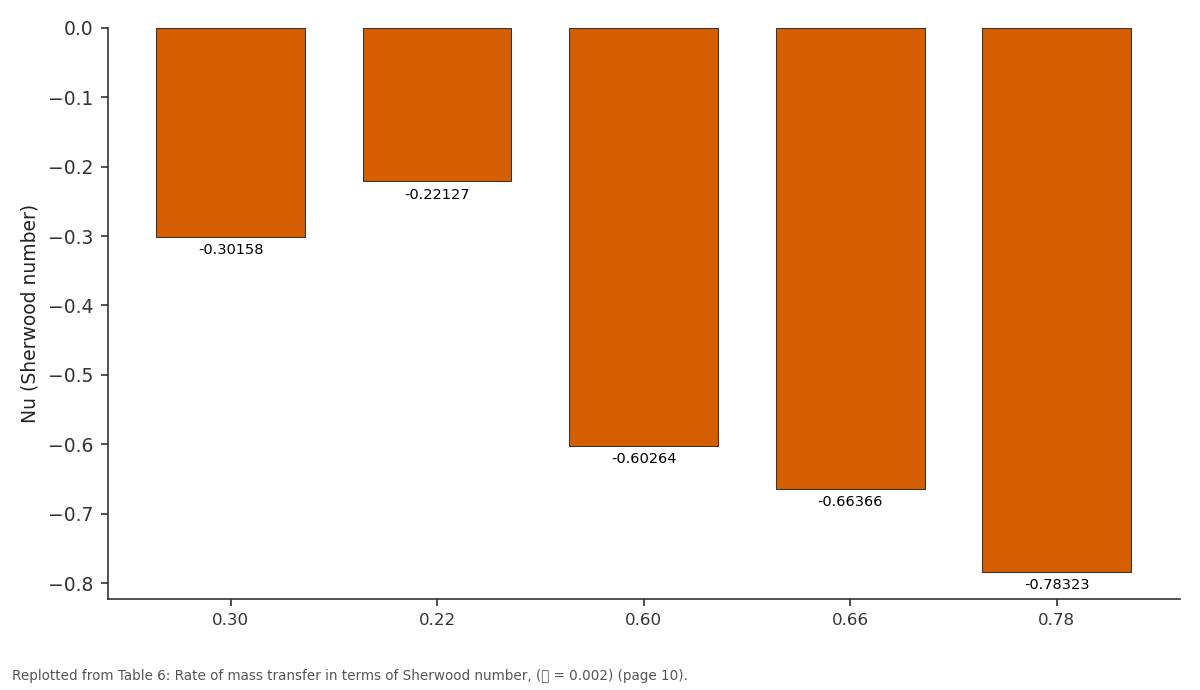
Nu: 0.30 vs 0.22 vs 0.60 vs 0.66 vs 0.78
Replotted from Table 6 (page 10) of the original paper. Every bar is the paper's own table value.
View source evidence ↗Figures & tables
From the original paper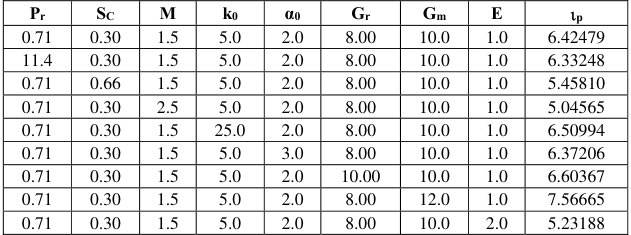 Table 1
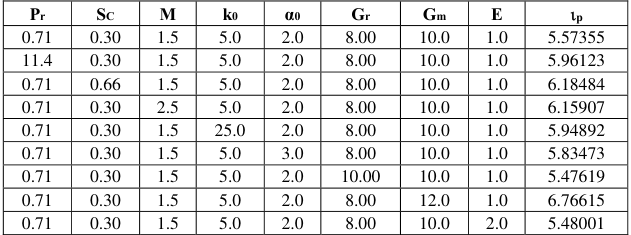 Table 2
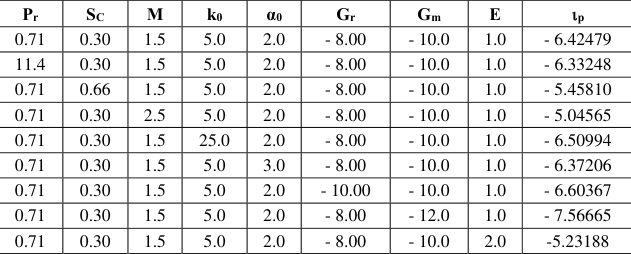 Table 3
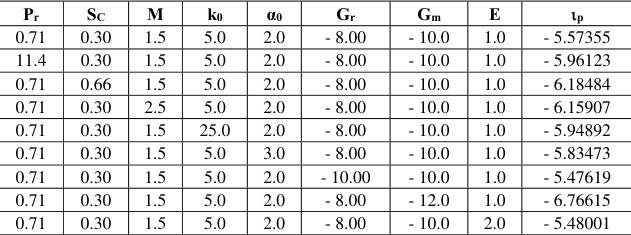 Table 4
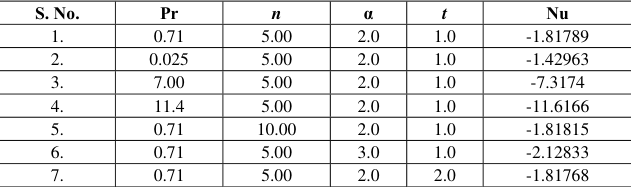 Table 5
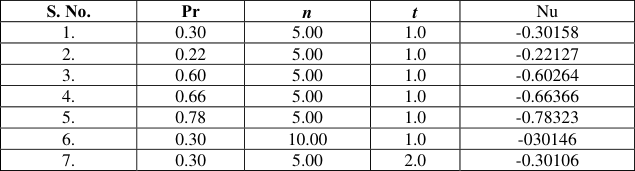 Table 6
Introduction
Free convection problem have attracted a considerable amount of interest because of its importance in atmospheric and oceanic circulations, nuclear reactors, powder transformers etc. Extensive review of the free convection flows in rotating system has been done by Gebhart (1973). Jana & Dutta (1977), Place & Daguenet (1987) have studied problems on flow of rotating convection fluids in absence of magnetic field. Singh (1994) has presented MHD free convection and mass transfer flow through porous medium bounded by a vertical porous plate in a rotating system. Singh (1995) has studied asymptotic behaviour of the unsteady laminar incompressible boundary layer flows over a roatating disc in the presence of uniformly applied magnetic field. Seth & Ghosh (1995) have discussed MHD flow in a rotating channel in the presence of applied magnetic field. Seth and Banerjee (1996) have studied combined free and forced convection flow of a viscous fluid in rotating channel in the presence of a uniform transverse magnetic field applied parallel the axis of rotation. Kumar & Sharma (1998) have investigated unsteady multiple boundary layers viscous flow though a porous medium bounded by a porous plate with suction or injection in a rotating system. Gupta & Pathak (1999) have analysed elasticplastic transition in non-homogeneous thick walled rotating cylinders. More recently, Singh et al. (2000) have discussed free convection flow of a rotating channel in the presence of a uniform transverse magnetic field applied parallel to the axis of rotation. Kumar & Sharma (1998) have investigated unsteady multiple boundary layers viscous flow though a porous medium bounded by a porous plate with suction 'or injection in a rotating system. Gupta & Pathak (1999) In the present chapter, free convection and mass transfer effects in the unsteady flow of an incompressible, electrically conducting, viscous liquid in a porous medium past an infinite porous vertical plate with time dependent suction in a rotating system in the presence of uniform magnetic field applied perpendicular to the flow region is studied. The effects of magnetic parameter, rotation parameter, Grashof number, heat source parameter, Prandtl number, permeability parameter, modified Grashof number and Schmidt number on primary velocity and secondary velocity for cooling case and the effects of the above stated parameters on primary velocity an secondary velocity for heating case are discussed with the help of graphs while the effects of these parameters on skin-friction are a discussed with the help of tables. Te rate of heat transfer and the rate of mass transfer are also discussed with the help of tables.
Formulation of the Problem
Consider an oscillatory flow of an incompressible, electrically conducting, viscous liquid through a porous medium past an infinite, hot, vertical, porous plate with constant heat source, in Cartesian coordinates system x, y, z in the presence of uniform magnetic field. We assume x-axis and y-axis in the plane of porous plate an z-axis normal to the plate with velocity components (u, v, w) in these directions respectively. Both the liquid and the plate are considered in a state of rigid body rotation about z-axis with uniform angular velocity . Further we assume that the uniform magnetic field , 0
is applied in the z-direction and the magnetic Reynolds number is assumed small. The constant heat source Q is assumed at z = 0 and the suction velocity at the plate is
where w0 is a positive real number. Initially, when 0 t the plate and the fluid are assumed to be at the same temperature T0 and the foreign mass is assumed to be uniformly distributed in the flow region such that it is everywhere C0. At t > 0, the temperature of the plate is instantaneously raised to Tw and the concentration of species is raised to Cw and thereafter maintained constant. In this analysis buoyancy force, Hall effect, effect due to perturbation of the field, induced magnetic field and polarization effect are ignore. Since the plate in infinite in extent, all physical variables depend on z and t only. In addition to above, we take the heat source of absorption type following Vajravelu & Sastri (1978) and the foreign mass is present at low level. In the present configuration, the equation of motion and energy equation are:
where g is the acceleration due to gravity, 0 is due volumetric coefficient of thermal expansion, is electrical conductivity of the liquid, is the density of the liquid, e is the magnetic permeability, 0 H is the constant magnetic field, 0 k is the constant permeability of the medium, is the coefficient of viscosity, K is the thermal conductivity, P C is the specific heat at constant pressure, T is the temperature, Tw is the plate temperature and T is the temperature far away from the plate, C is the concentration of species, Cw is the concentration of species at the plate and the other symbols have their usual meaning. The boundary conditions are:
We introduced the following non-dimensional quantities:
Using these non-dimensional quantities, the equations ( 1), ( 2), ( 3) and ( 4) after ignoring the starts, reduce to:
where Using q = u + iv in ( 6) and ( 7), we obtain
The equations (2.8) and (2.9) can be written as:
The boundary condition (2.5) are transformed to :
Solution of the Problem
In order to solve the equations ( 10), ( 11) and ( 12), we assume the velocity, temperature and concentration of the liquid in the neighbourhood of the plates as:
The transient velocity profiles can be deduced from the equation ( 14) for 2 nt . Hence, cosnt =0 and sinnt =1. So we have:
Also transient temperature and transient concentration can be deduced from the equations ( 16) and ( 17) respectively, for . 2
nt
Using ( 14) -( 17) in ( 10) -( 11) and comparing the similar terms, we have the following equations:
The corresponding boundary conditions (2.13) are reduced to:
The solutions of equations (3.5) to (3.10), under the boundary condition (3.14) are :
Substituting the value 0 and in the equation ( 14), the values of and in the equation ( 15) and the values of and in the equation ( 16), we obtain:
Hence, Primary velocity (u) and secondary velocity (v)
Skin Friction:-
The skin friction for fluid at the plate is: ,
Rate of Heat and Mass Transfer
The rate of heat transfer in terms of Nusselt number (Nu) at the plate is:
The rate of mass transfer in terms of Sherwood number (Sh) at the plate is:
Figures and tables from the paper
| Pr | SC | M | k0 | α0 | Gr | Gm | E | p |
|---|---|---|---|---|---|---|---|---|
| 0.71 | 0.30 | 1.5 | 5.0 | 2.0 | 8.00 | 10.0 | 1.0 | 6.42479 |
| 11.4 | 0.30 | 1.5 | 5.0 | 2.0 | 8.00 | 10.0 | 1.0 | 6.33248 |
| 0.71 | 0.66 | 1.5 | 5.0 | 2.0 | 8.00 | 10.0 | 1.0 | 5.45810 |
| 0.71 | 0.30 | 2.5 | 5.0 | 2.0 | 8.00 | 10.0 | 1.0 | 5.04565 |
| 0.71 | 0.30 | 1.5 | 25.0 | 2.0 | 8.00 | 10.0 | 1.0 | 6.50994 |
| 0.71 | 0.30 | 1.5 | 5.0 | 3.0 | 8.00 | 10.0 | 1.0 | 6.37206 |
| 0.71 | 0.30 | 1.5 | 5.0 | 2.0 | 10.00 | 10.0 | 1.0 | 6.60367 |
| 0.71 | 0.30 | 1.5 | 5.0 | 2.0 | 8.00 | 12.0 | 1.0 | 7.56665 |
| 0.71 | 0.30 | 1.5 | 5.0 | 2.0 | 8.00 | 10.0 | 2.0 | 5.23188 |
Table text extracted from the original PDF; superscript letters are shown inline. The original table image is below.
View original table image
| Pr | SC | M | k0 | α0 | Gr | Gm | E | p |
|---|---|---|---|---|---|---|---|---|
| 0.71 | 0.30 | 1.5 | 5.0 | 2.0 | 8.00 | 10.0 | 1.0 | 5.57355 |
| 11.4 | 0.30 | 1.5 | 5.0 | 2.0 | 8.00 | 10.0 | 1.0 | 5.96123 |
| 0.71 | 0.66 | 1.5 | 5.0 | 2.0 | 8.00 | 10.0 | 1.0 | 6.18484 |
| 0.71 | 0.30 | 2.5 | 5.0 | 2.0 | 8.00 | 10.0 | 1.0 | 6.15907 |
| 0.71 | 0.30 | 1.5 | 25.0 | 2.0 | 8.00 | 10.0 | 1.0 | 5.94892 |
| 0.71 | 0.30 | 1.5 | 5.0 | 3.0 | 8.00 | 10.0 | 1.0 | 5.83473 |
| 0.71 | 0.30 | 1.5 | 5.0 | 2.0 | 10.00 | 10.0 | 1.0 | 5.47619 |
| 0.71 | 0.30 | 1.5 | 5.0 | 2.0 | 8.00 | 12.0 | 1.0 | 6.76615 |
| 0.71 | 0.30 | 1.5 | 5.0 | 2.0 | 8.00 | 10.0 | 2.0 | 5.48001 |
Table text extracted from the original PDF; superscript letters are shown inline. The original table image is below.
View original table image
| Pr | SC | M | k0 | α0 | Gr | Gm | E | p |
|---|---|---|---|---|---|---|---|---|
| 0.71 | 0.30 | 1.5 | 5.0 | 2.0 | - 8.00 | - 10.0 | 1.0 | - 6.42479 |
| 11.4 | 0.30 | 1.5 | 5.0 | 2.0 | - 8.00 | - 10.0 | 1.0 | - 6.33248 |
| 0.71 | 0.66 | 1.5 | 5.0 | 2.0 | - 8.00 | - 10.0 | 1.0 | - 5.45810 |
| 0.71 | 0.30 | 2.5 | 5.0 | 2.0 | - 8.00 | - 10.0 | 1.0 | - 5.04565 |
| 0.71 | 0.30 | 1.5 | 25.0 | 2.0 | - 8.00 | - 10.0 | 1.0 | - 6.50994 |
| 0.71 | 0.30 | 1.5 | 5.0 | 3.0 | - 8.00 | - 10.0 | 1.0 | - 6.37206 |
| 0.71 | 0.30 | 1.5 | 5.0 | 2.0 | - 10.00 | - 10.0 | 1.0 | - 6.60367 |
| 0.71 | 0.30 | 1.5 | 5.0 | 2.0 | - 8.00 | - 12.0 | 1.0 | - 7.56665 |
| 0.71 | 0.30 | 1.5 | 5.0 | 2.0 | - 8.00 | - 10.0 | 2.0 | -5.23188 |
Table text extracted from the original PDF; superscript letters are shown inline. The original table image is below.
View original table image
| Pr | SC | M | k0 | α0 | Gr | Gm | E | p |
|---|---|---|---|---|---|---|---|---|
| 0.71 | 0.30 | 1.5 | 5.0 | 2.0 | - 8.00 | - 10.0 | 1.0 | - 5.57355 |
| 11.4 | 0.30 | 1.5 | 5.0 | 2.0 | - 8.00 | - 10.0 | 1.0 | - 5.96123 |
| 0.71 | 0.66 | 1.5 | 5.0 | 2.0 | - 8.00 | - 10.0 | 1.0 | - 6.18484 |
| 0.71 | 0.30 | 2.5 | 5.0 | 2.0 | - 8.00 | - 10.0 | 1.0 | - 6.15907 |
| 0.71 | 0.30 | 1.5 | 25.0 | 2.0 | - 8.00 | - 10.0 | 1.0 | - 5.94892 |
| 0.71 | 0.30 | 1.5 | 5.0 | 3.0 | - 8.00 | - 10.0 | 1.0 | - 5.83473 |
| 0.71 | 0.30 | 1.5 | 5.0 | 2.0 | - 10.00 | - 10.0 | 1.0 | - 5.47619 |
| 0.71 | 0.30 | 1.5 | 5.0 | 2.0 | - 8.00 | - 12.0 | 1.0 | - 6.76615 |
| 0.71 | 0.30 | 1.5 | 5.0 | 2.0 | - 8.00 | - 10.0 | 2.0 | - 5.48001 |
Table text extracted from the original PDF; superscript letters are shown inline. The original table image is below.
View original table image
| S. No. | Pr | n | α | t | Nu |
|---|---|---|---|---|---|
| 1. | 0.71 | 5.00 | 2.0 | 1.0 | -1.81789 |
| 2. | 0.025 | 5.00 | 2.0 | 1.0 | -1.42963 |
| 3. | 7.00 | 5.00 | 2.0 | 1.0 | -7.3174 |
| 4. | 11.4 | 5.00 | 2.0 | 1.0 | -11.6166 |
| 5. | 0.71 | 10.00 | 2.0 | 1.0 | -1.81815 |
| 6. | 0.71 | 5.00 | 3.0 | 1.0 | -2.12833 |
| 7. | 0.71 | 5.00 | 2.0 | 2.0 | -1.81768 |
Table text extracted from the original PDF; superscript letters are shown inline. The original table image is below.
View original table image
| S. No. | Pr | n | t | Nu |
|---|---|---|---|---|
| 1. | 0.30 | 5.00 | 1.0 | -0.30158 |
| 2. | 0.22 | 5.00 | 1.0 | -0.22127 |
| 3. | 0.60 | 5.00 | 1.0 | -0.60264 |
| 4. | 0.66 | 5.00 | 1.0 | -0.66366 |
| 5. | 0.78 | 5.00 | 1.0 | -0.78323 |
| 6. | 0.30 | 10.00 | 1.0 | -030146 |
| 7. | 0.30 | 5.00 | 2.0 | -0.30106 |
Table text extracted from the original PDF; superscript letters are shown inline. The original table image is below.
View original table image
References
13 in the original paper- Lighthill MJ. The response of laminar skin friction and heat transfer to fluctuations in the stream velo. Proc. R. Soc. 1954; 224A:1-23.
- Ahmadi G, Manvi R. Equation of motion for viscous flow through a rigid porous medium. Ind. J. Techno. 1971; 9:441-444.
- Bhathawala PH. Two parametric singular perturbation methods in the fluid flow through porous media, 1978, 255.
- Ahmadi G, Manvi R. Equation of motion for viscous flow through a rigid porous medium. Int. J. Techno. 1971; 9:441-444.
- Afzal N. Two dimensional buoyantplume in porous media higher order effects. Int. J. Heat Mass Transfer. 1985; 28:20292041.
- Shrivastava C, Sharma BR. The flow and heat transfer of a porous medium of infinite thickness. J. Math. Phys. Sci. 1992; 26(6);539-547.
- Abdussattar MD. Free convection and mass transfer flow through porous medium past an infinite vertical porous plate. Ind. J. Pure and Appl. Math. 1994; 25:259-266.
- Ahmed N, Sharma D. Three dimensional free convective flow and heat transfer through a porous medium. Int. J. pure. Appl. Math. 1997; 28:1345-1353.
- Alam MM, Sattar MA. Local Solution of a MHD free convection and mass transfer flow with thermal diffusion. Ind. J. Theo. Phys. 1999; 47:19-34.
- Adekojo waheed et al. Mass transfer by free and forced convection from single spherical liquid drops. Int. J. of Heat and Mass Transfer. 2002; 45:4507-4514.
- Batchelor GK. An introduction to Fluid Dynamics. Cambridge University press, London, 1967.
- Busse FH, Joseph DD. Bounds of heat transfer in a porous layer. J. Fluid Mech. 1972; 54:521-543.
- Yucel A. Natural convection heat and mass transfer along a vertical cylinder in a porous medium. Int. J. Heat Mass Transfer. 1990; 33:2265-2274.