
Research article · 2018 · Full text
International Journal of Statistics and Applied MathematicsOn the introduction of location parameter to Nakagami-m distribution
Volume 3(4) · Pages 147–154
Research areasStatistical Distribution Estimation and ApplicationsBayesian Methods and Mixture ModelsHydrology and Drought Analysis
Abstract
Author-writtenThis research paper examined the Nakagami-m distribution with its properties and then investigated in the new proposed three-parameter extended Nakagami by the introduction of the location parameter. The new proposed distribution, also named as Nakagami-Akintunde distribution, was examined with some basic properties including moments, skewness, kurtosis, asymptotic behaviors and estimation of parameters. The proposed model is much more flexibility and has better representation of data than other existing three-parameter probability distributions like Wei bull distribution, Gamma distribution, Frechet distribution and others. A simulated data set is used to illustrate the importance the potentiality of the new model.
Summary
Source-checkedPlain-language reading of the full paper, prepared with AI and checked against the text. Each point links to the authors' own words.
Why it matters
- The Nakagami-m distribution is a flexible lifetime distribution used in communication engineering to model radio signal fading and wireless signal attenuation. View evidence ↗
- Beyond engineering, this distribution is used in reliability theory for product failure times and in biomedical fields to model the appearance of lung cancer and tumors. View evidence ↗
- Research in macro-cellular urban environments has indicated that the Nakagami distribution provides a better fit than several other distributions, including the Rayleigh-lognormal and generalized-K. View evidence ↗
The question
- The study aims to extend the standard Nakagami-m distribution by introducing a location parameter to create a new three-parameter distribution. View evidence ↗
What they did
- The proposed model, termed the Nakagami-Akintunde distribution, incorporates three parameters: shape (m), speed (Ω), and location (s). View evidence ↗
- The author uses a classical statistical approach, employing raw-moments and maximum likelihood methods to estimate the distribution's parameters and properties. View evidence ↗
- The analysis of the new distribution includes the derivation of its moments, skewness, kurtosis, and asymptotic behaviors. View evidence ↗
What they found
- The three-parameter extended Nakagami distribution can generate a three-parameter Weibull distribution by setting specific values for m, s, and Ω. View evidence ↗
- Setting the location parameter (s) to zero reduces the new three-parameter model back to the original two-parameter Nakagami-m distribution. View evidence ↗
- When compared to the Weibull, Gamma, and Frechet distributions using identical parameters, the Nakagami-Akintunde distribution showed greater spread and skewness. View evidence ↗
- Visual analysis of the probability density function indicates that the distribution is skewed to the right. View evidence ↗
What it means
- The author concludes that the Nakagami-Akintunde distribution is a viable model for various fields, including survival analysis, economics, and environmental engineering. View evidence ↗
Figures & tables
From the original paper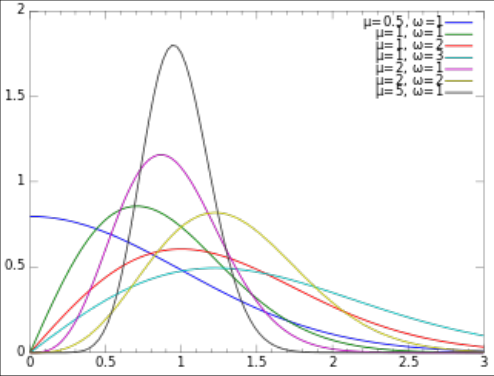 Figure 1
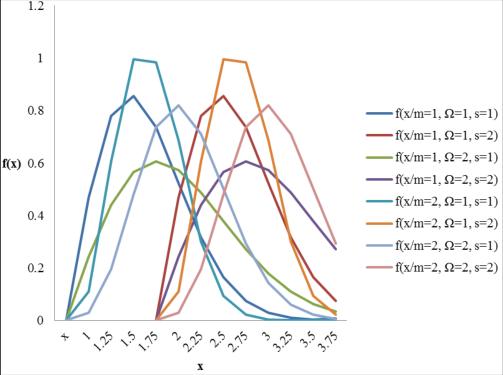 Figure 2
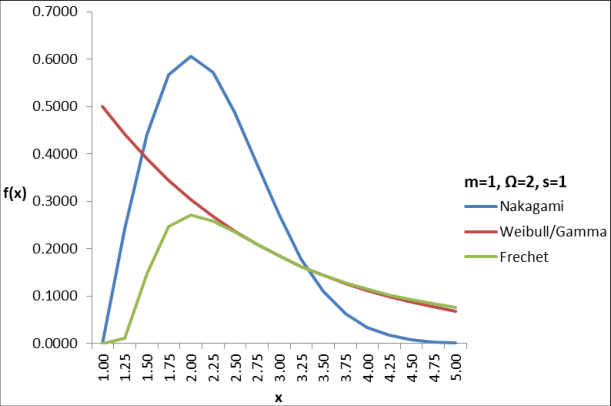 Figure 3
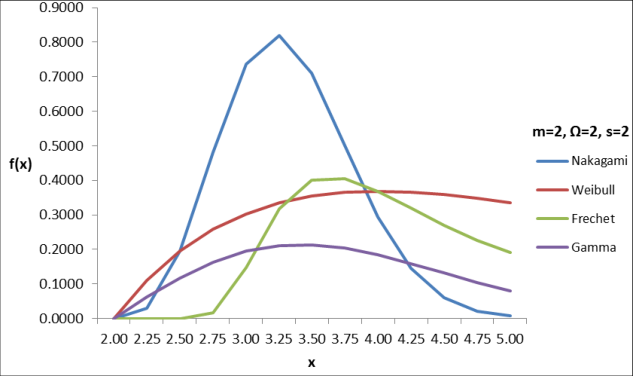 Figure 3
Introduction
Of the probability distributions, Nakagami-m distribution can be considered as a flexible lifetime distribution. The distribution has been used to model attenuation of wireless signals traversing multiple paths, fading of radio signals, data regarding communicational engineering, and so forth since the time of its derivation and formulation by Nakagami, M. (and after whom the distribution was named) in 1960 [1] . The distribution has also been employed to model failure times of a variety of products (and electrical components) such as ball bearing, vacuum tubes, and electrical insulation. It is also widely considered in biomedical fields, such as to model the time to the occurrence of tumors and appearance of lung cancer. It has the applications in medical imaging studies to model the ultrasounds especially in Echo (heart efficiency test). Shanker et al. [2] And Tsui et al. [3] used the Nakagami distribution to model ultrasound data in medical imaging studies. Nakagami distribution is extensively used in reliability theory and reliability engineering. Yang and Lin [4] during their investigations to derive the statistical model of spatial-chromatic distribution of images through extensive evaluation of large image database discovered that a two-parameter Nakagami distribution well suits the purpose. Kim and Latchman [5] also used the Nakagami distribution in their analysis of multimedia. However, several distributions have been proposed to describe the composite fast fading and shadowing. Initially, the Rayleighlognormal distribution was used by Suzuki [6] to model this compound fading. Also, the Nakagami-lognormal distribution has been employed to model the composite fading by Abu-Dayya and Beaulieu [7] , Ho and Stuber [8] , Tjhung and Chai [9] , and many others. Recently, some other distributions such as the 𝛼-𝜇 by Yacoub [10] , the generalized-𝐾 by Shankar [11] , or the mixture Gamma (MG) distribution by Atapattu, Tellambura and Jiang [12] have been proposed in the literature. Nevertheless, the results derived from a measurement campaign carried out in a macro-cellular urban environment by Reig and Rubio [13] show that the Nakagami distribution is the best fit distribution when compared with the Rayleigh-lognormal, 𝛼-𝜇 and generalized-𝐾 distributions.
Estimation of Two Parameters of Nakagami-m Distribution
There are two main philosophical approaches to estimation of parameters and properties in probability distributions in Statistics. The first is called the classical approach which was founded by Professor R.A. Fisher in a series of fundamental papers around 1930. In classical approach, we use the same method as obtained by Ahmad et al. [14] . The second approach is the Bayesian approach, which was first discovered by Reverend Thomas Bayes. In this approach, parameters are treated as random variables and data is treated as fixed. Recently Bayesian estimation approach has received great attention by most researchers among them are Al-Aboud [15] who studied Bayesian estimation for the extreme value distribution using progressive censored data and asymmetric loss. Ahmed et al. [16] considered Bayesian Survival Estimator for Wei bull distribution with censored data. An important pre-requisite in this approach is the appropriate choice of prior(s) for the parameters. Very often, priors are chosen according to one's subjective knowledge and beliefs. The other integral part of Bayesian inference is the choice of loss function. A number of symmetric and asymmetric loss functions have been shown to be functional; see Pandey et al. [17] , Al-Athari [18] , S.P. Ahmad and K. Ahmad [19] , Ahmad et al. [20,21] , and so forth. In this research paper, the classical approach is used in estimating the parameters and properties by methods of raw-moments and method of maximum likelihood.
Estimation of-The k-th Raw Moment of Two Parameters Nakagami-m Distribution
The probability density function (p.d.f) of the Nakagami-m distribution [1] with two parameters {m, Ω} is given as:
Where 𝑚 is the shape parameter and Ω is the speed parameter. Then by the raw moment method,
. This is the mean of the distribution.
Estimation of-The Variance of Two Parameters Nakagami-m Distribution
Estimation of-The Variance of Two Parameters Nakagami-m Distribution
Estimation of-The Skewness of Two Parameters Nakagami-m Distribution
Estimation of-The Skewness of Two Parameters Nakagami-m Distribution
Estimation of-The Kurtosis of Two Parameters Nakagami-m Distribution
Estimation of-The Kurtosis of Two Parameters Nakagami-m Distribution
Estimation of-The Speed Parameter of Two Parameters Nakagami-m Distribution Using Maximum Likelihood Function method
Let (𝑥 1 , 𝑥 2, … , 𝑥 𝑛 ) be a random sample of size n having pdf (1); then the maximum likelihood estimator of speed parameter Ω, when the shape parameter 𝑚 is known, is obtained by:
The logarithm of the likelihood function is obtained as:
Taking the derivatives of log 𝐿(𝑥 1 , 𝑥 2 , … , 𝑥 𝑛 / 𝑚, Ω) with respect to Ω and setting it to zero, we have:
𝑛 (11) Equation ( 13) affirms that equation ( 4) is true, thus,
𝑛
The graph below shows the curve of the pdf of the Nakagami-m distribution at several values of the two parameters {m, Ω} as given by [22]
Extending the Two-Parameters Nakagami Distribution to Three Parameters Nakagami Distribution
Like other distribution having three parameters such as Gamma distribution, Wei bull distribution, Frechet distribution and many others, Nakagami-m distribution is also sought out to be extended to three parameters which are 𝑚 -the shape parameter, Ω -the speed parameter and 𝑠 -the location shape parameter (which is just introduced). This research paper proposes the three parameters Nakagami distribution which the researcher develops and the classical approach is used in estimating the parameters and properties by methods of raw-moments and method of maximum likelihood.
Definition:
The probability density function (P.D.F) of the extended Nakagami distribution with three parameters {m, Ω, s} is given as:
Where 𝑚 is the shape parameter, Ω is the speed parameter and 𝑠 is the location parameter.
Estimation of-The k-th Raw Moment of Three Parameters extended Nakagami Distribution
Using the raw moment method,
This is the mean of the distribution. When k=2,
Estimation of-The Variance of Three Parameters extended Nakagami Distribution
Estimation of-The Variance of Three Parameters extended Nakagami Distribution
Estimation of-The Skewness of Three Parameters extended Nakagami Distribution
Estimation of-The Skewness of Three Parameters extended Nakagami Distribution
Estimation of-The Kurtosis of Three Parameters extended Nakagami Distribution
Estimation of-The Kurtosis of Three Parameters extended Nakagami Distribution
Estimation of-The Speed Parameter of Three Parameters extended Nakagami Distribution Using Maximum Likelihood Function method
Let (𝑥 1 , 𝑥 2, … , 𝑥 𝑛 ) be a random sample of size n having pdf (12); then the maximum likelihood estimator of speed parameterΩ, when the shape parameter 𝑚 is known, is obtained by: It is noted from the graph the distribution is rightly skewed.
Relationship of Three Parameter Extended Nakagami-m Distribution to Other Distribution
The three-parameter extended Nakagami distribution is closely related to three-parameter Weibull distribution. By setting2 = 𝛼, 𝑚 = 1 γ = s 𝑎𝑛𝑑 Ω = 𝛽 𝛼 , a three-parameter Weibull distribution is generated with probability density function (pdf) [23] :
Furthermore, normal distribution can be generated from the three-parameter extended Nakagami distribution by setting𝑚 = 1 2 , 𝑠 = 𝜇 𝑎𝑛𝑑 Ω = 𝜎 2 . This resulted in the normal distribution with probability density function (pdf):
Thus, 𝑋~𝑁𝑎𝑘𝑎𝑔𝑎𝑚𝑖(𝛼 = 2, 𝑚 = 1 𝑠 = γ Ω = 𝛽 𝛼 ) = Y~Weibull(α, β, γ) and 𝑋~𝑁𝑎𝑘𝑎𝑔𝑎𝑚𝑖(𝑚 = 1 2 , 𝑠 = 𝜇, Ω = 𝜎 2 ) = 𝑌~𝑁𝑜𝑟𝑚𝑎𝑙(𝜇, 𝜎 2 ). It can then be easily deduced that the location parameter 𝑠 can serve as any of the measures of central tendency/average/location. It also examines how much the random variable deviates from the measures of central tendency/average/location. In addition, by setting the location parameter𝑠 = 0, the three-parameter extended Nakagami distribution will become the (twoparameter) Nakagami-m distribution. Thus as Nakagami-m distribution can be used to generate Gamma distribution and Chisquared distribution, so also the three-parameter extended Nakagami distribution by methods of mathematical logic/reasoning and induction [22] . The new three-parameter Nakagami distribution was then studied alongside with other three-parameter distributions, most specially Wei bull distribution, Gamma distribution and Frechet distribution by using the same values for the scale, speed and location parameters. As shown in the Figure 3 and4, it was observed that the new three-parameter Nakagami distribution is well spread and skewed than all others.
Conclusion
In this research paper, the probability density function (pdf) of the new extended three-parameter Nakagami distribution developed has been presented with all its parameters estimation and properties. The new proposed distribution can be known as Nakagami-Akintunde distribution. Furthermore, the new model may be applicable to many areas such as survival analysis, economics, pollution, engineering (including communication engineering), environmental, and many others.
Figures and tables from the paper
References
22 in the original paper- Nakagami M. The m-distribution-a general formula of intensity distribution of rapid fading in Statistical Methods in Radio Wave Propagation: Proceedings of a Symposium Held at the University of California, Los Angeles, June 18-20, W.C. Hoffman, Ed, Pergamon Press, Oxford, UK. 1958, 1960, 3-36.
- Shanker AK, Cervantes C, Loza-Tavera H, Avudainayagam S. Chromium toxicity in plants Environment International. 2005; 31(5):739-753.
- Tsui PH, Huang CC, Wang SH. Use of Nakagami distribution and logarithmic compression in ultrasonic tissue characterization Journal of Medical and Biological Engineering. 2006; 26(2):69-73.
- Yang DT, Lin JY. Food availability, entitlement and the Chinese famine of 1959-61 Economic Journal, 2000; 110(460):136158.
- Kim K, Latchman HA. Statistical traffic modeling of MPEG frame size: experiments and analysis Journal of Systemics, Cybernetics and Informatics. 2009; 7(6):54-59.
- Suzuki H. A statistical model for urban radio propagation IEEE Transactions on Communications. 1977; 25(7):673-680.
- Abu-Dayya AA, Beaulieu NC. Micro-and macro-diversity NCFSK (DPSK) on shadowed Nakagami-fading channels IEEE Transactions on Communications. 1994; 42(9):2693-2702.
- Ho M, Stuber G. Co-channel interference of microcellular systems on shadowed Nakagami fading channels Proceedings of the 43rd IEEE Vehicular Technology Conference (VTC '93), May, 1993, 568-571.
- Tjhung TT, Chai CC. Fade statistics in Nakagami-lognormal channels IEEE Transactions on Communications. 1999; 47(12):1769-1772.
- Yacoub MD. The 𝛼-𝜇 distribution: a physical fading model for the Stacy distribution IEEE Transactions on Vehicular Technology. 2007; 56:122-124.
- Shankar PM. Error rates in generalized shadowed fading channels Wireless Personal Communications. 2004; 28(3):233-238.
- Atapattu S, Tellambura C, Jiang H. A mixture gamma distribution to model the SNR of wireless channels IEEE Transactions on Wireless Communications. 2011; 10(12):4193-4203.
- Reig Rubio J. Estimation of the composite fast fading and shadowing distribution using the log-moments in wireless communications IEEE Transactions on Wireless Communications. 2013; 12(8):3672-3681.
- Ahmad K, Ahmad SP, Ahmed A. Some important characterizing properties, information measures and estimations of Wei bull distribution. International Journal of Modern Mathematical Sciences, 2014: 12(2):88-97.
- Al-Aboud FM. Bayesian estimations for the extreme value distribution using progressive censored data and asymmetric loss International Mathematical Forum. 2009; 4(33):1603-1622.
- Ahmed AOM, Ibrahim NA, Arasan J, Adam MB. Extension of Jeffreys' prior estimate for Wei bull censored data using Lindley's approximation Australian Journal of Basic and Applied Sciences. 2011; 5(12):884-889.
- Pandey BN, Dwividi N, Pulastya B. Comparison between Bayesian and maximum likelihood estimation of the scale parameter in Weibull distribution with known shape under linex loss function Journal of Scientific Research. 2011; 55:163172.
- Al-Athari FM. Parameter estimation for the double-pareto distribution Journal of Mathematics and Statistics. 2011; 7(4):289294.
- Ahmad SP, Ahmad K. Bayesian analysis of Weibull distribution using R software Australian Journal of Basic and Applied Sciences. 2013; 7(9):156-164.
- Ahmad K, Ahmad SP, Ahmed A. On parameter estimation of erlang distribution using Bayesian method under different loss functions Proceedings of International Conference on Advances in Computers, Communication, and Electronic Engineering, University of Kashmir, 2015, 200-206.
- Ahmad K, Ahmad SP, Ahmed A. Bayesian analysis of generalized gamma distribution using R software, Journal of Statistics Applications & Probability. 2015; 4(2):323-335. www.wikipedia.com/probability/Nakagami_m
- Akintunde Oyetunde A, Adelagun ROA. Modeling Air Pollution by the use of Wei bull Distribution for Sustainable Management International Conference Proceeding of Sustainable Development and Environmental Protection by Institute for Environmental Research and Development, Bells University of Technology Ota, 2012, 134-13.
Cited by 2
From OpenAlex, OpenCitations and reference lists read by Scinovex
- Maximum Likelihood Estimation for the Nakagami Distribution Using Particle Swarm Optimization Algorithm with Applications ↗
Adi Omaia FAOURİ, Pelin Kasap · Necmettin Erbakan Üniversitesi Fen ve Mühendislik Bilimleri Dergisi · 2023
Nakagami dağılımı, radyo sinyallerinin sönümlenmesini modellemek için ortaya çıkmıştır ve çeşitli disiplinlerde yaygın olarak kullanılmaktadır. Bu çalışmada, dağılımın şekil ve ölçek parametrelerini tahmin etmek için en çok olabilirlik (ML) tahmin yöntemi kullanılmıştır. Ancak, bu dağılım için olabilirlik denklemlerinin açık çözümleri bulunmamaktadır. Bu nedenle, bu denklemlerin çözümü için, parçacık sürüsü optimizasyon (PSO), genetik algoritma (GA) ve quasi-newton (QN) algoritmaları olmak üzere…
❝ 2PDF - Modeling and application of three-parameter Nakagami-m distribution to Nigeria telecommunication ↗
Akintunde Oyetunde A, Ubaka Obiaderi N, Atunmobi Babatunde R · International Journal of Physics and Mathematics · 2019
The research paper examined the quality of service of the Nigeria telecommunication service of the major telecommunication providers in Nigeria. The Call Set-Up Success Rate (CSSR) and Dropped Call Rate (DCR) were analyzed using three parameters Nakagami-m distribution. The parameter estimates of the Nakagami-m distribution were provided and were tested if they fit into Nakagami-m distribution. The research work recommended