
Research article · 2018 · Full text
International Journal of Statistics and Applied MathematicsSize-biased poisson-weighted Lindley distribution and its applications
Volume 3(3) · Pages 146–155
Research areasStatistical Distribution Estimation and Applications
Abstract
Author-writtenA size-biased Poisson-weighted Lindley distribution has been suggested and its moments and moments based measures have been derived and discussed. Maximum likelihood estimation has been discussed for estimating the parameters of the distribution. Some applications of the proposed distribution have been explained and the goodness of fit shows much closer fit over size-biased Poisson distribution and size-biased Poisson-Lindley distribution.
Summary
Source-checkedPlain-language reading of the full paper, prepared with AI and checked against the text. Each point links to the authors' own words.
Why it matters
- Size-biased distributions are a type of weighted distribution used when the probability of recording a sample observation is proportional to the size of the unit. View evidence ↗
- These distributions are applicable across various fields, including ecology, biomedical science, and econometrics. View evidence ↗
- The authors aim to create a two-parameter size-biased Poisson-weighted Lindley distribution (SBP-WLD) specifically to model count data that does not include zero counts. View evidence ↗
The question
- The research seeks to determine if the proposed SBP-WLD provides more flexibility for modeling count data than the one-parameter size-biased Poisson distribution or the SBPLD. View evidence ↗
What they did
- The authors derived various moments and used graphical analysis to explain the behavior of the index of dispersion, kurtosis, skewness, and coefficients of variation. View evidence ↗
- Maximum likelihood estimation (MLE) was employed to estimate the parameters of the SBP-WLD. View evidence ↗
- The distribution's goodness of fit was tested using three real-world datasets: immunogold assay data, snowshoe hare abundance data, and public group size distribution data. View evidence ↗
What they found
- For the immunogold assay dataset, the SBP-WLD showed the lowest AIC (359.30) compared to SBPLD (411.28) and SBPD (1011.87), indicating a better fit. View evidence ↗
- In the snowshoe hare abundance dataset, SBP-WLD achieved a lower AIC of 409.54 than SBPLD (459.10) and SBPD (1187.80). View evidence ↗
- For the public group size dataset, SBP-WLD again provided the best fit with an AIC of 4156.56, compared to 4624.36 for SBPLD and 10447.34 for SBPD. View evidence ↗
What it means
- The authors conclude that the proposed SBP-WLD is a superior model for the analyzed count datasets compared to SBPD and SBPLD. View evidence ↗
Visual summary
3 visualsIllustrations explain the paper; charts are replotted from the paper's own table values.
Model Comparison Concept
AI-generated conceptual illustration (mathematical probability density curves). It explains the idea and does not show study data.
View source evidence ↗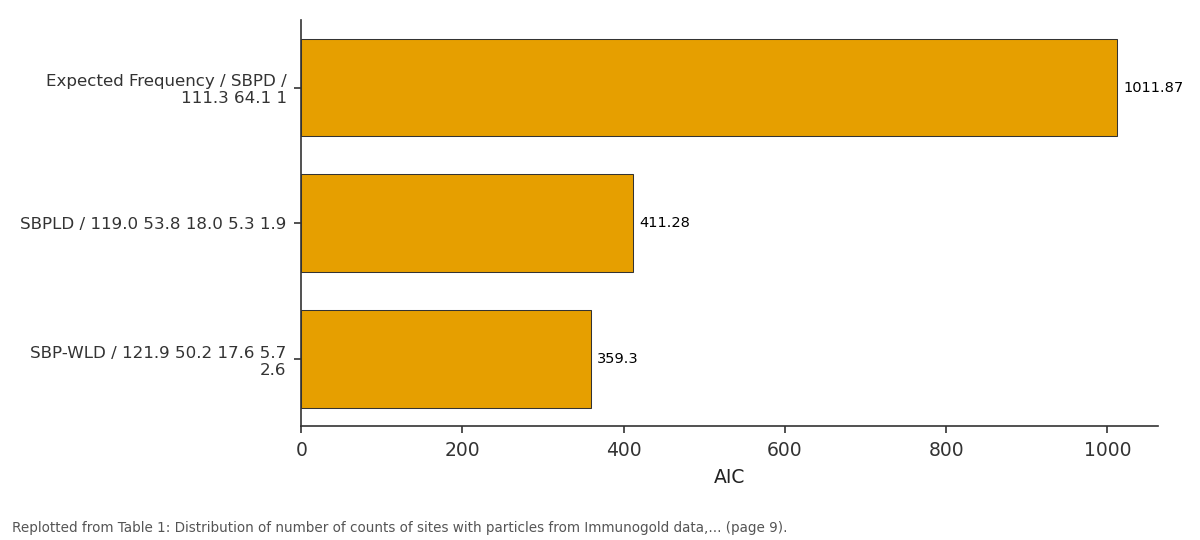
AIC: Expected Frequency /... vs SBPLD / 119.0 53.8 18.0... vs SBP-WLD / 121.9 50.2...
Replotted from Table 1 (page 9) of the original paper. Every bar is the paper's own table value.
View source evidence ↗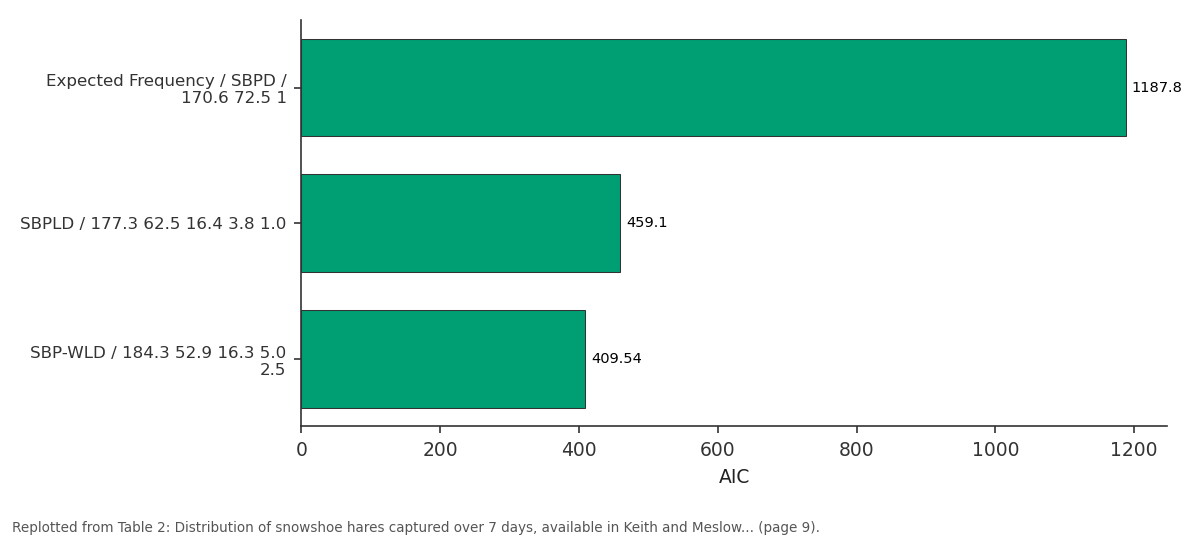
AIC: Expected Frequency /... vs SBPLD / 177.3 62.5 16.4... vs SBP-WLD / 184.3 52.9...
Replotted from Table 2 (page 9) of the original paper. Every bar is the paper's own table value.
View source evidence ↗Figures & tables
From the original paper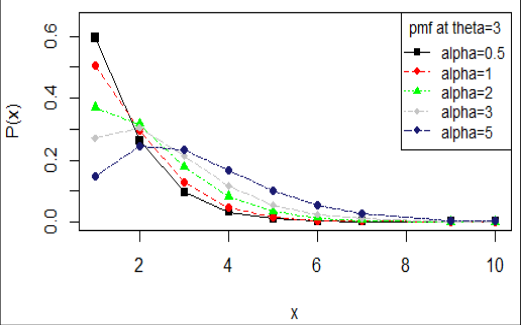 Figure 1
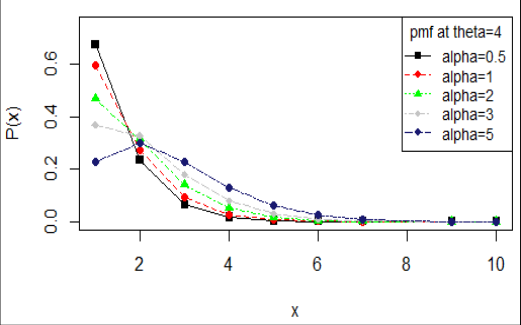 Figure 1
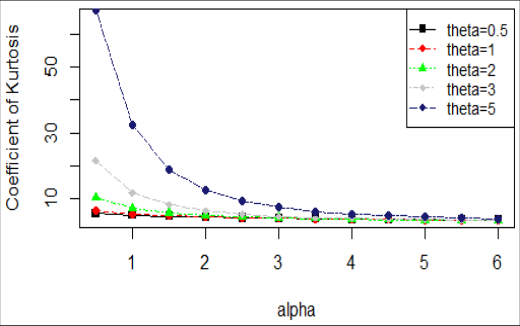 Figure 2
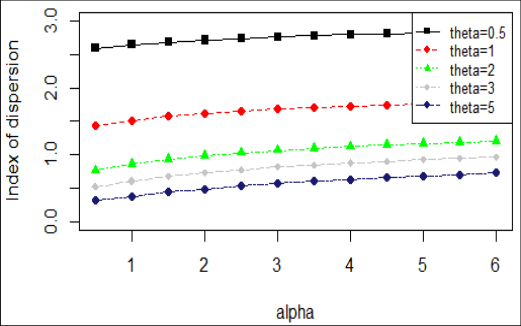 Figure 2
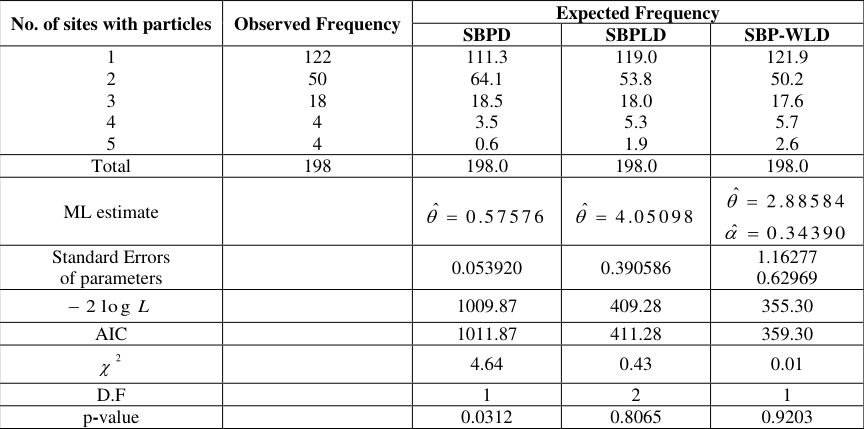 Table 1
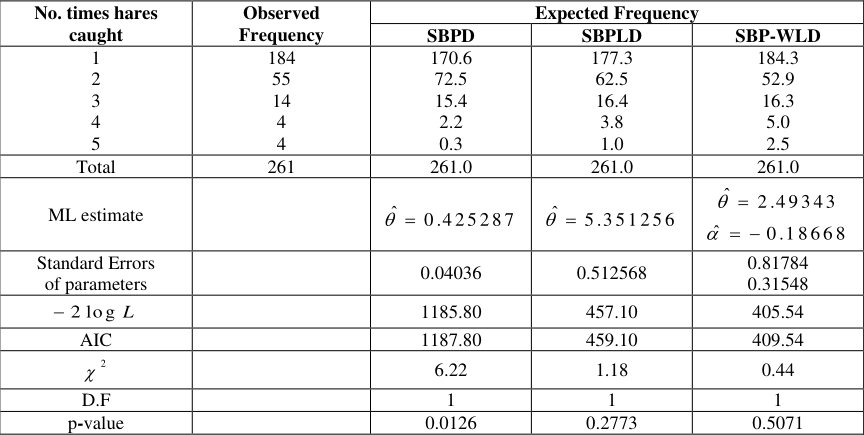 Table 2
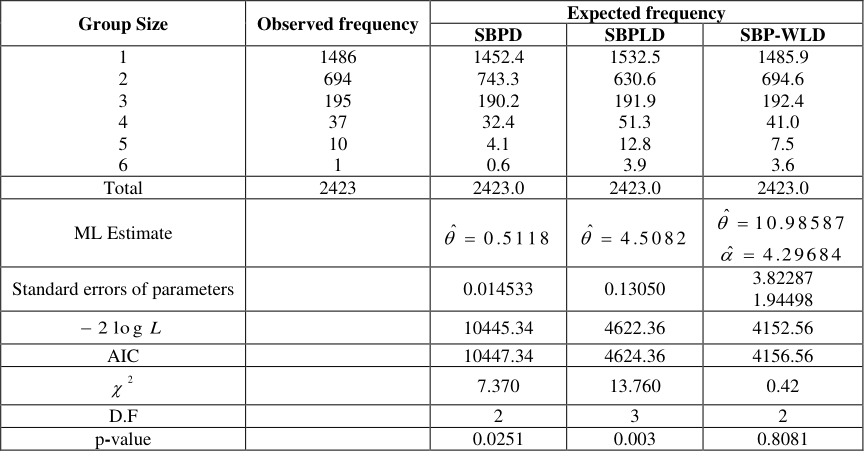 Table 3
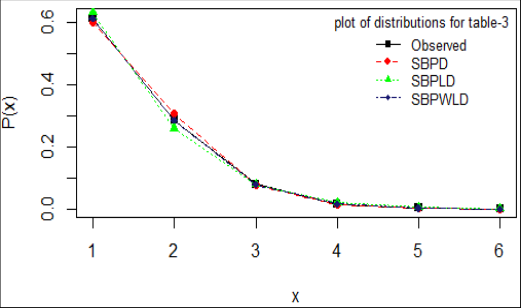 Figure 3
Introduction
Suppose a random variable X has probability distribution 0 ; ; 0 ,1, 2 , ..., 0 P x x .
If sample units are weighted or selected with probability proportional to x , then the corresponding size-biased distribution of order is defined by its probability mass function (pmf) 0 ; ; ) is known as areabiased distribution and is applicable for area-biased sampling. Size-biased distributions are a particular class of weighted distributions which arise naturally in practice when observations from a sample are recorded with probability proportional to some measure of unit size. In field applications, size-biased distributions can arise either because individuals are sampled with unequal probability by design or because of unequal detection probability. Size-biased distributions come into play when organisms occur in groups, and group size influences the probability of detection. Fisher (1934) [5] firstly introduced these distributions to model ascertainment biases which were later formalized by Rao (1965) [14] in a unifying theory for problems where the observations fall in non-experimental, non-replicated and non-random categories. Size-biased distributions have applications in environmental science, econometrics, social science, biomedical science, human demography, ecology, geology, forestry etc. Much works seem be done by different researchers on size-biased distributions and their applications including Patil and Ord (1976) [11] , Patil and Rao (1977, 1978) [12,13] , Patil (1981) [10] , Ducey and Gove (2015), some among others. Using (1.1) and the mean of Poisson-Lindley distribution introduced by Sankaran (1970) [15] , Ghitany and Al-Mutairi (2008) [6] proposed a size-biased Poisson Lindley distribution (SBPLD) having pmf
x P x Px
The mean and the variance of the SBPLD are given by [16] have a detailed study on SBPLD and its applications to model data relating to thunderstorms and observed that SBPLD is a suitable model for thunderstorms data.
The pmf of Poisson-weighted Lindley distribution (P-WLD) introduced by Abd El-Monsef and Sohsah (2014) [1] is given by
Shanker and Shukla (2017) [18] have detailed study on various descriptive statistics, estimation of parameters and applications of P-WLD. The mean and the variance of P-WLD obtained by Shanker and Shukla (2017) [18] are
Note that P-WLD is a Poisson mixture of a two-parameter weighted Lindley distribution, introduced by Ghitany et al. (2011) [7] is defined by its pdf
Where, It can be easily shown that Lindley distribution introduced by Lindley (1958) [9] is a particular case of WLD at [17] discussed various moments based properties including coefficient of variation, coefficient of skewness, coefficient of kurtosis and index of dispersion of weighted Lindley distribution and its applications to model lifetime data from biomedical sciences and engineering.
The main motivation of this paper is to propose a two-parameter size-biased Poisson-weighted Lindley distribution (SBP-WLD), a size-biased version of Poisson-Weighted Lindley distribution (P-WLD), to model count data excluding zero counts because twoparameter SBP-WLD have enough flexibility than one parameter size-biased Poisson distribution and SBPLD. Various moments and moments based measures have been obtained. The nature and behavior of coefficients of variation, skewness, kurtosis, index of dispersion have been explained graphically. Maximum likelihood estimation has been discussed for estimating the parameters of the distribution. Applications and the goodness of fit of the proposed distribution have been explained through datasets relating to some real count datasets and compared with other size-biased distributions.
Size-Biased Poisson-Weighted Lindley Distribution
Using the pmf of P-WLD (1.3) and its mean from (1.4) in (1.1), the pmf of size-biased Poisson-weighted Lindley distribution (SBP-WLD) can be obtained as
2). Since it is difficult and complicated to obtain the moments of SBP-WLD directly, an attempt has been made to derive the pmf of SBP-WLD as a size-biased Poisson mixture of size-biased weighted Lindley distribution (SB-WLD) which is very much helpful in deriving the moments. Suppose the parameter of size-biased Poisson distribution (SBPD) with pmf
Follows size-biased weighted Lindley distribution (SB-WLD) with pdf
Thus the SBPD mixture of SB-WLD can be obtained as
Which is the pmf of SBP-WLD obtained in (2.1). The nature and behavior of SBP-WLD has been shown graphically for varying values of parameters and in figure 1.
Statistical Constants
Using (2.4), the r th factorial moment about origin of the SBP-WLD (2.1) can be obtained as
Using gamma integral and a little algebraic simplification, the r th factorial moment about origin of SBP-WLD (2.1) can be obtained as
Taking 1, 2 , 3, a n d 4 r in (3.1), the first four factorial moments about origin of SBP-WLD (2.1) can be obtained
. Now using the relationship between factorial moments about origin and the moments about origin, the first four moments about origin of SBP-WLD (2.1) can be obtained as
between moments about mean and the moments about origin, the moments about mean of the SBP-WLD (2.1) can be obtained as
the SBP-WLD (2.1)) are thus obtained as
Nature and behavior of coefficient of variation, coefficient of skewness, coefficient of kurtosis and index of dispersion of SBP-WLD for varying values of parameters a n d are shown in figure -2. , where k the largest is observed value having non-zero frequency. Thus, the log likelihood function of SBP-WLD can be obtained as
2) is the solutions of the following log likelihood equations
These two log likelihood equations do not seem to be solved directly. However, the Fisher's scoring method can be applied to solve these equations. We have
The maximum likelihood estimates
Where 0 and 0 are the initial values of and , respectively. These equations are solved iteratively till sufficiently close values of and are obtained.
Applications
In this section the goodness of fit of SBP-WLD has been presented for three real count datasets. The first dataset is immunogold assay data of Cullen et al. (1990) [3] regarding the distribution of number of counts of sites with particles from immunogold assay data, the second dataset is animal abundance data of Keith and Meslow (1968) [8] regarding the distribution of snowshoe hares captured over 7 days, and the third dataset is the data relating to the size distribution of freely-forming small groups at various public places available in Coleman and James (1961) [2] . The goodness of fit by SBPD and SBPLD has also been given for ready comparison. The fit of these distributions are based on maximum likelihood estimates of the parameters. The standard errors of parameters, values of 2 lo g L and AIC (Akaike Information criterion) for all the considered distributions have also been given.
Note that AIC has been calculated using the formula and AIC, it is obvious that in three datasets SBP-WLD gives much closer fit over SBPD and SBPLD, and hence it can be considered an important size-biased distributions. The probability plots of the fitted distributions for the three datasets have also been shown in figure 3.These plots also shows that SBP-WLD is a better model for the considered datasets. [2] .
Group
Group
Figures and tables from the paper
References
18 in the original paper- Abd El-Monsef MME, Sohsah NM. Poisson-Weighted Lindley Distribution, Jokull Journal, 2014; 64(5):192-202.
- Coleman JS, James J. The equilibrium size distribution of freely forming groups, Sociometry. 1961; 24:13-25.
- Cullen MJ, Walsh J, Nicholson LV, Harris JB. Ultrastructural localization of dystrophin in human muscle by using gold immunolabelling, proceeding of the Royal Society of London. 1990; 20:197-210.
- Ducey MJ, Gove JH. Size-biased distributions in the generalized beta distribution family, with applications to forestry, Forestry-An International Journal of Forest Research. 2015; 88:143-151.
- Fisher RA. The effects of methods of ascertainment upon the estimation of frequencies, Ann. Eugenics. 1934; 6:13-25.
- Ghitany ME, Al-Mutairi DK. Size-biased Poisson-Lindley distribution and Its Applications, Metron-International Journal of Statistics. 2008; LXVI(3):299-311.
- Ghitany ME, Alqallaf F, Al-Mutairi DK, Husain HA. A two-parameter weighted Lindley distribution and its applications to survival data, Mathematics and Computers in simulation. 2011; 81:1190-1201.
- Keith LB, Meslow EC. Trap response by snowshoe hares, Journal of Wildlife Management. 1968; 20:795-801.
- Lindley DV. Fiducial distributions and Bayes' theorem, Journal of the Royal Statistical Society, Series B. 1958; 102-107.
- Patil GP. Studies in statistical ecology involving weighted distributions. In Applications and New Directions, JK. Ghosh and J. Roy (eds). Proceeding of Indian Statistical Institute. Golden Jubliee, Statistical Publishing society, 1981, 478-503.
- Patil GP, Ord JK. On size-biased sampling and related form-invariant weighted distributions, Sankhya Ser. B. 1976; 38:4861.
- Patil GP, Rao CR. The Weighted distributions: A survey and their applications. In applications of Statistics (Ed P.R. Krishnaiah0, North Holland Publications Co. Amsterdam, 1977, 383-405.
- Patil GP, Rao CR. Weighted distributions and size-biased sampling with applications to wild-life populations and human families, Biometrics. 1978; 34:179-189.
- Rao CR. On discrete distributions arising out of methods of ascertainment In: Patil, G.P. (eds) Classical and Contagious Discrete Distributions. Statistical Publishing Society, Calcutta, 1965, 320-332.
- Sankaran M. The discrete Poisson-Lindley distribution, Biometrics. 1970; 26:145-149.
- Shanker R, Hagos F, Abrehe Y. On Size-Biased Poisson-Lindley Distribution and Its Applications to Model Thunderstorms, American Journal of Mathematics and Statistics. 2015; 5(6):354-360.
- Shanker R, Shukla KK, Hagos F. On Weighted Lindley distribution and Its Applications to Model Lifetime Data, Jacobs Journal of Biostatistics. 2016; 1(1):1-9.
- Shanker R, Shukla KK. On Poisson-Weighted Lindley distribution and its Applications, Communicated, 2017.