
Research article · 2018 · Full text
International Journal of Statistics and Applied MathematicsNew results on l-cordial labeling of graphs
Volume 3(2) · Pages 641–644
Research areasGraph Labeling and Dimension Problems
Abstract
Author-writtenIn this paper we obtain new families of L- cordial graphs. It includes Flag of Cn given by FL(Cn), Cn+, bull(Cn),shell graph Sn, Sn+, Sn+t.we have shown that all of them are l- cordial.
Summary
Source-checkedPlain-language reading of the full paper, prepared with AI and checked against the text. Each point links to the authors' own words.
Why it matters
- L-cordial labeling is a method where edges are assigned unique labels from 1 to the total number of edges, and vertices are labeled 0 or 1 based on whether the maximum incident edge label is even or odd, with the counts of 0s and 1s differing by no more than one. View evidence ↗
- Previous research has already established that certain graph types, including stars, paths, cycles, and triangular snakes, are L-cordial. View evidence ↗
The question
- The objective of this study is to determine if new families of graphs, specifically Flag of Cn, Cn+, bull(Cn), shell graphs Sn, Sn+, and Sn+t, are L-cordial. View evidence ↗
What they did
- The study focuses on graphs that are simple, connected, finite, and undirected. View evidence ↗
- The shell graph Sn is constructed by adding n-3 concurrent chords from one vertex to all non-adjacent vertices in a cycle Cn, resulting in n vertices and 2n-3 edges. View evidence ↗
- A flag graph Fl(G) is created by fusing an edge to any vertex of a graph G, increasing the vertex count by one and the edge count by one. View evidence ↗
- A crown graph G+ is formed by fusing one edge to every vertex of graph G, resulting in 2p vertices and q+p edges for a (p,q) graph. View evidence ↗
- A bull graph bull(G) is constructed by adding pendent edges to two adjacent vertices of graph G, resulting in p+2 vertices and q+2 edges. View evidence ↗
What they found
- The study proves that the flag graph of a cycle, FL(Cn), is L-cordial. View evidence ↗
- The study proves that the crown graph of a cycle, Cn+, is L-cordial. View evidence ↗
- The study proves that the bull graph of a cycle, bull(Cn), is L-cordial. View evidence ↗
- The study proves that the shell graph Sn is L-cordial. View evidence ↗
- The study proves that the crown of a shell graph, Sn+, is L-cordial. View evidence ↗
- The study proves that the shell graph with t pendent edges attached at each point, Sn+t, is L-cordial. View evidence ↗
What it means
- The authors conclude that the generalized graph families studied, FL(Cn), bull(Cn), Sn+, and Sn+t, are all L-cordial. View evidence ↗
- The authors state that further investigation into L-cordial labeling for additional types of graphs is necessary. View evidence ↗
Visual summary
1 visualsIllustrations explain the paper; they do not show study data.
L-Cordial Labeling Concept
AI-generated conceptual illustration (mathematical graph consisting of vertices and edges). It explains the idea and does not show study data.
View source evidence ↗Figures & tables
From the original paper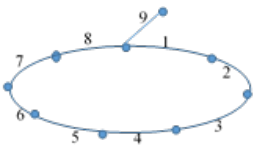 Figure 3
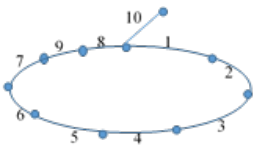 Figure 3
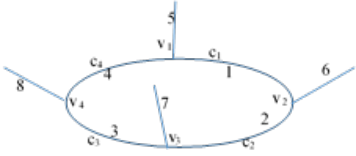 Figure 3
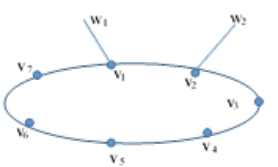 Figure 3
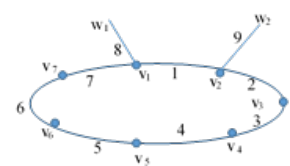 Figure 3
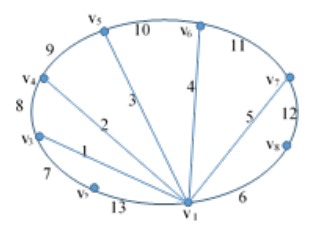 Figure 3
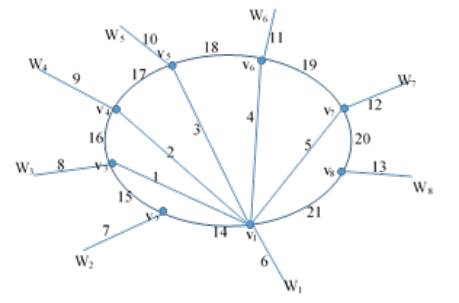 Figure 3
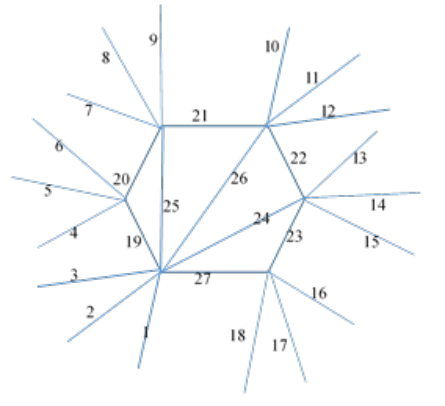 Figure 3
Introduction
Bapat [2] introduces the following new labeling. A graph G(V,E) has a L-cordial labeling if there is a bijection f from E(G) to {1,2,...,|E|} that assigns 0 to a vertex v if the largest label on the edges incident to v is even number and assigns 1 to v otherwise and this assignment satisfies the condition that the number of vertices labeled with 0 and the number of vertices labeled with 1 differ by at most 1. A graph that admits an L-cordial labeling is called as Lcordial graph. He shows that stars, path, cycles, and triangular snakes are L-cordial graphs. The graphs considered here are simple, connected and finite and un directed. For definitions and terminology we depend on J. Gillian [5] , Harary [6] , D. West [7] .We also use v f (0,1) =(x,y) to indicate number of vertices labeled with 0 are x in number and number of vertices with 1 are y in number. In all figures below the number are the edge labels.
Preliminaries
1. A shell graph Sn is obtained from a cycle Cn by taking n-3 concurrent chords from any vertex to all other non-adjacent vertices. It has n vertices and 2n-3 edges. 2. Fl(G) is a graph obtained from (p,q) graph g by fusing an edge with any vertex of G. The resultant graph has p+1 vertices and q+1 edges. This is flag graph of G.In this paper we discuss Fl(C n ). 3. G + is a crown graph which is same as GꙨK 2 .Initially crown was defines for C n . It is obtained by fusing an edge each to every vertex of G. If G is a (p,q) graph then G + has 2p vertices and q+p edges. In this paper we discuss crown of shell graph. 4. When t distinct edges are fused at each vertex of a (p,q) graph G we get G +t . It has p + tp vertices and q + tp edges. Note that when t=1 we get crown graph. 5. Fusion of vertex. Let G be a (p,q) graph. let u ≠ v be two vertices of G. We replace them with single vertex w and all edges incident with u and that with v are made incident with w. If a loop is formed is deleted. The new graph has p-1vertices and at least q-1 edges [6] . If u ϵ G 1 and v ϵ G 2 , where G 1 is (p 1 ,q 1 ) and G 2 is (p 2 ,q 2 ) graph. Take a new vertex w and all the edges incident to u and v are joined to w and vertices u and v are deleted. The new graph has p 1 +p 2 -1 vertices and q 1 + q 2 edges. Sometimes this is referred as u is identified with v. 6. A bull graph bull(G) was initially defined for a C 3 -bull.It has a copy of G with an pendent edge fused with any two adjacent vertices of G. For G ia a (p,q) graph, bull(G) has p+2 vertices and q+2 edges.
Results proved 3.1 Theorem
Proof: Define a function f : E(G){0,1} as follows:
Case 1: n is even number, n = 2x Label the pendent edge as n+1. The edge adjacent to pendent edge is labeled as 1 and there on the consecutive edges joining degree 2 vertices are labeled as 2, 3, onwards. The last edge labeled is the one adjacent to pendent edge. The vertex label number distribution is v f (0,1)=(x,x+1) for n is even number.
Case 2: n is odd number n= 2x+1, x =1, 2,. Label the pendent edge as n+1. The edge adjacent to pendent edge is labeled as 1 and there on the consecutive edges joining degree 2 vertices are labeled as 2, 3, onwards upto n-2 edges. From remaining last two edges the one adjacent to pendent edge is labeled as n-1 and remaining edge is labeled as n. The labelnumber distribution is v f (0,1)=(x,x)
Theorem: bull (C n ) is l-cordial.
Proof: Take a cycle C n = (v 1 , c 1 , v 2 , c 2 , .. v n-1 , c n , v 1 ) and (v 1 w 1 ) and (v 2 w 2 ) as pendent edges.
Define a function f: E(G){1, 2, ..n, n+1, n+2} as follows. For n= 2x+1, f(c i )= i for i =1, 2, ..n. f(v 1 w 1 )=n+1 and f(v 2 w 2 )= n+2 When n is even number given by 2x we have the vertex label number distribution is v f (0,1)=(x+1,x+1) when n is odd number 2x+1, x= 1,2,.. ve f (0,1)=(x+1,x+2) when n is even number 2x, x=2, 3, .. ).
Case 2: n is odd number, 2x+1 and t is even number say 2y.
Define a function f: E(G) {1,2, 3,..,(t+2)n-3} as follows:
The vertices are distributed as as ( ). ).
Conclusions
In this paper we have generalized definition of some established graph and obtained flag graph FL(C n ), Bull graph bull(C n ), crown of shell S n + , Shell with t number of pendent edges attached at each point S n +t .We have discussed L-cordiality and have shown that all these graphs are L-cordial.It is necessary to investigate L-cordial labeling for more graphs.
Figures and tables from the paper
References
4 in the original paper- Bapat MV. Ph.D. thesis, Equitable and other types of graph labeling. University Of Mumbai, 2004.
- Bapat MV. Some vertex prime graphs and a new type of graph labeling. Internat. J. Math. Trends and Tech. 2017; 47(1):4955.
- Bapat MV. A Note on L-cordial Labeling of Graphs. International Journal of Mathematics and its Applications. 2017; 5(4D):457-460.
- Joe Gallian Dynamic survey of graph labeling, 2016.
Cited by 3
From OpenAlex, OpenCitations and reference lists read by Scinovex
- Considering Square Difference Labelling for Validating Theta Graphs of Dynamic Machinaries ↗
International Journal of Innovative Technology and Exploring Engineering · 2019
In this work, we prove that the graphs Z-Pn, braid graph, switching of an apex vertex of CHn, ʘ K2, bull graph (Cn), truncated tetrahedron, frutcht graph are Square difference graph (SDG).
❝ 0PDF - Corona Graphs for Astronomical Calcualtions using L-Cordial Labeling ↗
International Journal of Innovative Technology and Exploring Engineering · 2019
In this work we examine L-Cordial Labeling for .T_n ʘK_1 ,DT_n ʘK_1 〖,Q〗_n ʘ K_(1 ), ,B_(n,n) ʘK_1, C_m ʘP_n Graphs
❝ 0PDF - L-Cordial Labeling for Path Union Graphs of Flywheel of 4 Stroke Single Cylinder Engine ↗
International Journal of Innovative Technology and Exploring Engineering · 2019
In this work we prove that path union of Hn, duplication of all edge of Hn, Cube Q3, Octahedron, , Hanging Hn ,Hanging Cube Q3, Pr, H(octohedron, Graphs admits L-Cordial Labeling.
❝ 0PDF