
Research article · 2019 · Full text
International Journal of Statistics and Applied MathematicsRelation of radicals with strong vertex connectivity and ideal symmetry in near rings
Volume 4(6) · Pages 65–67
Research areasRings, Modules, and Algebras
Abstract
Author-writtenThe most interesting and active field of current research in mathematics is theory of near- ring due to its wide application in coding theory, group theory, geometry, cryptography and block- designing etc. Near rings are one of the generalized structure of rings, the study and research on near- rings is very systematic and continuous. Near- rings around in all directions of mathematics and continuous research is being conducted. In this paper we study about the relation of radicals in a Near ring with strong vertex connectivity of graphs.
Summary
Source-checkedPlain-language reading of the full paper, prepared with AI and checked against the text. Each point links to the authors' own words.
Why it matters
- Near-ring theory is a highly active area of mathematical research because it has broad applications in fields such as cryptography, coding theory, and geometry. View evidence ↗
- Near-rings serve as a generalized structure of rings, and their study is conducted systematically. View evidence ↗
The question
- The objective of this research is to investigate the relationship between radicals in a near-ring and the strong vertex connectivity of associated graphs. View evidence ↗
What they did
- The study employs a theoretical approach using theorems and proofs to analyze the properties of an ideal $I$ of a near-ring $N$ and its corresponding graph $(G_I(N))$. View evidence ↗
What they found
- A non-zero nil radical $I$ of a near-ring $N$ acts as a strong vertex cut of the graph $(G_I(N))$, and conversely, if $I$ is a strong cut and $x^n=0$ for all $x$ in $I$, then $I$ is a nil radical. View evidence ↗
- For a non-zero nil radical $I$ of $N$, the vertex connectivity $K(G_I(N))$ is equal to the cardinality of the ideal $|I|$. View evidence ↗
- If $I$ is a 3-prime ideal of a near-ring $R$, the girth $gr(G_I(R))$ of the associated graph is either 3 or infinity. View evidence ↗
- In a commutative zero-symmetric near-ring with unity, a maximal ideal $I$ is a strong vertex cut of $(G_I(N))$, making the graph ideal symmetric. View evidence ↗
- In a zero-symmetric near-ring where $I$ is a nil radical, an element $x$ belongs to $I$ if and only if its degree in the graph is equal to the degree of the zero element. View evidence ↗
- If $N$ is a zero-symmetric near-ring and $I$ is a nil radical, the resulting graph $(G_I(N))$ is an ideal symmetric graph. View evidence ↗
- If $(G_I(N))$ is an ideal symmetric graph, $I$ is a 3-semiprime ideal, and the condition $deg(x)=deg(0)$ implies $x$ is in $I$, then $I$ is a nil radical and a strong vertex cut. View evidence ↗
What it means
- The author concludes by establishing several theoretical links between the algebraic properties of near-ring radicals and the structural connectivity properties of their associated graphs. View evidence ↗
Visual summary
1 visualsIllustrations explain the paper; they do not show study data.
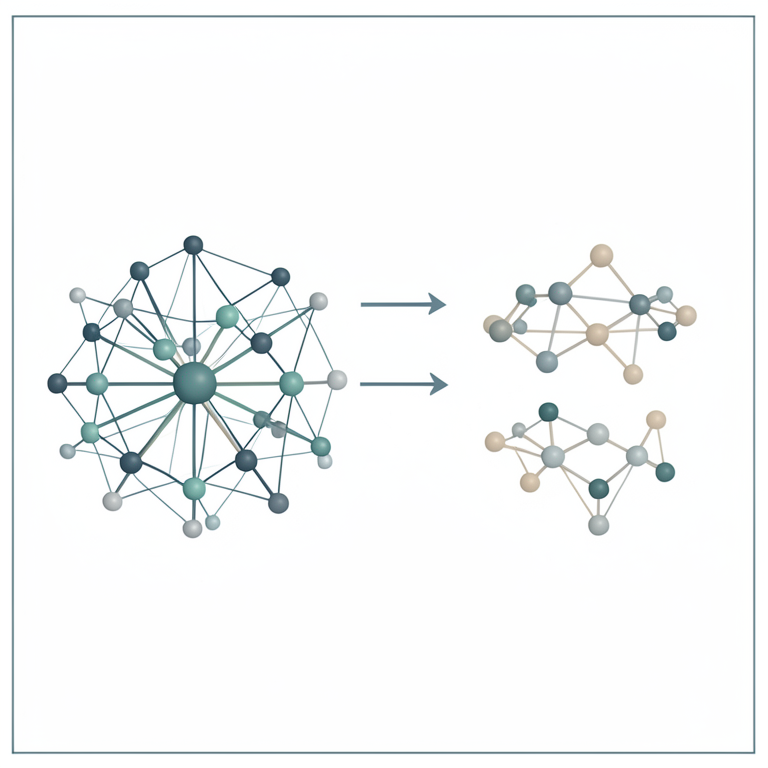
Nil Radical as a Vertex Cut
AI-generated conceptual illustration (An abstract mathematical graph consisting of nodes and edges). It explains the idea and does not show study data.
View source evidence ↗Introduction
The most interesting and active field of current research in mathematics is theory of near-ring due to its wide application in coding theory, group theory, geometry, cryptography and blockdesigning etc. Near rings are one of the generalized structure of rings, the study and research on near-rings is very systematic and continuous. Near-rings around in all directions of mathematics and continuous research is being conducted, which show that their structure has power and beauty all its own. Modern ring theory has very active mathematical discipline and studying rings in their own right. The key ideas important to near-ring were formed by L.E. Dickson in 1905. Actually he gave the concept of near-field. In 1930 Wieland studied nearrings which were not near-fields. In this paper we study about the relation of radicals in a Near ring with strong vertex connectivity of graphs. Theorem 1.1: Let 𝐼 be an ideal of 𝑁. If 𝐼 be a non zero nil radical, then 𝐼 be a strong vertex cut of (𝐺 𝐼 (𝑁)). If 𝐼 be a strong cut of (𝐺 𝐼 (𝑁)) and for all 𝜖 𝐼 𝑥 𝑛 = 0, then 𝐼 is a nil radical.
Proof: Suppose that 𝐼 be a nil radical of 𝑁. If 𝐼 = 𝑁, then there is nothing to prove. Let 𝐼 ≠ 𝑁 and 𝑥, 𝑦 ∈ 𝑁 such that𝑥 ≠ 𝑦 If possible, suppose that there exists an edge between the vertices 𝑥 and 𝑦 in (𝐺 𝐼 (𝑁)), then either 𝑥𝑁𝑦 ⊆ 𝐼 or 𝑦𝑁𝑥 ⊆ 𝐼. without loss of generality, suppose that 𝑥𝑁𝑦 ⊆ 𝐼. Since 𝐼 is a nil radical, therefore, 𝑥𝑁𝑦 ⊆ 𝐼 and either 𝑥 𝑛 = 0 or 𝑦 𝑛 = 0 implies that either 𝑥 𝜖 𝐼 or 𝑦𝜖 𝐼 But this is a contradiction to the fact that 𝑥, 𝑦 ∈ 𝑁\𝐼. Hence, 𝐼 is a strong vertex cut. Conversely, suppose that 𝐼 is 3semi-prime ideal and 𝐼 is a strong vertex cut of (𝐺 𝐼 (𝑁)).
Claim: 𝐼 is a nil radical. We take 𝑥, 𝑦 ∈ 𝑁\𝐼 such that 𝑥𝑁𝑦 ⊆ 𝐼 and either 𝑥 𝑛 = 0 or, 𝑦 𝑛 = 0. Since 𝐼 is 3semi-prime ideal of 𝑁 therefore 𝑥 = 𝑦 implies 𝑥 𝜖 𝐼 Let 𝑥 ≠ 𝑦. If it possible then suppose 𝑥 ∈ 𝑁\𝐼and 𝑦 ∈ 𝑁\𝐼. 𝑆ince 𝐼 is a strong vertex cut of (𝐺 𝐼 (𝑁)), therefore, there is no edge between 𝑥 and 𝑦 in (𝐺 𝐼 (𝑁)). It implies that 𝑥𝑁𝑦 ⊈ 𝐼 and 𝑦𝑁𝑥 ⊈ 𝐼. But this is a contradiction. Therefore, either 𝑥 𝜖 𝐼 or 𝑦 𝜖 𝐼. Hence, 𝐼 is a nil radical. Proof: Since 𝐼 be a non zero nil radical of 𝑁, therefore 𝐼 ≠ {0}. Since 𝐼 is a strong vertex cut of 𝑁. Therefore, if we remove 𝐼 from the graph (𝐺 𝐼 (𝑁)), then (𝐺 𝐼 (𝑁)) is totally disconnected. Hence, 𝐾(𝐺 𝐼 (𝑁)) = | 𝐼 |.
Theorem 1.3:
Let 𝐼 be a 3prime ideal of a near ring 𝑅, then 𝑔𝑟(𝐺 𝐼 (𝑅)) = either ∞ or 3.
Proof: Suppose I= {0} then, there is no cycle. Hence 𝑔𝑟(𝐺 𝐼 (𝑅)) = ∞. Suppose 𝐼 ≠ 0. Since we know that in a graph of a near ring with respect to an ideal the maximum distance between any two vertices of (𝐺 𝐼 (𝑅)) is at most 2. Since 𝐼 is a 3prime ideal. So, each element of 𝐼 is connected to each element of 𝑁 except itself. But by the definition of graph of a near ring with respect to an ideal, the distance between any two vertices of (𝐺 𝐼 (𝑁)) is at most 2. Therefore, 𝑔𝑟(𝐺 𝐼 (𝑅)) = 3 or, 𝑔𝑟(𝐺 𝐼 (𝑅)) = ∞. Theorem 1.4: If 𝑁 is a commutative zero symmetric near-ring with unity and 𝐼 is a maximal ideal of 𝑁, then 𝐼 is a strong vertex cut of (𝐺 𝐼 (𝑁)) and (𝐺 𝐼 (𝑁)) is ideal symmetric.
Proof: Since 𝑁 is a commutative zero symmetric near-ring with unity and 𝐼 is a maximal ideal of 𝑁, so, 𝐼 is a prime ideal of 𝑁. Therefore, 𝑥𝑁𝑦 ⊆ 𝐼 or 𝑥𝑁𝑦 ⊆ 𝐼 implies either 𝑥 𝜖 𝐼 or 𝑦 𝜖 𝐼 for 𝑥, 𝑦 ∈ 𝑁. This implies 𝐼 is a 3prime ideal. Therefore, 𝐼 is a strong vertex cut. Since 𝑁 is a commutative zero symmetric near-ring with unity and 𝐼 is a 3prime ideal, this implies (𝐺 𝐼 (𝑁)) is an ideal symmetric graph.
Theorem 1.5: Let 𝐼 be a non-zero nil radical of 𝑁 and 𝑥 be a vertex in (𝐺 𝐼 (𝑁)), if deg(𝑥) = deg(0), then 𝑥 𝜖 𝐼.
Proof: Since 𝐼 be a non-zero nil radical of 𝑁 and 𝑥 be a vertex of (𝐺 𝐼 (𝑁)). Let us suppose that deg(𝑥) = deg(0). Then 𝑥𝑁𝑦 ⊆ 𝐼 or 𝑦𝑁𝑥 ⊆ 𝐼 and either 𝑥 𝑛 = 0 or 𝑦 𝑛 = 0 for all 𝑦 𝜖 𝑁 such that 𝑥 ≠ 𝑦 Without loss of generality, let us assume 𝑥𝑁𝑦 ⊆ 𝐼 and either 𝑥 𝑛 = 0 or 𝑦 𝑛 = 0 for all 𝑦 𝜖 𝑁 such that 𝑥 ≠ 𝑦. If I= N, then 𝑥 𝜖 𝑁 And hence it is proved. Suppose that 𝐼 ≠ 𝑁 and let 𝑦 ∈ 𝑁\𝐼. Since 𝐼 is a nil radical of 𝑁 and 𝑥𝑁𝑦 ⊆ 𝐼 and either 𝑥 𝑛 = 0 or 𝑦 𝑛 = 0 this implies 𝑥 𝜖 𝐼. Hence it is proved. Proof: Let 𝑁 be a zero symmetric near-ring and 𝐼 be a nil radical of 𝑁. Suppose that (𝑥 ∈ 𝐺 𝐼 (𝑁)) also, let 𝑥 ∈ 𝐼. If 𝑥 = 0, then deg(𝑥) = deg(0). If it possible, suppose that deg(𝑥) < deg(0), then there exists a vertex 𝑦 such that 𝑦 is not adjacent to 𝑥 in(𝐺 𝐼 (𝑁)). This implies that 𝑥𝑁𝑦 ⊆ 𝐼 and 𝑦𝑁𝑥 ⊆ 𝐼. Now as 𝑥 ∈ 𝐼 and 𝐼 is an ideal of 𝑁, we have 𝑥𝑁 ⊆ 𝐼. Therefore, 𝑥𝑁𝑦 ⊆ 𝐼 𝑦 . But 𝑁 is zero symmetric near ring, we have 𝐼 𝑦 ⊆ 𝐼. Thus we get 𝑥𝑁𝑦 ⊆ 𝐼. Which is a contradiction. Hence deg(𝑥) = deg(0). Conversely, suppose that 𝑥 be a vertex in 𝐺 𝐼 (𝑁) such that deg(𝑥) = deg(0), let 𝑥𝑁𝑦 ⊆ 𝐼 or, 𝑦𝑁𝑥 ⊆ 𝐼 and either 𝑥 𝑛 = 0 for all 𝑥 ∈ 𝑁 or 𝑦 𝑛 = 0 for all 𝑦 ∈ 𝑁 such that 𝑦 ≠ 𝑥 without loss of generality, let us assume for all 𝑦 ∈ 𝑁 and either 𝑥 𝑛 = 0 for all 𝑥 ∈ 𝑁 or 𝑦 𝑛 = 0 for all 𝑦 ∈ 𝑁 such that 𝑦 ≠ 𝑥. If 𝐼 = 𝑁, then 𝑥 ∈ 𝐼. Let 𝐼 ≠ 𝑁. Choose 𝑦 ∈ 𝑁\𝐼. Since 𝐼 is a nil radical of 𝑁 and 𝑥𝑁𝑦 ⊆ 𝐼 and 𝑥 𝑛 = 0, we get 𝑥 ∈ 𝐼. Theorem 1.8: Let 𝐼 be an ideal of 𝑁. Suppose 𝑁 is a zero symmetric near-ring and 𝐼 is a nil radical of 𝑁, then (𝐺 𝐼 (𝑁)) is an ideal symmetric graph.
Proof: Since 𝑁 is a zero symmetric near-ring and 𝐼 is a nil radical of 𝑁. Let 𝑥, 𝑦 be distinct vertices of (𝐺 𝐼 (𝑁)) with an edge between 𝑥 and 𝑦, then 𝑥𝑁𝑦 ⊆ 𝐼 or 𝑦𝑁𝑥 ⊆ 𝐼 Assume that 𝑥𝑁𝑦 ⊆ 𝐼. Since 𝐼 is a nil radical of 𝑁, therefore, 𝑥𝑁𝑦 ⊆ 𝐼 and 𝑥 𝑛 = 0 or 𝑦 𝑛 = 0 implies that either 𝑥 ∈ 𝐼 or 𝑦 ∈ 𝐼. Now as 𝑁 is zero-symmetric and 𝐼 is a nil radical therefore, we get that deg(𝑥) = deg(0) or deg(𝑦) = deg(0). Hence (𝐺 𝐼 (𝑁)) is an ideal symmetric graph. Theorem 1.9: Let (𝐺 𝐼 (𝑁)) is an ideal symmetric graph and 𝐼 is 3-semiprime ideal of N. For every 𝑥 ∈ 𝑁, deg(𝑥) = deg(0) in (𝐺 𝐼 (𝑁)) implies 𝑥 ∈ 𝐼, then 𝐼 is nil radical and 𝐼 is a strong vertex cut of (𝐺 𝐼 (𝑁)).
Proof: Suppose that (𝐺 𝐼 (𝑁)) is an ideal symmetric graph, 𝐼 is a 3semi-prime ideal of 𝑁 and for every 𝑥 ∈ 𝑁, deg(𝑥) = deg(0) in (𝐺 𝐼 (𝑁)) implies 𝑥 ∈ 𝐼 also let 𝑥, 𝑦 ∈ 𝑁 and 𝑥𝑁𝑦 ⊆ 𝐼. Since 𝐼 is a 3semi-prime ideal of 𝑁, therefore, 𝑥 = 𝑦 implies 𝑥 ∈ 𝐼 and 𝑥 𝑛 = 0. Let ≠ 𝑦. Now there is an edge between 𝑥 and 𝑦 in (𝐺 𝐼 (𝑁)). Since (𝐺 𝐼 (𝑁)) is an ideal symmetric graph, therefore deg(𝑥)
= deg(0) or deg(𝑦) = deg(0) that is 𝑥 𝑛 = 0 or 𝑦 𝑛 = 0. This implies that 𝑥 ∈ 𝐼 or 𝑦 ∈ 𝐼. Thus, 𝐼 is a nil radical of 𝑁. Hence, 𝐼 is a strong vertex cut of (𝐺 𝐼 (𝑁)).
References
8 in the original paper- Anderson FW, Fuller KR. Rings and Categories of Modules, 2 nd Edition, Springer-Verlag, New York, 1992.
- Bhavanari S, Vijyakumari. Graph a near-ring with respect to an ideal, Comm. Algebra, 2010; 38:1957-1967.
- Bondy JA, Murty USR. Graph theory with applications, 5 th Edition, The Macmillan Press Ltd, London, 1982.
- Booth GL, Groenewald NJ, Veldsman S. A Kurosh-Amitsur prime radicals for near rings, Comm. Algebra, 1990; 18(9):3111-3122.
- Ferrero CC, Ferrero G. Near-rings: Some developments linked to Semi-groups and groups, Kluwer Academic Publishers, Amsterdam, Netherland, 2002.
- Groenewald NJ. The completely prime radical in near-rings, Acta Math. Hungar, 1988; 51:301-305.
- Groenewald NJ. Different prime ideals in near-rings, Comm. Algebra, 1991; 19:2667-2675.
- Veldsman S. On equi-prime near-rings, Comm. Algebra, 1992; 20(9):2569-2587.