
Research article · 2020 · Full text
International Journal of Statistics and Applied MathematicsFluctuations in ground temperature with variable suction velocity and a convective boundary condition
Volume 5(1) · Pages 51–57
Research areasNanofluid Flow and Heat TransferNumerical methods in inverse problemsGeothermal Energy Systems and Applications
Abstract
Author-writtenThis paper considers a convective flow of heat into the ground through the surface with a variable suction velocity. The problem is two dimensional with the soil surface taken to be optically thin environment which makes the radiative heat transfer significant. All other soil properties are assumed to be constant. The governing dimensional equations were reduced to non-dimensional form using some dimensionless parameters, and the transient non-linear partial differential equation (P.D.E.) was solved analytically. Asymptotic method was adopted to linearize the P.D.E. and the resulting homogeneous and non-homogeneous ordinary differential equations were solved using undetermined coefficients methods. The results were shown graphically. It is observed that temperature fluctuates sinusoidally with time.
Summary
Source-checkedPlain-language reading of the full paper, prepared with AI and checked against the text. Each point links to the authors' own words.
Why it matters
- Ground temperature is a critical subject of study because soil properties significantly impact diverse fields, including agriculture, civil engineering, architecture, and building technology. View evidence ↗
- Measuring ground heat flux is challenging; while heat flux plates can be used, they must be placed several centimeters below the surface to prevent disturbances. View evidence ↗
- The precision of heat flux measurements can be compromised by the rapid movement of liquid water and vapor near the soil surface, which causes poor thermal contact between the soil and the measurement plate. View evidence ↗
The question
- The research aims to analyze ground temperature by incorporating convective boundary conditions and a suction velocity that changes over time. View evidence ↗
What they did
- The study uses a two-dimensional model where the soil surface is treated as an optically thin environment, making radiative heat transfer significant while other soil properties remain constant. View evidence ↗
- The authors reduced dimensional equations to non-dimensional form and solved the transient non-linear partial differential equation analytically using an asymptotic method for linearization and the method of undetermined coefficients. View evidence ↗
What they found
- Increasing the Prandtl number, Radiation parameter, and Biot number all lead to a decrease in ground temperature as depth increases. View evidence ↗
- Ground temperature varies sinusoidally over time, and the period of this variation decreases as the frequency of the suction velocity oscillation increases. View evidence ↗
- The amplitude of the soil temperature's sinusoidal variation decreases as depth increases, eventually becoming insignificant. View evidence ↗
- Increasing the asymptotic parameter (epsilon) and the suction velocity parameter (A) decreases the temperature profile, though this effect diminishes at greater depths. View evidence ↗
- Data from the study's tables confirm that ground temperature consistently decreases as the depth increases. View evidence ↗
What it means
- The authors conclude that while ground temperature fluctuates over time, it is reduced by higher Prandtl numbers, Radiation parameters, and Biot numbers as depth increases. View evidence ↗
Visual summary
3 visualsIllustrations explain the paper; charts are replotted from the paper's own table values.

Temperature Oscillation vs Depth
AI-generated conceptual illustration (A vertical cross-section of soil beneath a ground surface). It explains the idea and does not show study data.
View source evidence ↗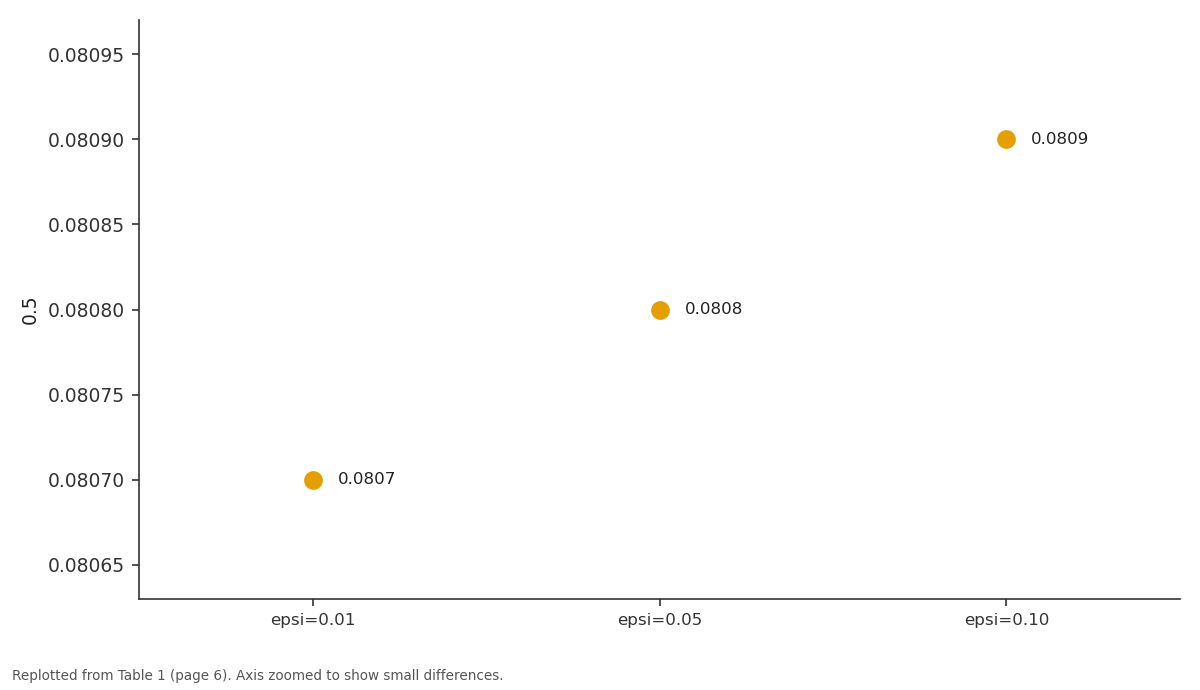
0.5: epsi=0.01 vs epsi=0.05 vs epsi=0.10
Replotted from Table 1 (page 6) of the original paper. Every bar is the paper's own table value.
View source evidence ↗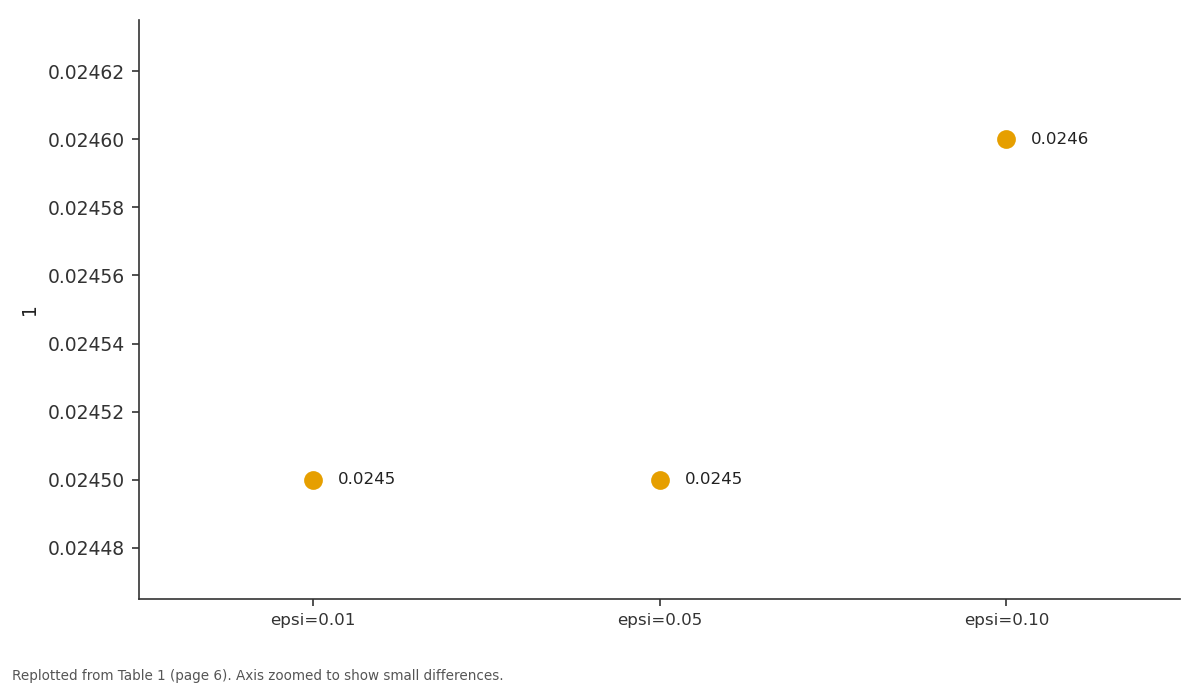
1: epsi=0.01 vs epsi=0.05 vs epsi=0.10
Replotted from Table 1 (page 6) of the original paper. Every bar is the paper's own table value.
View source evidence ↗Figures & tables
From the original paper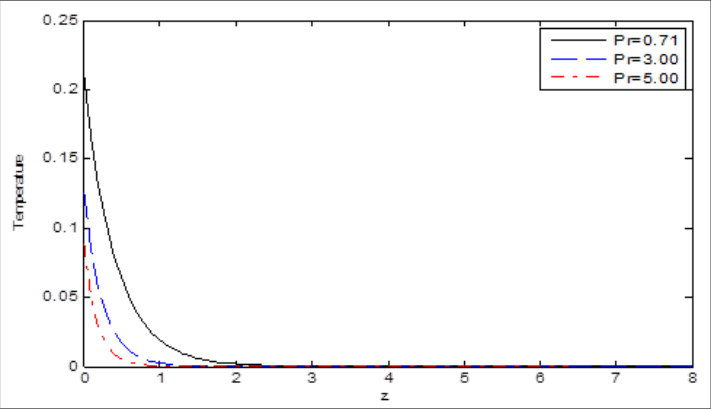 Figure 1
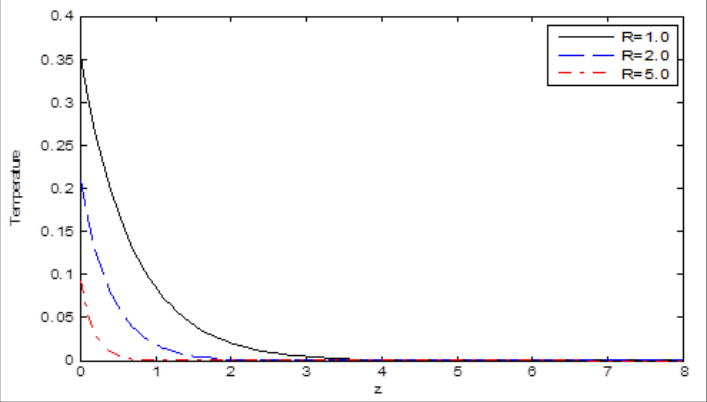 Figure 2
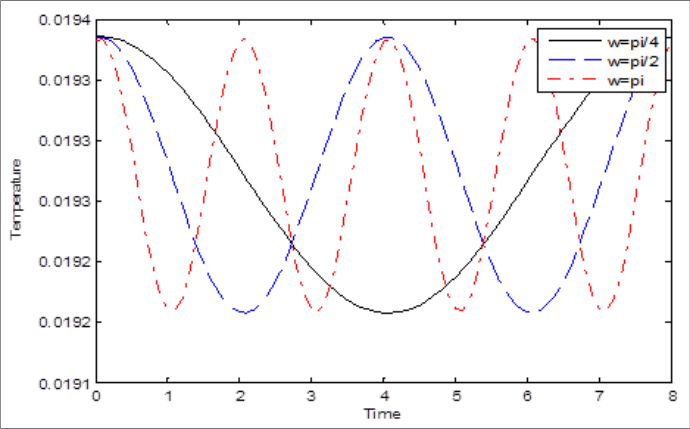 Figure 3
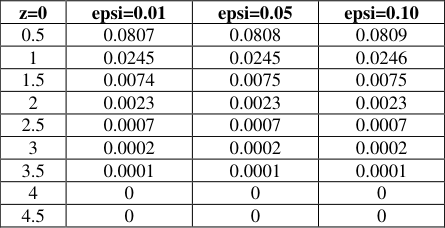 Table 1
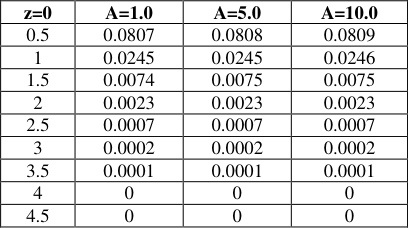 Table 2
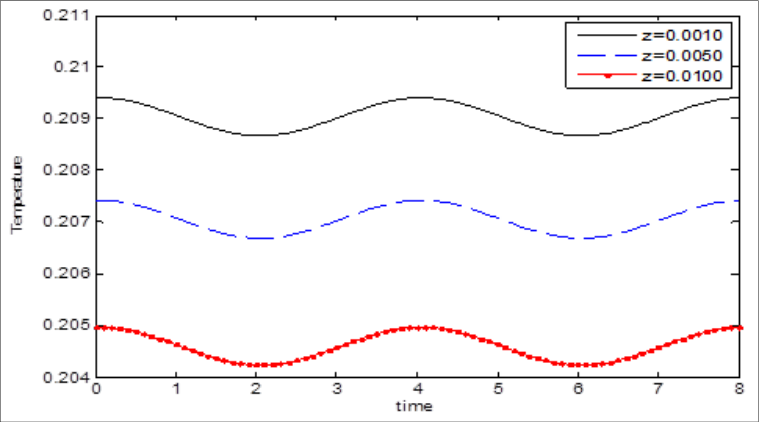 Figure 4
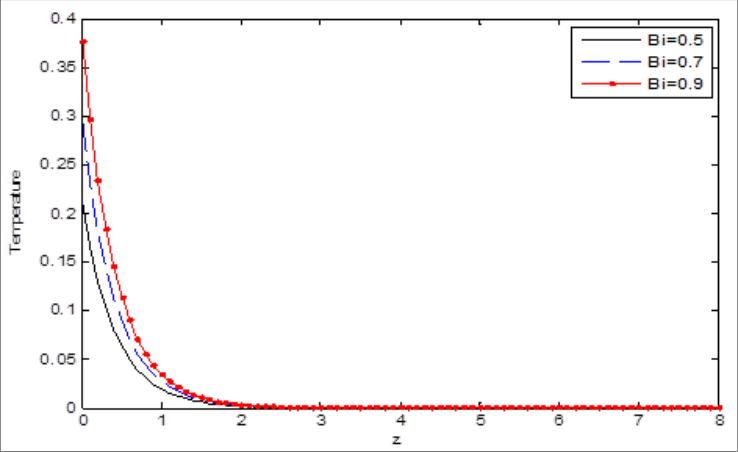 Figure 5
Introduction
The subject of ground temperature is a very important one which has been gaining more attention as the day goes by. This is because the ground with its properties plays so much significant roles in various fields of study. It ranges from agriculture to constructions in civil engineering, architecture and building technology. Because of this wide range of use of the ground, many researchers have developed interest into exploring the behavior of the ground under different situations. For example, in drying process, energy transfer in a wet cooling tower, the process of evaporation at the surface of water body, etc, heat and mass transfer occur simultaneously. Achievable use of this type of flow may be seen in many industries. In power industry for example, among methods of generating electric power is one in which electrical energy is extracted directly from a moving conducting fluid. This is of a huge practical importance to engineers and scientists because of its frequent occurrence in many branches of science and engineering, [1] . Exact measurement of ground heat flux is a difficult task. According to Oke [2] , heat flux plates can be used to measurement soil heat flux directly. However, the flux sensor usually needs to be positioned normal at a few centimeters below the surface at a certain depth in the soil to avoid disturbances. Relatively fast movement of water (both liquid and vapor) near the surface of the soil affects the precision of the measurements by heat flux disks owing to poor thermal contact between the plate and soil [3] . Makinde and Bello [4] studied the Effects of Soil Temperature Pattern on the Performance of Cucumber Intercrop with Maize in a Tropical Wet-and-Dry Climate of Nigeria. They discovered that mean soil temperature of 33 °C and 31 °C at 5 and 10cm during late season could be said to have enhanced the productivity of cucumber yield by about 50% compared to early season with mean soil temperature of 30 °C and 29 °C at 5cm and 10cm below soil surface. The mean cucumber yield of 9t/ha and 6.1t/ha for mono and mixed crop respectively during early season trial was significantly lower (P<0.05) than the mean cucumber yield of 15.34t/ha and 12.34t/ha for late season. Akinpelu, Olaleye and Adewoye [5] investigated the effects of some physical parameters on ground temperature with time-dependent suction velocity in the presence of internal heat generation. Considering a great depth into the ground where the internal heat generation is much more significant, their results showed that the increase in prandtl number and radiation parameter increased the temperature. However, the temperature fluctuates with time. Okedoye [6] investigated the analytical analysis of steady Magneto-hydrodynamics (MHD) free convective heat and mass transfer flow past a semi-infinite vertical porous plate in a porous medium. His results showed that temperature profile decreased with increase in Prandtl, but increased with increasing Dufor number. Akinpelu et al. [7] studied the variations in ground temperature in the presence of radiative heat flux and spatial dependent soil thermophysical property. They observed that the increase in prandtl number and radiation parameter decreased the temperature. The temperature also fluctuates with time at different values of the frequency of oscillation and depth. The investigations of Nwaigwe [8] also revealed decrease in ground temperature at increasing prandtl number and radiation parameter. The author however imposed a Dirichlet type of boundary condition. Sharma [9] studied the unsteady free convective viscous incompressible flow past an infinite vertical porous flat plate with periodic heat and mass transfer in slip-flow regime. He discovered that the temperature increased near the plate but decreased far away from the plate. In this research work, effort was however made to consider the ground temperature involving convective boundary conditions with time dependent suction velocity.
Formulation of the Problem
In this research work, we assumed that the heat is flowing into the ground through the surface, and this is maintained at a constant temperature, ' T . The flow is considered in the vertical direction ( ' z -axis) only. It is also assumed that the surface of the soil is an optically thin environment and that the radiative heat transfer is significant. The thermal conductivity k is considered to be constant, i.e. 0 k k . Other properties like specific heat capacity, C p and density, are also constant. The surface of the soil is horizontally homogeneous with vegetative cover. Under the above assumptions and before the introduction of dimensionless variables, the transient heat transfer equations of the flow are as follows:
The boundary conditions considered in this work are:
From equation (1), w is not a function of z .It is either a constant or a function of time.
Where, . velocity suction initial the is w For the purpose of this work w is taken to be ) 1 (
The negative sign indicates that suction is towards the ground surface. is the frequency of oscillation. A and are very small positive parameters such that their product is far less than one, that is 1 A Substituting equation (6) into equation ( 5), we have
Introducing the following dimensionless parameters:
Equation ( 7) simplifies to:
Equation (3) also simplifies to: Where, 11) is a partial differential equation and since is small, a time dependent perturbation method can be adopted. Solution of the following form is assumed:
Method of Solution
Method of Solution
Substitute
Solving equations ( 13) and (15), and applying their boundary conditions give
Based on equations ( 17) and (18), equation (12) becomes
Hence, the required solution. Where, 00 2 2 1 20
Discussion of Results
The approximate analytical solution is graphically displayed to illustrate the effect of the various physical parameters of interest on the model. Figures 12345show the behaviour of the ground temperature for different values of the flow parameters. Figure 1, 2 and 5 portray the temperature profile at various prandtl number (P r ), Radiation parameter (R) and Biot number respectively. As these all increase, the temperature decreases with corresponding increasing depth. This result is in agreement with that of [15]. Figures 3 and4 show the sinusoidal variation of temperature of the soil with time at each frequency of oscillation of the suction velocity and each depth of the soil respectively. The former reveals that the period of the variation of the temperature of the ground decreases with increase in the frequency of oscillation of the suction velocity. The latter shows that the amplitude of variation of the soil temperature decreases with depth and becomes insignificant as the depth increase.
Tables 1 -2 illustrate the temperature profile for different values of the flow variables that are not considered in figures 1 -5. It can be seen from the tables that the temperature of the ground decreases with increase in the depth. It can also be noticed that increase in the asymptotic parameter, ε and the suction velocity parameter, A decreases the temperature profile respectively. This effect becomes insignificant with increase in depth.
Conclusions
This study investigated the fluctuations in ground temperature under a convective boundary condition and variable suction velocity. An approximate analytical solution is obtained for the problem. The effects of some physical parameters of interest on ground temperature were also examined. It was discovered that the ground temperature fluctuates with time but decreased with increasing prandtl number, Radiation parameter and biot number as the depth deepens.
Figures and tables from the paper
| z=0 | epsi=0.01 | epsi=0.05 | epsi=0.10 |
|---|---|---|---|
| 0.5 | 0.0807 | 0.0808 | 0.0809 |
| 1 | 0.0245 | 0.0245 | 0.0246 |
| 1.5 | 0.0074 | 0.0075 | 0.0075 |
| 2 | 0.0023 | 0.0023 | 0.0023 |
| 2.5 | 0.0007 | 0.0007 | 0.0007 |
| 3 | 0.0002 | 0.0002 | 0.0002 |
| 3.5 | 0.0001 | 0.0001 | 0.0001 |
| 4 | 0 | 0 | 0 |
| 4.5 | 0 | 0 | 0 |
Table text extracted from the original PDF; superscript letters are shown inline. The original table image is below.
View original table image
| z=0 | A=1.0 | A=5.0 | A=10.0 |
|---|---|---|---|
| 0.5 | 0.0807 | 0.0808 | 0.0809 |
| 1 | 0.0245 | 0.0245 | 0.0246 |
| 1.5 | 0.0074 | 0.0075 | 0.0075 |
| 2 | 0.0023 | 0.0023 | 0.0023 |
| 2.5 | 0.0007 | 0.0007 | 0.0007 |
| 3 | 0.0002 | 0.0002 | 0.0002 |
| 3.5 | 0.0001 | 0.0001 | 0.0001 |
| 4 | 0 | 0 | 0 |
| 4.5 | 0 | 0 | 0 |
Table text extracted from the original PDF; superscript letters are shown inline. The original table image is below.
View original table image
References
9 in the original paper- Mohammed Ibrahim S. Radiation Effects on Mass Transfer Flow through a Highly Porous Medium with Heat Generation and Chemical Reaction. IRSN Computational Mathematics. 2013, Article ID 765408.
- Oke TR. Boundary -Layer Climates. Methuen, New York, 1987.
- Icimball BA, Jackson RD. Soil-heat flux determination: a non-alignment method with computed thermal conductivity". Soil Science soc. Am. J. 1975; 40:25-28.
- Makinde AA, Bello NJ. Effects of Soil Temperature Pattern on the Performance of Cucumber Intercrop with Maize in a Tropical Wet-and-Dry Climate of Nigeria. Researcher. 2009; 1(2):24-36. (ISSN: 1553-9865). http://www.sciencepub.net, [email protected]
- Akinpelu FO, Olaleye OA, Adewoye SK. The effects of some physical parameters on ground temperature with timedependent suction velocity in the presence of internal heat generation. Imperial Journal of Interdisciplinary Research (IJIR). 2017; 3(8). ISSN: 2454-1362, http://www.onlinejournal.in
- Okedoye AM. Analytical Solution of MHD Free Convective Heat and Mass Transfer Flow in a Porous Medium. The Pacific Journal of Science and Technology. 2013; 14(2).
- Akinpelu FO, Alabison RM, Olaleye OA. Variations in Ground Temperature in the presence of Radiative Heat Flux and Spatial Dependent soil thermophysical property. International Journal of Statistics and Applied mathematics. 2016; 2(1):5763.
- Nwaigwe C. Mathematical modeling of ground temperature with suction velocity and radiation. American Journal of Scientific and Industrial Research. 2010; 1(2):238-241. Doi: 10.525/ajsir.
- Sharma PK. Fluctuating Thermal and Mass Diffusion on Unsteady Convection Flow pass a Vertical Plate in Slip-flow Regime. Latin American Applied Research. 2005; 33:313-319.