
Research article · 2018 · Full text
International Journal of Statistics and Applied MathematicsSome techniques for solving network optimization problem
Volume 3(2) · Pages 10–14
Research areasTransport Systems and Technology
Abstract
Author-writtenThe paper deals with stream designation problems in networks Optimization utilizing Some Techniques for solving. Its primary object is to examine and propose strategies for discovering settlements of SNOP connect weight framework understanding the accepted request design for the given network resources. Such settlements can bring about an altogether better network performance, as contrasted and the rearranged weight setting heuristics normally used nowadays. In spite of the fact that the setup of the connection weight framework is principally done in the network planning stage, still extra re-optimizations are doable, and in reality fundamental, keeping in mind the end goal to adapt to significant changes in traffic conditions and with real assets' disappointments and adjustments. The paper details a network optimization problem, proves its NP-fulfillment, and talks about conceivable heuristic methodologies and related optimizations methods for solving it. Two basic approaches are viewed as (the immediate approach and the two phase approach) and the subsequent optimization algorithms are displayed. The contemplations are represented with numerical results.
Summary
Source-checkedPlain-language reading of the full paper, prepared with AI and checked against the text. Each point links to the authors' own words.
Why it matters
- Optimizing the connection weight framework in networks can lead to significantly better performance compared to the weight setting heuristics currently in use. View evidence ↗
- While network weight setup usually happens during planning, re-optimization is essential to adapt to traffic changes and resource failures. View evidence ↗
The question
- The primary goal of the research is to examine and propose strategies for finding solutions for the SNOP connection weight framework based on accepted request designs for network resources. View evidence ↗
What they did
- The authors detail a network optimization problem, prove that it is NP-complete (referred to as NP-fulfillment), and discuss heuristic methodologies to solve it. View evidence ↗
- The study evaluates two primary approaches for solving the problem: an immediate approach and a two-phase approach. View evidence ↗
- The problem is formulated using a node-link representation where link weights are variables between 0 and 1, and the objective involves the shortest path length between nodes. View evidence ↗
What they found
- The Mixed Integer Programming (MIP) formulation of the flow allocation problem (FAP) proved too difficult to solve even for small networks using the CPLEX solver. View evidence ↗
- The one-stage approach (WA), which uses a Local Search technique to find link weight frameworks, is found to be very fast, although it requires tuning. View evidence ↗
- The SAN application generally produces better solutions than the WA approach, but it has significantly longer running times. View evidence ↗
- The proposed optimization techniques produce weight frameworks that significantly outperform the simple weight frameworks currently used in SNOP networks. View evidence ↗
What it means
- The authors conclude that the two-stage approach based on the SAL heuristic may be practically useful for real IP networks, where the number of transit nodes is typically low (e.g., around 30). View evidence ↗
- Because the MIP formulation is computationally intractable, the authors recommend the use of heuristic methods to solve the flow allocation problem (FAP). View evidence ↗
Visual summary
1 visualsIllustrations explain the paper; they do not show study data.
Comparison of Optimization Approaches
AI-generated conceptual illustration (A network of interconnected nodes and edges). It explains the idea and does not show study data.
View source evidence ↗Figures & tables
From the original paper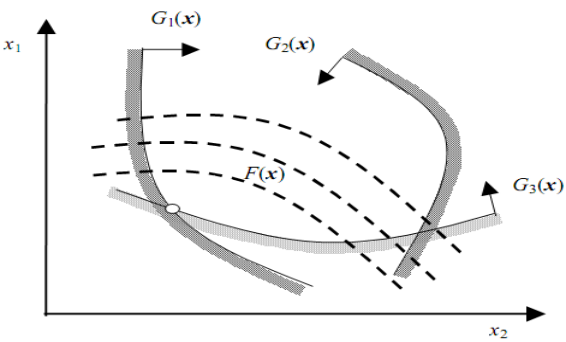 Figure 1
Introduction
There are many cases in down to earth applications where the variables of optimization are not constant. A few or all of the variables must be chosen from a rundown of number or discrete values. For instance, auxiliary individuals may must be outlined utilizing segments accessible in standard sizes; member-cross-sectional measurements may must be chosen from the economically accessible ones. Along these lines, impressive intrigue was appeared for discrete variable building optimization problems since the late 1960s and mid-1970s. In any case, around then even optimization methods for less complex consistent nonlinear programming (NLP) problems were still in the process of development. In the 80s, a noteworthy exertion was put into development and assessment of such algorithms. Although research around there keeps on growing better strategies, particularly for huge scale problems, a few dependable algorithms are now accessible for NLP problems, including sequential quadratic programming (SQP) and increased Lagrangian techniques. In recent years, the concentration has moved back to applications to practical problems that normally utilize discrete or blended discrete persistent factors in their formulation [1] . Among the techniques for discrete variable nonlinear optimization problems, the following techniques have been most generally examined: branch and bounds (BBM), zero one variable techniques, rounding-off techniques. Punishment work approach, sequential linear programming (SLP) and irregular search techniques have likewise been connected to discrete optimization problems [2] .
Review of literature
The obliged optimization problem, which is more commonsense optimization problem, has been formulated in terms of a few parameters and limitations. The parameters chosen to portray the outline of a structure are known as design variables while the limitations are known as imperative conditions [3] . Mathematicians formulated the optimization problem in a standard mathematical function formula.
Design variables: Certainly, the idea of optimizing a structure surmised some adaptability to change the design elements. The potential in changing communicated as far as scopes of reasonable changes of certain design variables signified by a vector x = {x1, x2,…, xn }. The design variables in the basic optimization problem may be the cross-sectional range, the hub position, the second snapshot of idleness, and so on. As it were, they are the parameters that control the geometry of the optimized structure. The design variable can take either constant or discrete variables [4][5][6] . A continuous variable is one that takes any value in the scope of the variety in its district. A discrete variable is one that takes just disconnected esteems, commonly from a rundown of passable esteems or an inventory. Along these lines, these design variables can be expressed as:
The vector of design variables x is divided into J sub-vectors . The components of these sub-vectors take values from a corresponding catalogue , i indicate the number of design variables in each sub-vector and λ is the number of sections in each catalogue.
Objective function:
The notation of optimization also implies that there is some merit function or functions that can be improved and can also be used as a measure of effectiveness of the design. The objective function, merit function, and cost function are names of the function being optimized and this function measures the effectiveness of the design [7] . This function might be a formulation of a single objective or multiple objectives as follows:
Optimization with more than one objective is generally referred to as multicriteria optimization. For structural optimization problems, weight, displacements, stresses, buckling loads, vibration frequency and cost or any combination of these can be used as objective function. The multi criteria function has different ways commonly used for reducing the number of functions to one. The first way is simply to generate a composite objective function that replaces all the objectives. The second way, most common in the formulation of design optimization problems, is to select the most important objective function, for instance the total weight of the structure, and to consider this function to be the goal of the optimization task [8] .
Constraints:
The limits, which take values for the design variables, are known as side constraints. The side constraints are divided into two types. The first type, commonly used in the design problem, is an inequality constraint:
Where the calculated and limited values of constraints and are is the number of inequality constraint functions. In the design optimization problem, not all constraints are functions of one term but they are functions of several terms. This can be expressed by Where ss is the number of terms in the constraint function.
Standard formulation:
From the above sections, the final formulation of the optimization problem can be mathematically represented by The feasible solution of a nonlinear problem can be graphically represented. For example, a nonlinear function F(x) of two design variables x1 and x2 with three nonlinear constraints G1(x), G2(x), and G3(x) can depicted as shown in Figure 1.
Features of a design optimization problem:
It is important to feature some of the features of the discrete nonlinear problem. First, any of the disparity limitations may not be dynamic at the optimum point on the grounds that the imperative surface may not go through any of the discrete points, i.e. in numerical calculations just a direct nearest toward the limitation limit might be found. Second, there is no basic basis, for example, Kuhn-Tucker condition to end the iterative search process. Along these lines, neighborhood optimality of the solution point can't be guaranteed unless an exhaustive search is performed. Third, the size of discreteness and nature of the discrete values may administer the conduct of a portion of the numerical algorithms and also the final solution of the problem. Fourth, the design problem is very nonlinear problem due to the idea of design variables and the connections between the imperative capacities and design variables. Fifth, constraints have distinctive plan for various individuals from the structure. For instance, a structure has pillars, sections, and a supporting framework. The limitations that control the plan of bars are unique in relation to those of propping frameworks or segments. Also, the arrangements of list areas for pillars are unique in relation to those of supporting frameworks or sections. Sixth, the computational exertion expected to achieve palatable outcomes increments with the multifaceted nature of the treated design problem. Subsequently, it is imperative to audit optimization techniques that arrangement with discrete design variables.
Discrete optimization techniques:
A review of the technique for discrete variable optimization was as of late. Several algorithms for discrete optimization problems were created, among them branch and bound strategy, punishment work approach, roundingoff, cutting plane, mimicked tempering, genetic algorithms, neural networks, and Lagrangian unwinding strategies. It is watched that a portion of the techniques for discrete variable optimization utilize the structure of the problem to accelerate the look for the discrete solution. This class of techniques is not reasonable for usage into a universally useful application. The branch and bound technique, recreated toughening, and genetic algorithm are the most used methods.
Direct approach
Branch-and-bound: Let us first notice that FAP can be formulated as a mixed linear-integer programme, using the node-link formulation of the directed graphs multi commodity problems. For the purpose of this section the usual notation used in this paper is slightly changed. The given demand volume to be allocated from node v to node t is given by d(v, t), and o(e) and t(e) denote the starting and end nodes of link e, respectively. Let V denote the set of nodes, let w(e) ∈ [0, 1] denote the weight of link e (variables), and let W (v, t) be the length of the shortest path from v to t (variables). Let {δ (e, t): e ∈ E, t ∈ V} be a set of binary variables such that if δ(e, t) = 1 iff link e is on a shortest path to node t. Let f (e, t) (variables) denote the flow to node t-on link e (it should be zero if e is not on a shortest path to node t). Let fx (v, t) (variables) denote the maximum flow to node t on all links outgoing from node v; this should be the flow on each link that is on a shortest path to node t. Note that using equality in (3.8) forces the shortest paths to be unique. Unfortunately, it turns out that the above MIP problem is difficult to solve already for small networks (we have tried CPLEX [7] ) so we do not report any numerical results for (1)- (8).
Lagrangean relaxation (LR):
Consider the following linear programming task, called OT, with no SNOP constraints on flows: Where is the flow realizing demand d on path j, and are given coefficients. Using LR we can solve the problem dual to OT (cf. [10] ). The idea of this approach is that the dual solution yields a weight system that can be used for the Some Techniques routing.
The dual problem to OT, abbreviated to DP, is as follows:
Maximize and λ with unlimited sign. (13) DP can be solved with sub gradient optimization since it can be shown that (13) is equivalent to (14) This in general will lead to a non-feasible solution to FAP, since the flows that solve the primal problem AT4 are in general different than those generated with the ECMP rule. Nevertheless, if a number of demands with multiple shortest paths is not large and when the number of the shortest paths for such demands is low (2-3 shortest paths) then we can expect that the ECMP flows will give a good near-optimal solution.
Conclusion
In the paper we have formulated an SNOP-related flow allocation problem (FAP) and proposed an arrangement of methods for settling it. We have demonstrated that FAP is NP-finished. We have considered a formulation of FAP in a MIP shape; shockingly the formulation turns out to be exceptionally hard to illuminate as of now for small networks, notwithstanding for such a complex solver as CPLEX. Along these lines, heuristic methods must be connected for FAP. Numerical studies demonstrate that the onestage approach, called WA, comprising in coordinate finding of achievable SNO Plink weight frameworks utilizing a Local Search technique, is very compelling quick, still it requires some tuning. The SAN application finds by and large better solutions than WA; still its running circumstances are much longer. Be that as it may, in the genuine IP networks the number of transit nodes is not high (30 travel hubs, say) and whatever is left of the hubs are simply entrance/departure switches which don't transit traffic. In this way, the two-stage approach in view of the SAL heuristic could maybe be very helpful practically speaking. Finally, it ought to be noticed that the proposed techniques yield the weight frameworks that beat the straightforward weight frameworks at present utilized as a part of the SNOP networks to an impressive extent.
References
8 in the original paper- Medhi D, Tipper D. Some approaches to solving a multi-hour broadband network capacity design problem with single-path routing, Telecommun. Systems, 2000; 13:269-271.
- Kozdrowski S, Pióro M, Arabas J, Szczesniak M. Robust design of multi commodity integral flow networks, in: Proceedings of the Seventh International Conference on Genetic Algorithms ICGA'97, University of Michigan, East Lansing, 1997.
- Pióro M, Gajowniczek P. Solving multi commodity integral flow problems by simulated allocation, Telecommun. Systems, 1997; 7(1-3):17-28.
- Fortz B, Thorup M. Internet traffic engineering by optimizing OSPF weights, in: Proceedings of the Infocom' 2000, Tel Aviv, 2000.
- Ben Ameur W, Gourdin E, Liau B. Dimensioning of internet networks, in: Proceedings of the DRCN, Munich, 2000.
- Faragó A, Szviatovszki B, Szentesi Á. Allocation of administrative weights in PNNI, in: Proceedings of the Networks' 98, Sorrento, 1998.
- Johnson DS, Aragon CR, McGeoch LA, Schevon C. Optimization by simulated annealing: an experimental evaluation, Oper. Res. 1991; 39(1).
- Pióro M, Stidsen T, Glenstrup A, Fenger C, Christiansen H. Design of robust optical networks, in: Proceedings of the NETWORKS' 2000, Toronto, 2000.