
Research article · 2018 · Full text
International Journal of Statistics and Applied MathematicsStrong equitable and inverse strong equitable domination number of some special classes of graphs
Volume 3(2) · Pages 645–651
Research areasAdvanced Graph Theory Research
Abstract
Author-writtenLet G = (V, E) be a simple, finite, undirected and connected graph. A non-empty subset D of V(G) is called a strong equitable dominating set of G if for every v V-D, there exists atleast one u D such that u and v are adjacent, also deg (u) ≥ deg (v) and if for every v V-D, there exists a vertex u D such that uv E(G) and ≤1. The minimum cardinality of such a minimal strong equitable dominating set is called a strong equitable domination number and it is denoted by se(G).If is a strong equitable dominating set, then is called an inverse strong equitable dominating set. The minimum cardinality of a minimal inverse strong equitable dominating set is called an inverse strong equitable domination number and it is denoted by
Summary
Source-checkedPlain-language reading of the full paper, prepared with AI and checked against the text. Each point links to the authors' own words.
Why it matters
- The study of domination in graphs is a rapidly growing area of graph theory with practical applications in social network modeling, coding theory, radio stations, and nuclear power plant problems. View evidence ↗
The question
- The authors aim to determine the strong equitable domination number for several specific classes of graphs. View evidence ↗
What they did
- The research analyzes six specific graph types: Clebsch (16 vertices, 40 edges), Soifer (9 vertices, 20 edges), Chvatal (12 vertices, 24 edges), Herschel (11 vertices, 18 edges), Fritsch (9 vertices, 21 edges), and Franklin (12 vertices, 18 edges). View evidence ↗
- The study also includes the Moser spindle graph, which consists of 7 vertices and 11 edges. View evidence ↗
- The authors evaluate the inverse strong equitable domination number, which is the minimum cardinality of a strong equitable dominating set found within the complement of the minimum strong equitable dominating set. View evidence ↗
What they found
- The inverse strong equitable domination number does not exist for the Soifer, Moser spindle, and Herschel graphs. View evidence ↗
What it means
- The authors conclude that they have successfully determined the strong and inverse strong equitable domination numbers, as well as the eccentricity, radius, and diameter, for the selected special classes of graphs. View evidence ↗
Visual summary
1 visualsIllustrations explain the paper; they do not show study data.
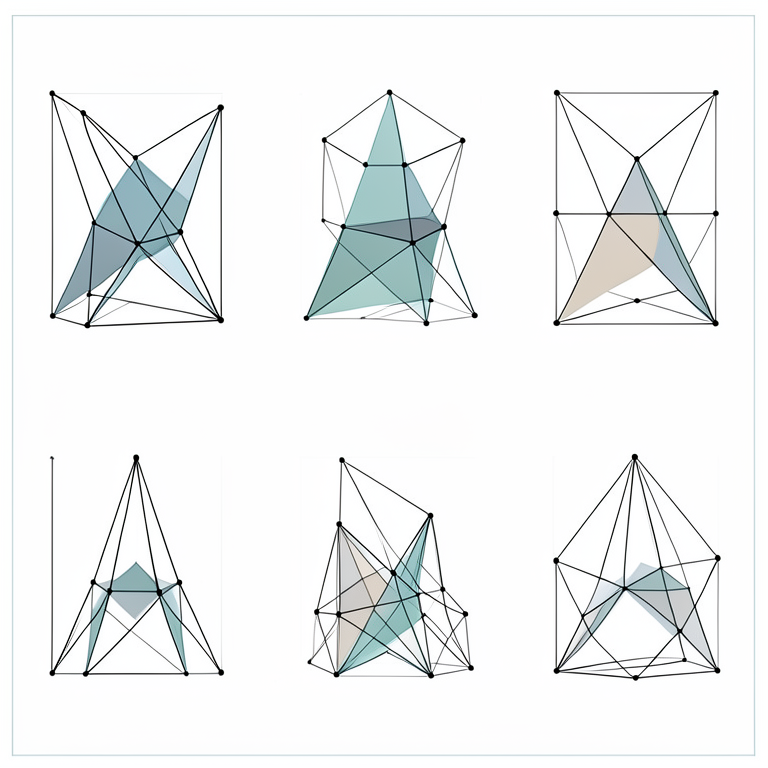
Study overview
AI-generated conceptual illustration (Mathematical graph structures (Clebsch, Soifer, Chvatal, Herschel, Fritsch, and Franklin graphs)). It explains the idea and does not show study data.
View source evidence ↗Introduction
In 1962, Ore used the name "dominating set" and "domination number". In 1977, Cockayne and Hedetniemi made an interesting and extensive survey of the results known at that time about dominating sets in graphs. The survey paper of Cockayne and Hedetniemi has generated a lot of interest in the study of domination in graphs. Domination has a wide range of applications in radio stations, modeling social networks, coding theory, nuclear power plants problems [10] . One of the fastest growing areas in graph theory is the study of domination and related subset problems such as independence, covering, matching and inverse domination. A non-empty subset D of V (G) in a graph G is a dominating set if every vertex in V-D is adjacent to atleast one vertex in D. The domination number ) (G is the minimum cardinality of a minimal dominating set of G.
The concept of inverse domination was introduced by V.R. Kulli [8] . If a non-empty subset D is called the minimum dominating set, then if V-D contains a dominating set D , then D is called the inverse dominating set of G and (G) is the inverse domination number.
Sampath Kumar and Pushpalatha introduced the concepts of strong and weak domination in graphs [11] . Let u, v V then u strongly dominates v if i) uv E and ii) deg (u) ≥ deg(v). A non-empty subset D V is a strong dominating set of G if every vertex in V-D is strongly dominated by atleast one vertex in D.
Swaminathan et al. [12] introduced the concept of equitable domination in graphs. A non-empty subset D of V(G) is called an equitable dominating set if for every vV-D, there exists a vertex uD such that uvE(G) and In this paper, we investigated some results on the strong equitable domination number of some special classes of graphs.
Preliminaries
Definition 2.1 [3] The Clebsch graph is a strongly regular quintic graph on 16 vertices and 40 edges. It is also known as the Greenwood-Gleason graph.
Definition 2.2
The Soifer graph is a planar graph on 9 vertices and 20 edges.
Definition 2.3
The Chvatal graph is a 4-regular graph on 12 vertices and 24 edges. It is a Hamiltonian graph. Definition 2.4 [5] The Herschel graph is a bipartite undirected graph with 11 vertices and 18 edges.
Definition 2.5
The Fritsch graph is the planar graph on 9 vertices and 21 edges.
Definition 2.6
The Franklin graph is a 3-regular graph on 12 vertices and 18 edges. It is a 3-vertex connected and 3 edge connected perfect graph.
Definition 2.7 [9] The Moser graph (also called the Moser Spindle graph) is an undirected graph on 7 vertices and 11 edges named after Mathematician Leo Moser and his brother William.
Results
Strong equitable domination number of some special graphs Definition 3.1 [1,2] A non-empty subset D of V(G) is called a Strong equitable dominating set of a graph G if for every v V-D, there exists a vertex u D such that uv E(G) and
The minimum cardinality of the Strong equitable dominating set is the strong equitable domination number and it is denoted by se (G).
In this section, we obtained the strong equitable domination number of some special classes of graphs.
Proof
By the theorem 3.6, the strong equitable domination number of Chvatal graph is se
The necessary and sufficient condition for the existence of atleast one inverse strong equitable dominating set of G is that G contains no isolated vertices. Let D be the minimum strong equitable dominating set of G and there exists an inverse strong equitable dominating set D of G which has three vertices. Clearly u in D strongly dominates v in V-D and ) deg(
Then D is the inverse strong equitable dominating set.
Observation: 4.6
The Inverse strong equitable domination number does not exist for the following graphs: i) Soifer graph ii) Moser spindle graph iii) Herschel graph
Conclusion
In this paper, we have investigated the strong equitable domination number and the inverse strong equitable domination number of some special classes of graphs. We have also attained the eccentricity, radius and diameter of those graphs.
References
12 in the original paper- Ameenal Bibi K, Rajakumari P. The Split domination, Inverse domination and equitable domination in the middle and the central graphs of the path and the cycle graphs, IJMTT. 2017; 49(3).
- Ameenal Bibi K, Rajakumari P. Strong and Weak domination of middle graphs of path and cycle, International Journal of Advanced Research in Computer science. 2017; 8(6):186-189.
- Arockia Arul Doss J, Prabhavathi S. The Domatic number of Clebsch Graph, International Journal of Innovative Research in Technology, Science & Engineering, 2015, 1(3). ISSN: 2395-5619
- Douglas B, West, Introduction to graph theory Second edition, 2015.
- Ganesan V, Dr. Balamurugan K. On Prime labeling of Herschel Graph, IJERME, 2016, I(II). ISSN: 2455-4200,
- Haynes TW, Hedetniemi ST, Slates PJ. Fundamentals of domination in graphs Marcel Dekker Inc. New York, U.S.A, 1998.
- Jayasree TG, Radha R Iyer. Results on the inverse domination number of some class of graphs, IJMET. 2018; 9(1):995-1004 Article ID: IJMET_09_01_106.
- Kulli VR, Sigarkanti SC. Inverse domination in graphs, Nat. Acad. Sci. Lect. 1991; 14:473-475.
- Mahadevan G, Selvam Avadayappan N, Ramesh T. Subramanian, Triple connected complementary tree domination number of a graph, International Mathematical Forum. 2013; 8(14)659-670.
- Preethi Gupta. Domination in graphs with application, Indian Journal of Research, 2013, 2(3). ISSN: 2250-1991.
- Sampath kumar E, Pushpalatha L. Strong Weak domination and domination balance in a graph, Discrete Math. 1996; 161:235-241.
- Swaminathan V, Dharmalingam KM. Degree equitable domination on graphs, Kragujevak Journal of Mathematics. 2011; 85(1):191-197.