
Research article · 2020 · Full text
International Journal of Statistics and Applied MathematicsCyclic surfaces in pseudo-euclidean space
Volume 5(1) · Pages 28–31
Research areasGeometric Analysis and Curvature FlowsGeometric and Algebraic TopologyPoint processes and geometric inequalities
Abstract
Author-writtenArticle observed concept of a cyclic surface defined in a Galilean space is generalized for a five-dimensional pseudo-Euclidean space of index two, and proved the existence of a full cyclic surface in pseudo-Euclidean spaces. The dimension of the smallest pseudo-Euclidean space is defined, where there exists a full cyclic surface.
Summary
Source-checkedPlain-language reading of the full paper, prepared with AI and checked against the text. Each point links to the authors' own words.
Why it matters
- Cyclic surfaces were originally defined in Galilean space, where they are characterized by points whose indicatrix curve is a hyperbola. View evidence ↗
- Previous research has established the differential characteristics and general study of these surfaces within the context of Galilean space. View evidence ↗
The question
- The objective of this research is to identify the specific pseudo-Euclidean spaces that can contain a cyclic surface. View evidence ↗
What they did
- The methodology for identifying a cyclic surface involves checking for a speed coefficient of 0, following established criteria. View evidence ↗
What they found
- The authors successfully generalized the concept of cyclic surfaces to a five-dimensional pseudo-Euclidean space of index two and proved that full cyclic surfaces exist in such spaces. View evidence ↗
What it means
- The paper defines the minimum dimensionality required for a pseudo-Euclidean space to support a full cyclic surface. View evidence ↗
Visual summary
1 visualsIllustrations explain the paper; they do not show study data.
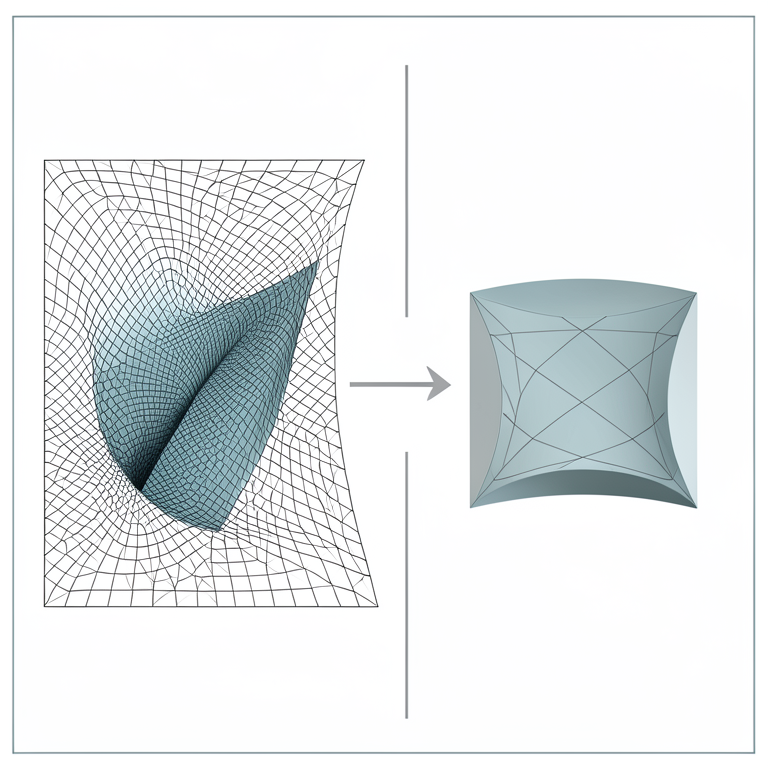
Study overview
AI-generated conceptual illustration (A three-dimensional geometric surface with a cyclic curvature embedded in a pseudo-Euclidean coordinate system). It explains the idea and does not show study data.
View source evidence ↗Introduction
Theory of cyclic surfaces was introduced by Artikbaev A. in Galilean space [1] . When classifying surface points in Galilean space, points with indicatrix curve hyperbola are called cyclic points. Cyclic points are called surfaces with cyclic surfaces. Cyclic surfaces in the Galilean space were studied by Kurbanov E. [2] . The differential characteristics of cyclic surfaces in Galilean space are given in [3] . Aim of this article is to determine which pseudo-Euclidean space contains a cyclic surface.
Methods
We are given an affine space and two 1 2 3 ( , , ,..., ) n X x x x x , vectors in this space.
Definition 1. Scalar product of these vectors is as follows: affine space is identified; space is -dimensional; -indexed Pseudo-Euclidean space is denoted by: ( -the number of negative thresholds) [4] . The norm of vectors is the square root obtained from the scalar product of these vectors, i.e. Distance between two points equal to the vector norm. If so
, , ) B y y y y y
Let be a five-dimensional two-indexed pseudo-Euclidean space. Then we look at a part space .
This part in space and scalar product vector's
Also, the distance between two points is calculated as follows and .
If is so, but these points do not intersect, the distance between them If we make this change , the vector forms the base vectors in three-dimensional space. The consequential space is a Galilean space.
Page Size and Layout
Look at the surface in this space: Say in a part of space let the surface be given in the form of a vector form. Vector formulas for any two-dimensional surface can be written as follows.
If we transformation (1), then the equation (3) takes shape. Here are equal. This gives a surface equation defined as a vector in Galilean space.
Thus,
this phase has a dense surface.
Say let the space be a regular surface defined by equation (2).
Theorem 1.
with this equation in space (4)
Any given surface is a cyclic surface.
Proof. The surface in question is included in this space because the three-dimensional part belongs to the space the main use. The second principal form for the surface to be a point of speed coefficient 0 Gat should be the best and sufficient [1] i.e find the surface equation. We will see the general form of the function for finding the surface equation . From the foregoing, satisfying this condition and if and
We have. This relationship shows the relationship is and only that is, depending on the parameter . From here we define here From this and when we find the functions, we obtain the following equation:
Based on the results, we have the following equation:
This cycle is a general view of the surface. From this surface is a cyclic surface will come from. Thus, the theorem is completely proved. ( , , , , ) 4) is a surface of the surface, the following equation for the surface capacity.
Note.
A double surface is a linear surface, and when we cut it with a special plane, a straight line forms on the surface. That is, the creators have a linear surface parallel to the special plane, and have the following equation:
(6) Cyclic surface in this theorem is in part three-dimensional space. We find that there are cyclic surfaces that do not fit into the four-dimensional space of space. For this, we refer to two-dimensional cyclic surfaces that do not belong to the four-dimensional space of space.
To us to get the two-dimensional equation of the full surface in space:
(7) Theorem 2. Pseudo-Euclidean space there is a twodimensional of full cyclic surface. Proof: Surface defined by equation ( 7) must satisfy equation ( 6) to be from surface of cyclic points (6) to equality: satisfaction our equality (9) turns out to be cyclic surface. The equation:
References
0 in the original paperCited by 1
From OpenAlex, OpenCitations and reference lists read by Scinovex
- Invariant Geometric Characteristics Under the Dual Mapping of an Isotropic Space ↗
Шерзодбек Исмоилов, Bekzod Sultanov · Asia Pacific Journal of Mathematics · 2023
In the paper, we give the definitions, basic concepts, and formulas of the basic geometric characteristics associated with the surface of an isotropic space R 2 3 .The geometric sense of the dual mapping is revealed.Using the geometric interpretation of the dual mapping, we prove that the dual asymptotic mapping is asymptotic.Some properties of shortest curves on a surface are…
❝ 2PDF