
Research article · 2018 · Full text
International Journal of Statistics and Applied MathematicsComparison of two weighted goal programming models for financial management of a health care system
Volume 3(2) · Pages 363–369
Research areasOptimization and Mathematical Programming
Abstract
Author-writtenIn this paper, we presented weighted goal programming model (WGP) for financial management of healthcare system in Hyderabad. The data are collected from the health care system’s financial statements from 2010 to 2017. In this study, we considered six financial metrics such as liability, equity, income, asset, profit and proportion of values in the statement. The weights in the goal programming model are obtained by percentage normalization and analytical hierarchy process (AHP). The problem was solved using PM-QM for windows and the solutions are compared.
Summary
Source-checkedPlain-language reading of the full paper, prepared with AI and checked against the text. Each point links to the authors' own words.
Why it matters
- Effective financial management is critical for healthcare systems to provide high-quality, low-cost services to patients. View evidence ↗
- Real-world decision-making problems are typically multi-objective, necessitating advanced programming techniques beyond single-objective linear programming. View evidence ↗
- Goal Programming (GP) is a widely used approach for formulating and solving multi-objective optimization problems. View evidence ↗
The question
- The study aims to present and compare weighted goal programming (WGP) models for the financial management of a healthcare system in Hyderabad. View evidence ↗
What they did
- Financial data was collected from the healthcare system's annual statements covering the period from 2010 to 2017. View evidence ↗
- The model analyzed six financial metrics: assets, liabilities, equity, income, profit, and the proportion of values in the financial statement. View evidence ↗
- The study compared two methods for determining weights in the goal programming model: percentage normalization and the Analytical Hierarchy Process (AHP). View evidence ↗
- The mathematical problems were solved and compared using PM-QM for Windows software. View evidence ↗
What they found
- Both weighting methods showed that assets and income remained unchanged, while profit, equity, and financial management values could be increased. View evidence ↗
What it means
- The authors conclude that both the percentage normalization and AHP-GP methods successfully achieved all goals and are useful for application in other areas. View evidence ↗
Visual summary
1 visualsIllustrations explain the paper; they do not show study data.

Weighting Method Comparison
AI-generated conceptual illustration (A conceptual schematic of a healthcare financial management system). It explains the idea and does not show study data.
View source evidence ↗Figures & tables
From the original paper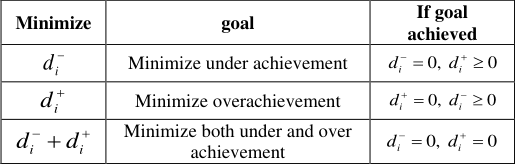 Table 1
 Table 2
 Table 3
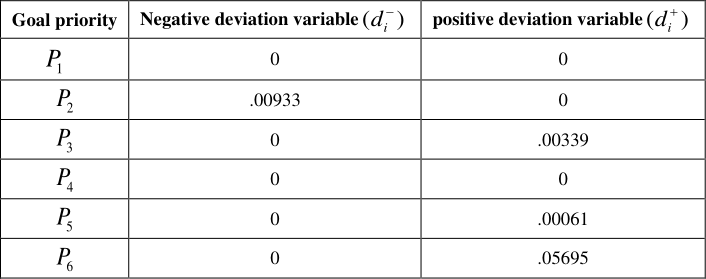 Table 4
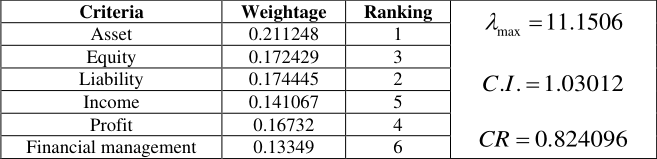 Table 5
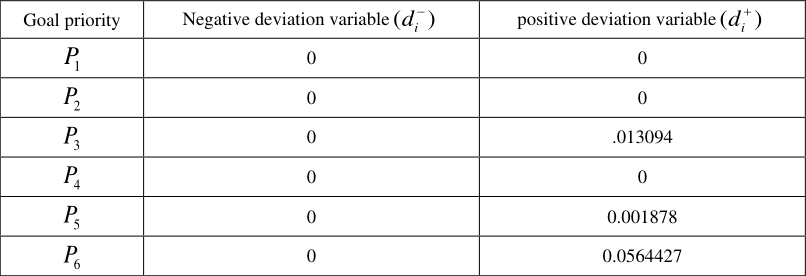 Table 6
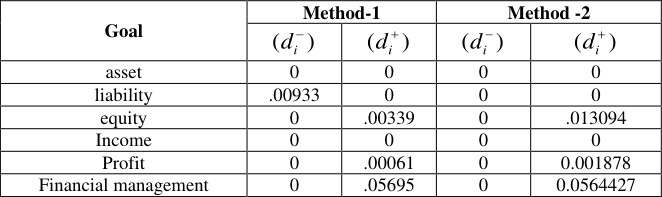 Table 7
Introduction
Now a day's health care systems are facing problems to meet the requirements of the patient's in terms of qualitatively and quantitatively. There is high competition among the health care systems to attract the patients/customers. They are facing problems in human resource planning, other infra-structure resources panning, technical resources planning. To provide high quality services for the patients at low cost for any health care system must overcome these issues. If the health care system is financially good, it can perform well. So, for any health care system financial management is important to run the system effectively. Financial management means not expecting high return/profit on investments. Health care system different from other systems. They always try to provide good service for the patients at reasonable charges. So, for the financial management of selected health care system at Hyderabad, we consider the parameters asset, liability, equity, profit, income and proportion of the values in the data from 2010to 2017.The data has been collected from the annual statements of the health care system certified the financial experts. We used the weighted goal programming in this paper. This method is applied in two ways 1) weights obtained by percentage normalization 2) weights obtained analytical hierarchy process (AHP).
Literature Review
Goal programming (GP) is an extension of linear programming introduced by Charnes [7] . Linear programming had been proved to be a good method to solve practical problems. But its drawback is that it can be used only in a single objective optimization. Real life decision making problems are multi-objective rather than single objective. Which led to the development of further programming techniques to deal with multi-objective real-world problems. Goal Programming (GP) is important and widely used in multi-objective optimization approach to formulate and solve many real-life problems with multiple objectives. GP [23] approach is one of the oldest multi-criteria decision-making methods. In GP we consider the constraints as goals and the objective is to minimize the undesired deviational variables. One of the popular variation of GP is weighted goal programming (WGP) [20] in which weights are used in the objective function. The weights can be obtained in different ways. In this study we considered percentage normalization and analytical hierarchy process (AHP) to get the relatives weights for the goals. In our previous studies [1,2] we have used lexicographic goal programming and weighted goal programming for financial management of health care system. In this paper we compare the two variations of the weighted goal programming models. There are numerous applications of GP. We review few studies. Goal programming is applied for optimization of bank loans [3] , financial portfolio management [4] , financial structure optimization [26] , funding allocation in universities/institutions [9,12], asset and liability management [24,11] , optimization of liquidity management of banks [18] , capital budgeting [13] , vehicle routing [6] , forest management [8] , optimization of pharmacy allocation [10] , human resource allocation in hospitals [16] , nurse scheduling [19] . AHP is most widely used pair wise comparison method of MCDM category. AHP is useful to prioritize the criteria and select the best alternative. The AHP was introduce by Saaty [21,22] Vaidya Kumar [27] presented a review paper on AHP. Steuer and Na, [25] applied AHP to the finance sector, Bruno et al. [5] evaluated supplier based AHP method, Ivley et al. [15] used AHP for medical equipment selection, Wang et al. [28] evaluated the relative importance weightings of alternative suppliers supported the delivery liableness, flexibility and responsiveness, cost, and asset. In the next section we presented general GP and AHP methodology.
Methodology
In this section we discuss the general goal programming methodology and AHP methodology
General Goal Programming
The generalized linear goal programming is defined as
ww and represent the relative weights to be assigned to each of the k =1... i n Different classes within the th i category to which the non-Archimedean transcendental value of i P is assigned. The i P are the preemptive priority factors who serve only as a ranking symbol that can be interpreted to mean that no substitutions across categories of goals will be permitted. It is assumed that the ordering of deviation variables in an objective function, will be minimized in order, where Where the deviational variables are mathematically defined as follows
The deviational variable cannot be basic variables at once, because by definition they are dependent. This indicates that in any simplex iteration, at most, one of them can assume a positive value. The following table-1 shows the various types of goal achievement.
Table 1: Goal achievement
Table 1: Goal achievement
Minimize goal If goal achieved
Minimize both under and over achievement 0, 0
AHP Methodology
In the goal programming, goals are prioritized by analytical hierarchy process. To make a decision in an organized way to generate priorities we need to decompose the decision into the following steps.
Step-1 outline the matter and confirm the sort of information sought-after. Step-2 Structure the choice hierarchy from the highest with the goal of the choice, then the objectives from a broad perspective, through the intermediate levels (criteria on that later components depend) to all-time low level (which typically could be a set of the alternatives). Step-3 Construct a collection of pairwise comparison matrices. Every part in associate degree higher level is employed to match the weather within the level right away below with regard to it. Step-4 Use the priorities obtained from the comparisons to weigh the priorities within the level right away below. Do that for each part. Then for every part within the level below add its weighed values and acquire its overall or international priority. Continue this method of advisement and adding till the ultimate priorities of the alternatives within the bottom most level is obtained. For detailed methodology is refer [22]
Data of the problem
The data is collected from the annual reports of the health care system which are uploaded in the website. We considered the asset, liability, equity, income, profit, as parameters. Table -.2 shows the data of the health care system (in Rs. millions).
Model Development
In this section we develop the method for the data
Decision Variables
The decision variables are defined as follows
The goal constraints:
The goals to be examined are: (1) asset accumulation, (2) liability reduction, (3) equity wealth, (4) earning and ( 5) profitability and ( 6) optimum management item on the financial statement. The goal constraints are defined below.
Goal 1: Asset Accumulation Goal: The management of healthcare system wants to maximize the asset accumulation. So, we have to minimize the negative deviational variable 1 d .
Weights By percentage normalization
In this method each deviation is turned into a percentage value away from its target level. Thus, all deviations are measured in the same units. In our problem, consider that the decision maker esteems the penalization of all unwanted deviations as equally important. The weighted goal programming with percentage normalization is given as follows
We can observe that the weights in the objective function have been divided by the target levels rather than the entire goal. The former gives the same effect as the latter but with less effort in reformulation. Also, the objective function contributions are actually proportions rather than percentages. That is, they are one hundredth of the percentage value. The entire achievement function could be multiplied by 100 to give percentages, but this does not affect the optimal solution found. The achievement function value a now has meaning, the total sum of proportional deviations away from the goals
Solution
The problem was solved by using POM-QM for windows (formerly DS for windows). The following table-4 shows the results. indicates that the proportion of the values given in the financial statement can be increased by 0.05695 in the period.
Weights by Analytical Hierarchy Process
Analytic hierarchy process (AHP) is a more generally accepted remedy by which the priorities of preemptive goals can be established. AHP utilizes hierarchical structures to represent a decision-making problem and then develops priorities for the alternatives on the basis of decision-makers' judgments throughout the decision-making process. The procedure requires the decision maker to judge the relative importance of each criterion and specify a preference on each criterion for decision alternatives based on pairwise comparisons for elements in hierarchy using the pairwise comparison matrix. For estimation of relative importance for the decision problems, the decision-makers perform synthetization and compute eigenvalues and eigenvectors that are used for measuring consistency. The value of consistency in judgment is determined by the smallest eigenvector. The result is that the smaller the value of consistency, the smaller the value of eigenvector. The value of the consistency ratio of 0.10 or less is considered to be acceptable. To prioritize the financial metrics, we have prepared set of questionnaires and was distributed among a great number of financial analyst/accountant and the judgements are considered. The AHP weights are in the following table-5
Conclusion
In this chapter first, we have applied weighted goal programming method in two ways: weights by percentage normalization and weights by AHP. The solutions are compared in the following table-7
Figures and tables from the paper
| Item (goal) | year | — | — | — | — | — | — | — | total |
|---|---|---|---|---|---|---|---|---|---|
| 2010 | 2011 | 2012 | 2013 | 2014 | 2015 | 2016 | 2017 | ||
| asset | 6,196.62 | 5,980.23 | 9,640.36 | 14,632.9 | 13,575.63 | 16,963.33 | 17,828.42 | 21,863.04 | 1,06,680.53 |
| liability | 5,228.46 | 5,350.15 | 5,438.24 | 5,050.31 | 5,550.09 | 7,959.93 | 9,821.75 | 9,783.53 | 54,182.46 |
| equity | 15,417.78 | 17,721.65 | 23,522.66 | 27,275.97 | 29,647.25 | 31,610.71 | 34,301.31 | 38,877.81 | 2,18,375.14 |
| income | 18,587.45 | 23,522.66 | 28,279.20 | 33,488.18 | 38,840.88 | 46,380.62 | 54,779.64 | 72,773.99 | 3,16,6,52.62 |
| profit | 1,519.64 | 1,817.18 | 2,309.90 | 3,091.08 | 3,307.20 | 3,465.95 | 3,694.39 | 1,311.6 | 20,516.94 |
| total | 46,949.95 | 54,391.87 | 69,190.36 | 83,538.44 | 90,921.05 | 1,06,380.54 | 1,20,425.51 | 1,44,609.97 | 6,54,136.69 |
Table text extracted from the original PDF; superscript letters are shown inline. The original table image is below.
View original table image
| Item(goal) | year | — | — | — | — | — | — | — | total |
|---|---|---|---|---|---|---|---|---|---|
| 2010 | 2011 | 2012 | 2013 | 2014 | 2015 | 2016 | 2017 | ||
| asset | 0.0062 | 0.0060 | 0.0096 | 0.0146 | 0.0136 | 0.0170 | 0.0178 | 0.0219 | 0.1067 |
| liability | 0.0052 | 0.0054 | 0.0054 | 0.0051 | 0.0056 | 0.0080 | 0.0098 | 0.0098 | 0.0542 |
| equity | 0.0154 | 0.0177 | 0.0235 | 0.0273 | 0.0296 | 0.0316 | 0.0343 | 0.0389 | 0.2184 |
| income | 0.0186 | 0.0235 | 0.0283 | 0.0335 | 0.0388 | 0.0464 | 0.0548 | 0.0728 | 0.3167 |
| profit | 0.0015 | 0.0018 | 0.0023 | 0.0031 | 0.0033 | 0.0035 | 0.0037 | 0.0013 | 0.0205 |
| total | 0.0470 | 0.0544 | 0.0692 | 0.0835 | 0.0909 | 0.1064 | 0.1204 | 0.1446 | 0.6541 |
Table text extracted from the original PDF; superscript letters are shown inline. The original table image is below.
View original table image
| Criteria | Weightage | Ranking | 11.1506 max C . I .1.03012 CR 0.824096 |
|---|---|---|---|
| Asset | 0.211248 | 1 | |
| Equity | 0.172429 | 3 | |
| Liability | 0.174445 | 2 | |
| Income | 0.141067 | 5 | |
| Profit | 0.16732 | 4 | |
| Financial management | 0.13349 | 6 |
Table text extracted from the original PDF; superscript letters are shown inline. The original table image is below.
View original table image
References
28 in the original paper- Prasad AVS, Dr. Y Raghunatha Reddy. A goal programming model for financial management of a healthcare system, International Journal of Mathematical Archive. 2017; 86(1):25-29, ISSN: 2229-5046
- Prasad AVS, Dr. Y Raghunatha Reddy. An AHP Based Weighted Goal programming Model for Financial Management of a Health Care System. International Journal of Mathematics and its Applications. 2017 ; 3-B:137-143
- Agarana MC. Optimization of banks loan portfolio management using goal programming technique, International journal of research in Applied, Natural, Social sciences. 2014; 2(8):43-52.
- Belaid Aouni. Financial portfolio management through goal programming mode l. European journal of operations research. 2014; 234(2):536-545.
- Bruno G, Esposito E, Genovese A, Passaro R. AHP-based approaches for supplier evaluation: Problems and perspectives. Journal of Purchasing and Supply Management. 2012; 18:159-172.
- Calvete HI, Gale C, Oliveros MJ, Sanchez-Valverde B. A goal programming approach to vehicle routing problems with soft time windows, European Journal of Operational Research. 2007; 177:1720-1733.
- Charnes A, Cooper WW. Management Models and Industrial Applications of Linear Programming, John Wiley & Sons, New York, 1961.
- Diaz-Balteiro L, Romero C. Forest management optimization models when carbon capture disconcerted A goal programming approach Forest Ecology Management. 2003; 174:447-457
- Ekezie DD, Onuoha DO. Goal programming-An application to budgetary allocation of an institution of higher learning, Research Journal in Engineering and Applied Sciences. 2013; 22:95-105.
- Ghand faroush P. Optimal allocation of time in a hospital pharmacy using goal programming. European Journal of Operations Research. 1993; 70:191-198.
- Giokas D, Vassiloglou M. A goal programming model for bank assets and liabilities. European Journal of Operations Research. 1991; 50:48-60.
- Hassan N. Goal programming with utility function for funding allocation of a university library. Applied Mathematical Sciences. 2012; 6(110):5487-5493.
- Hawkins Clark A. A goal programming approach for capital budgeting, financial management. 1974; 3(1):50-62
- Ignizio JP. Goal Programming and Extensions, Lexington Books, Lexington, MA, 1976.
- Ilya IvIev, Jakub Vcek, Peter Kneppo. Multi criteria decision analysis for supporting the selection of medical devices under uncertainty. European journal of operations research. 2015; 247(1):216-228
- Kwak NK, McCarthy KJ, Parker GE. A human resource planning model for hospital/medical technologists: An analytic hierarchy process approach. Journal of Medical Systems. 1997; 3:173-187.
- Lee SM, Goal Programming for Decision Analysis, Auerback, Philadelphia, PA, 1972.
- Mohammadi. Optimization of bank liquidity management using goal programming and fuzzy AHP, Research Journal of Recent Sciences. 2015; 4(6):53-61.
- Musa AA, Saxena U. Scheduling nurses using goal programming techniques. IIE Transactions. 1984; 16(3):217-21.
- Raja Raman. A weighted goal programing model for planning sustainable development applied to gulf cooperation council countries, applied energy. 2017; 185(2):1931-1939.
- Saaty TL. The analytic hierarchy process: Planning, priority setting, resources allocation. New York, NY: McGraw, 1980.
- Saaty TL. The analytical Hierarchy process. McGraw-Hill, New York, 1980.
- Schniederjans MJ Goal Programming, Methodology and Applications, Kluwer Publishers, Boston, 1995.
- Soheyla N. Asset and liability optimal management mathematical modeling for banks. Journal of Basic and Applied scientic Research. 2013; 3(1):484-493.
- Steuer RE, Na P. Multiple criteria decision making combined with finance: A categorized bibliographic study, European Journal of Operational Research. 2003; 150(3):496-515.
- Tunjo P. Financial structure optimization by using a goal programming approach, Croatian Operational Research Review (CRORR). 2012; 3:150-162.
- Vaidya OS. Kumar S. Analytic hierarchy process: An overview of applications, European Journal of Operational Research. 2006; 169(1):1-29.
- Wang G, Huang SH, Dismukes JP. Product-driven supply chain selection using integrated multi-criteria decision-making methodology. International Journal of Production Economics. 2004; 91(1):1-15.
Cited by 4
From OpenAlex, OpenCitations and reference lists read by Scinovex
- Optimizing the Financial Management of Electronic Companies using Goal Programming Model ↗
Lam Weng Hoe, Lam Weng Siew, Lee Pei Fun · Journal of Physics Conference Series · 2021
Abstract The swift development and transformation of emerging technologies such as augmented reality, robotics, biometrics and 3D printing place varying degree of pressure to the electronic industry to play a trailblazing role in making the world a smarter place of living. The concept of smart city increases the demand for the upgrades and sophistication of electronic components. Shorter product life…
❝ 5PDF - Optimization of production planning for food and beverage MSMEs: case in the covid-19 pandemic ↗
Vita Sarasi, Nugroho Djati Satmoko, Vivian Winita · Operations Excellence Journal of Applied Industrial Engineering · 2023
Micro, Small, and Medium Enterprises (MSMEs) in the food and beverage sector is one of the sectors negatively affected by the COVID-19 outbreak, even though this sector is one of the largest contributors to the Gross Domestic Product of the non-oil and gas industry in Indonesia. This study intends to provide an overview of solutions in the form of case…
❝ 2PDF - Optimization Analysis of Company Financial Statements Using Weighted Goal Programming with Analytical Hierarchy Process ↗
Hagni Wijayanti, Sudradjat Supian, Diah Chaerani, Adibah Shuib · Preprints.org · 2024
Financial statements depict the condition of a company and need to be analyzed and evaluated to assess its performance. This research aims to analyze financial statements to describe the financial condition, measure business development over time, and evaluate the achievement of the com-pany's objectives. An optimization analysis of financial ratios is performed using the Weighted Goal Programming (WGP) model, which…
❝ 1PDF - Robust Goal Programming as a Novelty Asset Liability Management Modeling in Non-Financial Companies: A Systematic Literature Review ↗
Hagni Wijayanti, Sudradjat Supian, Diah Chaerani, Adibah Shuib · Computation · 2024
In addressing asset-liability management (ALM) problems, goal programming (GP) has been widely applied to integrate multiple objectives. However, it is inadequate in handling data changes in ALM caused by interest rate fluctuations. Therefore, a more robust and improved ALM optimization method is needed to manage fluctuations in financial ratios in ALM. This study introduces a novel approach by combining a…
❝ 0PDF