
Research article · 2018 · Full text
International Journal of Statistics and Applied MathematicsTheoretical concept of linear higher and algebraic equations
Volume 3(2) · Pages 434–442
Research areasPolynomial and algebraic computationNumerical methods for differential equationsMatrix Theory and Algorithms
Abstract
Author-writtenThis paper contributes to the theoretical analysis of linear Differential Algebraic Equations of higher order as well as of the regularity and singularity of matrix polynomials. An algebraic number field is a finite extension field of the field of rational numbers. Within an algebraic number field is a ring of algebraic integers, which plays a role similar to the usual integers in the rational numbers.Some invariants and condensed forms under appropriate equivalent transformations are given for systems of linear higher-order Differential-Algebraic Equations’ with constant and variable coefficients. Inductively, based on condensed forms the original Differential-Algebraic Equations system can be transformed by differentiation-and-elimination steps into an equivalent strangeness-free system, from which the solution behaviour (including consistency of initial conditions and unique solvability) of the original Differential-Algebraic Equations system and related initial value problem can be directly read off. It is shown that the following equivalence holds for a Differential-Algebraic Equations system with strangeness-index ^ and square and constant coefficients. For any consistent initial condition and any right-hand side the associated initial value problem has a unique solution if and only if the matrix polynomial associated with the system is regular.
Summary
Source-checkedPlain-language reading of the full paper, prepared with AI and checked against the text. Each point links to the authors' own words.
Why it matters
- Differential-algebraic equations (DAEs) are essential for modeling chemical reaction kinetics, electrical circuits, and constrained mechanical systems. View evidence ↗
- Solving DAEs can be difficult because they often require numerical differentiation, which is an unstable operation. View evidence ↗
- Algebraic number fields are finite extension fields of rational numbers containing a ring of algebraic integers. View evidence ↗
The question
- The study aims to provide a theoretical analysis of higher-order linear Differential-Algebraic Equations and the singularity and regularity of matrix polynomials. View evidence ↗
What they did
- The author uses equivalent transformations to derive condensed forms and invariants for linear higher-order DAE systems with both variable and constant coefficients. View evidence ↗
- The research employs an inductive process of differentiation-and-elimination steps to transform DAE systems into equivalent strangeness-free systems. View evidence ↗
- The author applies coordinate changes and algebraic manipulations to establish condensed forms for quadratic matrix polynomials. View evidence ↗
What they found
- For a DAE system with constant coefficients, a unique solution to the initial value problem exists if and only if the associated matrix polynomial is regular. View evidence ↗
- Converting a second-order DAE system into a first-order system can increase the strangeness-index by one. View evidence ↗
- The conversion of higher-order DAEs to first-order systems is not always equivalent because the first-order system may require a higher degree of smoothness for the right-hand side function. View evidence ↗
- Using condensed forms, the author demonstrates that the system can be partially decoupled into an algebraic part, an ordinary-differential-equation part, and a coupling part. View evidence ↗
- The inductive transformation process results in strangeness-free systems that allow for the direct determination of solution uniqueness, solvability, and initial condition consistency. View evidence ↗
What it means
- The author concludes that they have successfully provided a theoretical analysis linking higher-order linear DAEs with the regularity and singularity of matrix polynomials. View evidence ↗
- The author notes that the practical implementation of detecting regularity, singularity, and nearness to singularity in software packages is a goal for future work. View evidence ↗
Visual summary
1 visualsIllustrations explain the paper; they do not show study data.
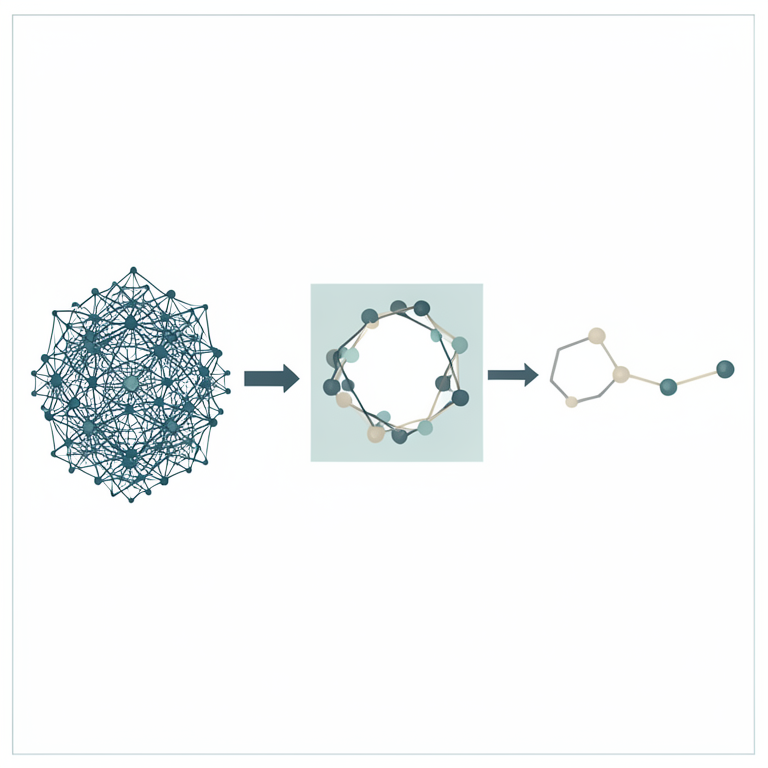
DAE System Decoupling Process
AI-generated conceptual illustration (A mathematical system of equations represented as geometric blocks of interconnected nodes and lines). It explains the idea and does not show study data.
View source evidence ↗Introduction
The main interest of algorithms in Algebraic Equations is that they provide number theorists with a means of satisfying their professional curiosity. The praise of numerical experimentation in number theoretic research is as widely sung as purely numerological investigations are indulged in, and for both activities good algorithms are indispensable [1] . What makes an algorithm good unfortunately defies definition-too many extra-mathematical factors affect its practical performance, such as the skill of the person responsible for its execution and the characteristics of the machine that may be used [2] . The present study addresses itself not to the researcher who is looking for a collection of welltested computational methods for use on his recently acquired personal computer. Rather, the intended reader is the perhaps imaginary pure mathematician who feels that he makes the most of his talents by staying away from computing equipment. It will be argued that even from this perspective the study of algorithms, when considered as objects of research rather than as tools, offers rich rewards of a theoretical nature. The problems in pure mathematics that arise in connection with algorithms have all the virtues of good problems [3] . They are of such a distinctly fundamental nature that one is often surprised to discover that they have not been considered earlier, which happens even in well-trodden areas of mathematics; and even in areas that are believed to be well-understood it occurs frequently that the existing theory offers no ready solutions, fundamental though the problems may be. Solutions that have been found often need tools that at first sight seem foreign to the statement of the problem [4] . In this paper, we consider systems of linear /th-order differential-algebraic equations with constant coefficients of the form (1) Where possibly together with initial conditions
Here, the nonnegative integer is the strangeness-index of the system (1), i.e. to get continuous solutions of the (1), the righthand side has to be continuously differentiable (later, in Section 2 we shall give an explicit definition of the strangeness-index). First, let us clarify the concepts of solution of the system (1), solution of the initial value problem (1)-( 2), and consistency of the initial conditions (2). A vector-valued function is called solution of the initial value problem ( 1)-( 2) if it is a solution of (1) and, furthermore, satisfies (2). Initial conditions (2.2) are called consistent with the system (1) if the associated initial value problem (1)-( 2) has at least one solution.
In the last section we saw that DAEs differ in many ways from ordinary differential equations. For instance the circuit lead to a DAE where a differentiation process is involved when solving the equations. This differentiation needs to be carried out numerically, which is an unstable operation. Thus there are some problems to be expected when solving these systems. In this section we try to measure the difficulties arising in the theoretical and numerical treatment of a given DAE. Modelling with differential-algebraic equations plays a vital role, among others, for constrained mechanical systems, electrical circuits and chemical reaction kinetics. In this paper we will give examples of how DAEs are obtained in these fields. We will point out important characteristics of differential-algebraic equations that distinguish them from ordinary differential equations. Consider the (linear implicit) DAE system: Ey' = A y + g (t) with consistent initial conditions and apply implicit Euler:
Now the true solution, y (tn), satisfies: E [(y (tn+1) -y (tn))/h + h y''(x)/2] = A y (tn+1) + g (tn+1)
And defining en = y(tn) -yn, we have: en+1 = (E-A h) -1 [E en-h2 y''(x)/2] e0 = 0, known initial conditions where the columns of Aa correspond to the voltage, resistive and capacitive branches respectively. The rows represent the network's nodes, so that ¡1 and 1 indicate the nodes that are connected by each branch under consideration. Thus AA assigns a polarity to each branch. Example 1 we investigate the initial value problem for the linear second-order constant coefficient Differential-Algebraic Equations'
Where is suciently smooth, together with the initial conditions? (4) Where a short computation shows that system (2.3) has the unique solution (5) Moreover, ( 5) is the unique solution of the initial value problem (3)-( 4) if the initial conditions (4) are consistent, namely, (6) If we let Then we have the following initial-value problem for the linear first-order Differential-Algebraic Equations' (7) Together with the initial condition (8) It is immediate that the system (7) of first-order Differential-Algebraic Equations has the unique solution (9) In this form, ( 9) is the unique solution of the initial value problem ( 7)-( 8) if the initial condition ( 8) is consistent, i.e. or in other words, the strangeness-index of the converted first-order system ( 7) is larger by one than that of the original second-order system (3). For a general system of/-th-order Differential-Algebraic Equations', it is not difficult to find similar examples. Differential-Algebraic Equations' into an associated system of first-order Differential-Algebraic Equations' is not always equivalent in the sense that higher degree of the smoothness of the right-hand side f (t) may be involved in the solutions of the latter. It should be noted that Example 3 also shows that, to obtain continuous solutions of a system of Differential-Algebraic Equations', some parts of the right-hand side f (t) may be required to be more differentiable than other parts which may be only required to be continuous; for a detailed investigation, we refer to, for example. Nonetheless, in order to simplify algebraic forms of a system of Differential-Algebraic Equations', we usually apply algebraic equivalence transformation to its matrix coefficients. For this reason and to avoid becoming too technical, we always consider the differentiability of the right-hand side vector-valued function f (t) as a whole, and do not distinguish the degrees of smoothness required of its components from each other.
Review of Literature
In this paper we will consider algorithms in algebraic number theory for their own sake rather than with a view to any of the above applications [7] . The discussion will be concentrated on three basic algorithmic questions that one may ask about algebraic number fields, namely, how to determine the Galois group of the normal closure of the field, or, more generally, of any polynomial over any algebraic number field; how to find the ring of integers of the field; and how to determine the unit group and the ideal class group of that ring of integers. These are precisely the subjects that are discussed in Algorithmic algebraic number theory [8] but our point of view is completely different. Present algorithms that "yield good to excellent results for number fields of small degree and not too large discriminate", but our attitude will be decidedly and exclusively asymptotic. For the purposes of the present study one algorithm is considered better than another if, for each positive real number N, it is at least N times as fast for all but finitely many values of the input data. It is clear that with this attitude we can make no claims concerning the practical applicability of any of the results that are achieved [9] . In fact, following Archimedes one should be able, on the basis of current physical knowledge, to find an upper estimate for all sets of numerical input data to which any algorithm will ever be applied, and an algorithm that is faster in all those finitely many instances may still be worse in our sense. We have mentioned for convenience of notation and expression, in this section we shall work mainly with systems of linear second-order Differential-Algebraic Equations' with constant coefficients Where are any nonsingular matrices. In particular, among those canonical forms for (13) are the wellknown Weier strass canonical form for regular matrix pencils and the Kronecker canonical form for general singular matrix pencils from which one can directly read off the solution properties of the corresponding Differential-Algebraic Equations'. Similarly, as we will see later in this chapter, the behaviour of solutions of the system (11), as well as the initial value problem (11)-( 12), depends on the properties of the quadratic matrix polynomial Here, by equivalence we mean not only that the relation However, it is also well-known that it is an open problem to find a canonical form for quadratic matrix polynomials (16), let alone higher-degree matrix polynomials, from which we can directly read off the solution properties of the corresponding system of Differential-Algebraic Equations'. Nonetheless, inspired by the work of (though the papers mainly deal with linear first-order Differential-Algebraic Equations with variable coefficients), we shall in this section give an equivalent condensed form for quadratic matrix polynomials (14) through purely algebraic manipulations and coordinate changes. Based on the condensed form we can partially decouple the system into three parts, namely, an ordinary-differential-equation part, an algebraic part and a coupling part, and therefore pave the way for the further treatment of the system in the following section. Sometimes, we will use the notation of a matrix (/ + 1)-tuple instead of the matrix polynomial degree which is associated with the general /th-order system (1) of Differential-Algebraic Equations'. By the following definition, we make the concept of equivalence between two general matrix (/ + 1)-tuples clear. Definition Two Where N (■) denotes the null space of a matrix, and R (-) the column space of a matrix.
The condensed form for a matrix pair (E, A) under equivalence relation (17) has been implicitly.
Then, the matrix pair (E, A) is equivalent to a matrix pair of the form
Are invariant under equivalence relation (17).
For completeness, we give a proof of this lemma. Proof of Lemma. In the following, the word "new" on top of the equivalence operator denotes that the subscripts of the entries are adapted to the new block structure of the matrices. Using Lemma, we obtain the following sequence of equivalent matrix pairs.
It remains to show that such quantities r, s, d, a, v, u are well-defined by ( 22) and invariant under the equivalence relation (17). In the case of r = rank (E), this is clear. For the other quantities, indeed, we only need to show two quantitiesa and s are well-defined and invariant under equivalence relation ( 17). Since we have proved Thus, a and s are indeed well-defined by ( 22) and therefore so are the quantities d, v and u. Thus, we have prepared the way for further analyzing the systems ( 11) and ( 1) of Differential-Algebraic Equations', which will be presented in the next two sections.
Linear 1 st And 2 nd Order Differential-Algebraic Equations
In this section, we discuss the system (11) of Differential-Algebraic Equations', and answer those questions raised at the beginning of this chapter. Let us start by writing down the system of differential-algebraic equations in the last section we saw that DAEs differ in many ways from ordinary differential equations. For instance the circuit lead to a DAE where a differentiation process is involved when solving the equations. This differentiation needs to be carried out numerically, which is an unstable operation. Thus there are some problems to be expected when solving these systems. In this section we try to measure the difficulties arising in the theoretical and numerical treatment of a given DAE.
Modelling with differential-algebraic equations plays a vital role, among others, for constrained mechanical systems, electrical circuits and chemical reaction kinetics. In this section we will give examples of how DAEs are obtained in these fields. We will point out important characteristics of differential-algebraic equations that distinguish them from ordinary differential equations. More information about differential-algebraic equations can be found but also in Consider the mathematical pendulum. By construction the rows of AA are linearly dependent. However, after deleting one row the remaining rows describe a set of linearly independent equations; the node corresponding to the deleted row will be denoted as the ground node.
As seen in the previous sections a DAE can be assigned an index in several ways. In the case of linear equations with constant coefficients all index notions coincide with the Kronecker index. Apart from that, each index definition stresses different aspects of the DAE under consideration. While the differentiation index aims at finding possible reformulations in terms of ordinary differential equations, the tractability index is used to study DAEs without the use of derivative arrays. In this section we made use of the sequence (2) established in the context of the tractability index in order to perform a refined analysis of linear DAEs with properly stated leading terms. We were able to find explicit expressions of (12) for these equations with index 1 and 2. Let me be the pendulum's mass which is attached to a rod of length l. In order to describe the pendulum in Cartesian coordinates we write down the potential energy U(x; y) = mgh = mgl ¡ mgy where ¡ x (t); y (t) ¢ is the position of the moving mass at time t. The earth's acceleration of gravity is given by g, the pendulum's height is h. If we denote derivatives of x and y by x˙ and y˙ respectively, the kinetic energy some additional simple examples: Consider the (linear implicit) DAE system: Ey' = A y + g (t) with consistent initial conditions and apply implicit Euler:
Now the true solution, y(tn), satisfies:
E [(y (tn+1) -y (tn))/h + h y''(x)/2] = A y (tn+1) + g (tn+1)
And defining en = y (tn) -yn, we have:
e0=0, known initial conditions where the columns of AA correspond to the voltage, resistive and capacitive branches respectively. The rows represent the network's nodes, so that ¡1 and 1 indicate the nodes that are connected by each branch under consideration. Thus AA assigns a polarity to each branch. This detailed analysis leads us to results about existence and uniqueness of solutions for DAEs with low index. We were able to figure out precisely what initial conditions are to be posed, namely D(t0)x(t0)=D(t0)x0 and D(t0)P1(t0)x(t0)=D(t0)P1(t0)x0 in the index 1 and index 2 case respectively.
Number Theory (Analytic and combinatorial number theory, algebraic number theory)
One of the features of the analytic and combinatorial number theory is the interplay of a great variety of mathematical techniques, including combinatory, harmonic analysis, probability theory, algebraic geometry or ergodic theory. The modern analytic number theory has benefitted from the harmonic analysis in some groups related to auto orphic forms, while Additive Combinatory is a relatively recent term coined to comprehend the developments of the more classical combinatorial number theory, mainly focused on problems related to the addition of integers [10] .
Algebraic Number Theory
Many problems in arithmetic can be translated into the problem of deciding if an algebraic variety contains rational points. Modular varieties and modular curves appear in the proof of three cornerstones in this area: Fatlings proof of Modell's conjecture; Wiles proof of Fermat's last theorem using the Shimura-Taniyama-Weil conjecture, and the Birch and Swine ton-Dyer conjecture whose case of analytic rank one has been proved by Gross-Zagier and Kolyvagin. The concept of height also plays a central role; it appears in two of these proofs and has been used to design algorithms to solve Diophantine equations. The Arakelov theory provides a framework to give precise definitions of heights and to study its properties.
Conclusion
In the first part of this paper, we have directly investigated the mathematical structures of general (including over-and underdetermined) linear higher-order systems of Differential-Algebraic Equations' with constant and variable coefficients.
Making use of the algebraic techniques devised and taking linear second-order systems of Differential-Algebraic Equations' as examples, we have given condensed forms, under strong equivalence transformations, for triples of matrices and triples of matrixvalued functions which are associated with the systems of constant and variable coefficients respectively. It should be noted that in the case of variable coefficients, we have developed a system of invariant quantities and a set of regularity conditions to ensure that the condensed form can be obtained. Based on the condensed forms, we have converted the systems into ordinarydifferential-equation part, 'strange' coupled differential-algebraic-equation part, and algebraic-equation part, and designed the differentiation-and-elimination steps to partially decouple the strange part. Inductively conducting such process of transformation and decoupling, we have, finally, converted the original systems into equivalent strangeness-free systems, from which the solution behaviour with respect to solvability, uniqueness of solutions and consistency of initial conditions can be directly read off. In the future we expect that detecting the regularity and singularity and providing information on the nearness to singularity will be realized in those software packages which deal with systems of linear differential-algebraic equations with constant coefficients and polynomial eigenvalue problems. In this paper we have presented the theoretical analysis of two interrelated topics: linear differential-algebraic equations of higher-order and the regularity and singularity of matrix polynomials. The researchers in Algebraic equations at also are studying Quadratic Forms both from the algebraic point of view (function fields of quadrics, generic splitting, the methods used in these studies include techniques from diverse areas of algebra.
References
10 in the original paper- Avigad Jeremy. Methodology and metaphysics in the development of Dedekind's theory of ideals". In: The Architecture of Modern Mathematics. Ed. by Jose Ferreiros and Jeremy Gray. Oxford University Press, 2006, 159. {186 (cit. on pp. 8, 30).
- Gabor Ivanyos, Marek Karpinski, Lajos Ronyai, Nitin Saxena. Trading GRH for algebra: algorithms for factoring polynomials and related structures. Co RR, abs/0811.3165, 2008, 30.
- Harper M, Murty R. Euclidean rings of algebraic integers, Canadian Journal of Mathematics. 2004; 56(1):71-76.
- Kimball Martin. Nonunique factorization and principalization in number fields. Proc. Amer. Math. Soc. 2011; 139(9):30253038.
- UM Ascher, LR Petzold. Projected collocation for higher-order higher-index di_erential-algebraic equations. J Comp. Appl. Math. 1992; 43:243-259.
- Balla K, M•arz R. A unied approach to linear di_erential algebraic algebraic equations and their adjoints. Z. Anal. Anwendungen. 2002; 21(3):783-802.
- Brenan KE, Campbell SL, Petzold LR. Numerical Solutions of Initial-Value Problems in Di_erential-Algebraic Equations. Classics in Applied Mathematics, 1996, 14.
- Byers R, He C, Mehrmann V. Where is the nearest non-regular pencil? Lin. Alg. Appl. 1998; 285:81-105.
- Coddington EA, Carlson R. Linear Ordinary Dierential Equations. SIAM. Philadelphia, 1997.
- Chu EKW. Perturbation of eigenvalues for matrix polynomials via the Bauer {Fike theorems. SIAM J Matrix Anal. Appl. 2003; 25:551-573.