
Research article · 2018 · Full text
International Journal of Statistics and Applied MathematicsConstruction of supersaturated design using triangular type PBIBD
Volume 3(2) · Pages 05–06
Research areasManufacturing Process and OptimizationOptimal Experimental Design MethodsProduct Development and Customization
Abstract
Author-writtenIn this paper, a new method for the construction of supersaturated design using Triangular type partially balanced incomplete block designs is proposed. The E(s2) value of the design are also derived. The construction is also illustrated with suitable example. An attempt is also made to compare these design and some remarks are made.
Summary
Source-checkedPlain-language reading of the full paper, prepared with AI and checked against the text. Each point links to the authors' own words.
Why it matters
- A supersaturated design is a type of factorial design where the number of factors exceeds the number of design points. View evidence ↗
- These designs are useful for identifying active main effects when there are many potential factors but experimentation is expensive, offering greater economy and flexibility. View evidence ↗
- An E(s2)-optimal design is one where the mean of the squared sum of cross products (s2) for all pairs of different factors is minimized to reduce non-orthogonality. View evidence ↗
The question
- The authors aim to develop a method for constructing supersaturated designs using triangular type partially balanced incomplete block designs (PBIBD). View evidence ↗
What they did
- The construction involves creating a v x v design using +1 for pairs of treatments that are first associates and -1 for those that are second associates. View evidence ↗
- The final supersaturated design consists of v+1 factors and v design points, achieved by adding a factor with a constant level of +1 to every design point. View evidence ↗
- The analysis evaluates the X'X matrix, which contains v(v-1)/2 distinct pairs of factors categorized into three groups to determine the E(s2) value. View evidence ↗
What they found
- For pairs belonging to the first associate class, the sum of cross products is calculated as [(n-4)(n-5)-4]/2. View evidence ↗
- For pairs belonging to the second associate class, the sum of cross products is (n^2 - 17n + 64)/2. View evidence ↗
What it means
- The authors conclude that their method allows for the estimation of up to 'v' main effects, which is higher than many existing designs. View evidence ↗
- The authors state that when these designs exist, they are more efficient than existing ones, specifically noting fewer confounded factors compared to Booth and Cox designs. View evidence ↗
Visual summary
1 visualsIllustrations explain the paper; they do not show study data.
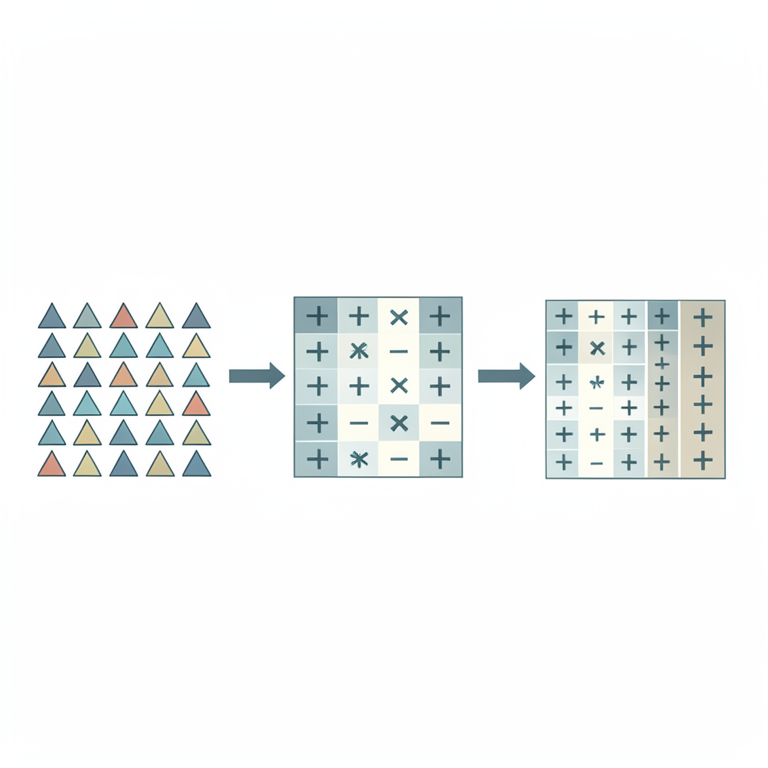
Design Construction Flow
AI-generated conceptual illustration (Mathematical matrices of positive and negative signs). It explains the idea and does not show study data.
View source evidence ↗Introduction
Supersaturated design is a factorial design having the more number of factors when compared with number of design points. These designs can be used to identify active factor main effects when experimentation is expensive and the number of potential factors is large. These designs are more economical and flexible because of their run size. Satterthwaite (1959) initially made an attempt to construct saturated designs randomly and suggested the random balance designs. Booth and Cox (1962) proposed a systematic method for the construction of super-saturated designs. After Booth and Cox (1962), no attempts were made till Lin (1993). Later several researchers made attempts on the construction of supersaturated designs.
Definition 1.1:
A factorial design X is said to be a supersaturated design, if the number of factors "p" is more than the number of design points 'n' i.e. p > n. Whenever, it is not possible to conduct the experiment with orthogonal design, we seek designs that are near orthogonal. To measure the lack of orthogonality, the degree of nonorthogonality is used. It depends on the all pairs of factors. Let sij be the sum of cross products between two different factors i and j of a design. If the expected value of s 2 i.e. the mean of 2 ij s of all pairs (i, j) for (i≠j) is minimum, then the design is said to be E(s 2 )-optimal design. This concept was proposed by Booth & Cox (1962) for selecting supersaturated designs. In this paper, an attempt is made to construct supersaturated design using triangular type PBIBD.
Construction of Supersaturated design using Triangular PBIBD
Consider a triangular PBIBD with parameters v, b, r, k, 1, 2, n, n1 and n2 (where 'n' is the order of triangular matrix). For each factor, identify the first associate and second associate treatments. Construct a design of order v x v with elements as 1 corresponding to each pair of treatments, put +1 if the pair of treatments belong to first associates and put -1 if the pair of treatment belongs to second associates. Obtain a super-saturated design X in (v+1) factors with v design points by augmenting a factor with level as +1 to each design point. Proof: Let Nbxv be the incidence matrix of a two associate class triangular PBIBD with parameters v, b, r, k, 1, 2, n1 and n2. Let Ti, Tj and Tk be any three factors. Let the pairs of factors (Ti, Tj) belong to first associate class and the pair of factors (Ti, Tk) belong to second associate class of the group divisible design. The elements of X'X matrix of saturated design will contain v(v-1)/2 distinct pairs of factors that are classified into three groups. The cross product terms corresponding to each pair of factor groups are i) belong to the first associate class are (+1, +1), (+1, -1), (-1, +1) and (-1,-1) occur (n-2), (n-2), (n-2) and (n-3)(n-4)/2 times respectively. Therefore, the sum of cross products is [ (n-4)(n-5) -4) ] /2 and ii) belong to the second associate class with the cross product terms being (+1, +1), (+1, -1), (-1, +1) and (-1,-1) occurs 4, (2n-8), (2n-8), [(n-4)(n-5)+4]/2 times respectively. Therefore, the sum of cross products is (n 2 -17n+64) /2. iii) cross product terms corresponding to each factor with augmented factor are (+1,+1), (-1, +1) occur (2n-4) and [ (n-2)(n-3)/2 +1] times. Therefore, the sum of the cross product term is (-n 2 +9n-16) /2. The off diagonal elements in the last row / column of X'X are [-n 2 +9n-16]/2 and in each other row/column the elements are [(n-4)(n-5)-4)]/2, [n 2 -17n+64]/2 and (-n 2 +9n-16)/2 occurring n1, n2 and one time respectively. Therefore, the E(s 2 )-value is A,B,C,D,E,F,G,H, I and J be the ten treatments.
The first and second associates for each treatment are
Construct a supersaturated design Xv x v+1 with levels 1 by placing for each treatment put +1 if it is a first associate treatment and put -1 if it is a second associate treatment and augmenting a factor (column) with all +1's.
Some Remarks On Proposed
Some Remarks On Proposed
References
7 in the original paper- Ameen Saheb Sk, Bhatra Charyulu N. Ch.Method for the construction of Super saturated design, International Journal of Mathematical Archive, 2013; 4(12):1-3.
- Booth KHV, Cox DR. Some systematic supersaturated designs, Technometrics, 1962; 4:489495.
- Lin DKJ. A new class of Supersaturated designs, Technometrics, 1993; 35:28-31.
- Lin DKJ. Generating Systematic Supersaturated Designs, Technometrics, 1995; 37:213-225.
- Nguyen NK, Cheng CS. New E(s 2 )-optimal supersaturated designs constructed from incomplete block designs, Technometrics, 2008; 50(1):26-31.
- Plackett RL. Burmann JP. The design of optimum multi-factorial experiments, Biometrica, 1946; 33:305-325.
- Satterthwaite F. Random Balance Experimentation Technometrics, 1959; 1:111-137.