
Research article · 2019 · Full text
International Journal of Statistics and Applied MathematicsStatistical analysis of reasons for migration in India
Volume 4(6) · Pages 14–18
Research areasAgricultural Economics and PracticesCOVID-19 epidemiological studies
Abstract
Author-writtenMigration is a global phenomenon caused not only by economic factors, but also by social, political, cultural, environmental, health, education and transportation factors. It commonly takes place because of the push factors of less opportunity in the socio economic situation and also because of pull factors that exist in more developed areas.
Summary
Source-checkedPlain-language reading of the full paper, prepared with AI and checked against the text. Each point links to the authors' own words.
Why it matters
- Migration is a worldwide occurrence driven by a diverse set of economic, social, political, cultural, environmental, health, education, and transportation factors. View evidence ↗
- Migration typically occurs due to 'push factors,' such as limited socio-economic opportunities in the origin area, and 'pull factors' found in more developed regions. View evidence ↗
- Increased economic activities have led people from rural areas to move toward urban centers. View evidence ↗
The question
- The study aims to analyze the reasons why people move from one location to another in India and how these reasons have changed over time. View evidence ↗
- The research also seeks to identify specific migration reasons across different streams, including rural-rural, rural-urban, urban-urban, and urban-rural. View evidence ↗
What they did
- The study utilizes Indian census data from 1981, 1991, and 2001, which included questions on the reasons for migration and the duration of stay. View evidence ↗
- The analysis specifically focuses on migrants whose duration of last residence was between 0 and 9 years. View evidence ↗
- Migration data was classified based on age, sex, and various duration intervals of residence. View evidence ↗
What they found
- Employment was the primary driver for male migration, accounting for approximately 38% in 1991 and 37.3% in 2001. View evidence ↗
- According to the 2001 Census, 307 million people migrated internally within India. View evidence ↗
- Natural calamities were recognized as a reason for migration in the 1981 and 1991 censuses, but were removed from the main categories in 2001. View evidence ↗
- The 2001 Census introduced 'moved after birth' as a reason for migration to account for the cultural practice of women giving birth at their parental homes. View evidence ↗
What it means
- The authors conclude that the upward trend in marriage-related migration indicates that moving to a husband's home after marriage is a mandatory social practice for females in India. View evidence ↗
- The grouping of various reasons into an 'any other causes' category limits the ability to perform a micro-level analysis of those specific migration drivers. View evidence ↗
- The authors note that the census does not give sufficient importance to man-made disasters, such as wars and political riots, as reasons for migration. View evidence ↗
Visual summary
3 visualsIllustrations explain the paper; charts are replotted from the paper's own table values.
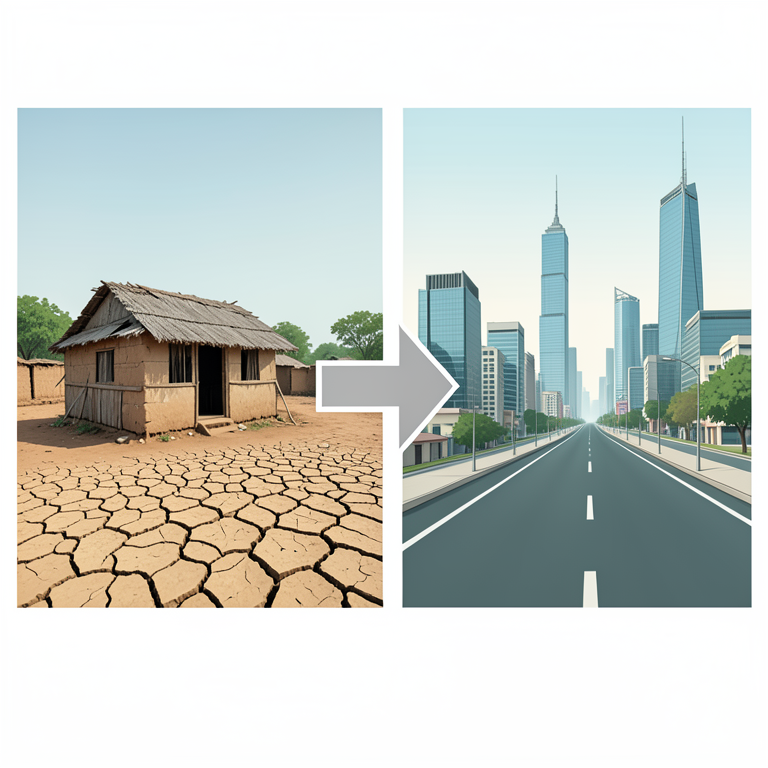
Push and Pull Factors of Migration
AI-generated conceptual illustration (Indian rural and urban landscapes). It explains the idea and does not show study data.
View source evidence ↗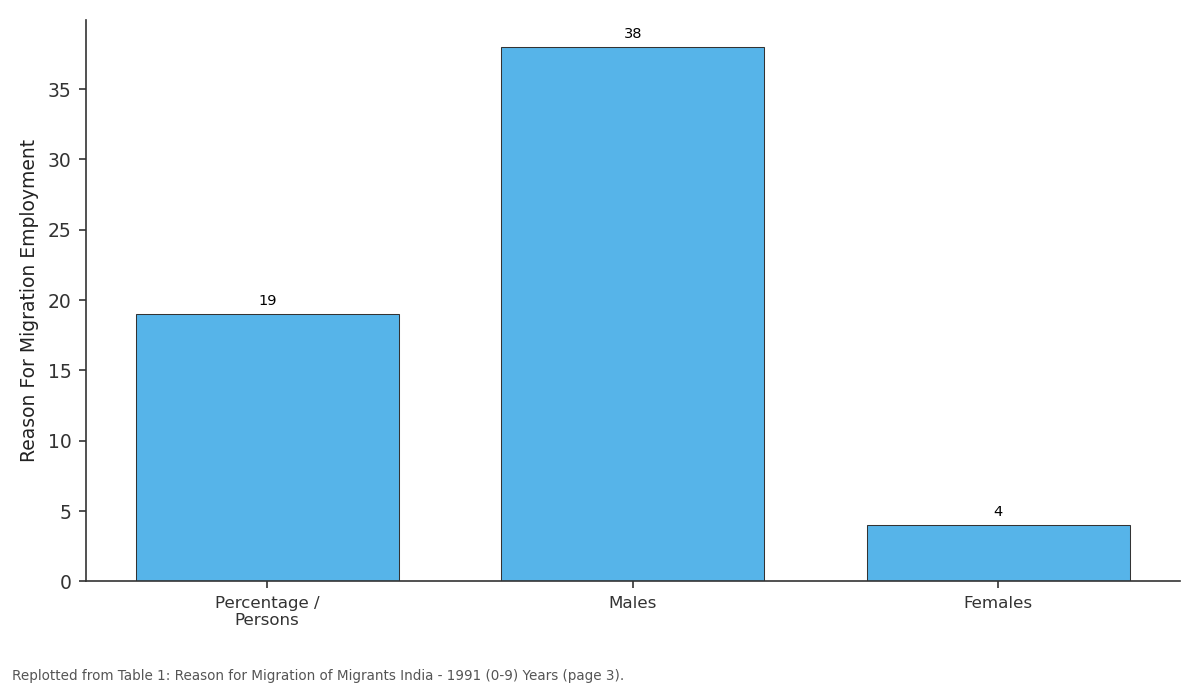
Reason For Migration Employment: Percentage / Persons vs Males vs Females
Replotted from Table 1 (page 3) of the original paper. Every bar is the paper's own table value.
View source evidence ↗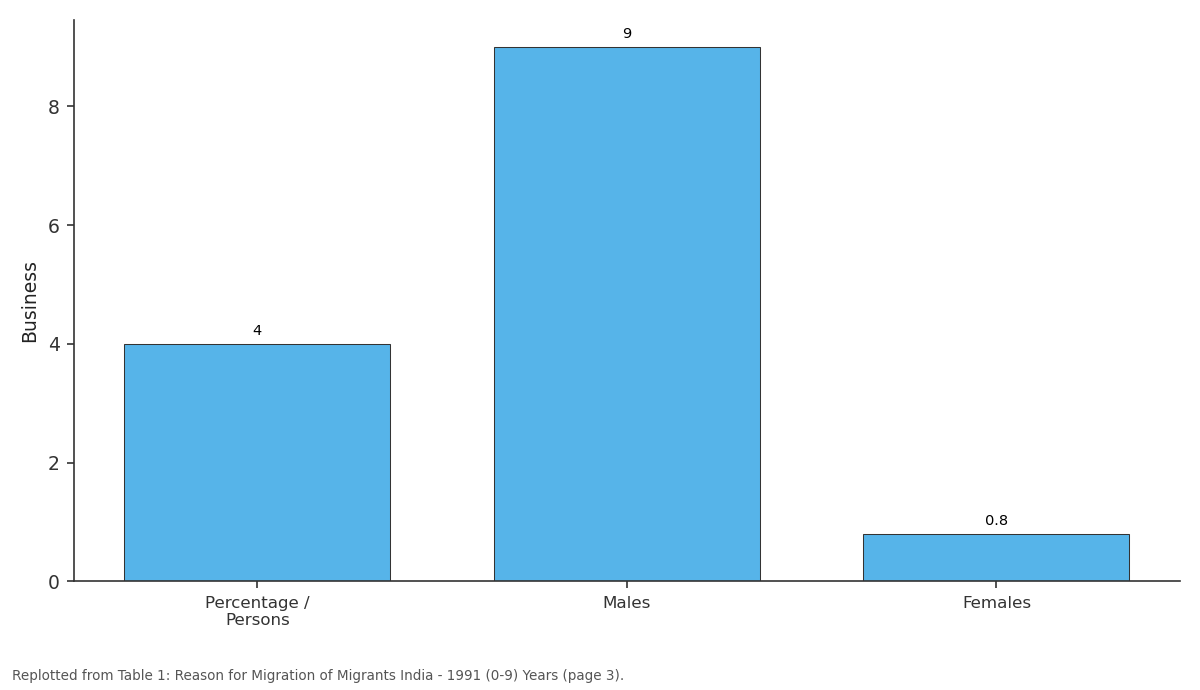
Business: Percentage / Persons vs Males vs Females
Replotted from Table 1 (page 3) of the original paper. Every bar is the paper's own table value.
View source evidence ↗Figures & tables
From the original paper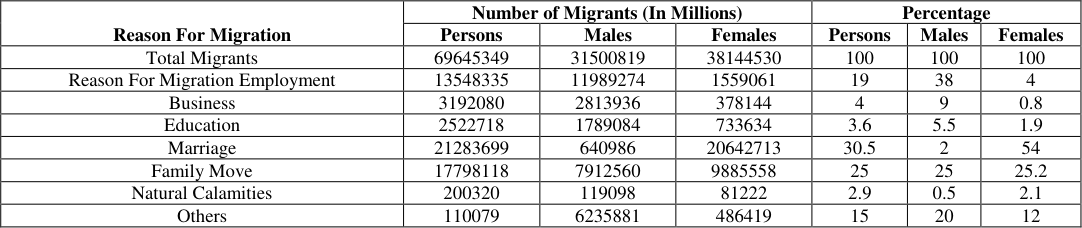 Table 1
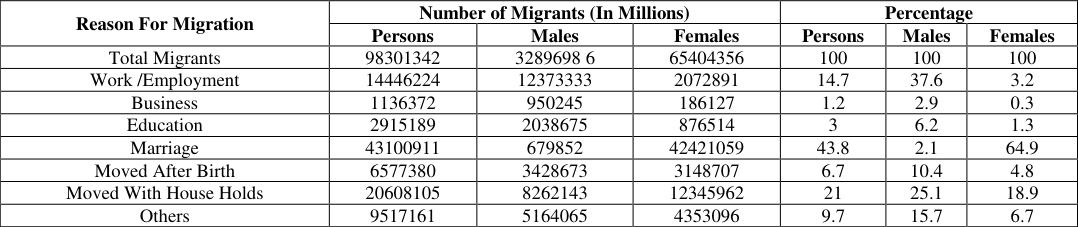 Table 2
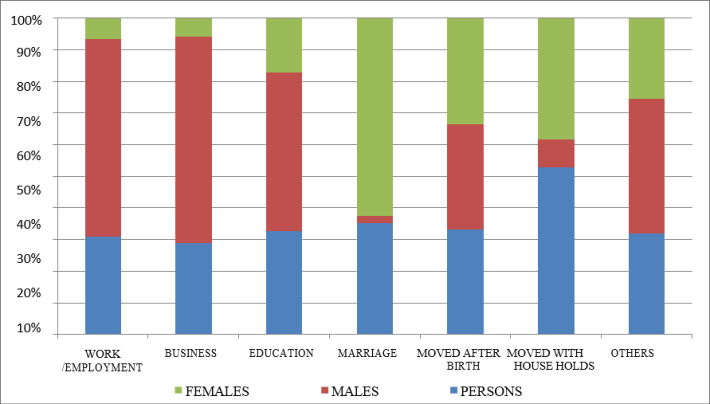 Figure 1
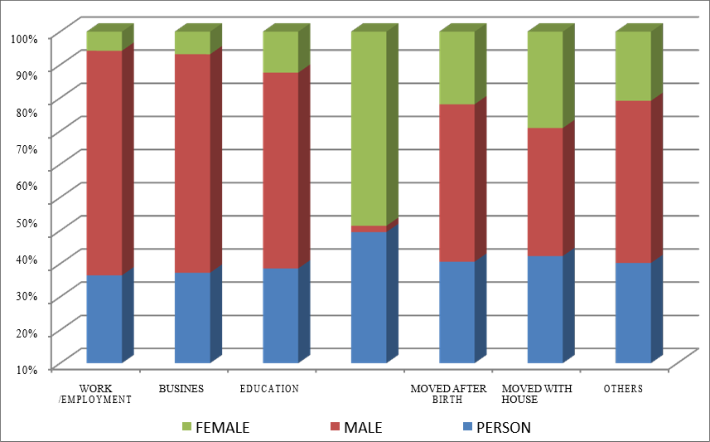 Figure 2
Introduction
As a result of introducing liberal global economy many changes have taken place in India and around the world led to positive growth of the economy. In addition it has many social and demographic implications also. People attached to rural area have started moving to words urban areas as a result of increased economic activities. Growth of Information and technologies have opened varieties of new type of jobs in urban set up and large number of students of younger generation have moved to urban Business and technician schools and institutions to acquire new skill and education. These changes have greatly influenced both internal and international migration in India context. Earlier larger number of internal migrants was of short distance, moving to nearest urban centres for searching jobs or for higher education or family dependents. About 70 to 80 percents of females are moving for the reason of marriage to join their husband family. (Sivamurthy and Kadi, 1984 [18] ; Kadi and Madagi 1994) [11] . In this chapter, an attempt has been made to study reasons for people moving from one place to another place and changes that have taken over the period as compared to past migration in Indian context. Also the study tries to bring out different reasons for migration with respect to each stream: ruralrural, rural-urban, urban-urban, urban-rural migration streams
Reason for Migration
Since first Indian census of 1881 to 1961, the Census data on migration were obtained only by asking the question on place of birth. In 1971 census, an additional question about the place of last residence of the respondent was introduced in order to get more information on volume of migration. However, in 1981, 1991 and 2001 census periods in addition to above question, the question, reasons for migration from place of last residence and duration of stay at the place of enumeration was included. Education is included as a reason of migration in census. Any person who has moved to join a school or a college, come under this category. However, census makes a distinction between those who moved voluntarily for education and those who moved along with earning member of the family. On account of occurrence of natural calamities in India or some parts of the country every year. Many people are ousted due to this reason. This has been recognised as one of the reasons of migration in the census of 1981 and 1991. But this reason dropped from main categories of reason in 2001. Census has also not given due importance to manmade disasters like wars social and political riots as a reason of migration.
In case of a person who has come into India from any other country as result of partition or has been repatriated, the reason for migration will be noted as others.
In India, thousands of people are getting displaced due to construction of highways, large irrigation projects and industrial establishments. Census of India is aware about this issue, but directed its enumerators to include this in other category.
In 2001 Census the reason: moved after birth was included keeping in view of cultural practices of women generally giving her first birth at her parental place rather than her husband's place. Because of this reason, the baby born at his or her maternal house is a migrant in his or her parental house because the place of last residence was different from place of enumeration. This is applicable to birth's occurring in hospitals and nursing homes. Internal migration is important is an important factor and in many countries is far greater than international migration. In India 307 million people were migrated internally in 2001 Census. In china 120 million people migrated internally in 2001 against a mere 4, 58,000 people migrating international for work. In Vietnam roughly 4.3 million people migrated internally in the five years before the 1999 Census whereas the number of international migrants was 3 lakhs. In India internal migration run into millions while international migration is only fraction of this (Srivastava and Sasikumar 2003).
Internal migration place significant role in moulding the social, economic and other structurally characteristics of a population of a country or a region (Khan 2010, White and Woods 1980). Migration occurs when various factors operate together and the importance of factors responsible for migration varies from place to place according localities particular development milieu.
The Causes of Internal Migration 1.2.1 Earning and Employment Opportunities
The following were the well known fact for migration. It is well known that the greater the gaps in earning between origin and destination the more likely are working age adults to move. It is far less clear how the significant gap in earnings is maintained between rural and urban formal employment for observationally equivalent workers. There is some recent evidence consisted with efficiency wage explanation of high urban wages. Migrants to town initially earn less than observationally equivalent natives, but the evidence indicates that the gap disappears within a few years and may even reverse. Many migrant to urban areas initially enter the informal sector. For some of this is a transitory phase prior to finding more formal employment. However statistical studies of these patterns are plagued by the lack of precision in defining the informal sector and the evidence is mixed as to whether the formal or informal urban sector offers higher pay to observationally equivalent workers. Finding on whether differences in unemployment rates between locations promote migration are mixed. Limited evidence suggests that migrants often identify their urban job before migrating. But other migrates do appear to search for work after moving either while in temporary employment or while openly unemployed. However at least one study maintains that off form migration in developing countries will sees only when the earning gap is entirely closed and hence that uncertainty about employment is Irrelevant. It has also been argued that unemployed workers may have at least a chance of re-employment in their home setting were information and contacts are more readily available. The location of newly created employment opportunities depends in part upon the development strategy adopted within a country. The imported substitution leads to employment concentration in large cities. However many other factors also affect the spatial distribution of industrial employment, including the land intensity of production, availability of appropriate infrastructure, agglomeration externalities, tax incentives tied to location as well as the local cost labour? It has been hypothesized that large towns offer a greater diversity of employment and hence a better chance of reemployment in the event of layoff. This might render large towns more attractive to migrating workers. At least one study shows that unemployment rates are lower in larger urban areas, though more systematic evidence on this issue does not seem to exist for the developing economies.
Family and Networks
Possessing networks of family and friends in town may encourage migration into town conversely; a welldeveloped network at home may discourage departure. However empirical examination of these propositions is hampered by difficulties in eliminating spurious effects in discerning, what advantageous the network offers and in defining the scope of a network. Migration at the time of marriage to join or accompany a spouse does seem common. A few studies also suggest that parents may have the welfare of other offspring in mind when making their own migration decision. Urban migrants often initial settle in ethnically similar neighbourhoods, which suggest that networks lower the affective cost of moving in some manner. Evidence from some cities even shows that subsequent moves within the city are to new neighbourhoods with the same ethnic composition.
Distance
Migration over short distances is much more common than migration to remote location. Whether this reflects the greater cost of moving further lack of information about more remote alternatives are less alienation in a year by setting remains undetermined. However few were out migration opportunities in a remote areas tend to generate longer residence which, in turn raises the sense of alienation in contemplating moves. The result is pockets of poverty in remote places. Incomplete or imperfect local capital markets may encourage out migration either directly through restriction on the ability of families to borrow or indirectly through effects on employment creation.
However solitary test of this potential interesting proposition proves inconclusive. The opportunity cost of financing costly migration is probably lower for wealthier families. This has been to important implication. First, migration may be more common from richer families and this in turn may exacerbate inequality in incomes. Secondly, has region becomes wealthier out migration may actually increase as the financial constraint is reduced.
Relative Economic Standing in the Community
Migrants may not only care about any absolute gain in earning through migration but also about their relative economic standing in the communities of origin and destination. One study of migration from rural area found that emigration to urban area was more likely among individuals with low income relatives to others in their village. They give importance for: Improved amenities in a location may attack industries or permit agricultural expansion to the extent that this results in employment expansion or higher wages.
Outmigration may be discouraged and in migration encouraged. Improved local amenities may also have direct effect upon migrant decisions. Simply by making life in this setting more attractive. On the other hand some forms of improved local amenities could exacerbate net out migration. It is visible that improved rural transport could act in this fashion by affecting local production patterns and hence reducing the local demand for labour and by making departure and return visits easier. It is obvious that episode of violence and naturally disasters result in mass migrations either of internally displaced person or of international refugees reason to which a well-documented is the extent to which ongoing violence. Political repression and recurrent risk from disasters swell the stream of migrants.
Migration has been intimately related to economic and social development and it is often seen as the result of imbalances in the levels of development.
People leave their places of birth and residence due to many reasons such as push and pull factors. Some factors are pushing people to leave their places of origin are poverty high population pressure on the land, lack of basic infrastructural facilities like health care education, natural disasters such has flood, drought, cyclonic, storms, earthquake, Tsunami/wars local conflicts also give extra push to migrate. Water logging can also be trigger for migration the uncontrolled use of irrigation facilities, water has resulted in the logging and salivation of land. This has led to falling crop yields. This leads to migration by poor marginal farmers.The most recent push factor appears to be a fall in agricultural returns due to fall in agricultural and due to macroeconomics reforms linked with liberalization and globalization policies creating a strong push from the country side. Factors with attract the people from different places (Pull factors) are better job opportunities, availability of regular work and relatively higher wages, better opportunities for education, better health facilities and source of entertainment and desire to acquire skills or gain new experiences etc.,
Figures and tables from the paper
| Reason For Migration | Number of Migrants (In Millions) | — | — | Percentage | — | — |
|---|---|---|---|---|---|---|
| Persons | Males | Females | Persons | Males | Females | |
| Total Migrants | 69645349 | 31500819 | 38144530 | 100 | 100 | 100 |
| Reason For Migration Employment | 13548335 | 11989274 | 1559061 | 19 | 38 | 4 |
| Business | 3192080 | 2813936 | 378144 | 4 | 9 | 0.8 |
| Education | 2522718 | 1789084 | 733634 | 3.6 | 5.5 | 1.9 |
| Marriage | 21283699 | 640986 | 20642713 | 30.5 | 2 | 54 |
| Family Move | 17798118 | 7912560 | 9885558 | 25 | 25 | 25.2 |
| Natural Calamities | 200320 | 119098 | 81222 | 2.9 | 0.5 | 2.1 |
| Others | 110079 | 6235881 | 486419 | 15 | 20 | 12 |
Table text extracted from the original PDF; superscript letters are shown inline. The original table image is below.
View original table image
| Reason For Migration | Number of Migrants (In Millions) | — | — | Percentage | — | — |
|---|---|---|---|---|---|---|
| Persons | Males | Females | Persons | Males | Females | |
| Total Migrants | 98301342 | 3289698 6 | 65404356 | 100 | 100 | 100 |
| Work /Employment | 14446224 | 12373333 | 2072891 | 14.7 | 37.6 | 3.2 |
| Business | 1136372 | 950245 | 186127 | 1.2 | 2.9 | 0.3 |
| Education | 2915189 | 2038675 | 876514 | 3 | 6.2 | 1.3 |
| Marriage | 43100911 | 679852 | 42421059 | 43.8 | 2.1 | 64.9 |
| Moved After Birth | 6577380 | 3428673 | 3148707 | 6.7 | 10.4 | 4.8 |
| Moved With House Holds | 20608105 | 8262143 | 12345962 | 21 | 25.1 | 18.9 |
| Others | 9517161 | 5164065 | 4353096 | 9.7 | 15.7 | 6.7 |
Table text extracted from the original PDF; superscript letters are shown inline. The original table image is below.
View original table image
References
19 in the original paper- Ginsberg RB. The papers on the use of and interpretation of probabilities models: with applications to the analysis of migration, working paper, CES WP 73; centre for environmental studies, Cambridge, 1971.
- Goodman LA. Statistical methods for the mover-stayer model, Journal of American statistical Association. 1961; 56:841-868.
- Greenwood MJ. An analysis of the determinants of geographical labour mobility in the United States. The review of economics and statistics. 1969; 51:189-194.
- Greenwood MJ, Ladman JR, Seigal BS. Long terms Trends in migratory behaviour in a developing country: The case of Mexico, Demography. 1981; 8:369-388.
- Isserman AM, Ragerson DA, Beaumant PM. Forecasting interested migration with limited data: A demographic economic approach. Journal of America Statistical Association. 1985; 80:277-285.
- Isserman AM, Plane DA, Rogerson PA, Beaumant PM. Forecasting interstate migration with limited data: A Demographic Economic approach, Journal of American, 1985.
- Kadi AS. A study of interstate migration in India: Application of migration models, unpublished PhD thesis Karnataka University Dharwad, 1984.
- Kadi AS. A simple model for estimating interstate migration for using limited data paper presented in all India Seminar on migration research in contest of development BHU Varanasi India, 1986.
- Kadi AS, Sivamurthy M. Interstate migration in India 1971-1991 Canadian studies in population. 1988; 15(1):37-50.
- Kadi AS, Madagi SB. A Study of Internal Migration in India through Statistical Models unpublished PhD thesis, 1994.
- Kim JG. Toward a comprehensive model of migration interstate population movement in the United States 1965-70 PhD thesis Cornel University Ithaca New York, 1979.
- King J. Interstate migration in Mexico, Economic development and cultural change. 1978; 11:83-101.
- Lee ES. A theory of migration demography, 1966, 47-57.
- Masser I, Gould WTS. Inter-Regional migration in tropical Africa Institute of British geographers London, 1975.
- Mayers GCR, Mc Ginnis, Masnick G. The duration residence approach to a Dynamic stochastic model of internal migration: A test of the axiom of cumulative inertia, social biology. 1982; 29:387-392.
- Premi MK. International migration in India 1961-1981 Social Action. 1984; 34:274-285.
- Sivamurthy M, Kadi AS. Reformulation of Singh and Yadav extended model of migration demography India. 1984; 13:238-46.
- Traver James D, Meleod RD. A test and modification of Zipf's hypothesis for predicting interstate migration Demography. 1923; 10:259-275.
- Vipul KantSingh, Alokumar RD, Singh, Yadav KNS. Research article changing pattern of internal migration in India: Some evidences from census data, 2011.