
Research article · 2017 · Full text
International Journal of Statistics and Applied MathematicsOn RGW⍺LC-Continuous and RGW⍺LC-Irresolute maps in topological spaces
Volume 2(5) · Pages 104–109
Research areasFuzzy and Soft Set Theory
Abstract
Author-writtenIn this paper we introduced RGW⍺LC-Continuous, RGW⍺LC*-Continuous, RGW⍺LC**-Continuous, sub-RGW⍺LC*-Continuous and RGW⍺LC-Irresolute Maps which are weaker than LC-Continuous and stronger than GβLC- Continuous and study some of their properties and their relationship with w-lc continuous, θ-lc-continuous, lδc-continuous and π-lc continuous etc.
Summary
Source-checkedPlain-language reading of the full paper, prepared with AI and checked against the text. Each point links to the authors' own words.
Why it matters
- Locally closed sets are defined as the intersection of an open set and a closed set within a topological space. View evidence ↗
- The concept of locally closed sets has been used by previous researchers to establish definitions for LC-continuity and LC-irresoluteness. View evidence ↗
- There is an ongoing academic effort to develop generalizations of locally closed sets and locally continuous maps. View evidence ↗
The question
- The authors aim to introduce and study the properties of three new classes of maps: RGW⍺LC-Continuous, sub-RGW⍺LC*-Continuous, and RGW⍺LC-Irresolute maps. View evidence ↗
What they did
- RGW⍺LC-continuity is defined by the condition that the inverse image of every closed set in the codomain is an RGW⍺-LC set in the domain. View evidence ↗
- Sub-RGW⍺LC*-continuity is defined based on the existence of a basis in the codomain whose elements' inverse images are RGW⍺LC* sets. View evidence ↗
- RGW⍺LC-irresoluteness is defined as the property where the inverse image of any RGW⍺-LC set in the codomain is an RGW⍺-LC set in the domain. View evidence ↗
What they found
- Locally-continuous functions are always RGW⍺LC-continuous. View evidence ↗
- RGW⍺LC-continuous functions are a subset of GβLC-continuous functions. View evidence ↗
- RGW⍺LC*-continuity implies RGW⍺LC-continuity. View evidence ↗
- A topological space is rgw⍺-submaximal if and only if every function originating from that space is RGW⍺LC*-continuous. View evidence ↗
- The composition of two RGW⍺LC-continuous maps is not necessarily RGW⍺LC-continuous. View evidence ↗
- If a map is RGW⍺LC-continuous (or its * or ** variants) and is composed with a continuous map, the resulting composition retains that continuity type. View evidence ↗
- Functions that are rgw⍺-irresolute are also RGW⍺LC-irresolute. View evidence ↗
- RGW⍺LC-irresoluteness (and its variants) implies the corresponding RGW⍺LC-continuity. View evidence ↗
What it means
- The authors conclude that they have successfully introduced and characterized the properties of RGW⍺LC-continuous and RGW⍺LC-irresolute maps. View evidence ↗
- The authors identify the study of rgw⍺-locally separation axioms in topological spaces as a direction for future work. View evidence ↗
Visual summary
1 visualsIllustrations explain the paper; they do not show study data.
Hierarchy of Continuity Maps
AI-generated conceptual illustration (Abstract geometric topological spaces). It explains the idea and does not show study data.
View source evidence ↗Figures & tables
From the original paper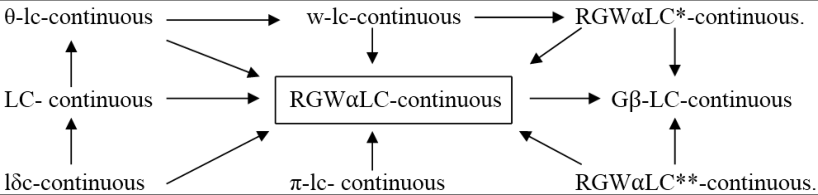 Figure 1
Introduction
Bourbaki [7] defined a subset of a topological space as locally closed if it is the intersection of an open set and a closed set. Stone [6] used the term FG for locally closed subset. Ganster and Reilly [5] used locally closed sets to define LC-continuity and LC-irresoluteness. Sundaram [9] introduced the concepts of generalized locally closed sets, GLC-continuous maps and GLCirresolute maps and investigated some of their properties. Also various authors have contributed to the development of generalizations of locally closed sets and locally continuous maps in topological spaces. In this paper, three new classes of continuous maps are introduced namely RGW⍺LC-Proof: (1) Assume that f is locally-continuous. Let V be a closed set in Y. Then f -1 (V) is locally closed in X. But, every locally closed set is RGW⍺LC set. Thus f -1 (V) is RGW⍺LC in X. Therefore f is RGW⍺LC -continuous. Similarly (2) to (5) can be proved. However the converse of the above theorem need not be true as seen from the following examples.
Example 3.5: Let X={a,b,c,d,e}, Y={a,b,c,d} 𝜏 ={X, ∅,{a},{d},{e},{a,d},{a,e},{d,e},{a,d,e}} and 𝜎= {Y, ∅,{a},{b},{a,b},{a,b,c}}. Let f: (X, 𝜏) →(Y, 𝜎) be the function defined f(a)=a, f(b)=b, f(c)=c, f(d)=d, f(e)=a. Then f is RGW⍺LCcontinuous but not locally continuous, since for the closed set {c,d} in (Y, 𝜎), f -1 ({c,d })= {c,d} is not locally closed in (X, 𝜏).
Example 3.6:
Let X=Y = {a,b,c}, 𝜏= {X, ϕ, {a}, {b}, {a,b}} and 𝜎= {Y, ϕ, {a}}. Let f: (X, 𝜏) →(Y, 𝜎) be the identity map function. Then f is RGW⍺LC-continuous but not θ-lc-continuous and lδc-continuous, since for the closed set {b,c} in (Y, 𝜎), f - 1 ({b,c})= {b,c} is not θ-locally closed and δ-locally closed set in (X, 𝜏). Example 3.9: Let X=Y= {a,b,c}, τ={X, ϕ,{a},{b,c}} and σ ={Y, ϕ, {a}}. Let map f: X→Y defined by f(a)=b, f(b)= a, f(c)=c, then f is GβLC-continuous but not RGW⍺LC-continuous as a closed set F={b,c} in Y, f -1 (F)= f -1 {b,c}={a,c} which is not rgw⍺-locally closed set. Proof: Let f: (X, 𝜏) →(Y, 𝜎) be a function and (X, 𝜏) be a door space and (Y, 𝜎) be any space. Let A∈𝜎. Then by assumption on (X, 𝜏), f -1 (A) is either open or closed. In both the cases f -1 (A) ∈RGW⍺LC(X, 𝜏) (resp. RGW⍺LC*(X, 𝜏), RGW⍺LC**(X, 𝜏)) and therefore f is RGW⍺LC-continuous (resp. RGW⍺LC*continuous, RGW⍺LC**-continuous). Theorem 3.13: A topological space (X, 𝜏) is rgw⍺-submaximal if and only if every function having (X, 𝜏) as domain is RGW⍺LC*-continuous. Proof: Let f: (X, 𝜏) →(Y, 𝜎) be a function and (X, 𝜏) be rgw⍺-submaximal. Then by theorem 3.50 of [12]
Conversely, assume that every function having (X, 𝜏) as domain be RGW⍺LC*-continuous. Consider the sierpinski space Y= {0, 1} with 𝜎 ={Y, ϕ, {0}}. Let U be a sub set of (X, 𝜏) and define f: (X, 𝜏) →(Y, 𝜎) by f(x) =0 for every x∈U and f(x)=1 for every x∉U. By assumption f -1 ({0}) =U ∈ RGW⍺LC*(X,). Therefore we have P(X) = RGW⍺LC*(X, 𝜏) and so (X, 𝜏) is rgw⍺submaximal, by theorem 3.50 of [12]. Therefore by hypothesis, f -1 (V) is rgw⍺-lc set in (X, 𝜏). That is f: (X, 𝜏) →(Y, 𝜎) be RGW⍺LC-continuous. Remark 3.16: Composition of two RGW⍺LC-continuous maps need not be RGW⍺LC-continuous as seen from the following example.
Example 3.17: Let X=Y=Z= {a,b,c} and 𝜏={X, ϕ, {a}}, 𝜎= {Y, ϕ, {a},{b,c}} and η= {Z, ϕ, {b}}. Let f: (X, 𝜏) →(Y, 𝜎) be the function defined f(a)=b, f(b)=a, f(c)=c, and g:(Y, 𝜎) →(Z, η) be a function defined as g(a)=b, g(b)=a, g(c)=c. Then both f and g are RGW⍺LC-continuous but their composition gοf: (X, 𝜏) →(Z, η) is not RGW⍺LC-continuous, since for a closed set {a,c} in (Z, η), (gοf) -1 ({a,c})=f -1 (g -1 ({a,c})= f -1 ({b,c}) = {a,c}which is not rgw⍺-lc set in (X, 𝜏). 1. If f is RGW⍺LC*-continuous, then f is sub-RGW⍺LC*-continuous. 2. f is sub-RGW⍺LC*-continuous if and only if there is a subbasis S for (Y, 𝜎) such that f -1 (V)∈ RGW⍺LC*(X, 𝜏) for each V∈S. 3. (iii)If f is sub-LC-continuous, then f is sub-RGW⍺LC*-continuous.
Proof: (i) Let f be RGW⍺LC*-continuous, β be basis of (Y, 𝜎) and V∈β. By hypothesis f -1 (V)∈ RGW⍺LC*(X, 𝜏) and so f is sub-RGW⍺LC*-continuous. (ii) Let f be sub-RGW⍺LC*-continuous. It follows from assumption that there is a basis β for (Y, 𝜎) such that f -1 (U) ∈ RGW⍺LC*(X, 𝜏) for each U∈β. Since βis also a subbasis for(Y, 𝜎) the proof is obvious. Conversely, let S be a subbasis of (Y, 𝜎) and β= {A⊂Y: A is an intersection of finitely many sets belonging to S}. Then β is a basis for (Y, 𝜎). For each U∈β, U=⋂{Fi: F∈S, i∈∧} where ∧ is a finite set. Now f -1 (U)= ⋂{f -1 (Fi): Fi ∈S, i∈∧}. By assumption, f - 1 (Fi) ∈ RGW⍺LC*(X, 𝜏) for each Fi ∈S, i∈∧. Also ⋂{f -1 (Fi): Fi ∈S, i∈∧}= f -1 (U)∈ RGW⍺LC*(X, 𝜏), by Theorem (i) and hence f is sub-RGW⍺LC*-continuous. (iii) Follows from LC(X, 𝜏)⊂ RGW⍺LC(X, 𝜏).
Remark 3.21:
The following examples show that the converses of (i) and (ii) of Theorem are not always true.
Example 3.22:
Let X= {a,b,c,d}, Y={a,b,c}, 𝜏={X, ϕ, {a}, {a,b}} and 𝜎={Y, ϕ, {a}, {c}, {a,c}}. Then RGW⍺LC*(X, 𝜏) = P(X)-{a,b,d}, and β= {{a},{b},{c}} is a basis for (Y, 𝜎). Define f: (X, 𝜏) →(Y, 𝜎) by f(a)=f(d)=a, f(b)=b, f(c)=c. Then f is sub-RGW⍺LC*-continuous but not RGW⍺LC*-continuous, since for the closed set {a,b}of (Y, 𝜎), f -1 ({a,b})={a,b,d}which is not rgw⍺-lc* set in (X, 𝜏).
Example 3.23:
Let X= Y={a,b,c}, 𝜏={X, ϕ, {a}, {b}, {a,b}} and 𝜎={Y, ϕ, {a}, {a,b}}. Then LC(X,𝜏) = {X, ϕ, {a}, {b}, {c}, {d}, {a,b}, {a,c}, {a,d}, {b,c}, {a,b,c}, {a,c,d}, {b,c,d}}, RGW⍺LC*(X, 𝜏) = P(X) and β= {Y,{a}, {a,b}}is a base for (Y, 𝜎). Define f: (X, 𝜏) →(Y, 𝜎) by f(a)=c, f(b)=d, f(c)=a, f(d)=b. Then f is sub-RGW⍺LC*-continuous but not sub-LC-continuous, since for the set {a,b}∈β, f -1 ({a,b})={c,d} which is not lc-set in (X, 𝜏).
Remark 3.24:
The composition of a sub-RGW⍺LC*-continuous function and a continuous function need not be a sub-RGW⍺LC*-continuous.
Solution: Take a sub-RGW⍺LC*-continuous function f: (X, 𝜏) →(Y, 𝜎) which is not RGW⍺LC*-continuous (for example the function in example). Hence there is a set V∈𝜎 such that f -1 (V) ∉ RGW⍺LC*(X, 𝜏). Let η= {Y, ϕ, V}. Then η is a topology on Y and the identity function g: (Y, 𝜎) → (Y, η) is continuous. But composition gοf: (X, 𝜏) →(Y, η) is not sub-RGW⍺LC*continuous.
RGW⍺LC -Irresolute maps
In this section, we define RGW⍺LC-Irresolute, RGW⍺LC*-Irresolute, RGW⍺LC**-Irresolute functions which are weaker than w-LC-irresolute functions and stronger than GβLC-Irresolute functions.
Definition 4.1:
Proof: (i) Let f is rgw⍺-irresolute, and V∈ RGW⍺LC(Y, 𝜎). Then V=U⋂F for some rgw⍺-open set U and some rgw⍺-closed set F in (Y, 𝜎). We have f -1 (V) = f -1 (U⋂F) =f -1 (U)⋂f -1 (F) where f -1 (U) is a rgw⍺-open set in(X, 𝜏), since is rgw⍺-irresolute. This shows that f -1 (V) ∈ RGW⍺LC(X, 𝜏) and hence f is RGW⍺LC-irresolute. (ii)Follows from the fact every open set is rgw⍺-lc, rgw⍺-lc* and rgw⍺-lc**.
Remark 4.5:
The converse of the Theorem 4.4 need not be true in general as seen from the following example. Then f is RGW⍺LC-irresolute but not rgw⍺-irresolute, since for the rgw⍺-closed set {b, c} of (Y, 𝜎), f -1 {b, c}= {a,b} which is not rgw⍺-closed set in (X, 𝜏).
Example 4.7: Let X= Y= {a,b,c}, 𝜏={X, ϕ, {a}} and 𝜎={Y, ϕ, {a}, {a,b}, {a,c}}. Let f: (X, 𝜏) →(Y, 𝜎) be an identity map. Then f is RGW⍺LC-continuous but not RGW⍺LC-irresolute, since for the rgw⍺-lc set {a,b} in (Y, 𝜎), f -1 ({a,b})={a,b} which is not rgw⍺-lc set in (X, 𝜏) Theorem 4.8: Let f: (X, 𝜏) →(Y, 𝜎) be a function. Then we have the following. (i)If f is w-LC-irresolute (resp. w-LC*-irresolute, w-LC**-irresolute), then it is RGW⍺LC-irresolute (resp. RGW⍺LC*-irresolute, RGW⍺LC**-irresolute). (ii)If f is RGW⍺LC-irresolute (resp. RGW⍺LC*-irresolute, RGW⍺LC**-irresolute), then it is Gβ-LC-irresolute (resp. Gβ-LC*irresolute, Gβ-LC**-irresolute).
Proof: (i) Follows from the fact that every w-lc set (resp. w-lc* set, w-lc** set) is a rgw⍺-lc set (resp. rgw⍺-lc* set, rgw⍺-lc** set). (ii)Follows from the fact that every rgw⍺-lc set(resp. rgw⍺-lc* set, rgw⍺-lc** set) is a gβ-lc set (resp. gβ-lc* set, gβ-lc** set). Remark 4.9: the converse of the Theorem need not be true in general as seen from the following example.
Example 4.10: Let X= Y= {a,b,c,d}, 𝜏={X, ϕ, {a}, {a,b } and 𝜎={Y, ϕ, {a}, {b}, {a,b,c}}. Let f: (X, 𝜏) →(Y, 𝜎) be an identity map. Now w-LC(X, 𝜏)={ X, ϕ, {a}, {b}, {a,b},{c,d}, {b,c,d}, RGW⍺LC(X, 𝜏)=P(X), w-LC(Y, 𝜎)= {X, ϕ, {a}, {b},{c}, {d}, {a,b}, {a,c}, {b,c}, {c,d}, {a,b,c}, {a,c,d}, {b,c,d} and RGW⍺LC(Y, 𝜎)= P(Y). Then f is RGW⍺LC-irresolute but not w-LCirresolute, since for the w-LC set {c} of (Y, 𝜎), f -1 {c} ={c} which is not w-LC set in (X, 𝜏).
Example 4.11: Let X= Y= {a,b,c}, 𝜏={X, ϕ, {a}} and 𝜎={Y, ϕ, {a}, {b},{a,b}} Let f: (X, 𝜏) →(Y, 𝜎) be an identity map. Then f is GβLC -irresolute but not RGW⍺LC-irresolute, since for the rgw⍺-lc set {a,c}of (Y, 𝜎), f -1 ({a,c})={a,c} which is not rgw⍺-lc set in (X, 𝜏).
Remark 4.12:
The following example shows that (i)RGW⍺LC-irresolute need not be RGW⍺LC*-irresolute. (ii)RGW⍺LC-irresolute need not be RGW⍺LC**-irresolute. Example 4.13: Let X= Y= {a,b,c,d}, 𝜏={X, ϕ, {a}, {b}, {a,b,c}} and 𝜎={Y, ϕ, {a}, {a,b}}. Let f: (X, 𝜏) →(Y, 𝜎) be an identity map. Then f is RGW⍺LC -irresolute but not RGW⍺LC*-irresolute, since for the rgw⍺-lc* set {c} of (Y, 𝜎), f -1 ({c})={c} which is not rgw⍺-lc* set in (X, 𝜏). Example 4.14: Let X= Y= {a,b,c,d}, 𝜏={X, ϕ, {a}, {a,b}} and 𝜎={Y, ϕ, {a}, {b}, {a,b,c}}. Let f: (X, 𝜏) →(Y, 𝜎) be an identity map. Then f is RGW⍺LC -irresolute but not RGW⍺LC**-irresolute, since for the rgw⍺-lc** set {a,d} of (Y, 𝜎), f -1 ({a,d})={a,d} which is not rgw⍺-lc** set in (X, 𝜏). Theorem 4.15: Any map defined on a door space is RGW⍺LC-irresolute. Proof: Proof is similar to that of Theorem Theorem 4.16: Let f: (X, 𝜏) →(Y, 𝜎) and g: (Y, 𝜎) → (Z, η) be two maps. Then 1. gοf: (X, 𝜏) → (Z, η) is RGW⍺LC-irresolute (resp. RGW⍺LC*-irresolute, RGW⍺LC**-irresolute) and f is RGW⍺LCirresolute (resp. RGW⍺LC*-irresolute, RGW⍺LC**-irresolute) and g is RGW⍺LC-irresolute (resp. RGW⍺LC*-irresolute, RGW⍺LC**-irresolute). 2. gοf: (X, 𝜏) → (Z, η) is RGW⍺LC-continuous if f is RGW⍺LC-irresolute and g is RGW⍺LC-irresolute.
Proof: (i) Let V∈ RGW⍺LC (Z, η). Since g is RGW⍺LC-irresolute, g -1 (V) ∈ RGW⍺LC(Y, 𝜎). Since f is RGW⍺LC-irresolute,f - 1 (g -1 (V))= (gοf) -1 (V) is rgw⍺-lc set in (X, 𝜏). Therefore gοf is RGW⍺LCirresolute. (ii)Let V∈η. Since g is RGW⍺LC-continuous, g -1 (V) ∈ RGW⍺LC(Y, 𝜎). Since f is RGW⍺LC-irresolute, f -1 (g 1 (V)= (gοf) -1 (V) ∈ RGW⍺LC(X, 𝜏). Therefore gοf is RGW⍺LC-continuous.
Conclusion
In this paper we have introduced and studied the properties of RGW⍺LC-continuous and RGW⍺LC-irresolute maps in topological spaces. Our future extension is to study rgw⍺-locally separation axioms in Topological Spaces.
Acknowledgement
The Authors would like to thank the referees for useful comments and suggestions.
Figures and tables from the paper
References
14 in the original paper- Arockiarani I, Balachandran K, Ganster M. Regular generalized locally closed sets and rgl-continuous functions, Indian J Pure Appl Math. 1997; 28:661-669.
- Balachandran K, sundaram P, Maki H. g-lc and glc-continuous function, indian j pure appp Math. 1966; 27:235-244
- Balachandran K, Sundaram P, Maki H. Generalized locally closed sets and GLC continuous functions, Indian J Pure. Appl. Math. 1996; 27:235-244.
- Ganster M, Reilly IL. Locally closed sets and LC-continuous functions, Internal J Math. and Math. Sci. 1989; 12:417-424.
- Stone M. Application of the theory of Boolean rings to general topology, Trans. Amer. Math. Soc. 1937; 41:374-481.
- Bourbaki N. General topology, Addison-Wesley, Reading, Mass, 1966.
- Levine N. Generalized closed sets in topology, Rend. Circ Mat. Palermo. 1970; 19(2):89-96.
- Sundaram P. Studied on generalizations of continuous maps in topological spaces, Ph.D. Thesis, Bharathiar University, Coimbatore, 1991.
- wali RS, vijayalaxmi R. Patil On rgw⍺-closed set in Topological spaces Jl of comp. and math. sci. 2017; 8(3):62-70.
- wali RS, vijayalaxmi R. Patil On rgw⍺-continuous and rgw⍺-irresolute maps in Topological spaces Int Jl of Math. Trends and Technology. 2017, 45(1).
- wali RS, vijayalaxmi R. Patil On rgw⍺-open set in Topological spaces Int Jl of Mathematical Archeive. 2017; 8(4):1-11
- Crossley SG, Hildebrand SK. Semi-topological properties, Fund. Math. 1972; 74:233-254.
- Benchalli SS, Patil PG, Rayanagaudar TD. ωα-Closed sets in Topological Spaces, The Global J Appl. Math. and Math. Sci. 2009; 2:53-63.
- Sheik john M. a study on generalization of closed sets on continuous maps in topological & bitopological spaces, Ph. D thesis, Bharathiar university, Coimbatore, 2002.