
Research article · 2018 · Full text
International Journal of Statistics and Applied MathematicsAnalysis of radiative free convective flow past a flat plate in the presence of transverse magnetic field with ramped wall temperature
Volume 3(4) · Pages 130–139
Research areasNanofluid Flow and Heat TransferFluid Dynamics and Turbulent FlowsRadiative Heat Transfer Studies
Abstract
Author-writtenAn analysis of radiative MHD free convective flow of a viscous, incompressible and electrically conducting fluid in the presence of transverse magnetic field with ramped temperature has been carried out. The dimensionless forms of non linear differential equations governing the flow problem along with boundary conditions are solved using Laplace transform technique. The comparison of results obtained for the velocity fields, temperature fields and concentration fields with variation in different fluid parameters for both ramped temperature and isothermal plate has been shown graphically. Further the expressions derived for skin friction, Nusselt number and Sherwood number are evaluated numerically and their variation with different parameters are presented in tabular form.
Summary
Source-checkedPlain-language reading of the full paper, prepared with AI and checked against the text. Each point links to the authors' own words.
Why it matters
- Magnetohydrodynamic (MHD) free convection flow is a significant area of study because it has broad applications across science, technology, engineering, astrophysics, and space dynamics. View evidence ↗
- Researching radiation and magnetic field effects on MHD flows is industrially important for processes like glass production, thermonuclear fusion, and aerospace applications involving high temperatures. View evidence ↗
- Most previous studies assumed continuous wall temperatures, but practical problems often involve non-uniform or discontinuous wall temperatures. View evidence ↗
The question
- The study aims to analyze the radiative MHD free convective flow of a viscous, incompressible, electrically conducting fluid past an exponentially accelerating infinite vertical flat plate with ramped temperature using the Laplace Technique. View evidence ↗
What they did
- The researchers measured the fluid's velocity, temperature, and concentration, as well as key dimensionless numbers. View evidence ↗
- The mathematical problem was solved using the Laplace transform technique. View evidence ↗
- The model considers a viscous, incompressible, electrically conducting fluid flowing past an exponentially accelerating infinite vertical flat plate under a transverse magnetic field with ramped temperature. View evidence ↗
What they found
- Fluid velocity increases as both the plate acceleration parameter and time increase. View evidence ↗
- An increase in the Radiation parameter and the Prandtl number leads to a decrease in fluid velocity. View evidence ↗
- Fluid velocity increases with higher Schmidt numbers, Thermal Grashof numbers, and Mass Grashof numbers. View evidence ↗
- Increasing the Magnetic number results in a decrease in fluid velocity. View evidence ↗
- Fluid temperature increases over time but decreases as the Prandtl number and Radiation parameter increase. View evidence ↗
- Along the ramped plate, fluid concentration increases with time but decreases as the Schmidt number increases. View evidence ↗
- Skin friction on both ramped and isothermal plates decreases when the plate acceleration parameter, Radiation parameter, Prandtl number, Schmidt number, Thermal Grashof number, or Magnetic parameter increases. View evidence ↗
- The Nusselt number, representing the rate of heat transfer, increases with higher Radiation and Prandtl numbers for both plate types. View evidence ↗
- The Sherwood number, representing the rate of mass transfer, decreases over time and increases as the Schmidt number increases. View evidence ↗
What it means
- The authors conclude that radiation reduces fluid temperature, which in turn decreases fluid velocity for both ramped and isothermal plates. View evidence ↗
- The authors state that while radiation increases the rate of heat transfer, thermal diffusion reduces it. View evidence ↗
Visual summary
3 visualsIllustrations explain the paper; charts are replotted from the paper's own table values.
System Setup
AI-generated conceptual illustration (A vertical flat plate in an electrically conducting fluid). It explains the idea and does not show study data.
View source evidence ↗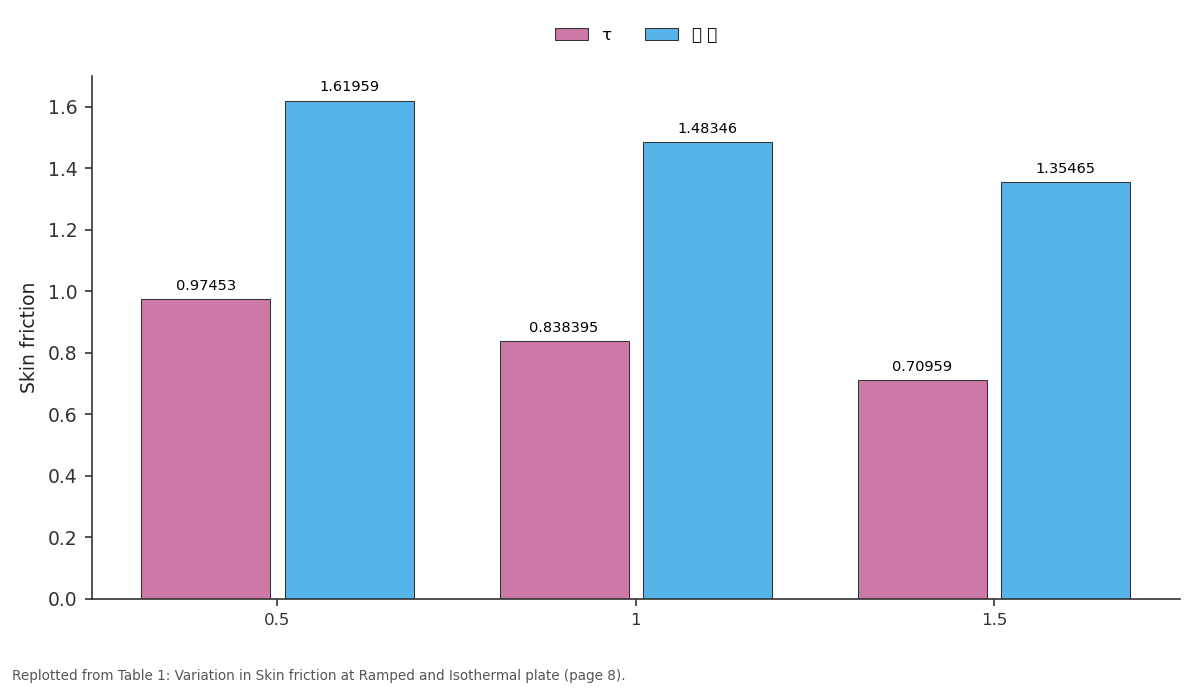
τ and 𝛕 𝒊: 0.5 vs 1 vs 1.5
Replotted from Table 1 (page 8) of the original paper. Every bar is the paper's own table value.
View source evidence ↗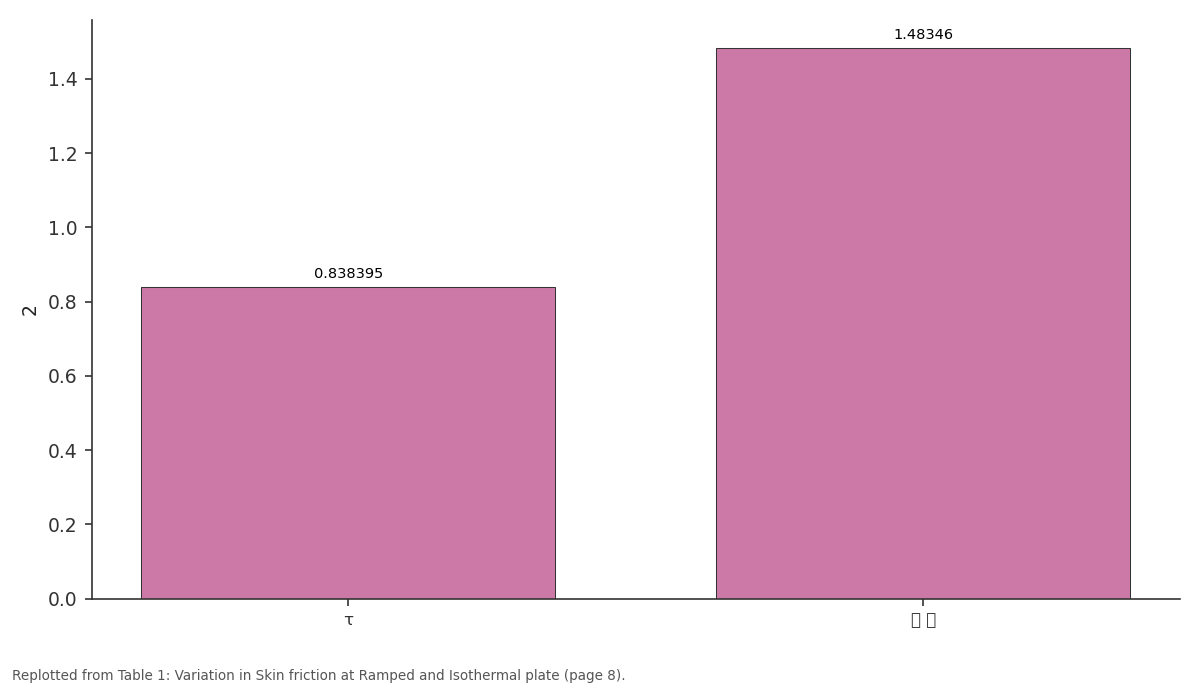
2: τ vs 𝛕 𝒊
Replotted from Table 1 (page 8) of the original paper. Every bar is the paper's own table value.
View source evidence ↗Figures & tables
From the original paper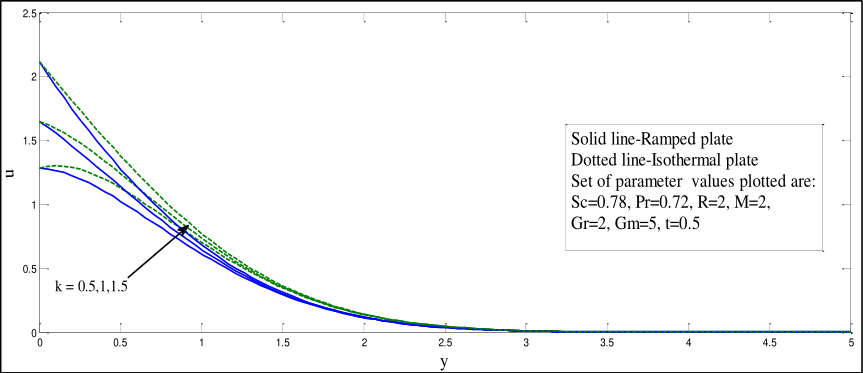 Figure 1
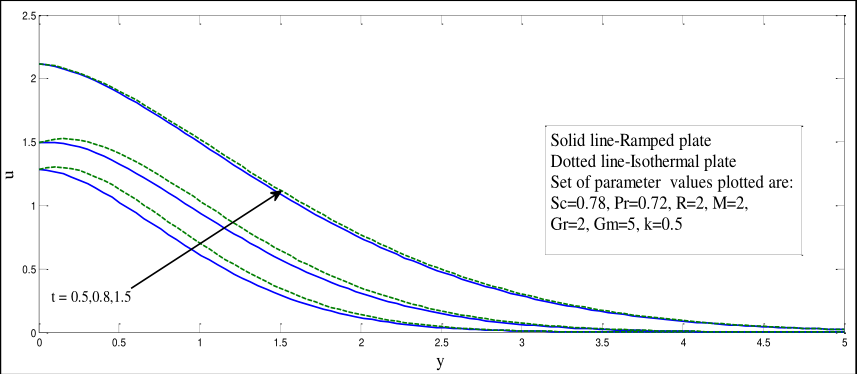 Figure 2
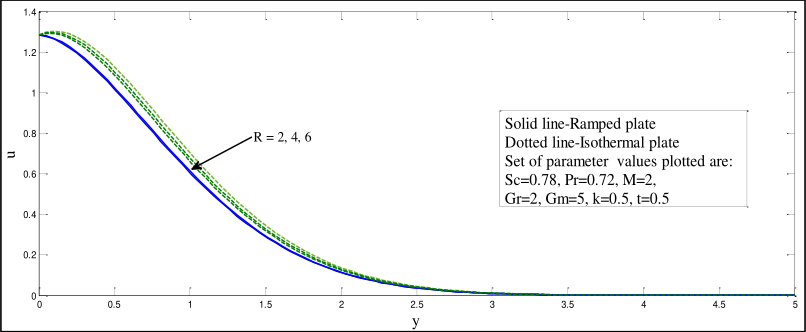 Figure 3
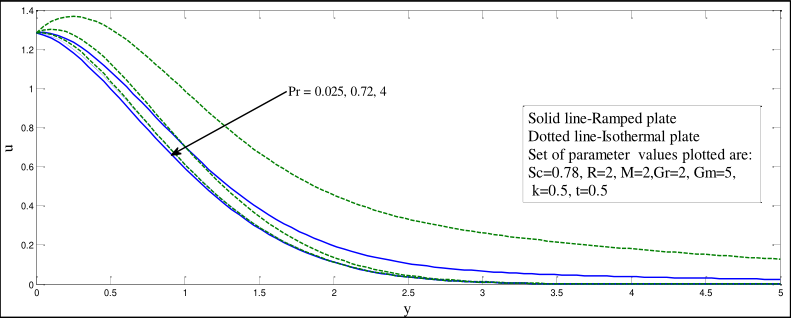 Figure 4
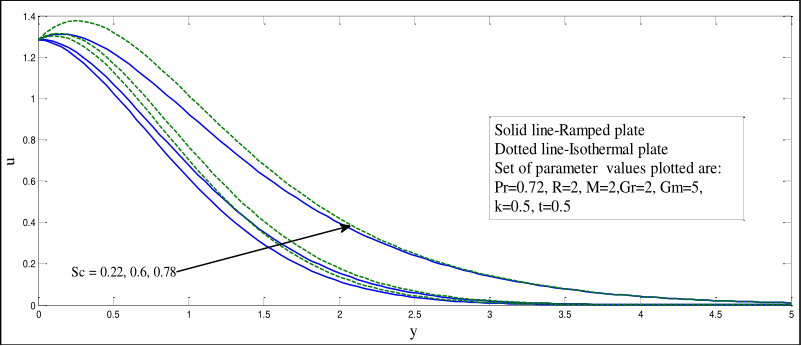 Figure 5
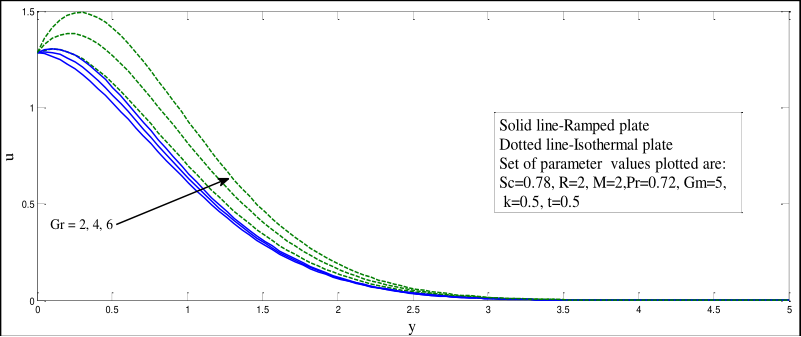 Figure 6
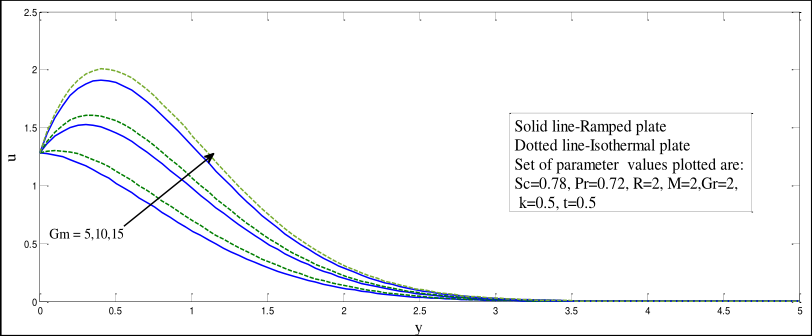 Figure 7
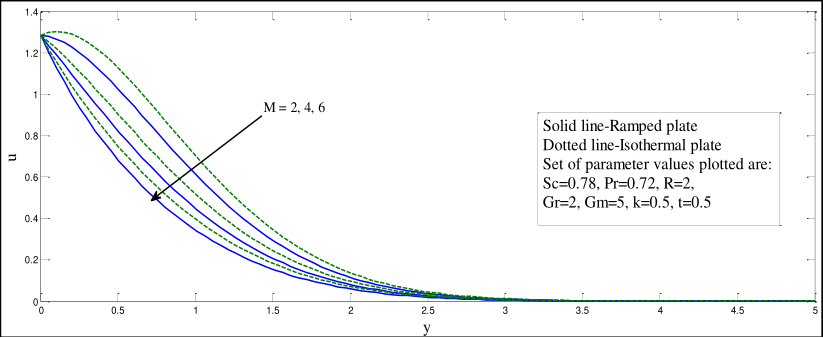 Figure 8
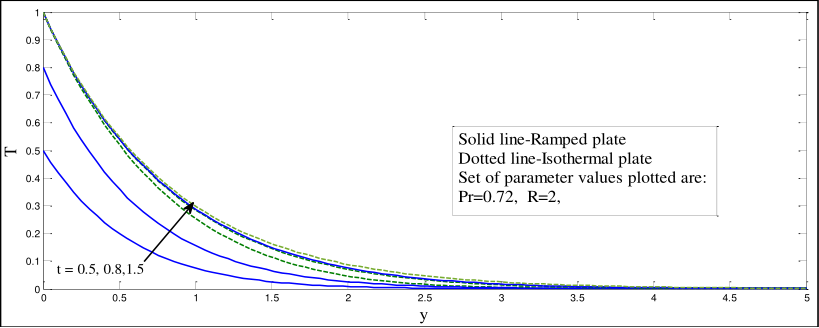 Figure 9
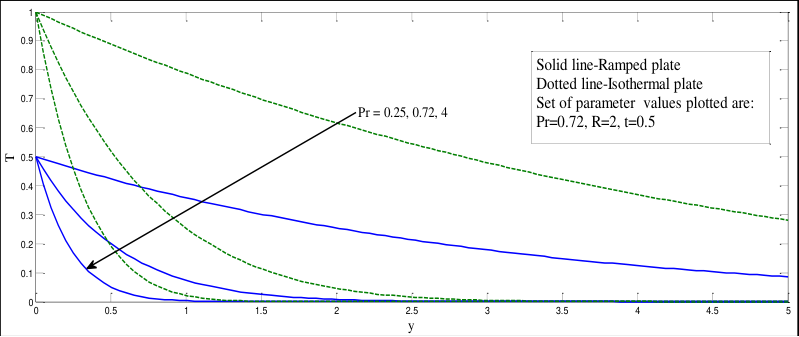 Figure 10
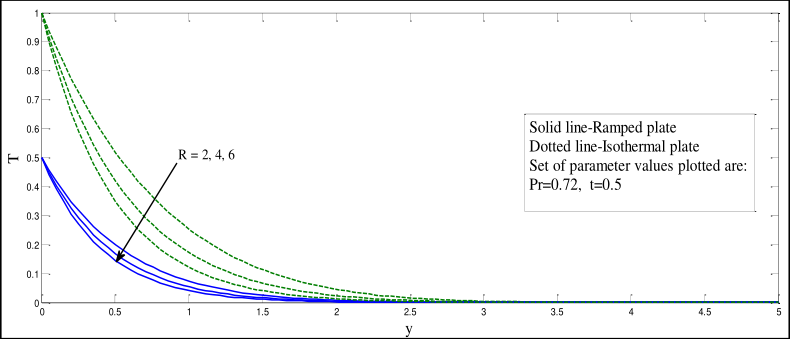 Figure 11
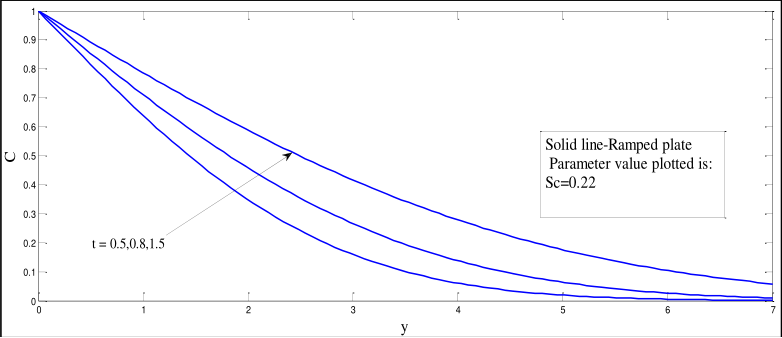 Figure 12
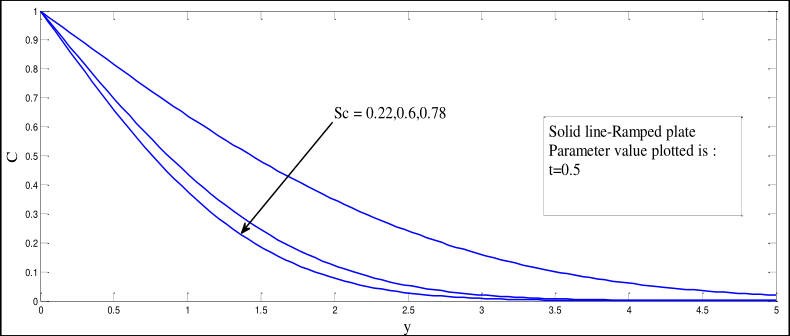 Figure 13
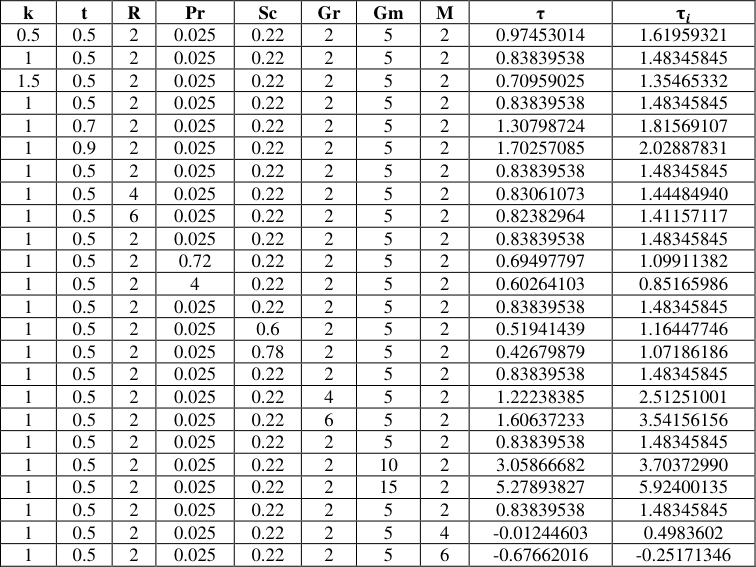 Table 1
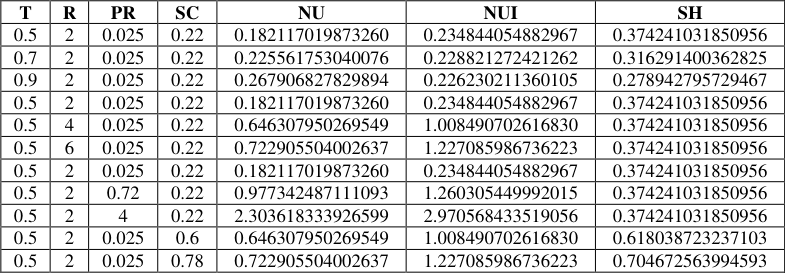 Table 2
Introduction
The subject of MHD free convection flow has drawn attention of many researchers through some past decades due to its wide range of applications in the field of science, technology, engineering, and astrophysics and space dynamics. A number of researchers has made contribution in solving problems of free convective flows under different boundary conditions, notably among them are Kim [9] , Takhar, Ahmed [20,1] et al., Singh and Garg [19] The study of magnetic field effects and radiation effects on MHD flows has been carried by many researchers due to their industrial importance like glass production, thermonuclear fusion and in space applications such as propulsion systems, plasma physics, in aerodynamics where we deal with high operating temperatures. Radiative heat transfer finds applications in the study of stellar and solar structure, radio propagation through ionosphere, MHD pumps etc. In this direction, Takhar [21] et al. investigated the radiation effects on MHD free convection flow of a radiating gas past a semi-infinite vertical plate. Raptis [15] studied the radiation and free convection flow through a porous medium. Further Bestman [2] et al. studied radiative transfer of unsteady hydromagnetic free convection flow in rotating fluid. Raptis [16] et al. analysed the radiation effects in an optically thin gray gas past a vertical infinite plate in the presence of a magnetic field. Badruddin [3] et al. studied free convection flow along with radiation characteristics for vertical plate embedded in porous medium. The study of thermal radiation of an optically thin gray gas in the presence of indirect natural convection was carried by Gosh [5] et al. Mazumdar [13] et al. also studied MHD flow past an impulsively started infinite vertical plate in the presence of thermal radiation. Further Siviah [17] et al. studied radiation effects on MHD free convection flow over a vertical plate with heat and mass flux. Recently Garg [6] et al. studied free convection and mass transfer flow past an accelerated plate in the presence of thermal radiation. Very recently Garg [7] studied radiation and free convection effects on moving vertical porous plate with variable temperature. Muduli [14] et al. investigated the radiative effects on transient free convective heat transfer past an exponentially accelerated hot vertical surface in porous medium in the presence of magnetic field using Laplace transform technique.
Above mention studies have considered the wall temperature to be well defined and continuous. But the concept of discontinuity in the wall temperature has not been discussed so far which may exist in some practical problems where the wall temperature may not be uniform. Under the consideration of this fact, Hayday [8] et al. investigated the free convection from a vertical plate with step discontinuities in surface temperature. Further researchers [10] - [12] have contributed towards the free convection flow problems with discontinuities of surface temperature. Unsteady natural convection flow in viscous incompressible fluid near vertical plate with ramped wall temperature was studied by Chandran [4] et al. Seth and Ansari [18] analysed the MHD natural convection flow past an impulsively moving vertical plate with ramped wall temperature in the presence of thermal diffusion with heat absorption. In the present paper, an analysis of radiative MHD free convective flow of a viscous, incompressible and electrically conducting fluid past an infinite vertical flat plate which is exponentially accelerating in the presence of transverse magnetic field with ramped temperature is carried out using Laplace Technique method. The velocity, temperature, concentration and some important dimensionless numbers characterizing fluid are studied for different parameters in detail.
Mathematical Analysis
An unsteady MHD free convective flow of a viscous, incompressible, electrically conducting fluid passing an infinite nonconducting vertical flat plate is considered. In the rectangular Cartesian co-ordinate system, 𝑥 ′ -axis is taken vertically upward along the plate. The 𝑦 ′ -axis is taken perpendicular to plate and a transverse magnetic field of uniform strength 𝐵 0 is applied along this axis. For time 𝑡 ′ < 0, the plate and the fluid is at constant temperature 𝑇 ∞ ′ and concentration 𝐶 ∞ ′ in a stationary conditions. At time 𝑡 ′ = 0, the plate starts accelerating with velocity 𝑈 0 𝑒 𝑘 ′ 𝑡 ′ in its own plane along the 𝑥 ′ -axis which causes the variation in temperature as 𝑇 * = 𝑇 ∞ ′ + ( 𝑇 𝑤 ′ -𝑇 ∞ ′ ) 𝑡 ′ 𝑡 0 ⁄ when 𝑡 ′ < 𝑡 0 and hereafter maintained at a uniform temperature 𝑇 𝑤 ′ for 𝑡 ′ > 0. Also for 𝑡 ′ > 0, species concentration is raised to 𝐶 𝑤 ′ . As the plate is infinite in extent so we assume that all the physical variables except pressures are functions of the space co-ordinate 𝑦 ′ and 𝑡 ′ only. The magnetic Reynolds number is assumed so small such that the induced magnetic field produced by fluid motion is negligible in comparison to applied magnetic field of strength 𝐵 0 . So in the absence of any input electric field and chemical reaction, the equations governing the unsteady MHD free convection heat and mass transfer flow of a viscous, incompressible, electrically conducting fluid under above stated assumptions are:
With the following initial and boundary conditions:
Where u', 𝞺, 𝘨, β', β*, T, C, 𝑐 𝑝 , k, 𝞾, 𝞼, D, Q respectively are fluid velocity in the 𝑥 ′ -direction, the fluid density, acceleration due to gravity, volumetric coefficient of thermal expansion, volumetric coefficient of expansion for concentration, the temperature of the fluid, species concentration, specific heat at constant pressure, thermal conductivity, the kinematic coefficient of viscosity, electrical conductivity, chemical molecular diffusivity, the radiative flux.
For an optically thin constant property gas, the radiative heat flux is expressed as
where 𝑎 * is the absorption constant and 𝜎 * is the Stefan Boltzmann constant. Assuming that the temperature differences within the flow are sufficiently small such that 𝑇 ′4 may be expresses as linear function of temperature which can be expanded using Taylor series about 𝑇 ∞ ′ . On neglecting the higher order terms, 𝑇 ′4 takes the form as
Introducing the following dimensionless variables and parameters as
Using equations ( 5) -( 7), equations ( 1) -( 3) becomes
Where M is the Magnetic number, Gr is the thermal Grashof number, Gm is the mass Grashof number, Pr is the Prandtl number, Sc is the Schmidt number, R is the radiation parameter.
Under the above non dimensionalization process the characteristic time 𝑡 0 is defined as
The corresponding initial and boundary conditions will take the form as 𝑢 = 0, 𝑇 = 0, 𝐶 = 0 𝑓𝑜𝑟 𝑦 > 0 𝑎𝑛𝑑 𝑡 ≤ 0
The system of equations ( 8) -( 10) subjected to initial and boundary conditions (11) defines the effect of radiative MHD free convective heat and mass transfer flow of a viscous, incompressible, electrically conducting fluid passing an exponentially accelerating infinite non-conducting vertical flat plate with ramped temperature.
Solution of the Problem
As we can observe that the equations ( 9) and ( 10) are independent from the equation ( 8), therefore we will find the solutions for temperature field T(y, t) and concentration field C(y, t) firstly. Thereafter we will use them to find the solution for velocity field u(y, t). Using Laplace transform method solutions of the equations ( 8) - (10) under the boundary conditions (11) are: 𝑢(𝑦, 𝑡) = 𝐴 2 (𝑦, 𝑡) + 𝑎 1 [ 𝐴 3 (𝑦, 𝑡) -𝐻(𝑡 -1)𝐴 3 (𝑦, 𝑡)] + 𝑎 2 𝐴 4 (𝑦, 𝑡)
T(y, t) = 𝐴 1 (𝑦, 𝑡) -𝐻(𝑡 -1)𝐴 1 (𝑦, 𝑡)
Nusselt Number
The Nusselt number which is the measure of rate of heat transfer is derived from temperature field as
Sherwood Number
The Sherwood number which is the measure of rate of mass transfer at plate is derived from Concentration field as
Skin Friction
The skin friction is derived from Velocity field as
Solution in case of isothermal plate
Solutions for the temperature field and velocity field using the equations ( 8)- (10) under the conditions of constant temperature are derived as
𝑢(𝑦, 𝑡) = 𝐴 2 (𝑦, 𝑡) + 𝑎 1 𝐴 5 (𝑦, 𝑡)+𝑎 2 𝐴 4 (𝑦, 𝑡)
However the expression for concentration field is same as for the ramped case which is given as in equation ( 14)
The Nusselt number is given as
The skin friction at the isothermal plate is
Results and Discussions
In this section we have analysed the effects of various parameters like Schmidt number(Sc), Prandtl number (Pr), Radiation parameter (R), Magnetic parameter, Thermal Grashof number (Gr), Mass Grashoff number (Gm), plate acceleration parameter (k) on Velocity distribution, temperature distribution and Concentration distribution through the figures 1-12 while keeping the other parameters as constant. Also the variations in Skin friction, Nusselt number and Sherwood number for both ramped and isothermal plate are examined through the tabs 1-2.
Figures ( 1) -( 8) illustrates the behaviour of velocity profiles with the variation in the parameter-plate acceleration parameter, time, Radiation parameter, Schmidt number, Prandtl number, Magnetic number, Thermal Grashoff number and Mass Grashoff number. In the figures ( 1) and ( 2), it is noticed that the velocity increases with the increase of both plate acceleration parameter and time but in the figures ( 3) and ( 4), there is decrease in the velocity with the increase in Radiation parameter and Prandtl number. In the figures ( 5), ( 6) and ( 7), it is observed that fluid velocity increases with the increase in Schmidt number, Thermal Grashof number and Mass Grashof number. However velocity shows decrement with the increase of Magnetic number in figure (8). Figures ( 9) -( 11) demonstrate the effects of time, Prandtl number and Radiation parameter on temperature distribution. Figure (9) shows that the temperature profile increases with the increase in time t whereas the figures ( 10) and ( 11) reveals that there is decrease in the temperature distribution with the increases in the Prandtl number and Radiation parameter. Figures ( 12) -( 13) shows the effects of time and Schmidt number on Concentration profiles. From figure (12), it is observed that concentration of the fluid along ramped plate increases with time whereas it shows the decrement in figure (13) along ramped plate with the increment in Schmidt number. In the tabs 1 and 2, we have compiled the effects of various parameters on Skin friction, Nusselt number and Sherwood number for both ramped and isothermal plate. From table 1, it is observed that the skin friction along both ramped plate and isothermal plate decreases with the increase in plate acceleration parameter, Radiation parameter, Prandtl number, Schmidt number, Thermal Grashof number and Magnetic parameter. However it shows increase along both the plates for increasing the time and Mass Grashoff number values. From table 2, it is observed that Nusselt number increases with increase in Radiation parameter and Prandtl number for both ramped and isothermal plate. But it increases with time for ramped plate and decreases with time for isothermal plate which indicates that rate of heat transfer become faster at ramped plate with time and it slowed down with time at isothermal plate. Also from table 2, it is clear that Sherwood number decreases with the progression of time and increases with increases in Schmidt number. It indicates that rate of mass transfer get slowed down as the time proceeds and it become faster as the Schmidt number is increased.
| T | R | PR | SC | NU | NUI | SH |
|---|---|---|---|---|---|---|
| 0.5 | 2 | 0.025 | 0.22 | 0.182117019873260 | 0.234844054882967 | 0.374241031850956 |
| 0.7 | 2 | 0.025 | 0.22 | 0.225561753040076 | 0.228821272421262 | 0.316291400362825 |
| 0.9 | 2 | 0.025 | 0.22 | 0.267906827829894 | 0.226230211360105 | 0.278942795729467 |
| 0.5 | 2 | 0.025 | 0.22 | 0.182117019873260 | 0.234844054882967 | 0.374241031850956 |
| 0.5 | 4 | 0.025 | 0.22 | 0.646307950269549 | 1.008490702616830 | 0.374241031850956 |
| 0.5 | 6 | 0.025 | 0.22 | 0.722905504002637 | 1.227085986736223 | 0.374241031850956 |
| 0.5 | 2 | 0.025 | 0.22 | 0.182117019873260 | 0.234844054882967 | 0.374241031850956 |
| 0.5 | 2 | 0.72 | 0.22 | 0.977342487111093 | 1.260305449992015 | 0.374241031850956 |
| 0.5 | 2 | 4 | 0.22 | 2.303618333926599 | 2.970568433519056 | 0.374241031850956 |
| 0.5 | 2 | 0.025 | 0.6 | 0.646307950269549 | 1.008490702616830 | 0.618038723237103 |
| 0.5 | 2 | 0.025 | 0.78 | 0.722905504002637 | 1.227085986736223 | 0.704672563994593 |
Table text extracted from the original PDF; superscript letters are shown inline. The original table image is below.
View original table image
| k | t | R | Pr | Sc | Gr | Gm | M | τ | 𝛕 𝒊 |
|---|---|---|---|---|---|---|---|---|---|
| 0.5 | 0.5 | 2 | 0.025 | 0.22 | 2 | 5 | 2 | 0.97453014 | 1.61959321 |
| 1 | 0.5 | 2 | 0.025 | 0.22 | 2 | 5 | 2 | 0.83839538 | 1.48345845 |
| 1.5 | 0.5 | 2 | 0.025 | 0.22 | 2 | 5 | 2 | 0.70959025 | 1.35465332 |
| 1 | 0.5 | 2 | 0.025 | 0.22 | 2 | 5 | 2 | 0.83839538 | 1.48345845 |
| 1 | 0.7 | 2 | 0.025 | 0.22 | 2 | 5 | 2 | 1.30798724 | 1.81569107 |
| 1 | 0.9 | 2 | 0.025 | 0.22 | 2 | 5 | 2 | 1.70257085 | 2.02887831 |
| 1 | 0.5 | 2 | 0.025 | 0.22 | 2 | 5 | 2 | 0.83839538 | 1.48345845 |
| 1 | 0.5 | 4 | 0.025 | 0.22 | 2 | 5 | 2 | 0.83061073 | 1.44484940 |
| 1 | 0.5 | 6 | 0.025 | 0.22 | 2 | 5 | 2 | 0.82382964 | 1.41157117 |
| 1 | 0.5 | 2 | 0.025 | 0.22 | 2 | 5 | 2 | 0.83839538 | 1.48345845 |
| 1 | 0.5 | 2 | 0.72 | 0.22 | 2 | 5 | 2 | 0.69497797 | 1.09911382 |
| 1 | 0.5 | 2 | 4 | 0.22 | 2 | 5 | 2 | 0.60264103 | 0.85165986 |
| 1 | 0.5 | 2 | 0.025 | 0.22 | 2 | 5 | 2 | 0.83839538 | 1.48345845 |
| 1 | 0.5 | 2 | 0.025 | 0.6 | 2 | 5 | 2 | 0.51941439 | 1.16447746 |
| 1 | 0.5 | 2 | 0.025 | 0.78 | 2 | 5 | 2 | 0.42679879 | 1.07186186 |
| 1 | 0.5 | 2 | 0.025 | 0.22 | 2 | 5 | 2 | 0.83839538 | 1.48345845 |
| 1 | 0.5 | 2 | 0.025 | 0.22 | 4 | 5 | 2 | 1.22238385 | 2.51251001 |
| 1 | 0.5 | 2 | 0.025 | 0.22 | 6 | 5 | 2 | 1.60637233 | 3.54156156 |
| 1 | 0.5 | 2 | 0.025 | 0.22 | 2 | 5 | 2 | 0.83839538 | 1.48345845 |
| 1 | 0.5 | 2 | 0.025 | 0.22 | 2 | 10 | 2 | 3.05866682 | 3.70372990 |
| 1 | 0.5 | 2 | 0.025 | 0.22 | 2 | 15 | 2 | 5.27893827 | 5.92400135 |
| 1 | 0.5 | 2 | 0.025 | 0.22 | 2 | 5 | 2 | 0.83839538 | 1.48345845 |
| 1 | 0.5 | 2 | 0.025 | 0.22 | 2 | 5 | 4 | -0.01244603 | 0.4983602 |
| 1 | 0.5 | 2 | 0.025 | 0.22 | 2 | 5 | 6 | -0.67662016 | -0.25171346 |
Table text extracted from the original PDF; superscript letters are shown inline. The original table image is below.
View original table image
Conclusion
An analysis on unsteady MHD free convective flow of a viscous, incompressible, electrically conducting fluid passing an infinite non-conducting vertical flat plate which is exponentially accelerated in the presence of magnetic field with ramped wall temperature is concluded as The presence of radiation effect reduces the fluid temperature which causes the decrease in fluid velocity for both ramped and isothermal plates. It is noticed that the velocity and temperature of the fluid for ramped and isothermal plate is decreased with the increase in Prandtl number which indicates that thermal diffusion tends to increase the fluid temperature and fluid velocity for both the plates. Also the progression in time shows the increase in fluid temperature and fluid velocity. The increases in Schmidt number, Thermal Grashof number and Mass Grashof number show the increase in fluid velocity which indicates that mass diffusion, thermal buoyancy forces and mass buoyancy forces retards the fluid flow. Concentration in the fluid flow decreases with increase in Schmidt number which shows that mass diffusion increases the species concentration. Also it increases with time. It is observed that radiation effect increases the rate of heat transfer but thermal diffusion reduces the rate of heat transfer.
Also the rate of mass transfer reduces with mass diffusivity. Skin friction at both the plates' increases with thermal diffusion, mass diffusion and time whereas it decreases with radiation effects and introduction of magnetic field.
Appendix
Appendix
Figures and tables from the paper
References
21 in the original paper- Ahmed N, Sarmah HK, Kalita D. Thermal diffusion effects on three dimensional MHD free convection with mass transfer flow from a porous plate, Lat. Am. Applied Research. 2011; 41:165-176.
- Bestman AR, Adjepong SK. Unsteady hydromagnetic free convection flow with radiative transfer in rotating fluid, Astrophysics Space Sci. 1998; 143:73-80.
- Badruddin IZ, Zainal ZA, Narayana PAA, Seetharameu KN, Lam WS. Free convection and radiation characteristics for a vertical plate embedded in a porous medium, Int. J Numerical Methods Engg. 2005; 65:2265-2278.
- Chandran P, Sacheti NC, Singh AK. Natural convection near a vertical plate with ramped wall temperature, Heat Mass Transf. 2005; 41:459-464.
- Gosh SK, Pop I. Thermal radiation of an optically thin gray gas in the presence of indirect natural convection. Int. J Fluid Mechanics Research. 2007; 34(6):515-520.
- Garg BP, Singh KD, Reena Pathak. An analysis of radiative free convection and mass transfer flow for an accelerated vertical plate in the presence of transverse magnetic field, Rajasthan journal of academic physical sciences. 2011; 10(1): 01-10.
- Garg, B. P., Radiation and free-convection effects on moving vertical porous plate with variable temperature, Rajasthan Journal of Academic Physical Sciences. 2011; 10(2):147-154.
- Hayday AA, Bowlus DA, McGraw RA. Free convection from a vertical plate with step discontinuities in surface temperature, J Heat Transf. 1967; 89:244-250.
- Kim J. Unsteady MHD convective heat transfer past a semi infinite vertical porous moving plate with variable suction, Int. J Engg. Sci. 2000; 38:833-845.
- Kelleher M. Free convection from a vertical plate with discontinuous wall temperature. J Heat Transf. 1971; 93:349-356.
- Kao TT. Laminar free convective heat transfer response along a vertical flat plate with step jump in surface temperature, Lett, Heat Mass Transf. 1975; 2:419-428.
- Lee S, Yovanovich MM. Laminar natural convection from a vertical plate with a step change in wall temperature, J. Heat Transf. 1991; 113:501-504.
- Mazumdar MK, Deka RK. MHD flow past an impulsively started infinite vertical plate in presence of thermal radiation, Rom. Journal of Phys. 2007; 52(5-7):565-573.
- Muduli JC, Dhal RK, Jena B, Sahoo M. Radiative effects on transient free convective heat transfer past an exponentially accelerated hot vertical surface in porous medium in the presence of Magnetic field. Acta Ciencia Indica. 2014; 2:207-216.
- Raptis, A. Radiation and free convection flow through a porous medium, International Communication in Heat and Mass Transfer. 1998; 25:289-295.
- Raptis A, Perdikis C, Leontitsis K. Effect of radiation in an optically thin gray gas flowing past a vertical infinite plate in the presence of a magnetic field, Heat and Mass transfer. 1998; 39:771-773. Doi: 10.1007/s00231-002-0317-8.
- Siviah M, Nagarajan AS, Reddy PS. Radiation effects on MHD free convection flow over a vertical plate with heat and mass flux, Emirates journal for Engg. Research. 1998; 15(1):35-40.
- Seth GS, Ansari MS. MHD natural convection flow past an impulsively moving vertical plate with ramped wall temperature in the presence of thermal diffusion with heat absorption, Int. J Appl. Mech. Engg. 2010; 15:199-215.
- Singh KD, Garg BP. Effects of mass transfer and free convection currents on the flow past an accelerated vertical plate in the presence of heat source/sink. Journal of Rajasthan Academy of Physical Sciences. 2010; 9:11-18.
- Takhar HS, Roy S, Nath G. Unsteady free convection flow of an infinite vertical plate due to the combined effects of thermal and mass diffusion, magnetic field and Hall current, Heat Mass Transfer. 2010; 39:825-834.
- Takhar HS, Gorla RSR, Soundalgekar VM. Radiation effects on MHD free convection flow of a radiating gas past a semiinfinite vertical plate, Int. J Numerical methods Heat fluid flow. 2010; 6:77-83.