
Research article · 2018 · Full text
International Journal of Statistics and Applied MathematicsOn the diophnatine equation 2x + py = z2
Volume 3(2) · Pages 336–337
Research areasAdvanced Combinatorial MathematicsMathematical Dynamics and FractalsAlgebraic Geometry and Number Theory
Abstract
Author-writtenIn this paper, we find all the solutions of the titled equation where p3(mod 4) and x, y and z are non negative integers except x = 1.
Summary
Source-checkedPlain-language reading of the full paper, prepared with AI and checked against the text. Each point links to the authors' own words.
Why it matters
- Finding all solutions to this specific Diophantine equation is considered an open problem in mathematics. View evidence ↗
What they did
- The proof relies on the application of Catalan's conjecture. View evidence ↗
- Catalan's conjecture is used as a preliminary proposition, stating that $(3,2,2,3)$ is the unique solution for $a^x - b^y = 1$ when the minimum of the variables is greater than 1. View evidence ↗
What they found
- If $p$ is a Mersenne prime of the form $2^q - 1$, then a solution exists where $x = q + 2$, $y = 2$, and $z = 2 + p$. View evidence ↗
- When $y = 0$, the equation simplifies to $z^2 - 2^x = 1$, which by Catalan's conjecture yields the solution $z = 3$ and $x = 3$ for any prime $p$. View evidence ↗
- The author notes that when $x = 1$, the equation has many solutions, providing a list of examples in Table 1. View evidence ↗
What it means
- The author concludes that they have successfully found all solutions for $p ≡ 3 (mod 4)$ except for the specific case where $x = 1$. View evidence ↗
- The author states that finding all solutions when $x = 1$, as well as finding all solutions for any arbitrary prime $p$, remains an open problem. View evidence ↗
Figures & tables
From the original paper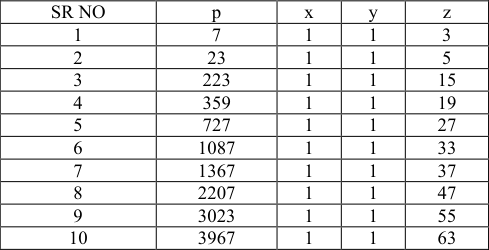 Table 1
Introduction
In 2011, A. Suvernamani [1], studied the titled equation and claimed to find all the solutions. But in 2013, Somchit Chotchaisthit [3], showed some misleading arguments in [1], and studied the equation for p = 11. In the same paper, author stated that to find all the solutions to the equation is still an open problem.
In this paper, we give all the solutions to the titled equation when 𝑝≡3(𝑚𝑜𝑑 4) and 𝒙, 𝒚 and 𝒛 are non negative integers except the case when x = 1. We list some solutions to the equation for x = 1. We use Catalan’s conjecture proved in [2]. 2. Preliminaries 2.1 Proposition (The Catalan’s conjecture) (3,2,2,3) is a unique solution (𝑎, 𝑏, 𝑥, 𝑦) of the Diophantine equation 𝑎𝑥−𝑏𝑦= 1 where 𝑎, 𝑏, 𝑥 and 𝑦 are integers with min{𝑎, 𝑏, 𝑥, 𝑦} > 1.
Proof: See in [3] 2.2 Lemma The equation 1 + 𝑝𝑦= 𝑧2, where 𝑝 is odd prime, 𝑦 and 𝑧 are non negative integers has a unique solution (𝑝, 𝑦, 𝑧) = (3,1,2) Proof: Let 𝑝 be prime, 𝑦 and 𝑧 are non negative integers such that 1 + 𝑝𝑦= 𝑧2. That is 𝑝𝑦= (𝑧+ 1)(𝑧−1). Thus there are non negative integers 𝛼 and 𝛽 such that 𝑝𝛼= 𝑧+ 1 and 𝑝𝛽= 𝑧−1, where 𝛼+ 𝛽= 𝑦 and 𝛼> 𝛽. Then 𝑝𝛽(𝑝𝛼−𝛽−1) = 2.
If 𝛽≠0 then taking this equation modulo 𝑝, we get 0 ≡2(𝑚𝑜𝑑 𝑝). But this is contradiction. Let 𝛽= 0, then 𝑝𝛼= 3 and thus 𝛼= 1 and 𝑝= 3. Hence there is unique solution (𝑝, 𝑦, 𝑧) = (3,1,2). 3.
Main Theorem 3.1 Theorem The Diophantine equation 2𝑥+ 𝑝𝑦= 𝑧2, where 𝑝≡3(𝑚𝑜𝑑 4), 𝑥, 𝑦 and 𝑧 are non negative integers, 𝑥≠1, then i) for 𝑝= 3, the equation has the solutions (𝑥, 𝑦, 𝑧) as {(3,0,3), (0,1,2), (4,2,5)} ii) for every prime 𝑝, the equation has the solutions of the form (𝑥, 𝑦, 𝑧) = (3,0,3) iii) for primes of the form 𝑝= 2𝑞−1, the solutions are given by (𝑝, 𝑥, 𝑦, 𝑧) = (2𝑞−1, 𝑞+ 2,2, 𝑝+ 2) Proof: Let 𝑝≡3(𝑚𝑜𝑑 4) and 𝑥, 𝑦 and 𝑧 be non negative integers such that 2x + py = z2 Maths 2018; 3(2): 336-337 Gawkhare Mahesh Agnel Institute of Technology and Design, Assagao, Goa, India Correspondence Gawkhare Mahesh Agnel Institute of Technology and Design, Assagao, Goa, India Here 𝑧 must be greater than 1. If x = 0, then by Lemma 2.2, we have unique solution (𝑝, 𝑥, 𝑦, 𝑧) = (3,0,1,2). So let 𝑥> 1. If 𝑦= 0, then we have 𝑧2 −2𝑥= 1.
By Catalan’s conjecture we have 𝑧= 3 and 𝑥= 3. Hence for any prime 𝑝, we have the solutions (𝑥, 𝑦, 𝑧) = (3,0,3). Observe that 𝑧2 must be odd and 𝑧2 ≡1(𝑚𝑜𝑑 4). Now 2𝑥≡ 0(𝑚𝑜𝑑 4) and Since 𝑝≡3(𝑚𝑜𝑑 4), and 𝑝𝑦≡3𝑦(𝑚𝑜𝑑 4), we have 𝑦 must be even.
Let 𝑦= 2𝑚. Thus 2𝑥= (𝑧+ 𝑝𝑚)(𝑧−𝑝𝑚). Thus there are non negative integers 𝛼 and 𝛽 such that 2𝛼= 𝑧+ 𝑝𝑚 and 2𝛽= 𝑧−𝑝𝑚, where 𝛼+ 𝛽= 𝑥 and 𝛼> 𝛽. Then 2𝛽(2𝛼−𝛽− 1) = 2𝑝𝑚, i.e. 2𝛽−1(2𝛼−𝛽−1) = 𝑝𝑚.
If 𝛽−1 ≠0, then taking this equation modulo 2, we get 𝑝𝑚≡0(𝑚𝑜𝑑 2). But this is contradiction. Let 𝛽−1 = 0, i.e. 𝛽= 1. Then 2𝛼−1 −𝑝𝑚= 1.
If min{𝛼− 1, 𝑚} > 1, then by Catalan’s conjecture, there is no solution. Again if 𝛼−1 = 0 or 𝛼−1 = 1, there is no solution. Let 𝑚= 1, then 𝑝= 2𝛼−1 −1, here 𝑝 is of the form of Mersenne prime. Thus if 𝑝= 2𝑞−1, then 𝑥= 𝑞+ 2, 𝑦= 2 and 𝑧= 2 + 𝑝.
Thus the solutions are given by (𝑝, 𝑥, 𝑦, 𝑧) = (2𝑞−1, 𝑞+ 2,2,2 + 𝑝) where 𝑝 is Mersenne prime, 𝑝= 2𝑞−1. This complete the proof. In this result, we exclude the case when 𝑥= 1, and we assert that the titled equation has many solutions in this case. We list some solutions in Table 1.
| ON RS | p | x | y | z |
|---|---|---|---|---|
| 1 | 7 | 1 | 1 | 3 |
| 2 | 23 | 1 | 1 | 5 |
| 3 | 223 | 1 | 1 | 15 |
| 4 | 353 | 1 | 1 | 13 |
| 5 | 727 | 1 | 1 | 27 |
| 6 | 1807 | 1 | 1 | 33 |
| 7 | 1367 | 1 | 1 | 37 |
| 0 | 2287 | 1 | 1 | 47 |
| 3 | 3823 | 1 | 1 | 55 |
| 18 | 3367 | 1 | 1 | 63 |
Table text extracted from the original PDF; superscript letters are shown inline. The original table image is below.
View original table image
Table 1: Some solutions of Equation (1) when 𝑥= 1 ON RS p x y z 1 7 1 1 3 2 23 1 1 5 3 223 1 1 15 4 353 1 1 13 5 727 1 1 27 6 1807 1 1 33 7 1367 1 1 37 0 2287 1 1 47 3 3823 1 1 55 18 3367 1 1 63
Conclusion
In this paper, we found all the solutions of the titled equation for 𝑝= 3( 𝑚𝑜𝑑 4) except the case when 𝑥= 1. However we listed some solutions when 𝑥= 1. Nevertheless, to find all the solutions of titled equation when 𝑥= 1 is still open problem. Also to find all the solutions of 2𝑥+ 𝑝𝑦= 𝑧2 for any prime 𝑝 is still an open problem.
Acknowledgements
Author is very thankful to the anonymous referees for the valuable guidance to enhance this paper.
References
3 in the original paper- Suvarnamni A. Solutions of the Diophantine equation 2𝑥+ 𝑝𝑦= 𝑧2”. Int. J. Math. Sci. Appl. 2011; 1:1415- 1419.
- Mihailescu P. Primary cyclotomic units and a proof of Catalan’s conjecture. J. Reine Angew. Math. 2004; 572:167-195.
- Somchit Chotchaisthit. On the Diophantine equation 2𝑥+ 11𝑦= 𝑧2”. Maejo Int. J. Sci. Technol. 2013; 7(02):291- 293.