Scinovex

Research article · 2017 · Full text

International Journal of Statistics and Applied Mathematics

New families and invariance under E-cordial labeling

Mukund V. Bapat

Volume 2(6) · Pages 151–154

Research areasGraph Labeling and Dimension ProblemsFuzzy and Soft Set TheoryAdvanced Mathematical Theories

↓ Read full-text PDF0 citations

Abstract

Author-written

In this paper we discuss new families of E- cordial labeling. These are FL(Sn), (S4)(k), Crown of shel, (Sn)(k), (K1,n:K1,n), (FL(C4) )(k), E-cordial invariance of (FL(C3) )(k)

Summary

Source-checked

Plain-language reading of the full paper, prepared with AI and checked against the text. Each point links to the authors' own words.

  1. Why it matters

    • E-cordial labeling was introduced in 1997 as a weaker version of edge-graceful labeling. View evidence ↗

      Why it matters

      E-cordial labeling was introduced in 1997 as a weaker version of edge-graceful labeling.

      In the paper's own words

      “In 1997 Yilmaz and Cahit [5] introduced a weaker version of edge-graceful called E-cordial. labeling.”

      Page 1

      Found in: Introduction

      Read it in the full textOpen PDF at page 1 ↗
    • A graph is considered E-cordial if there exists a labeling where the counts of vertices labeled 0 and 1 differ by at most 1, and the counts of edges labeled 0 and 1 also differ by at most 1. View evidence ↗

      Why it matters

      A graph is considered E-cordial if there exists a labeling where the counts of vertices labeled 0 and 1 differ by at most 1, and the counts of edges labeled 0 and 1 also differ by at most 1.

      In the paper's own words

      “The function f is called an E-cordial labeling of G if the number of vertices labeled 0 and the number of vertices labeled 1 differ by at most 1 and the number of edges labeled 0 and the number of edges labeled 1 differ by at most 1.”

      Page 1

      Found in: Introduction

      Read it in the full textOpen PDF at page 1 ↗
  2. The question

    • The study aims to investigate E-cordial labeling for several new graph families, including flag graphs of shells and one-point unions of specific graph copies. View evidence ↗

      The question

      The study aims to investigate E-cordial labeling for several new graph families, including flag graphs of shells and one-point unions of specific graph copies.

      In the paper's own words

      “In this paper we discuss new families of E-cordial labeling. These are FL(Sn), (S4)(k), Crown of shel, (Sn)(k), (K1,n:K1,n), (FL(C4) )(k), E-cordial invariance of (FL(C3) )(k)”

      Page 1

      Found in: Theorem:

      Read it in the full textOpen PDF at page 1 ↗
  3. What they did

    • The research focuses on graphs that are simple, connected, undirected, and finite. View evidence ↗

      What they did

      The research focuses on graphs that are simple, connected, undirected, and finite.

      In the paper's own words

      “The graphs considered are finite, undirected, simple and connected.”

      Page 1

      Found in: Introduction

      Read it in the full textOpen PDF at page 1 ↗
    • The vertex labels are derived from the sum of the labels of the incident edges modulo 2. View evidence ↗

      What they did

      The vertex labels are derived from the sum of the labels of the incident edges modulo 2.

      In the paper's own words

      “Define f on V by f(v) =Σf(uv) (mod 2).”

      Page 1

      Found in: Introduction

      Read it in the full textOpen PDF at page 1 ↗
    • Flag graphs (FL(G)) are constructed by attaching a copy of K2 to a specific vertex of the base graph G. View evidence ↗

      What they did

      Flag graphs (FL(G)) are constructed by attaching a copy of K2 to a specific vertex of the base graph G.

      In the paper's own words

      “FL(G) is a flag graph of G and is obtained by attaching a copy of k2to a suitable vertex of G.”

      Page 1

      Found in: Definitions 3.1.

      Read it in the full textOpen PDF at page 1 ↗
  4. What they found

    • The flag graph of a shell, FL(Sn), is E-cordial if and only if n is an even number. View evidence ↗

      What they found

      The flag graph of a shell, FL(Sn), is E-cordial if and only if n is an even number.

      In the paper's own words

      “Theorem: Fl(Sn) is E-cordial iff n is even number.”

      Page 1

      Found in: Results proved 4.1. Theorem: Fl(Sn) is E-cordial iff n is even number.

      Read it in the full textOpen PDF at page 1 ↗
    • The one-point union of k copies of S4 is generally E-cordial, except when the number of vertices is congruent to 2 (mod 4). View evidence ↗

      What they found

      The one-point union of k copies of S4 is generally E-cordial, except when the number of vertices is congruent to 2 (mod 4).

      In the paper's own words

      “Theorem: One point union of k copies of S4 i.e. (S4)(k) is E- cordial”

      Page 2

      “Note that * in the first column indicate that for that value of k the graph is not E-cordial. The note made by Yilmaz and Cahit is also observed here, that for number of vertices congruent to 2(mod 4), the graph is not E- cordial.”

      Page 2

      Found in: Results proved 4.1. Theorem: Fl(Sn) is E-cordial iff n is even number.

      Read it in the full textOpen PDF at page 2 ↗
    • The graph (K1,n: K1,n) is E-cordial for both even and odd n, with edge distributions always being equal (ef(0)=ef(1)=n). View evidence ↗

      What they found

      The graph (K1,n: K1,n) is E-cordial for both even and odd n, with edge distributions always being equal (ef(0)=ef(1)=n).

      In the paper's own words

      “Theorem: (K1,n: K1,n) is E-cordial.”

      Page 2

      “for n is even vf(0)=n+1 vf(1)= n on vertices. ef(0)=n = ef(1) on edges. For n is odd, vf(0) = n, vf(1)= n+1 on vertices. ef(0)=n = ef(1) on edges.”

      Page 2

      Found in: Results proved 4.1. Theorem: Fl(Sn) is E-cordial iff n is even number.

      Read it in the full textOpen PDF at page 2 ↗
    • The one-point union of k copies of FL(C3) is E-cordial across three different structural configurations, except when 3k is congruent to 1 (mod 4). View evidence ↗

      What they found

      The one-point union of k copies of FL(C3) is E-cordial across three different structural configurations, except when 3k is congruent to 1 (mod 4).

      In the paper's own words

      “Theorem: All three structures of G = (FL (C3))(k) i.e. One point union of k- copies of FL(C3) is E-cordial except for 3k≡1(mod 4)”

      Page 2

      Found in: Theorem:

      Read it in the full textOpen PDF at page 2 ↗
    • Because the E-cordiality of (FL(C3))(k) holds regardless of which of the three possible union points is used, the graph is considered invariant under E-cordial labeling. View evidence ↗

      What they found

      Because the E-cordiality of (FL(C3))(k) holds regardless of which of the three possible union points is used, the graph is considered invariant under E-cordial labeling.

      In the paper's own words

      “Thus G= (FL(C3) )(k) i.e. One point union of k- copies of FL(C3) is E-cordial though it has 3 different structures.as explained in figures.(except for 3k≡1(mod 4))”

      Page 4

      Found in: Theorem:

      Read it in the full textOpen PDF at page 4 ↗
    • The one-point union of k copies of FL(C4) is E-cordial, with vertex distributions of 2k+1 and 2k. View evidence ↗

      What they found

      The one-point union of k copies of FL(C4) is E-cordial, with vertex distributions of 2k+1 and 2k.

      In the paper's own words

      “Theorem: G = (FL(C4) )(k) i.e. One point union of k- copies of FL(C4) is E-cordial.”

      Page 4

      “The number distribution is vf(0)=2k+1 and vf(1)=2k for given k. ef(0)=ef(1)=5x for k = 2x and for k=2x-1 ef(0)=5x+3, ef(1)=5x+2.”

      Page 4

      Found in: Theorem:

      Read it in the full textOpen PDF at page 4 ↗
  5. What it means

    • The authors conclude that (FL(C3))(k) is invariant under E-cordial labeling. View evidence ↗

      What it means

      The authors conclude that (FL(C3))(k) is invariant under E-cordial labeling.

      In the paper's own words

      “Thus the (FL(C3)(k) is invariant under E-cordial labeling.”

      Page 4

      Found in: Theorem:

      Read it in the full textOpen PDF at page 4 ↗
    • The authors suggest that future research should investigate whether the same invariance applies to (FL(Cn))(k) for any given n. View evidence ↗

      What it means

      The authors suggest that future research should investigate whether the same invariance applies to (FL(Cn))(k) for any given n.

      In the paper's own words

      “We are sure that the same thing will be followed for (FL(Cn)(k) for given n. This will attract future attention.”

      Page 4

      Found in: Definitions 3.1.

      Read it in the full textOpen PDF at page 4 ↗

Visual summary

2 visuals

Illustrations explain the paper; charts are replotted from the paper's own table values.
AI-generated illustration
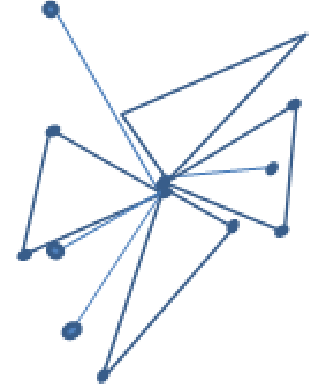
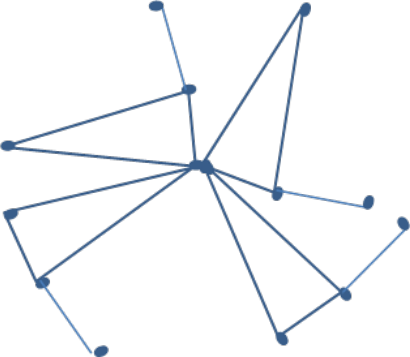
AI-generated conceptual illustration (mathematical graph consisting of vertices and edges). It explains the idea and does not show study data.↗ Enlarge
E-Cordial Labeling Concept
AI-generated conceptual illustration (mathematical graph consisting of vertices and edges). It explains the idea and does not show study data.

AI-generated conceptual illustration (mathematical graph consisting of vertices and edges). It explains the idea and does not show study data.

Open full-size image ↗

E-Cordial Labeling Concept

AI-generated conceptual illustration (mathematical graph consisting of vertices and edges). It explains the idea and does not show study data.

View source evidence ↗
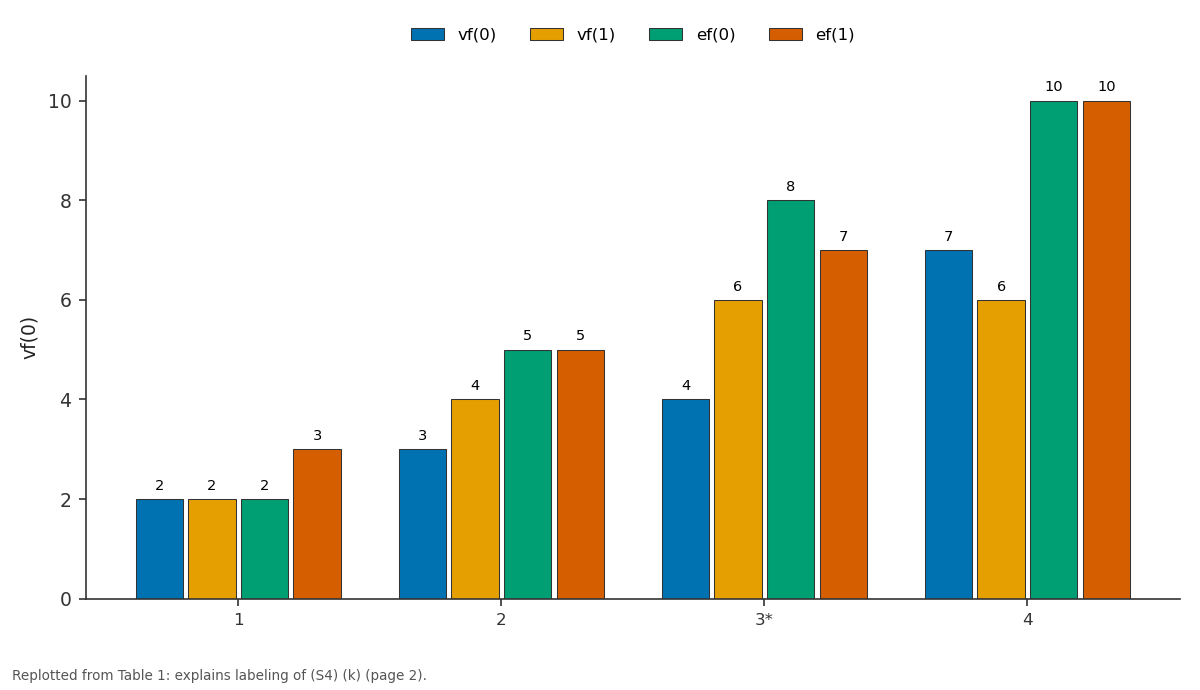
Replotted from source data
Replotted from Table 1 (page 2) of the original paper. Every bar is the paper's own table value.↗ Enlarge
vf(0) and vf(1) and more: 1 vs 2 vs 3* vs 4
Replotted from Table 1 (page 2) of the original paper. Every bar is the paper's own table value.

Replotted from Table 1 (page 2) of the original paper. Every bar is the paper's own table value.

Open full-size image ↗

vf(0) and vf(1) and more: 1 vs 2 vs 3* vs 4

Replotted from Table 1 (page 2) of the original paper. Every bar is the paper's own table value.

View source evidence ↗

Figures & tables

From the original paper
explains labeling of (S4) (k)Table 1Page 2FL(S6): E-cordial labelingFigure 1Page 2Four types of labeled copies of S4Figure 2Page 2(K1, 3:K1, 3) is E-cordialFigure 3Page 2Type 1 structure. Note that * in the first column indicate that for that value of k the graph is not E-cordial.Table 2Page 3Labeled copy of Type A and Type B. These are building blocks of G =Figure 4Page 3Pendent vertex is joined to obtain the structureFigure 5Page 3Case 2 G-unlabeled structure- not isomorphic to G inFigure 6Page 3Case 3 G-unlabeled structure- not isomorphic to G in case 1and case 2.But E-cordial.Figure 7Page 4Type A and type B with Labels. Note in both types, vertex distribution is same. But edge distribution is different.Figure 8Page 4
FULL TEXT Original article · reflowed for reading

Introduction

In 1997 Yilmaz and Cahit [5] introduced a weaker version of edge-graceful called E-cordial. labeling. Let G be a graph with vertex set V and edge set E and let f a function from E to {0, 1}. Define f on V by f(v) =Σf(uv) (mod 2). The function f is called an E-cordial labeling of G if the number of vertices labeled 0 and the number of vertices labeled 1 differ by at most 1 and the number of edges labeled 0 and the number of edges labeled 1 differ by at most 1. A graph that admits an E-cordial labeling is called E-cordial. The graphs considered are finite, undirected, simple and connected. For terminology and definations we refer Harary [4] , Dynamic survey of graph labelling [3] . Further by vf(0, 1)=(a, b) we mean number of vertices with label 0 are a in number and that with label 1 are b in number. Similar convention is followed for edge numbers ef(0, 1) = (x, y).

Definitions 3.1.

Shel Sn is obtained from Cn by taking n-3 chords starting with the same vertex on Sn say v and ending on the vertices of Cn that are not adjacent to v. 3.2. FL(G) is a flag graph of G and is obtained by attaching a copy of k2to a suitable vertex of G. If This vertex is changed then the graph may differ structurally. For FL(Cn) and FL(Kn) which vertex is used to attach K2 does not matters. For Flag of Sn we attach K2 at apex of Sn.

3.3.

Antena graph Consider a G = (p, q) graph. At each of it's vertex attach a path of length m. then we get a antenna graph antenna (G, m). If we attach K antennas of different length at each vertex of G then it is k-antena(G).

Results proved 4.1. Theorem: Fl(Sn) is E-cordial iff n is even number.

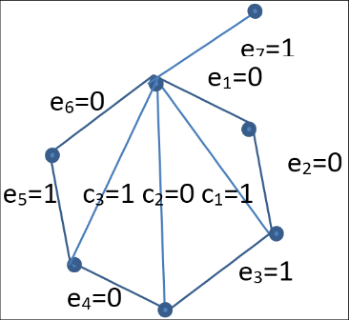
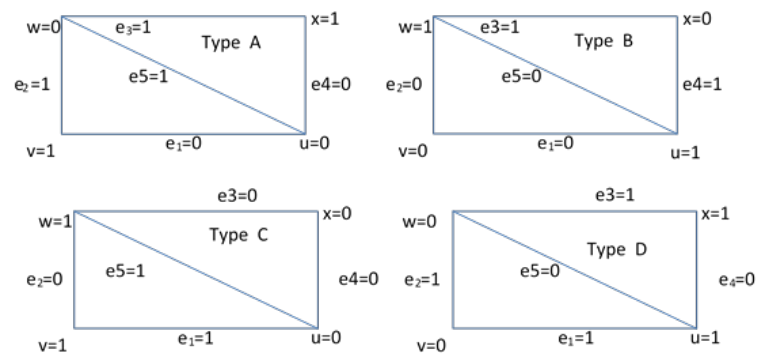
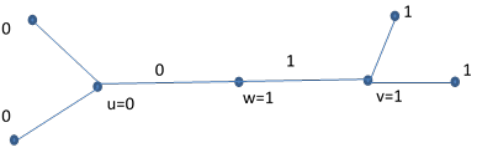
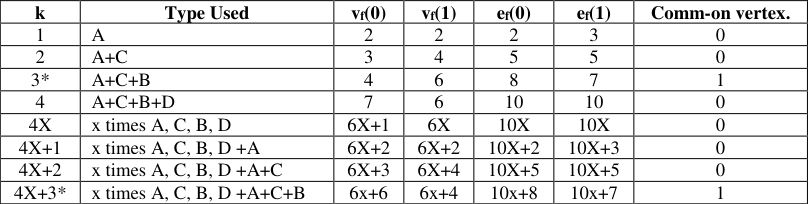
Proof: Ordinary names given to vertices are that u1 is the apex vertex and main cycle Cn of Sn is given by (u1, e1, u2, e2,.. en, u1). The chords are given by ci=(u1uj),i = j-2 and j = 3, 4,.., n-2. Define a function f;E→{0,1}by f(ei)=0 for i is a even number and f(ei)= 1 for i>1and is an odd number. f(e1)=0. The chords n-3 in number are labeled as f(ci) =1 for i is an odd number and f(ei) = 0 for i is an even number. The final vertex numbers distribution we get is vf(0, 1)=(x+1, x) for p≡1(mod 4) and vf(0, 1)= (x, x+1) for p≡3(mod 4). and edge numbers are ef(0, 1) = (n-1, n-1). The table 1 explains the construction of G from using different types (A, B, C, D) of labels and resultant vertex and edge distribution. Note that * in the first column indicate that for that value of k the graph is not E-cordial. The note made by Yilmaz and Cahit is also observed here, that for number of vertices congruent to 2(mod 4), the graph is not E-cordial. Label all the pendent vertices incident with u as 1 and that at v as 0.edge (uw) is labeled as 0 and edge (wv) as 1.

Table 1. explains labeling of (S4) (k)
kType Usedvf(0)vf(1)ef(0)ef(1)Comm-on vertex.
1A22230
2A+C34550
3*A+C+B46871
4A+C+B+D7610100
4Xx times A, C, B, D6X+16X10X10X0
4X+1x times A, C, B, D +A6X+26X+210X+210X+30
4X+2x times A, C, B, D +A+C6X+36X+410X+510X+50
4X+3*x times A, C, B, D +A+C+B6x+66x+410x+810x+71

Table text extracted from the original PDF; superscript letters are shown inline. The original table image is below.

View original table image
explains labeling of (S4) (k)↗ Enlarge
Table 1
explains labeling of (S4) (k)

explains labeling of (S4) (k)

Open full-size image ↗
Original paper tableSource PDF · page 2 ↗

The label numbers are given by: for n is even vf(0)=n+1 vf(1)= n on vertices. ef(0)=n = ef(1) on edges.

For n is odd, vf(0) = n, vf(1)= n+1 on vertices. ef(0)=n = ef(1) on edges. Thus G is E-cordial.

Theorem:

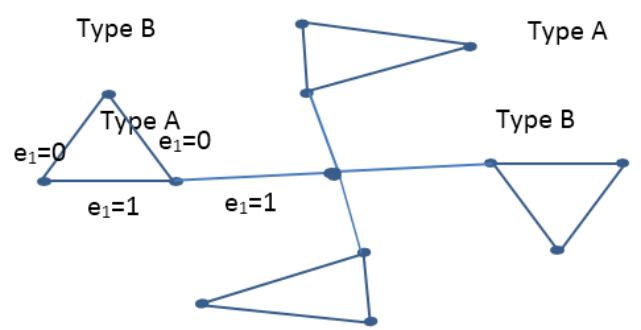
All three structures of G = (FL (C3)) (k) i.e. One point union of k-copies of FL( C3) is E-cordial except for 3k≡1(mod 4) Proof: There can be three distinct points on FL(C3)which are used in three cases to obtain one point union. These points on FL(C3) are i) pendent vertex ii) degree 2 vertex iii) degree 3 vertex. We discuss three cases separately. Case 1: The common point is pendent vertex u.

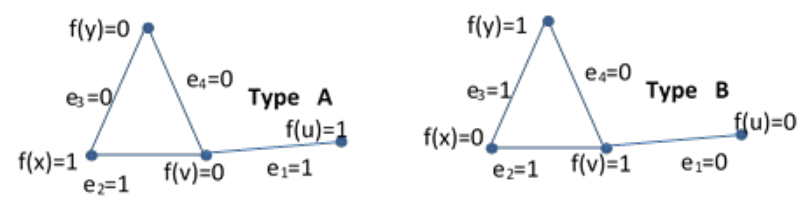
The union point is taken on pendent vertex of FL(C3).The i th copy of FL(C3) is defined as (u ei1 ui2 ei2 ui3 ei3 ui4 ei4 ui2) i =1,2, k. We use two type of labeling namely type A and Type B to design G. Fig. 4 gives details. The Edge distribution is always ef(0)=2k=ef(1) for every k.

Figure 4. Labeled copy of Type A and Type B. These are building blocks of G =
Labeled copy of Type A and Type B. These are building blocks of G =↗ Enlarge
Figure 4
Labeled copy of Type A and Type B. These are building blocks of G =

Labeled copy of Type A and Type B. These are building blocks of G =

Open full-size image ↗
Original paper figureSource PDF · page 3 ↗

The vertex distribution we have, (for k>4) For k ≡ 0(mod 4) we have vf(0)= 3k/2+1,vf(1)=vf(0)-1 For k ≡ 1(mod 4) vf(0)=(3k+1)/2; vf(1)=vf(0) For k ≡ 2(mod 4) vf(0)=3k/2; vf(1)=vf(0)+1 For k ≡ 3(mod 4) vf(0)=(3k+3)/2; vf(1)=vf(0)-2 Thus except for k ≡3(mod 4) we have G is Ecordial. This is equivalent to observation if n≡2 (mod 4) the graph is not E-cordial. Where n is number of vertices on graph and is given by 3k+1.

Figures and tables from the paper

Figure 1. FL(S6): E-cordial labeling
FL(S6): E-cordial labeling↗ Enlarge
Figure 1
FL(S6): E-cordial labeling

FL(S6): E-cordial labeling

Open full-size image ↗
Original paper figureSource PDF · page 2 ↗
Figure 2. Four types of labeled copies of S4
Four types of labeled copies of S4↗ Enlarge
Figure 2
Four types of labeled copies of S4

Four types of labeled copies of S4

Open full-size image ↗
Original paper figureSource PDF · page 2 ↗
Figure 3. (K1, 3:K1, 3) is E-cordial
(K1, 3:K1, 3) is E-cordial↗ Enlarge
Figure 3
(K1, 3:K1, 3) is E-cordial

(K1, 3:K1, 3) is E-cordial

Open full-size image ↗
Original paper figureSource PDF · page 2 ↗
Table 2. Type 1 structure. Note that * in the first column indicate that for that value of k the graph is not E-cordial.
kType of labelf(u). It is label of common vertexvf(0)vf(1)ef(0)=ef(1)
1A1222k
2A+B1342k
3*A+B+A0642k
4A+B+A+B1762k

Table text extracted from the original PDF; superscript letters are shown inline. The original table image is below.

View original table image
Type 1 structure. Note that * in the first column indicate that for that value of k the graph is not E-cordial.↗ Enlarge
Table 2
Type 1 structure. Note that * in the first column indicate that for that value of k the graph is not E-cordial.

Type 1 structure. Note that * in the first column indicate that for that value of k the graph is not E-cordial.

Open full-size image ↗
Original paper tableSource PDF · page 3 ↗
Figure 5. Pendent vertex is joined to obtain the structure
Pendent vertex is joined to obtain the structure↗ Enlarge
Figure 5
Pendent vertex is joined to obtain the structure

Pendent vertex is joined to obtain the structure

Open full-size image ↗
Original paper figureSource PDF · page 3 ↗
Figure 6. Case 2 G-unlabeled structure- not isomorphic to G in
Case 2 G-unlabeled structure- not isomorphic to G in↗ Enlarge
Figure 6
Case 2 G-unlabeled structure- not isomorphic to G in

Case 2 G-unlabeled structure- not isomorphic to G in

Open full-size image ↗
Original paper figureSource PDF · page 3 ↗
Figure 7. Case 3 G-unlabeled structure- not isomorphic to G in case 1and case 2.But E-cordial.
Case 3 G-unlabeled structure- not isomorphic to G in case 1and case 2.But E-cordial.↗ Enlarge
Figure 7
Case 3 G-unlabeled structure- not isomorphic to G in case 1and case 2.But E-cordial.

Case 3 G-unlabeled structure- not isomorphic to G in case 1and case 2.But E-cordial.

Open full-size image ↗
Original paper figureSource PDF · page 4 ↗
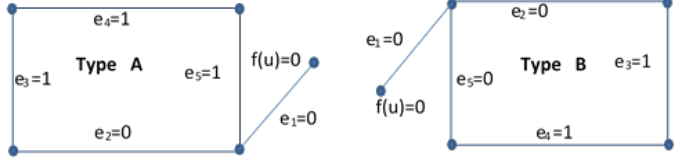
Figure 8. Type A and type B with Labels. Note in both types, vertex distribution is same. But edge distribution is different.
Type A and type B with Labels. Note in both types, vertex distribution is same. But edge distribution is different.↗ Enlarge
Figure 8
Type A and type B with Labels. Note in both types, vertex distribution is same. But edge distribution is different.

Type A and type B with Labels. Note in both types, vertex distribution is same. But edge distribution is different.

Open full-size image ↗
Original paper figureSource PDF · page 4 ↗

References

3 in the original paper
  1. Bapat MV. Ph. D. Thesis, University of Mumbai 2004.
  2. Gallian J. Electronic Journal of Graph Labeling (Dynamic survey). 2016.
  3. Yilmaz R, Cahit I. E-cordial graphs, Ars Combin. 1997; 46:251-266.