
Research article · 2019 · Full text
International Journal of Statistics and Applied MathematicsThree dimensional convective MHD flow and heat transfer in a porous medium
Volume 4(3) · Pages 47–53
Research areasNanofluid Flow and Heat TransferHeat and Mass Transfer in Porous MediaFluid Dynamics and Turbulent Flows
Abstract
Author-writtenThe effect of variation of suction velocity on the three dimensional convective flow and heat transfer through a porous medium under the influence of a uniform magnetic field perpendicular to the wall is investigated. A series expansion method is used for solving the governing equations and expressions for velocity and temperature distributions are obtained. The skin friction and the rate of heat transfer at the wall are discussed with the help of various graphs.
Summary
Source-checkedPlain-language reading of the full paper, prepared with AI and checked against the text. Each point links to the authors' own words.
Why it matters
- Laminarizing the boundary layer over a profile is important in aeronautical engineering because it reduces drag and significantly lowers vehicle power requirements. View evidence ↗
- Fluid suction and heat transfer from the wall boundary can prevent the transition from laminar to turbulent flow, which otherwise increases the drag coefficient. View evidence ↗
The question
- The study aims to investigate how variations in suction velocity affect three-dimensional convective flow and heat transfer in a porous medium when a uniform magnetic field is applied perpendicular to the wall. View evidence ↗
What they did
- The authors used a series expansion method to solve the governing equations and derive expressions for temperature and velocity distributions. View evidence ↗
- The model considers an incompressible viscous fluid flowing through a porous medium, bounded by an infinite vertical porous wall with a perpendicular uniform magnetic field. View evidence ↗
- The suction velocity at the wall is modeled as a basic steady distribution with a superposed weak transversally varying distribution. View evidence ↗
- Heat transfer at the wall is analyzed using the Nusselt number (Nu) to determine the heat transfer factor. View evidence ↗
What they found
- The skin friction factor (F) increases with the parameter R until it reaches a maximum, then decreases toward zero. View evidence ↗
- Increasing the permeability parameter K2 leads to a significant decrease in the skin friction factor (F). View evidence ↗
- When R approaches 0, the heat transfer factor H approaches 1, indicating the absence of oscillatory flow. View evidence ↗
- As R approaches infinity, the heat transfer factor H approaches 0, meaning heat transfer reaches a quasi-steady value. View evidence ↗
- For any given value of the Hartmann number (M), the heat transfer factor H increases as the permeability parameter K1 increases. View evidence ↗
What it means
- The authors conclude that the effects of suction velocity on skin friction and heat transfer can be characterized through the derived expressions and graphical analysis. View evidence ↗
Visual summary
1 visualsIllustrations explain the paper; they do not show study data.
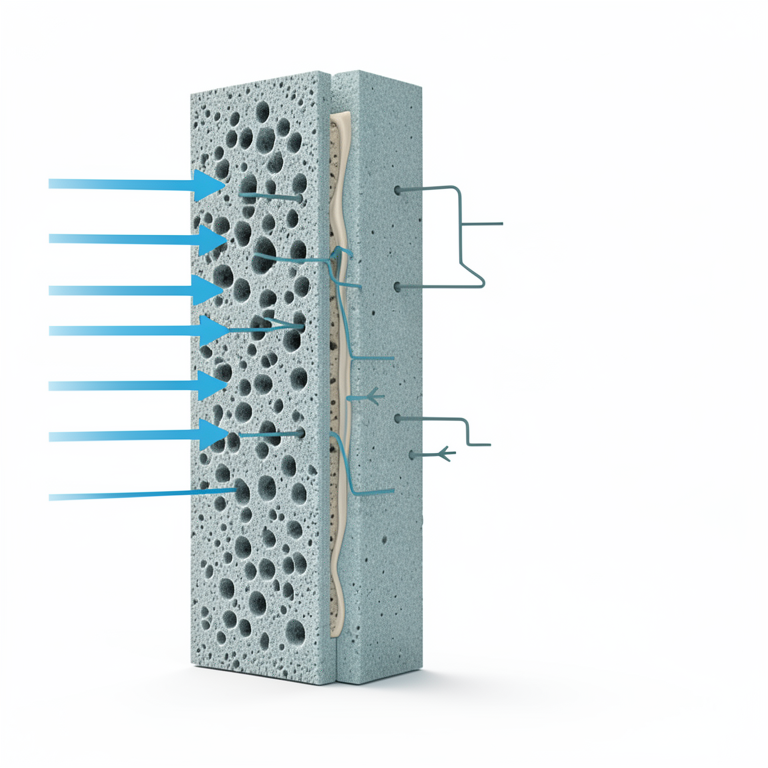
System Setup
AI-generated conceptual illustration (A vertical porous wall with fluid flow and a magnetic field). It explains the idea and does not show study data.
View source evidence ↗Figures & tables
From the original paper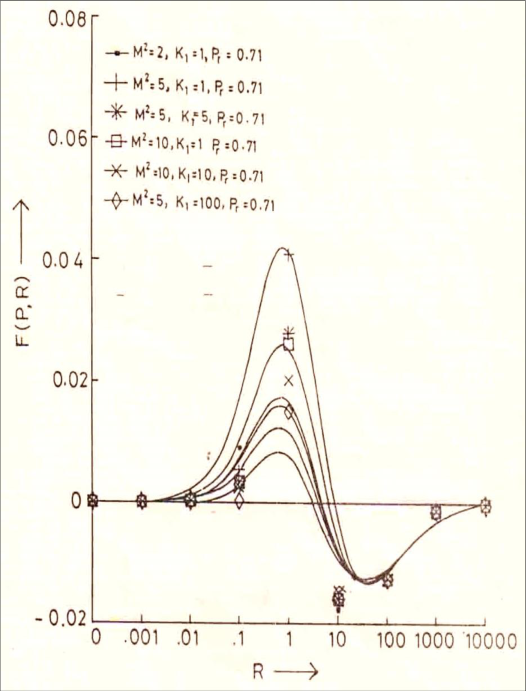 Figure 1
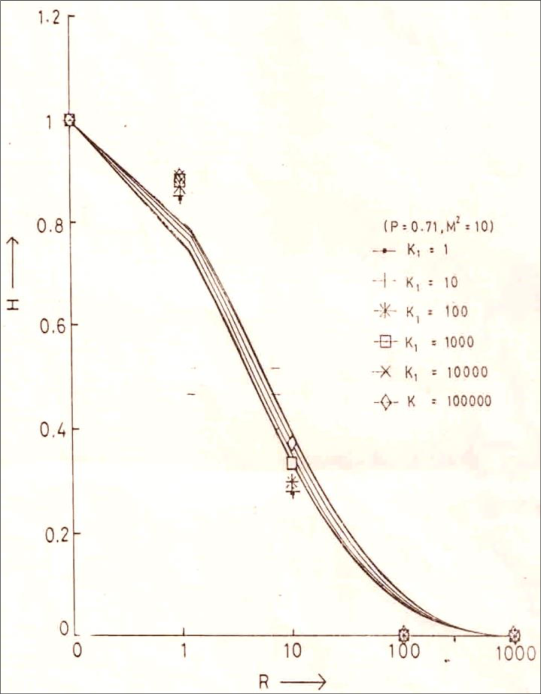 Fig. 2
Introduction
It is clear from the experimental and theoretical studies that the problem of laminar flow has gained considerable importance in the field of Aeronautical engineering in view of its applications that the 'laminarization' of the boundary layer over a profile reduces the drag and hence the vehicle power requirement is reduced by a very substantial amount. The development on this subject has been compiled by Lachman [2] . Theoretical & experimental investigations have shown that the transition from laminar to turbulent flow which causes the drag coefficient to increase, may be prevented by the suction of fluid and heat transfer from the boundary of the wall. Gersten and Gross [1] have studied the effect of transverse sinusoidal suction velocity on flow and heat transfer along an infinite vertical porous wall. Singh, Mishra and Narayan [3] discussed the effect of variation of suction velocity on the three dimensional free convective flow and heat transfer through a porous medium. P.K. Path et al. [4] discussed the effects of heat and mass transfer on three dimensional MHD free convective flow of a viscous incompressible fluid through a highly porosity medium with periodic permeability. T.S. Reddy et al. [5] discussed the effects of hall current, chemical reaction and radiation on a free convection flow bounded by a vertical surface embedded in porous medium under the influence of uniform magnetic field. The object of the present paper is to study the effect of variation of suction velocity on the three dimensional convective flow and heat transfer through a porous medium under the influence of a uniform magnetic field perpendicular to the wall. Because of its vast applications in engineering problems, a large number of researchers have contributed to the investigation in this area. The velocity field and temperature distribution are obtained. The skin friction and the rate of heat transfer at the wall are discussed in detail.
Formulation of the problem
Let us consider three dimensional convective flow of an incompressible viscous fluid through a porous medium bounded by an infinite vertical porous wall under the influence of a uniform magnetic field perpendicular to the wall. Let the wall be on x-z plane and y-axis be taken normal to the wall and directed into the fluid. The suction velocity distribution is taken in the form:
which consist of a basic steady distribution v 0 < 0 with a superposed weak transversally varying distribution 𝜀 v 0 cos (𝜋𝑧/𝐿) of wave length L. Every physical quantity is independent of x because the wall is infinite in x-direction. The flow always remains three dimensional due to the variation of suction velocity. Let u, v and w be the velocity components in x, y and z directions respectively, and T the temperature distribution. Since the physical variables are the function of y and z only, therefore, the flow is governed by the system of equations: Here the variation in density are neglected every where except in its association with the buoyancy force. The last term in equation ( 3) to (5) account for the pressure drop across the porous material. The term mu in equation (3) accounts for uniform magnetic field. The basic flow in the medium is entirely due to the buoyancy force, caused by temperature difference between the wall and the medium. The appropriate boundary conditions are given as:
Solution of the problem
If in the suction velocity the amplitude 𝜀 of oscillations is small then expanding the physical variables in the powers of 𝜀, we have:
where Q = (T -T∞) / (T w -T∞).
.. (9)
When 𝜀 = 0, then the problem reduces to the two dimensional MHD convection flow in an infinite porous medium with constant suction velocity at the wall. In this case the governing equations take the form: The boundary condition (15) reduces to
Solving equations ( 16) to (18) with the help of the boundary conditions (19), we get
Using the scheme of non dimensionalisation as already introduced and removing the bars over the physical quantities for convenience, the equations ( 23) to ( 27) reduce to:
The boundary condition reduces to
Now we are required to find the solutions of the above equations. Clearly the solutions for v 1 (𝑦,𝑧) and p 1 (𝑦,𝑧) are independent of the main flow component u 1 (𝑦,𝑧) and the temperature field, Q 1 . Hence we may assume that: where, prime denotes differentiation with respect to 𝑦. From these relations in dimensionless form and the governing equations (29) to (33), with the help of boundary conditions (34) we obtain: )
] /𝜆 The skin friction factor F(P, R) vanishes in the limiting case as R→ 0 and R→. This factor is numerically evaluated for different values of R and permeability parameters K 1 and K 2 . The results are shown graphically. From figure 1, it is clear that F tends to its limiting values as R→ 0 and R→, for each K 2 , also F increases with R and attains the maximum values, after which it decreases and approaches to zero. Also as the values of K 2 increases, F decreases significantly.
The heat flux at the wall in terms of Nusselt numbers Nu is given as: The heat transfer factor H(P, R) takes constant values for limiting values of R for all values of permeability parameter K 1 , H→ 1 and R→0 which shows that there is no oscillatory flow, and when R→, then H→0 which shows that the heat transfer approaches to quasi-steady value. These results are shown in Fig. 2. It is also observed that the value of H increases as the value of K 1 increases for each value of M.
References
5 in the original paper- Gersten K, Gross JF. Flow and Heat Transfer Along a plane wall with periodic suction. ZAMP Jour. Appl. Math. Phy. 1974; 25:399-408.
- Lackmann GV. Boundary Layer and Flow Control: Its Principles and Applications. Vol. I & II, Pergaman Press, 1981.
- Singh Mishra, Narayan. Indian Jour. Pure. Appl. Math. 1988; 19:1130-1135.
- Rath PK, Dash GC, Patra AK. Three dimensional MHD free convective flow with heat and mass transfer through a porous medium with periodic permeability and chemical reaction. Proc. of National Academy of Science. 2013; 83:105-114.
- Reddy TS, Reddy OSP, Raju MC, Varma SVK. MHD Freee convection Heat and mass transfer flow through a porous medium bounded by a vertical surface in presence of hall current. Advances in Applied Science Research. 2012; 3(6):34823490.