
Research article · 2018 · Full text
International Journal of Statistics and Applied MathematicsA hybrid approach for solving real life transportation problems using robust methods
Volume 3(1) · Pages 252–258
Research areasOptimization and Mathematical ProgrammingReligion and Sociopolitical Dynamics in Nigeria
Abstract
Author-writtenA lot of fundamentals are illustrated for resolving fuzzy transportation problem (FTP). But this present work define a crucial method for unfolding fuzzy FTP using robust technique to manifest the parameters by fuzzy numbers. As per literature it is little bit tough to limit the membership function to the normal form. In this paper, a new approach is illustrated for solving FTP using allocation table method (ATM) to determine the initial basic feasible solution. Moreover, a modified distribution method algorithm (MDMA) is proposed to optimize the best possible solution for real life fuzzy transportation problems. The minimal fuzzy transportation cost calculation has been represented with numerical examples.
Summary
Source-checkedPlain-language reading of the full paper, prepared with AI and checked against the text. Each point links to the authors' own words.
Why it matters
- Organizations in modern competitive markets are increasingly driven to find better mathematical and economic solutions to deliver more value to consumers. View evidence ↗
- There is a growing demand for efficient methods to transport bulk goods to consumers at the lowest possible cost. View evidence ↗
- Because real-world cost data is often imprecise due to unpredictable judgments or lack of proof, fuzzy numbers are used to represent this uncertainty. View evidence ↗
The question
- The study aims to define a method for solving fuzzy transportation problems (FTP) using robust techniques to handle parameters represented by fuzzy numbers. View evidence ↗
What they did
- The authors use an allocation table method (ATM) to establish the initial basic feasible solution for the transportation problem. View evidence ↗
- A modified distribution method algorithm (MDMA) is proposed to optimize the solution for real-life fuzzy transportation problems. View evidence ↗
- The method employs a robust ranking technique to convert fuzzy numbers into representative crisp values. View evidence ↗
- The proposed method is demonstrated using a numerical example involving three supply sources and three demand destinations. View evidence ↗
What they found
- In the provided numerical example, the problem was determined to be balanced with a total value of 125. View evidence ↗
- After applying the MDMA to optimize the solution, the optimal fuzzy transportation cost was reduced to 971.25 Rs. View evidence ↗
What it means
- The authors conclude that their hybrid approach is effective for real-life transportation problems because it can handle both triangular and trapezoidal fuzzy numbers. View evidence ↗
Visual summary
1 visualsIllustrations explain the paper; they do not show study data.
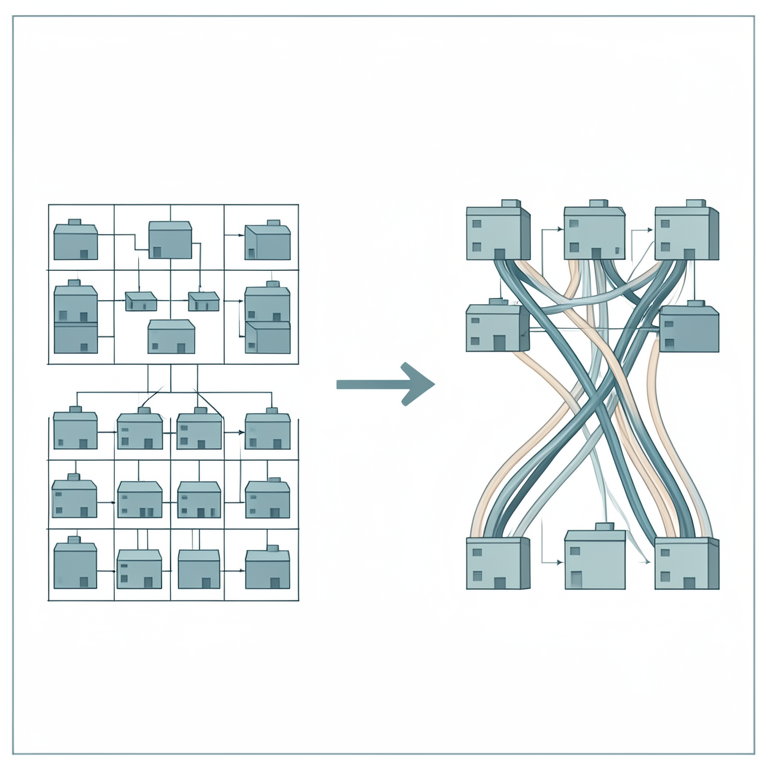
Hybrid Optimization Workflow
AI-generated conceptual illustration (A logistics network of warehouses and delivery destinations). It explains the idea and does not show study data.
View source evidence ↗Introduction
In modern competitive market either mathematics or economics, the thrust of organizations to achieve better solutions to generate and convey better values to consumers becomestronger. Transportation conceptsare a platform to deliver a Robust framework to meet the requirements. How and when to send the goods to the consumers in the bulk with cheap in cost manner, become more demanding. Hitchcock has illustrated this fundamental theory of transportation problems [1] . Fuzzy transportation problem is a singular type of linear programming problem (LPP) in which products are shifted from a set of origin point to the destinations w.r.t. the supply & demand [2] . There are two types of transportation problem known as balanced or unbalanced based on demand and supply which can be resolved by the simplex method. Further, Charnes & Cooper proposed the stepping stone concept which imparts an alternative way to determine the simplex method. Later in 1963, Dantzig and Thapa manipulated the simplex method to the FTP as the primitive simplex transportation method [3] . An initial basic feasible solution for FTP can be acquired by using the north-west corner concept, least cost concept and Vogel's approximation concepts. The MDMA is quite convenient method for getting the optimal solution for FTP. The transportation problem is unfolded with parameters like cost, supply as well as demand. The random information may be described by fuzzy (crisp values). Zimmermann, Oheigeartaigh, and Chanas [46] represented a LP model for resolving FTP with crisp cost coefficients as well as fuzzy demand-supply values. These crisp values may be normal, general, triangular & trapezoidal. Ranking method is applied to convert the fuzzy number into crisp form. In real world, there are various situations due to unpredictability in judgments, lack of proof etc. Although it is tough to reveal precise data for the cost parameter. Fuzzy number is used to represent this uncertain data. The main concern of FTP is to get the minimal transportation cost of some commodities through a capacitated network. Liu and Kao [7] denoted a technique for solving FTP based on extension principle. Later, a two stage cost minimizing FTP in which availability & requirements are trapezoidal fuzzy numbers. A parametric approximation is used to find a solution & to minimize transportation costs in the two levels. Dinagar and Palanivel [8] unveiled FTP for trapezoidal fuzzy numbers. Fuzzy MDMA is presented to achieve the optimum output in terms of fuzzy numbers. Solairaju and Natarajan [9] also proposed fuzzy zero point algorithm (FZPA) for trapezoidal fuzzy numbers in terms of cost, availability & requirement. Chen mentioned a point that it is quite though to restrict the membership function in general form, so he introduced a new concept of generalized numbers for FTP. In literature, it has been seen that normalization is used to convert general term into normal form which requires to solve real problem. Moreover, this process is mathematically correct but have some disadvantages in term of loss of information. There are a lot of research work in which generalized fuzzy numbers are utilized for resolving real situation but still having scope for solving the transportation problems. In this proposed work, the FTP solving method using robust ranking for the representative value of the fuzzy number. Further, we are using ATM by Ahmed in 2016 illustrated a new approach for FTP solution using ATM. This method also enhance optimality of MDMA. Furthermore, the concept is described with suitable mathematical example. In Section 2, operations of fuzzy number with some definitions on TrFN is unveiled. In Section 3, a concept to achieve initial basis feasible solution (IBFS) as well as optimal FTP solution is revealed. Section 4give mathematical examples to demonstrate the FTP solution. Lastly, Section 5 represents the conclusion.
Operations of Fuzzy Number
Definition 1: Let us say Z a nonempty set of universe. A fuzzy set f ) also define the membership function in following manner:
Definition 4:
A GFN f = , , , , is known to be a GTrFN (generalized trapezoidal fuzzy number) if its membership function is represented as
Robust Ranking Technique
Yager, in 1981 illustrated a concept known as robust ranking technique in a following manner:
Let us assume that f be a convex fuzzy no. & the Robust's ranking index is denoted as
Since by means of all above definitions 1-5 as well as ranking index relation we conclude eq. 1 such that
The proposed paper give R( f ) index as a representative value of fuzzy no. f . Likewise, for R( ~ij C ) index the fuzzy cost value is ~ij C .
Fuzzy Transportation Problem
Let us say, the mathematical fuzzy problem is
Where, Cij Unit cost of transportation from i th supply to j th demand. ZijQuantity transportation from i th supply to j th demand. σij Total items availability at i th supply point. δij Total items requirement at j th demand point.
Initial Basic Feasible Solution (IBFS) Algorithmic Steps using ATM 1. First, convert fuzzy LPP into fuzzy transportation table (FTT). The transportation cost to be put on the table allocation using Robust's ranking technique. 2. Second, check whether the given FTP is balanced or unbalanced. It should be balanced. 3. Third, Find minimum odd cost in FTT. If there does not exist odd cost in the FTT, every cells cost divide by 2 until reaches on atleast one odd value. 4. Fourth, Draw another table known as allocation table having the minimum odd cost and subtract selected minimum odd cost only from each of the odd cost valued cells of the FTT. 5. Fifth, Start with minimum odd cost in allocation table to exhaust the row(availability) or column(demand). 6. Sixth, Specify the least allocation cell cost and allocate minimum of availability/requirement at the place of selected allocation cell value in the allocation table. In case of similar allocation cell cost, select the allocation cell cost where minimum allocation can be made. 7. Repeat Step-6 as far as the requirement as well as availability are depleted. 8. At last, from the FTT, the total fuzzy transportation cost can be calculated.
Modified Distribution Method Algorithm (MDMA) for finding optimal solution
a. Compute IBFS by proposed allocation tabular method. b. Find Ai and Bj for all row and column which satisfy the following Ai+Bj=Cij, set A1=0. c. Get the improvement index value for all unoccupied cell by Eij Cij Ai Bj d. The Eijvalue decide the IBFS is optimal solution or not.
Case1: if Eij 0, for all unoccupied cell. IBFS solution is optimal. Case2: if Eij 0, for at least one unoccupied cell. IBFS solution is not optimal. e. Find out the unoccupied cell with high negative value of Eij. f. Then design the closed loop below. g. Starting this closed loop by choosing the empty cell and progress vertical and horizontal moves with corner cells occupied and come back to close the loop. "+" sign for empty cell and "-" for the non-empty cell. h. The minimum allocation value from the cells which have "-"sign. Then, assign this value to the empty cell and rest cell will be modified with their sign. i. These new values provide improved basic feasible solution. j. This process will be continued till Eij≥0 for all the empty cell.
Mathematical Problem
In this manner rest of the ranking index values can be calculated as follows: . Rs
To optimize this IBFS apply MDMA as discussed above in previous section.
Step 2: A1 B1 7.25, A1 B2 6.75, A1 B3 8 A2 B1 6.25, A3 B2 9.25 Let say A1=0, We get B1 7.25, B2 6.75, B3 8, A2 1, A3 2.5
Step 3: Now, improvement index for every unused cell Step 4: Since one of the indices is not positive i.e. solution is not optimal. Thus, it is requires to draw one closed path.
Step 5: Find out the unoccupied cell with high negative value of Eij. So E31 2.25.
After repeating all above described steps we get E22 E23 E33 0. Therefore optimal fuzzy solution is 12 y =10, 13 y =25, 21 y =40, 31 y =5 and 32 y =45. Hence, the given allocation provides optimal fuzzy transportation cost. It is given by: 6.75 * 5 8 * 25 6.25 * 40 7.5 * 5 9.25 * 45 971.25 Rs.
Conclusion
In this paper, the transportation costs are considered as generalized fuzzy numbers. Mathematical formulation of FTP is explainedby suitable numerical example. In this present work, the allocation tabular concept is proposed to find initial basic feasible solution for FTP. It is noticeable with the help of ϒ-level cut set & Robust's ranking method for the representative value of the fuzzy no. based on requirement and availability are real numbers.Moreover, the cost is available by means of trapezoidal fuzzy numbers. Furthermore, MDMA is used to improve IBFS to reach optimality.Since, these methods are quite interesting for solving the real-life transportation problem as they solve triangular and trapezoidal fuzzy number.
References
14 in the original paper- Hitchcock FL. The distribution of a product from several sources to numerous localities. J Math. Phys. 1951; 20:224-230.
- Charnes A, Cooper WW. The stepping-stone method for explaining linear programming calculation in transportation problem, Management Science. 1954, 49-69.
- Dantzig GB, Thapa MN. Springer: Linear Programming: 2: Theory and Extensions", Princeton University Press, New Jersey, 1963.
- Zimmermann HJ. Fuzzy programming and linear programming with several objective functions Fuzzy Sets Syst. 1978; 1:4555.
- Oheigeartaigh M. A fuzzy transportation algorithm", Fuzzy Sets System. 1982; 8:235-243.
- Chanas S, Kolodziejckzy W, Machaj AA. A fuzzy approach to the transportation problem", Fuzzy Sets System. 1982, 1984; 13:211-221.
- Liu ST, Kao C. Solving fuzzy transportation problems based on extension principle", European J. Oper. Res. 2004; 153:661674.
- Dinagar DS, Palanivel K. The transportation problem in fuzzy environment", International Journal of Algorithms Computing and Mathematics. 2009; 2:65-71.
- Nagarajan R, Solairaju A. Computing improved fuzzy optimal hungarian assignment problem with fuzzy costs under Robust ranking techniques. International Journal of Computer Applications. 2010; 6:6-13.
- Mohanaselvi S, Ganesan K. Fuzzy Optimal Solution to Fuzzy Transportation Problem: A New Approach. International Journal of Computer Science and Engineering. 2012; 4(3):367-375.
- Kaur A, Kumar A. A new approach for solving fuzzy transportation problems using generalized trapezoidal fuzzy numbers. Applied Soft Computing. 2012; 12:1201-1213.
- Shanmugasudari M, Ganesan K. A Novel Approach for the Fuzzy optimal solution of Fuzzy Transportation", International Journal of Engineering Research and Applications. 2013; 3(1):1416-1424.
- Srinivas B, Ganesan G. Optimal solution for intuitionistic fuzzy transportation problem via revised distribution method. International Journal of Mathematics Tends and Technology. 2013, 2015; 19:150-161.
- Ramanuja Rao K, Rajnesh Mudaliar K. A perfect Mathematical Formulation of Fuzzy Transportation Problem Provides an Optimal Solution Speedily, Asia-Pacific World Congress on Computer Science and Engineering. 2016, 271-278.