
Research article · 2019 · Full text
International Journal of Statistics and Applied MathematicsIntuitionistic fuzzy technique to find the critical path
Volume 4(3) · Pages 39–42
Research areasMulti-Criteria Decision Making
Abstract
Author-writtenIn this paper, intuitionistic fuzzy number has been applied to find the critical path for the project scheduling problems with the aid of interval valid intuitionistic fuzzy numbers (IVIFN). Decision maker’s risk attitude index and decision maker’s risk index ranking value has also been utilized to find the critical path. In order to explain intuitionistic fuzzy technique to find critical path, numerical example has been illustrated in this paper.
Summary
Source-checkedPlain-language reading of the full paper, prepared with AI and checked against the text. Each point links to the authors' own words.
Why it matters
- Network diagrams are essential tools for organizing project execution and determining the time required for completion. View evidence ↗
- Real-world project scheduling often involves vagueness caused by factors such as distorted due dates, unavailable capital, or weather impediments. View evidence ↗
- Fuzzy set theory is useful for managing the ambiguity associated with the duration of activities within a project network. View evidence ↗
The question
- The study aims to apply intuitionistic fuzzy numbers, specifically interval valid intuitionistic fuzzy numbers (IVIFN), to identify the critical path in project scheduling problems. View evidence ↗
What they did
- The method incorporates the decision maker's risk attitude index and risk index ranking value to determine the critical path. View evidence ↗
- The approach utilizes trapezoidal intuitionistic fuzzy numbers, which are defined by both membership and non-membership functions. View evidence ↗
- The proposed algorithm involves identifying activities, establishing precedence, estimating fuzzy activity times, calculating earliest start times (EST) and latest finish times (LFT), and determining total slack (TS) to find the critical path. View evidence ↗
- The technique was demonstrated using a hypothetical project network consisting of four nodes (N={1,2,3,4}) with specific fuzzy activity times. View evidence ↗
What they found
- In the numerical example, the critical path for both the membership and non-membership functions was identified as 1 → 3 → 4. View evidence ↗
- For the critical path 1 → 3 → 4, the rank values were 0.4953 for the membership function and 0.4318 for the non-membership function. View evidence ↗
- The path 1 → 2 → 4 had higher rank values (0.5606 for membership and 0.5827 for non-membership) compared to the critical path. View evidence ↗
- The path 1 → 2 → 3 → 4 resulted in rank values of 0.5360 for membership and 0.4487 for non-membership, placing it between the other two paths in rank. View evidence ↗
What it means
- The authors conclude that intuitionistic fuzzy numbers, combined with the decision maker's risk attitude and ranking values, can be effectively used to find the critical (shortest) path in project scheduling. View evidence ↗
Visual summary
2 visualsIllustrations explain the paper; charts are replotted from the paper's own table values.
Algorithm Workflow
AI-generated conceptual illustration (A network diagram of interconnected nodes and paths). It explains the idea and does not show study data.
View source evidence ↗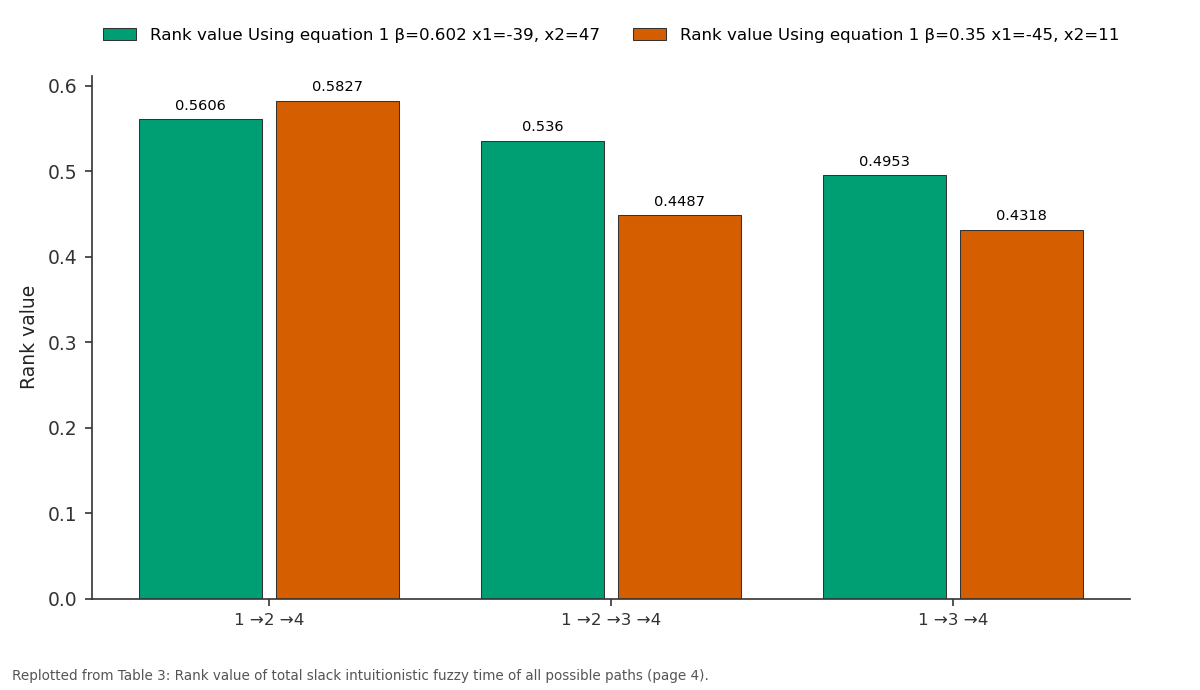
Rank value Using equation 1 β=0.602 x1=-39... and Rank value Using equation 1 β=0.35 x1=-45...: 1 →2 →4 vs 1 →2 →3 →4 vs 1 →3 →4
Replotted from Table 3 (page 4) of the original paper. Every bar is the paper's own table value.
View source evidence ↗Figures & tables
From the original paper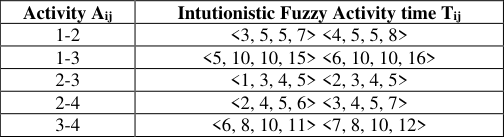 Table 1
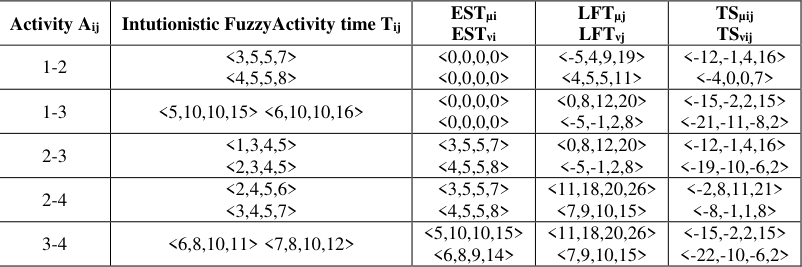 Table 2
 Table 3
Introduction
A constructed network is an imperative tool in the development, and it organizes a definite project execution. Network diagram plays a vital role in formative project-completion time. In real life situation, vagueness may arise from a number of possible sources like: due date may be distorted, capital may unavailable, weather situation may root several impediments. Therefore, the fuzzy set theory can play a significant role in this kind of problems to handle the ambiguity about the time duration of deeds in a project network. Fuzzy set theory as developed by Zadeh [11] and the concept of fuzzy numbers presented by Dubois and Prade [4] are applied to present a fuzzily defined system. Chanas and Zielinski [12] proposed a method to make critical path analysis in the network with fuzzy activity times (interval activity times, fuzzy numbers of L-R type) by directly applying the extension principle [11] to the classical criticality notion treated as a function of activity duration time in the network. And two methods of calculation of the path degree of criticality are presented. Slyeptsov and Tyshchuk [13] presented an efficient method of computation of fuzzy time windows for late start and finish times of operations in the problem of fuzzy network. G. Liang and T.C. Han [6] proposed a fuzzy critical path for project networks. Elizabeth and L. Sujatha [5] discussed a critical path problem under fuzzy Environment. C.T Chen and S.F Huang [2] proposed a new model that combines fuzzy set theory with the PERT technique to determine the critical degrees of activities and paths, latest and earliest starting time and floats. S.H. Nasution [8] proposed a fuzzy critical path method by considering interactive fuzzy subtraction and by observing that only the non-negative part of the fuzzy numbers can have physical work. Basic definitions of intuitionistic fuzzy set theory have been reviewed. K.Atanassov [1] proposed a procedure to find out the intuitionistic fuzzy critical path using an illustrative example. The results are discussed. Finally, some conclusions are drawn.
Preliminaries 2.1 Definition: Fuzzy Set
Let X be the universal set A fuzzy set A in X represented by A={(𝑥, 𝜇 𝐴 (𝑥))/𝑥𝜀𝑋},where the function𝜇 𝐴 (𝑥):X→ [0,1] is the membership degree of element x in the fuzzy set A.
Definition: Intuitionistic Fuzzy Set
Let X be an Universe of discourse, then an Intuitionistic Fuzzy Set (IFS) A in X is given by A={(𝑥, 𝜇 𝐴 (𝑥), 𝜐 𝐴 (𝑥))/𝑥𝜀𝑋},where the function 𝜇 𝐴 (𝑥):X→ [0,1] and 𝜐 𝐴 (𝑥):X→ [0,1] determine the degree of membership and non-membership of the element𝑥𝜀𝑋, respectively and for every 𝑥𝜀𝑋,0 ≤ 𝜇 𝐴 (𝑥) + 𝜐 𝐴 (𝑥) ≤ 1.
Definition: Intuitionistic Fuzzy Number
An IFN A is An IF subset of the real line. Normal ie, there is an 𝑥 0 𝜀𝑅such that 𝜇 𝐴 (𝑥 0 ) =1 (so 𝜐 𝐴 (𝑥 0 ) =0). Convex for the Membership function 𝜇 𝐴 (𝑥). ie, 𝜇 𝐴 (𝜆𝑥 1 + (1 -𝜆)𝑥 2 ) ≥ 𝑚𝑖𝑛( 𝜇 𝐴 (𝑥 1 ), 𝜇 𝐴 (𝑥 2 )) for every 𝑥 1 , 𝑥 2 𝜀𝑅, 𝜆𝜀[0,1]. Concave for the non-membership function ie 𝜐 𝐴 (𝜆𝑥 1 + (1 -𝜆)𝑥 2 ) ≤ 𝑚𝑎𝑥( 𝜐 𝐴 (𝑥 1 ), 𝜐 𝐴 (𝑥 2 )) for every 𝑥 1 , 𝑥 2 𝜀𝑅, 𝜆𝜀[0,1].
Definition: Trapezoidal Intuitionistic Fuzzy Number
An Intuitionistic Fuzzy Number 𝐴 = {< 𝑎, 𝑏, 𝑐, 𝑑 >< 𝑎 ′ , 𝑏 ′ , 𝑐 ′ , 𝑑 ′ >}is said to be a trapezoidal intuitionistic fuzzy number if its membership function and non-membership function are given by
Definition: Algebraic Operations of any Two Trapezoidal Intuitionistic Fuzzy Number Addition
Definition: Algebraic Operations of any Two Trapezoidal Intuitionistic Fuzzy Number Addition
Definition: Decision Maker's Risk Attitude Index
For an Intuitionistic fuzzy critical path analysis problem [14] , using the Trapezoidal Intuitionistic fuzzy numbers such as 𝑇 𝑖𝑗 =< 𝑎 𝑖𝑗 , 𝑏 𝑖𝑗 𝑐 𝑖𝑗 , 𝑑 𝑖𝑗 > to denote the intuitionistic fuzzy activity time of activity 𝐴 𝑖𝑗 the decision maker's risk attitude index 𝛽can be obtained by
where ACT and t denote the set of all actives and the number of actives in a project network, respectively.
Definition: Decision Maker's Risk Index Ranking Value
The ranking value 𝑅(𝐴 𝑖 ) of the trapezoidal intuitionistic fuzzy number 𝐴 𝑖 can be obtained as follows:
𝑅(𝐴 𝑖 ) = 𝛽[(𝑑 𝑖 -𝑥 1 )/(𝑥 2 -𝑥 1 -𝑐 𝑖 + 𝑑 𝑖 )] + (1 -𝛽){1 -[(𝑥 2 -𝑎 𝑖 )/(𝑥 2 -𝑥 1 + 𝑏 𝑖 -𝑎 𝑖 )]}. . . . . . . . . . . . (2) Where 𝛽is the decision maker's risk attitude index, 𝑥 1 = 𝑚𝑖𝑛{ 𝑎 1 , 𝑎 2, . . . . . . , 𝑎 𝑛 } and 𝑥 2 = 𝑚𝑎𝑥{ 𝑑 1 , 𝑑 2, . . . . . . , 𝑑 𝑛 }
Definition: Rules for Ranking Trapezoidal Intuitionistic Fuzzy Number
Now, we rank the intuitionistic fuzzy numbers 𝐴 𝑖 and 𝐴 𝑗 according to the following rules [9] :
Definition: An Intuitionistic Fuzzy Completion Time
Assume that there exists a path P c in a project network such that IFCPM(P c )=min{IFCPM(P i )/𝑃 𝑖 𝜀𝑃} then the path P c is an intuitionistic fuzzy critical path.
Intuitionistic fuzzy critical path analysis 3.1 Notation
Intuitionistic fuzzy critical path analysis 3.1 Notation
N :
The set of all nodes in a project network. A ij : The activity between nodes i and j. 𝑇 𝜇𝑖𝑗 , 𝑇 𝜐𝑖𝑗 : The intuitionistic fuzzy activity time for membership function and non-membership function.
Figures and tables from the paper
| Activity Aij | Intutionistic Fuzzy Activity time Tij |
|---|---|
| 1-2 | <3, 5, 5, 7> <4, 5, 5, 8> |
| 1-3 | <5, 10, 10, 15> <6, 10, 10, 16> |
| 2-3 | <1, 3, 4, 5> <2, 3, 4, 5> |
| 2-4 | <2, 4, 5, 6> <3, 4, 5, 7> |
| 3-4 | <6, 8, 10, 11> <7, 8, 10, 12> |
Table text extracted from the original PDF; superscript letters are shown inline. The original table image is below.
View original table image
| Paths | IFCP(Pµk) K=1–m | Rank value Using equation 1 β=0.602 x1=-39, x2=47 | Rank | IFCP(Pνk) K=1-m | Rank value Using equation 1 β=0.35 x1=-45, x2=11 | Rank |
|---|---|---|---|---|---|---|
| 1 →2 →4 | <-14,7,15,37> | 0.5606 | III | <-26,-10,-6,9> | 0.5827 | III |
| 1 →2 →3 →4 | <-39,-4,10,47> | 0.5360 | II | <-45,-20,-12,11> | 0.4487 | II |
| 1 →3 →4 | <-30,-4,4,30> | 0.4953 | I | <-43,-21,-14,4> | 0.4318 | I |
Table text extracted from the original PDF; superscript letters are shown inline. The original table image is below.
View original table image
References
14 in the original paper- Atanassov K. Intuitionistic Fuzzy sets, and systems. 1986; 20(1):87-96.
- Chen CT, Huang SF. Applying fuzzy methods for measuring criticality in project network, Information sciences. 2007; 177:2448-2458.
- Chanas SP, Zielinski. Critical Path analysis in the Network with Fuzzy Activity Times, Fuzzy sets and Systems. 2001; 122:195-204.
- Dubois D, Prade H. Possibility Theory: An Approach to Computerized Processing of Uncertainty, New York: Plenum, 1988.
- Elizabeth S, Sujatha L. Fuzzy Critical Path Problem for Project Network. International Journal of Pure and Applied Mathematics. 2013; 85(2):223-240.
- Liang GS, Han TC. Fuzzy Critical Path for Project Network, Information and Management Sciences. 2004; 15(4):29-40.
- Mahdavi I, Nourifar R, Heidarzade A, Amiri NM. A Dynamic Programming Approach for Finding Shortest Chains in Fuzzy Network, Applied Soft Computing. 2009; 9(2):502-511.
- Nasution SH. Fuzzy critical path method, IEEE Trans. Systems ManCyber net. 1994; 24:48-57.
- Salim Rezvani. Ranking method of Trapezoidal Intuitionistic Fuzzy, Annals of Fuzzy Mathematics and Informatics. 2013; 5(3):515-523.
- Slyeptsov AI, Tyshchuk TA. Fuzzy Critical Path Method for Project Network Planning and Control, Cyber net. System Anal. 1997; 3:158-170.
- Zadeh LA. Fuzzy sets, Information and control. 1965; 8:138-353.
- Chanas S, Zielinski P. Critical path analysis in the network with fuzzy activity times, Fuzzy Sets and Systems. 2001; 122:195-204.
- Slyeptsov AI, Tyshchuk TA. A method of computation of characteristics of operations in a problem of fuzzy network, Cybernetics and Planning and Management System Analysis. 2003; 39(3):367-378.
- Jayagowri P, Geetharamani G. A Critical Path Problem Using Intuitionistic Trapezoidal Fuzzy Number, Applied Mathematical Sciences. 2014; 8(52):2555-2562.
Cited by 2
From OpenAlex, OpenCitations and reference lists read by Scinovex
- Optimization Algorithms of PERT/CPM Network Diagrams in Linear Diophantine Fuzzy Environment ↗
M. Parimala, Karthikeyan Prakash, Ashraf Al-Quran, Muhammad Riaz, Saeid Jafari · Computer Modeling in Engineering & Sciences · 2023
The idea of linear Diophantine fuzzy set (LDFS) theory with its control parameters is a strong model for machine learning and optimization under uncertainty. The activity times in the critical path method (CPM) representation procedures approach are initially static, but in the Project Evaluation and Review Technique (PERT) approach, they are probabilistic. This study proposes a novel way of project…
❝ 6PDF - A Study on Intuitionistic Fuzzy Critical Path Problems Through Centroid Based Ranking Method ↗
T. Yogashanthi, Shakeela Sathish, K. Ganesan · Mathematics and Statistics · 2022
In this study the intuitionistic fuzzy version of the critical path method has been proposed to solve networking problems with uncertain activity durations. Intuitionistic fuzzy set [1] is an extension of fuzzy set theory [2] unlike fuzzy set, it focuses on degree of belonging, the degree of nonbelonging or non-membership function and the degree of hesitancy which helps the decision…
❝ 2PDF