
Research article · 2020 · Full text
International Journal of Geography Geology and EnvironmentRock magnetic properties of enderbites in Gaisin Block of Ukrainian Shield
Volume 2(2) · Pages 23–28
Research areasMining and Gasification TechnologiesGeotechnical and Geomechanical EngineeringGeological Studies and Exploration
Abstract
Author-writtenThe actual problems of detail studying of geological structures of the Ukrainian Precambrian Shield (US) were used. The aim of the work was to verify the possibility maping of xenolites of enderbytes of the abnormal magnetic field. The magnetic susceptibility Curie points of feromagnetic minerals and other properties of enderbytes were investigated. It is shown that the studies enderbites not create high positive anomalies of the magnetic field, and are actually "dumb" in the anomalous magnetic field. On the prospect of suggested further study of those areas where high positive magnetic field anomalies coincide with places spread enderbite.
Summary
Source-checkedPlain-language reading of the full paper, prepared with AI and checked against the text. Each point links to the authors' own words.
Why it matters
- Studying the magnetic properties of enderbites is essential for understanding Precambrian rocks, which represent the initial formation of the Earth's crust. View evidence ↗
- Much of the Precambrian basement of the Ukrainian Shield is difficult to map because it is covered by layers of sandstone, clay, and chalk. View evidence ↗
- Geologists typically identify the Precambrian basement by analyzing gravitational anomalies and abnormal magnetic field induction. View evidence ↗
The question
- The study aimed to determine if xenolites of enderbytes could be mapped using abnormal magnetic fields. View evidence ↗
What they did
- The authors employed a new complex petro-magnetic method called magnetic scanning (MMS) to investigate the rock exposures. View evidence ↗
What they found
- The majority of enderbyte samples (80%, or 43 out of 54) exhibited low magnetic susceptibility between 0 and 12·10-3 u.SI, suggesting a low magnetite content. View evidence ↗
- While most values were low, some points showed MS in the 40-50·10-3 u.SI range, and only three out of 620 measured points reached very high values of 70-75·10-3 u.SI. View evidence ↗
- Thermomagnetic curves and ore microscopy confirmed the presence of pyrrhotite (pirotine), indicated by a sharp fall in the MSi/MS1 curve after heating to 380 °C. View evidence ↗
- Enderbites have a higher density (2.67 to 2.77 g/cm³) compared to pink granite (2.6 g/cm³), which may cause positive gravitational anomalies. View evidence ↗
- The study found that enderbites are unable to create high positive magnetic field anomalies. View evidence ↗
What it means
- The authors conclude that enderbites in the Gaisin Block are weak-magnetic rocks containing magnetite and pyrrhotite. View evidence ↗
Figures & tables
From the original paper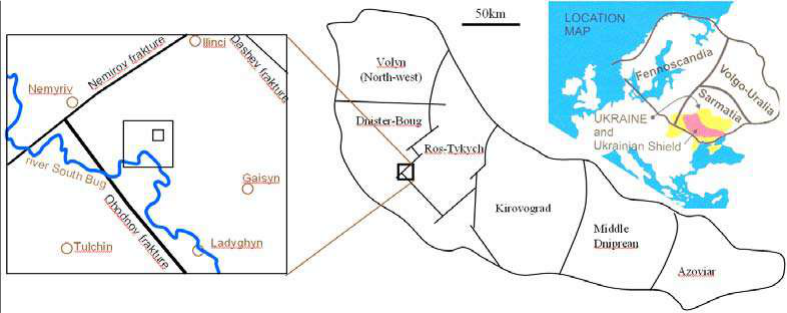 Figure 1
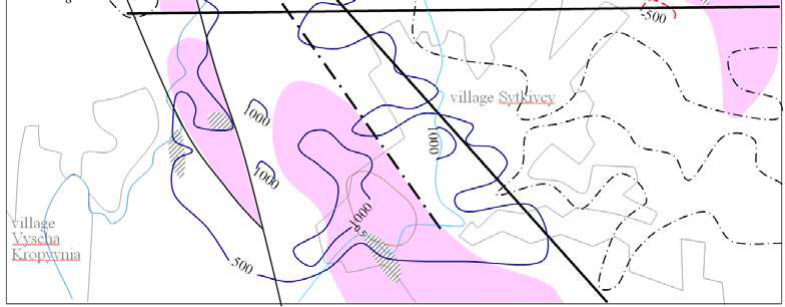 Figure 2
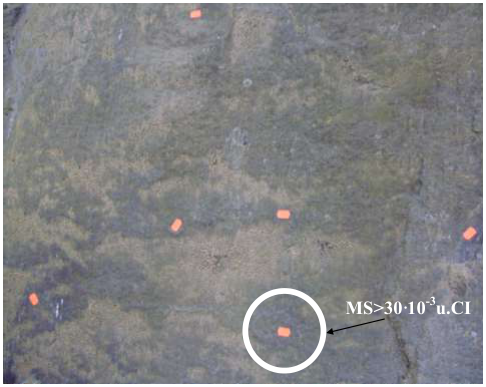 Figure 4
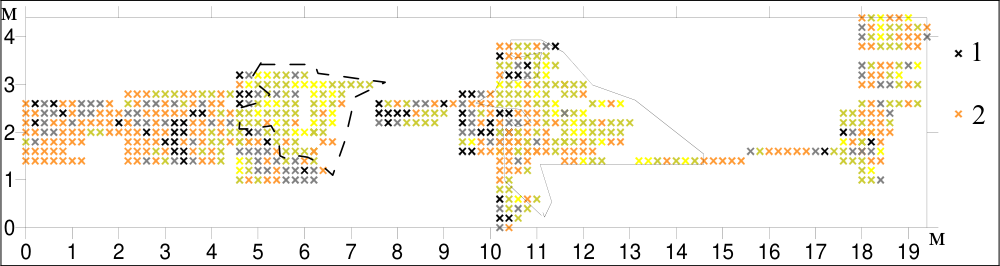 Figure 3
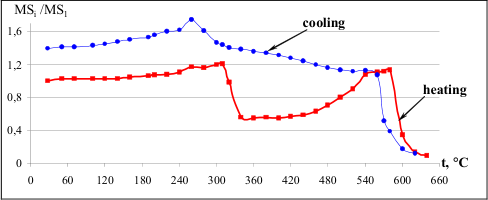 Figure 5
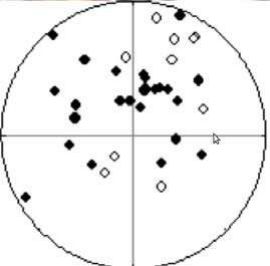 Figure 6
Introduction
In expositions of Ukrainian Precambrian Shield (US) due to magnitometric methods during state geological testing in 1960-1980 years were practically not investigated. Now, an actual problem of geological re-carting of US our government is declared [7] . The investigation of the US with new metods besid on more detailed and complexs geology-geopthysical become actual. In this article athtors new detalin commplexs magnitometric metods [metod MMS] are used fo investigation xenolites of the enderbytes. The basic question of article is how enderbytes are sited in Gaisin block of US (along rivers Southern Boug). It is known [31] because rocks in Gaisin block were cardinally changed during metamorphism but enderbytes is very ancient rocks that weren't changed. Therefore, studying of enderbytes magnetic properties is important for fundamental investigation of Precambrian rocks -that is result of appearance and the first formation of the Earth's crust. The rocks in the US are mixed in a difficult correlation with each other. Is very difficult to set on map the boundaries of various rocks, because they very rarely come to the surface and are almost invisible. Almost all Precambrian basement of US is hidden and covered by layers of chalk, clay, sandstone. The geologists-cartographs detected the Precambrian basement thorough abnormal magnetic field induction and gravitational anomalies analised. Sediments rocks hasn't many magnetite minerals, therefore their rocks do not produced anomalies of magnetic field. But the different granits of US can has a different numbers of ferromagnetic minerals and formed different intensive magnetic field anomalies. The old methods for interpretation adnormal magnetic field are used different petrografic groups it has some magnetic properties of samples for all area. Today, investigation samples with concretic exposures (different petrografic composition) in complex with observation magnetic field in this territory [complex metod] and this material are used for complex geological analis of adnormal magnetic field. Unchanged enderbytes xenolites in Gaisin block are present conserved. Enderbyte consists practically from all granite-forming minerals. There are a quartz, hyperstene, biotite and feldspar. The difference is in content of feldspar -in enderbyte he not consist kaly K. This is formad green-gray colour enderbyte, whenever granites are gray or pink. Enderbyte has unique macrostructures [8,34] .
Material and Methods
Study area. In this article investigation area in the US Ros-Tykych megablock in the Uman smoll blockes in the Gaisin very smoll blockes. Gaisin blockes betwin Gayvoron and Podol block (parts of Dnistrovo-Bug megablock). Nemirov and Obodnov fractures Gaisin from Podol block is separed. Dashev fracture Gaisin from all other Uman block is separated.
Dashev fracture Gaisin from all other Uman block is separated (Figure 1). Gaisin block consists of unique composite rocks, it is the Gaisin complex [30,31] . Gaisin complex it is wery motley becous plagio-granits and grano-diorites is alternated in one metrs and contains xenolites of gneis, kristal slate, enderbyte. Xenolites of enderbyte is unique rocks in Gaisin complex. On all territory of Gaisin block is one exposure of enderbytes. Enderbytes exposure located on board of river Gorodishe (to north of the village Sytkivci, Vinniza region of Ukraine, coordinates latitude 48 55 42.01 N, longitude 29 11 30.51 E). It exposure of enderbytes in this article is investigated. The enderbytes exposure located on Sutkivci territory geological maping. Katuk and all Sutkivcy territory were geological investigated and created geological map in scale 1:10000 [4] . We geological map with magnetic anomalies field map are combined (Figure 2). On figure 2 we can see then big xenolites of enderbytes are sited on differet anomalies magnetic field where there is high T (up to 1500 nTl) and low T (-500 nTl). Thus, according [4], the source of negative and positive anomalies of magnetic field are same enerbytes. Therefore is actual to study the magnetic properties of enderbytes to determined the nature of such ambiguity reflected in the abnormal magnetic field. Methodology. In this work the autors new complexing detalisated magnitometric method is using by enderbytes investigation. It is method of magnetic scanning (MMS) which let use a new possibilities of mapping for highdifferenciated sectors of precamdrian basement. Magnetic Scanning -it is a complex petro-magnetic method of detail investigation of rocks exposures as we described earlier [920] . In this method, laboratoric and "in field" magnetometric investigations are carried out in direct interrelation with each other. At the first stage authors analyzed and correlations "magnetic field -geological structure" appears. At the second stage, magnetometric investigations "in field" are carried out. The detailed measuring of magnetic susceptibility MS were executed by capameter KT-5 (Czech production). The modern counterparts of KT-5 is KT-9. The templates of rose granites and enderbytes were selected. The magnetic susceptibility of their templates were measured on astatic laboratory magnetometer LAM-24 (Czech production). The principle of the sensor is a magnetic field of pattern shifts magnets of astatic system from the equilibrium. It is need to measure in 12 direction and how much deviated astatic system. These measurements allow to calculate the value of the natural remanent magnetization of the sample, its magnetic susceptibility and orientation of remanent magnetization vector. The magnetic minerals in rocks are definite by thermomagnetic analysis. It consists in consequent measuring of magnetic susceptibility MS of heated template. The laboratoric magnetometer KLY-2 fixes a change MS of sample which heated in an oven. The modern counterparts of KLY-2 is MFK1 Kappabridges of compani AGICO.
The density of sample was measured by method of hydrostatic gravimetry. The dynamic of change of magnetic minerals was investigated by rock microscopy.
Results and discussion
Over enderbytes exposure on the board of river Gorodishe T =-351 nTl. We MS of enderbytes on exposure were observed. 80% of MS numbers is small 0-12•10 -3 u.SI (fig. 3). It isn't big for granitoides of Gaisin complexes.
(Then we were investigated other granitoid exposures near enderbytes exposure we were indentified pink grenites with small MS <10•10 -3 u.SI and migmatites with big MS > 30•10 -3 u.SI.) Some big MS in the range 40-50•10 -3 u.SI interspersed in the total weight with low values of MS 0-12•10 -3 u.SI. It big MS found on the exposure is not regularly (Figure 4). This can be explained by nothomogenous distribution of magnetite that have a several agglomerates in the enderbyte. The curve MSi/MS1 falls sharply after heating to 380 0 C indicating the presence pirotine. Ore microscopy revealed the presence of pirotine graines in enderbites. Enderbite samples which was identified pyrrhotite have heightened the Q factor in the range 1.5-2 units (normal 0.4-0.6 units).
These samples back oriented vector of the remanent magnetization (Figure 6). Mostly vector of the remanent magnetization is oriented in the direction of modern magnetic field (for the coordinates our enderbites exposure declination 11 37.68 inclination 64 66.05). The low values of the magnetic susceptibility, and hence the induced magnetization are indicated that enderbite will not significantly affect the nature of the anomalous magnetic field. That part enderbites it is inversely oriented remanent magnetization can only weaken the magnetic field. Map of the anomalous magnetic field shows that the enderbites exposure is in the negative conjugate field anomalies. The positive part of the conjugate anomaly is located south-west enderbites exposure (see Figure 2). It is necessary to examine the method of magnetic scanning exposure in the area of positive anomalies of the magnetic field (T>1000nTl) in order to identify the source of that. Place high positive anomalies of the magnetic field coincides with the place enderbite body position (see Figure 2). Our research has shown that enderbites can not create high positive anomalies of the magnetic field. This means that the anomaly magnetic field may cause or other rocks or there enderbites are located on the magnetic properties different from those examined enderbites. Enderbite density ranges from 2.67 to 2.77 g/sm 3 . Enderbite density ranges from 2.67 to 2.77 g/sm 3 while the pink granite have a density of 2.6 g/sm 3 . Migmatites in representation of areas in figure 2 it we invistigeted have a density from 2.6 to 2.7 g/sm 3 . This indicates that enderbites have high density and can produce positive anomalies in the gravitational field. Compare anomalies card Bug and geological map shows that the anomalies coincide with the contours of the body contours enderbite. This suggests that the creation of a geological map does not take into account the anomalous magnetic field map. This requires a new analysis of existing spatial information.
Conclusion
The magnetic susceptibility of enderbites in Gaisin Block are investigated in the first time. It is established that enderbites are weak-magnetic (MS<12
Figures and tables from the paper
References
45 in the original paper- Antsiferov AV, Dovbnich MM, Tyapkin KF etc. Integration of geophysical methods, Donetsk: Weber. 2008, 335.
- Chmielewska VK. Integration of geophysical methods for studying the Earth's crust, International University of Nature, Society and Man "Dubna" (1997), http://geo.web.ru/db/msg.html?mid=1161636&uri=pag e200011.html
- Katyuk et al. Group Geological Survey 1: 50,000 with the general search area sheets of M-35-119 A, B -120, B, (Gysin), Report geol.-shooting squad for 19871991. Kiev, 1992, 345.
- Mondal S, Piper JDA, Hunt L, Bandyopadyay G, Basu Mallik Paleomagnetic S. Rock magnetic study of charnockites from Tamil Nadu, India, and the Ur protocontinent in Early Paleoproterozoic times, Precambrian Research Journal of Asian Earth Sciences, 2009; 34: 493-506.
- Lysek A et al. Formational analysis the lower range of the Precambrian of the Ukrainian Shield during geological survey, Kiev, 2006, 203.
- Lisak AM, Pascenco VG. Sobitovaya formation is the western part of the Ukrainian shield (volume and internal structure), Questions of the theory and practice of conformational studies of the Precambrian lower, Lviv: Vishcha School, 1981, 92-104.
- Organization and realization geological reinvestigation mapping area scale of 1: 200,000, complication and preparation to edition state geological map of Ukraine scale of 1: 200,000, Instruction, Kiev, 1999, 296.
- Kostenko M. Geological studying of early mapped surfaces, and formation of StateGeological Map 1:200 000 .., Mineral.Resoursy of Ukraine, 2018; v.3, 3-12.
- Manshtein A.K. Small-deep geophysics. Novosibirsk edition (2002), 136 pages. http://www.nemfis.ru/maloglgf.pdf
- Murzviov L. Possibilities of magnetometric scanning in continuous regime at investigation of petrol-perspective sector. Neftegazovoe Delo (Petrol-gaz Business, in Russian), 2007. http://www.ogbus.ru.
- Starokadomsky D, Ishenko A, Reshetnyk M. Filling with the Graphene Nanoplates as a Way to Improve Properties of Epoxy-Composites for Industrial and Geophysical Machinery// American Journal of Physics and Applications -2017; 5(6):120-125.
- JDA Piper, Basu Mallik S, Bondyopadhyay G, Mondal S, Das AK. Palaeomagnetic and Rock Magnetic study of a deeply-exposed continental crustal section in the charnockite Belt of southern India: implications to crustal magnetization and palaeoproterozoic continental nuclei, Precambrian Res. 2003; 121:185-219.
- Reshetnyk MN. The complex magnetic scanning as an effective method to investigate the exposures of Precambrian Basement: example of Ukrainian Shield, Scientific Journal of Pure and Applied Sciences. 2012; 1(1):22-29. http://www.sjournals.com/index.php/SJPAS/article/vie w/239/pdf
- Reshetnyk MM, Sukhorada AV, Khomenko RV. Structural and geological information of magnetic scanning of the Precambrian foundation (at the Middle Shield of the Ukrainian Shield, in the region of Gayvoron-Zavalla), News of the Kiev National University of Taras Shevchenko. Geology, 2010; 48:44-48.
- Reshetnyk MN. Scanning of Magnetic Properties in Precambrian Basement, Geosciences, 2012; 2(3):33-38. http://article.sapub.org/10.5923.j.geo.20120203.01.html
- MM Reshetnyk Rocks magnetic properties of Precambrian basement (for example Ukrainian shield) structural-geological informativity. Diss. PhD speciality geophysics, T.Shevchenko National University of Kyiv, Kiev, 2012, 200.
- Reshetnуk MM. Small-scale magnetometry at the Polish geological structures of the Precambrian foundation, News of the Kiev National University of Taras Shevchenko. Geology, 2013; 1(60):51-55.
- Zavoysky V. Mountain-sun compass. Geophysical Journal. 2003; 25(5):112-117.
- Ryabokon VV, Scherbakov IB. Sobit Ukrainian shield and their genesis, Kiev, Preprint IGFM, 1977, 53.
- Sherbakov I. Petrology of Ukrainian Shield, Lvov, ZUKZ, 2005, 362.
- Sukhorada AV, Reshetnik MM, Khomenko RV. Magnіtnі markers structuring kristalіchnogo foundation Serednogo Pobuzhzhya (on prikladі area HaivoronZavallia), Vіsn. Kiev. the University. Ser. "Geologіya", 2008; 44:17-20.
- Sukhorada AV, Guzіy MІ, Іvahnenko OP, Popov SA. Before boarding about magnіtomіneralogіchnu model Gaysinskogo block Ukrayinsky shield, News of the Kiev National University of Taras Shevchenko. Geology, 1995; 14:103-115.
- Zhang J, JDA. Piper Magnetic fabric and post-orogenic uplift and cooling magnetisations in a Precambrian granulite terrain: The Datong-Huai'an region of the North China Shield, Tectonophysics, 1994; 234: 227246.
- Kujelow ТК. Geologycal structure of Precambrian in Middle Pobujie region. Geological Journal (USSR, inRussian), 1960, 20(2): 30-46.
- Kujelow TK. Reflection of the tectonics of the Ukrainian Shield in magnetic and gravitational fields, Soviet Geology. 1964: 2:75-87.
- Orlyuk MI, Orlova MI. A review of the results of studies of the paleo-magnetic information content of Precambrian crystalline rocks of the Ukrainian Shield. Geophysical Journal. 2013, 84-108.
- Tyapkin KF. Study of fault and folded structures of the Precambrian by geological and geophysical methods. - Kiev: Naukova Dumka Edition, 1986, 168.
- Tyapkin KF, Dovbnich MM. A new rotational hypothesis of structure formation and its geological and mathematical substantiation: monograph. Donetsk: Knowledge Edition, 2009, 342.
- Tolstoy MI. Petrophysics of granitoids of the Ukrainian shield [MI Tolstoy, AV Chekunov, IB Shcherbakov]. Kiev: Naukova Dumka Edition, 1987, 232.
- Fedyuk V.I. Micromagnetic survey and its geological capabilities. Moscow: Gostekhizdat Edition, 1958, 63.
- Sholpo LE. The use of magnetism of rocks in geological survey [Sholpo LE, Rusinov B.Sh., Ilaev M.G. and etc.]. Leningrad: Nedra Edition, 1986, 234.
- Kosnyreva MV. Development of a complex of geophysical methods for solving applied problems of soil mapping: author. dis. on the science. Degree of Ph.D. geol.-miner.: spec. 04.00.22 "geophysicist". Moscow, 2007, 201.
- Starokadomsky D, Ishenko A, Reshetnyk M. Filling with the Graphene Nanoplates as a Way to Improve Properties of Epoxy-Composites for Industrial and Geophysical Machinery. American Journal of Physics and Applications 2017, 5(6):120-125.
- Завойський В.М. Гірничий сонячний компас // Геофизический журнал. -2003; 25(5):112-117.
- Ryabokon VV, Scherbakov Sobit IB. Ukrainian shield and their genesis, Kiev, Preprint IGFM, 1977, 53.
- Sherbakov I. Petrology of Ukrainian Shield, Lvov, ZUKZ, 2005, 362.
- Sukhorada AV, Reshetnik MM, Khomenko RV. Magnіtnі markers structuring kristalіchnogo foundation Serednogo Pobuzhzhya (on prikladі area HaivoronZavallia), Vіsn. Kiev. the University. Ser. "Geologіya", 2008; 44:17-20.
- Sukhorada AV, Guzіy MІ, Іvahnenko OP, Popov SA. Before boarding about magnіtomіneralogіchnu model Gaysinskogo block Ukrayinsky shield, Vіsn. Kiev. the University. Ser. "Geologіya", 1995; 14:103-115.
- Zhang J, J.D.A. Piper Magnetic fabric and postorogenic uplift and cooling magnetisations in a Precambrian granulite terrain: The Datong-Huai'an region of the North China Shield, Tectonophysics, 1994; 234: 227-246.
- Кужелов ТК. Геологічна структура докембрію Середнього Побужжя // Геологічний журнал. - 1960; 20(2):30-46.
- Кужелов Т.К. Отражение складчатой тектоники Украинского щита в магнитном и гравитационном полях// Советская геология. -1964, 75-87.
- Украинского Щита. Геофизический Журнал, 2013, 84-108.
- Тяпкин К. Ф. Изучение разломных и складчатых структур докембрия геолого-геофизическими методами. -Киев : Наук. думка, 1986, 168.
- Тяпкин К.Ф., Довбнич М.М. Новая ротационная гипотеза структурообразования и ее геологоматематическое обоснование: монография. - Донецк: «Ноулидж», 2009, 342.
- Федюк В.И. Микромагнитная съемка и ее геологические возможности. -М: -Гостехиздат, 1958, 63с.