
Research article · 2017 · Full text
International Journal of Statistics and Applied MathematicsConstruction of Gaussian Diophantine triples with the property D (25)
Volume 2(6) · Pages 301–302
Research areasMathematical Dynamics and FractalsChaos-based Image/Signal EncryptionAdvanced Mathematical Theories and Applications
Abstract
Author-writtenWe search for Gaussian Diophantine triples with the property D(25) and we present 11 general sets of Gaussian Diophantine triples with the property D(25).
Summary
Source-checkedPlain-language reading of the full paper, prepared with AI and checked against the text. Each point links to the authors' own words.
Why it matters
- Gaussian integers (z[i]) serve as a basic generalization of standard integers (Z) and share similar mathematical behaviors. View evidence ↗
- Because Gaussian integers possess unique prime factorization, they can be reasoned using the same logic applied to ordinary integers. View evidence ↗
The question
- The objective of the research is to find and present 11 general sets of Gaussian Diophantine triples that possess the property D(25). View evidence ↗
What they did
- To expand the double into a triple, a non-zero Gaussian integer 'c' is introduced that maintains the required property. View evidence ↗
What they found
- The paper provides a table containing 10 additional sets of Gaussian Diophantine triples that exhibit the D(25) property. View evidence ↗
What it means
- The authors conclude that they have successfully presented 11 sets of Gaussian triples with property D(25) and suggest that further research could search for similar triples with other properties. View evidence ↗
Visual summary
1 visualsIllustrations explain the paper; they do not show study data.
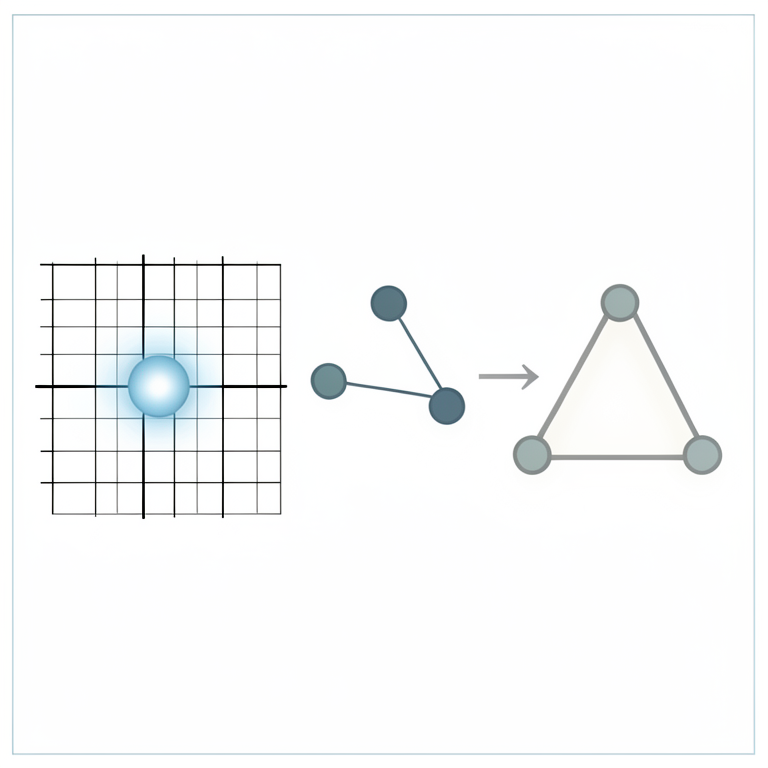
Conceptual Construction of a Diophantine Triple
AI-generated conceptual illustration (Gaussian integers represented as points on a complex plane grid). It explains the idea and does not show study data.
View source evidence ↗Introduction
The Gaussian integer z[i] is the simplest generalization of ordinary integer Z and they behave in much the same way. This was first introduced by Carl Friedrich Gaussian in his second monograph on quartic reciprocity in the year 1832. In particular z[i] enjoys unique prime factorization and this allows us reason z[i] as the same way we do about Z. For basics and ideas [1-3] has been studied.
For various ideas on triples and quadruples [4-13] has been referred. [14, 15] has been studied for ideas on Gaussian Diophantine quadruples. CC Recently in [16, 17] Special dio 3-tuples are constructed from n Gno n In this paper search for Gaussian Diophantine triples with the property D(25) and we present 11 general sets of Gaussian Diophantine triples with the property D(25). Definition Gaussian integers are defined as z[i] = } , ; { Z b a ib a A sequence of non-negative integers is said to be Diophantine m-triple if each ) ( 1 j i a a j i is the square of an integer. A Diophantine 3-triple is also known as Diophantine triples.
Method of Analysis Let ikq kp a 1 ; ikq kp b 11 be two Gaussian integers. We have 2 25 ab (1) where ikq kp 6 Hence (a,b) is a Gaussian Diophantine double with the property D(25) Introduce c such that c is any non-zero Gaussian Integer with the property. 2 25 ac (2) 2 25 bc (3) Taking b and a , we have from (2) and (3) kq i kp c 4 24 4 Thus we have the Gaussian Diophantine triples } 4 24 4, 11 , 1 { kq i kp ikq kp ikq kp with the property D(25) for any k > 0. Maths 2017; 2(6):301-302 P Saranya Assistant Professor, Department of Mathematics, Cauvery College for Women, Trichy, Tamil Nadu, India G Janaki Associate Professor, Department of Mathematics, Cauvery College for Women, Trichy, Tamil Nadu, India Correspondence P Saranya Assistant Professor, Department of Mathematics, Cauvery College for Women, Trichy, Tamil Nadu, India D(4),International Journal of Physics and Mathematical Sciences. 2014; 4(2):65-67. 16. Janaki G, Saranya P.
Construction of Special Dio 3- In the following table we present 10 sets of Gaussian Diophantine triples with the property D (25) Tuples from CC - I”, International Journal of Advanced n Gno n S. No a B C 1 ikq kp 1 ikq kp 9 kq i kp 4 16 4 2 ikq kp 2 ikq kp 8 kq i kp 4 12 4 Research and Development, 2017, l-26, 151-154. 17. Janaki G, Saranya P. Construction of Special Dio 3- Tuples from CC - II, International Journal for Research 3 ikq kp 3 ikq kp 7 kq i kp 4 8 4 n Gno n 4 ikq kp 4 ikq kp 6 kq i kp 4 4 4 5 ikq kp 6 ikq kp 4 kq i kp 4 4 4 in Applied Science and Engineering Technology. 2017; 5(11):1642-1645. 6 ikq kp 7 ikq kp 3 kq i kp 4 8 4 7 ikq kp 8 ikq kp 2 kq i kp 4 24 4 8 ikq kp 9 ikq kp 1 kq i kp 4 16 4 9 ikq kp 12 ikq kp 2 kq i kp 4 28 4 10 ikq kp 2 ikq kp 12 kq i kp 4 28 4
Conclusion
In this paper we have presented 11 sets of Gaussian triples with the property D(25). One may also search for similar Gaussian triples with suitable property.
Experimental
Math. 2008; 17(1). 6. Gopalan MA, Srividhya G. Diophantine Quadruple for Fibonacci and Lucas Numbers with property D(4), Diophantus Journal of Mathematics. 2012; 1(1):15-18, 7. Gopalan MA, Srividhya G.
Some non-extendable P-5 sets, Diophantus Journal of Mathematics. 2012; 1(1):19-22. 8. Gopalan MA, Srividhya G. Two Special Diophantine Triples, Diophantus Journal of Mathematics. 2012; 1(1):23-27. 9. Gupta H, Singh K.
On k-triad Sequences, International Journal of Mathematics and Mathematical Sciences. 1985; 5:799-804. 10. Srividhya G. Diophantine Quadruples for Fibonacci numbers with property D(1), Indian Journal of Mathematics and Mathematical Science. 2009; 5(2):57- 59. 11. Deshpande MN.
One interesting family of Diophantine triples. Internet J. Math. ed. Sci.
Tech. 2012; 33:253-256. 12. Deshpande MN. Families of Diophantine Triplets, Bulletin of the Marathwada Mathematical Society.2003; 4:19-21. 13. Fujita Y.
The extensibility of Diophantine pairs (k- 1,k+1), Journal of Number Theory. 2008; 128:322- 353, 14. Vidhyalakshmi S, Gopalan MA, Lakshmi K. Gaussian Diophantine quadruples with property D(1), IOSR Journal of Mathematics. 2014; 10(3):II, 12-14 15. Gopalan MA, Vidhyalakshmi S, Premalatha E, Presenna R.
Gaussian Diophantine quadruples with property
References
5 in the original paper- Dickson LE. History of Theory of Numbers and Diophantine Analysis, Dove Publications, New York, 2005, 2.
- Mordell LJ. Diophantine Equations Academic Press, New York, 1970.
- Carmicheal RD. The Theory of Numbers and Diophantine Analysis, Dover Publications, New York, 1959.
- Dujella. The problem of the extension of a parametric family of Diophantine triples, Publ. Math. Breen. 1997; 51:311-322.
- Dujella A, Vinko Petricevic. Strong Diophantine Triples,