
Research article · 2017 · Full text
International Journal of Statistics and Applied MathematicsAnalysis of various factors of reliability using Boolean function technique in refinery unit
Volume 2(5) · Pages 35–40
Research areasProcess Optimization and IntegrationReliability and Maintenance Optimization
Abstract
Author-writtenFor the system of multistation elements, the problems of developing Boolean reliability model has acknowledged on the basis of algebra of groups of incompatible events. The objective of this paper to find the various reliability factor of refinery unit which is a subunit of Vacuum Distillation Unit (VDU). The subunits used in the considered unit are Pump, Desalter, Furnace, atmospheric fractionator and gas separator and these subunits are connected through pipes. The reliability factor and mean time to failure (MTTF) is Exponentially and weibully distributed. We illustrate the use of technique by means of examples and introduce numerical results.
Summary
Source-checkedPlain-language reading of the full paper, prepared with AI and checked against the text. Each point links to the authors' own words.
Why it matters
- Vacuum distillation units (VDUs) are common in the refining industry, appearing in approximately 80% of refineries. View evidence ↗
- The refining process uses atmospheric distillation units to separate lighter hydrocarbons from heavier oils based on their boiling points. View evidence ↗
- Atmospheric distillation units are limited to 750°F, as temperatures above this cause thermal cracking that hinders the distillation process. View evidence ↗
The question
- The study aims to determine various reliability factors for a refinery unit that serves as a subunit of a Vacuum Distillation Unit (VDU). View evidence ↗
What they did
- The analyzed system consists of a pump, desalter, furnace, atmospheric fractionator, and gas separator, all connected by pipes. View evidence ↗
- The model assumes that the reliability factor and mean time to failure (MTTF) follow either exponential or Weibull distributions. View evidence ↗
- The reliability model assumes the system starts in a good state, components are binary (good or bad), no repairs are possible, any single unit failure can fail the system, and failures are independent. View evidence ↗
- The author uses the Boolean function technique and the algebra of logics to analyze the reliability parameters of the refinery unit. View evidence ↗
What they found
- Reliability decreases at a roughly uniform rate under exponential distribution, whereas the failure rate decreases rapidly under Weibull distribution. View evidence ↗
- The system's MTTF exhibits a catastrophic decrease initially before transitioning to a more uniform rate of decline as the failure rate increases. View evidence ↗
What it means
- The author concludes that the Boolean function technique and algebra of logics are effective tools for analyzing the reliability parameters of a refinery subunit. View evidence ↗
Visual summary
2 visualsIllustrations explain the paper; charts are replotted from the paper's own table values.
Refinery Unit Components
AI-generated conceptual illustration (industrial oil refinery unit). It explains the idea and does not show study data.
View source evidence ↗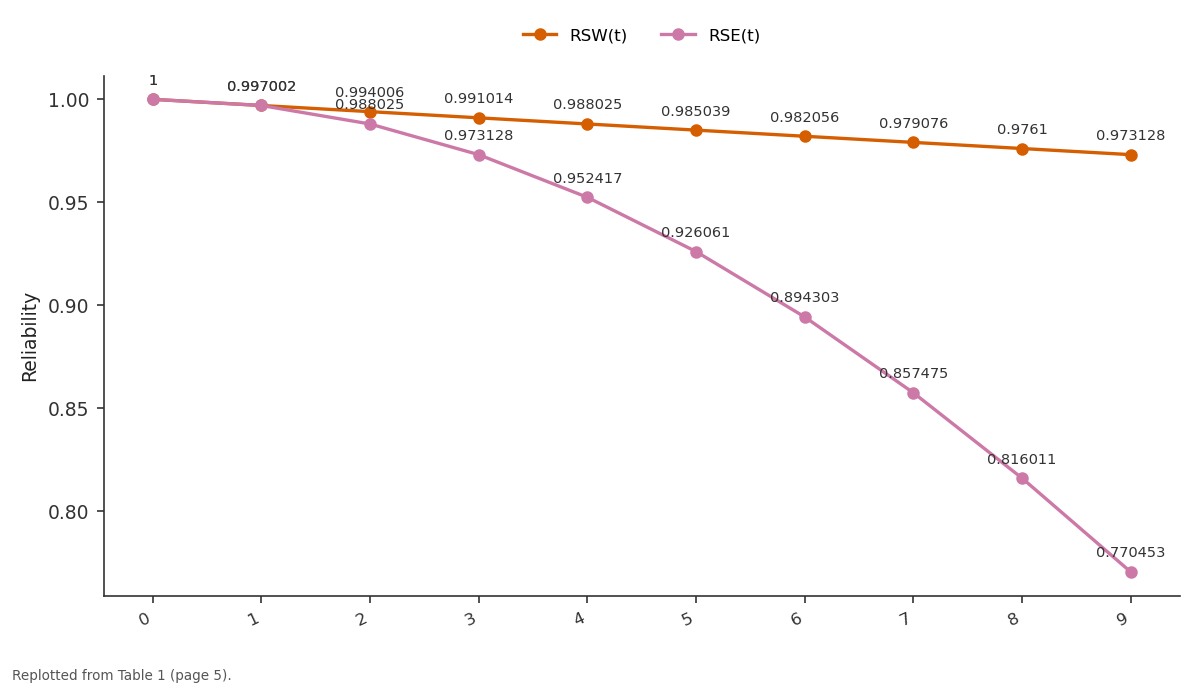
RSW(t) and RSE(t): 0 vs 1 vs 2 vs 3 vs 4
Replotted from Table 1 (page 5) of the original paper. Every bar is the paper's own table value.
View source evidence ↗Figures & tables
From the original paper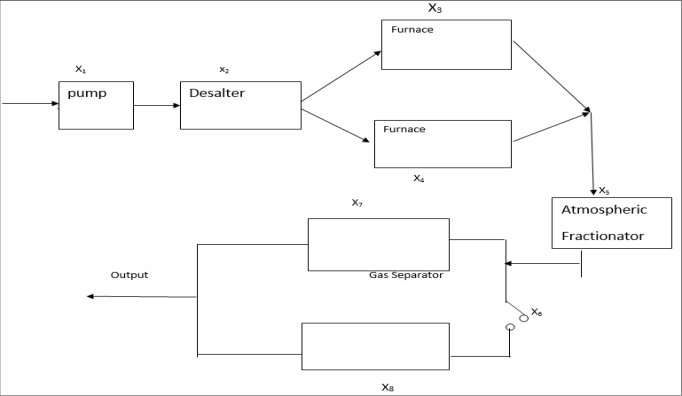 Figure 1
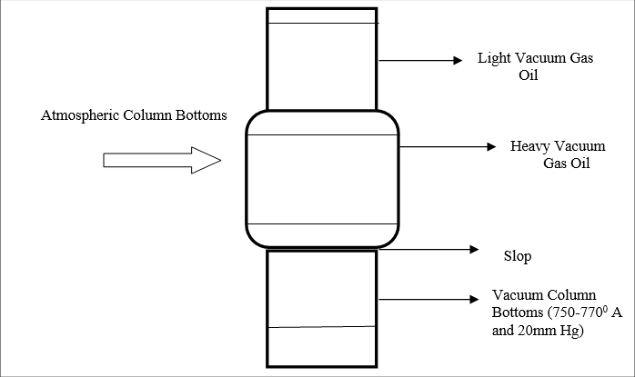 Figure 2
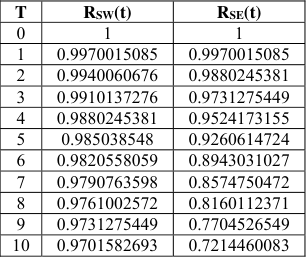 Table 1
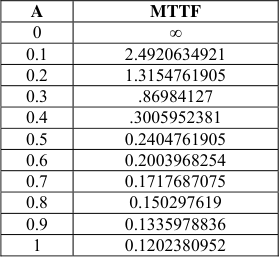 Table 2
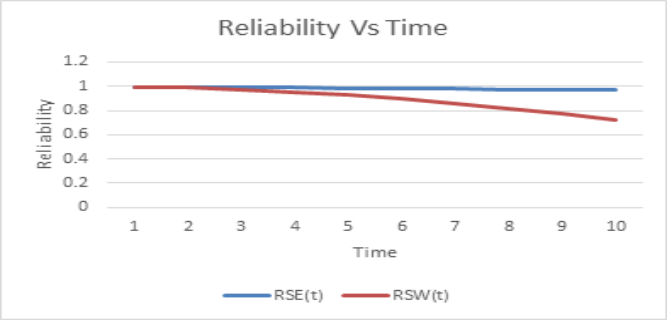 Figure 3
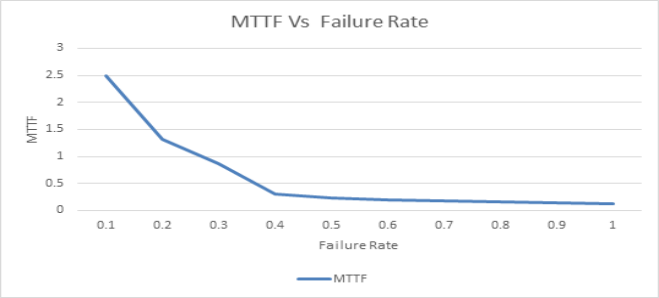 Figure 4
Introduction
About 80% of the refineries have a vacuum distillation unit. A secondary processing unit consisting of VDU. In the refining process, the atmospheric distillation unit is separate the lighter hydro carbon from the heavier oil based on the boiling point. The ADU is capable of boiling crude oil fraction to the temperature of 750oF.
Above this temperature the oil will be thermally crack impedes the distillation process. The lighter products are boiled up and the heavier oil called bottoms remain at the bottom of ADU. These bottoms are run through a vacuum distillation column for further refinement. These vacuum distillation columns are less than atmospheric pressure of 760 mm of mercury.
Gas oils are slightly heavier than middle distillates such as jet fuel, Diesel, Kerosene. These gas oils are further refined to make such light cycle oil, gasoline. The desalted crude enter the heat exchange network which use the vapour of column condenser, the pump around the circuits streams and the products are cooled and then enters the furnace where it is heated to about 340-372 oC. Fig 1 Maths 2017; 2(5): 35-40 Dr.
Reena Garg Assistant, Professor (Mathematics), Department of Humanities and Sciences, YMCA University of Science and Technology, Faridabad, Haryana, India Correspondence Dr. Reena Garg Assistant, Professor (Mathematics), Department of Humanities and Sciences, YMCA University of Science and Technology, Faridabad, Haryana, India Fig 2 Assumptions The following assumption have been associated with this model: a) Initially, the whole system is good and operable. b) Every component of the system remains either in good or bad state. c) There is no repair facility to repair a failed component. d) The whole system can fail due to failure of any one of its units. e) Failures are statistically-independent. Notations x1 : state of pump x2 : state of desalter x3,x4 : states of furnace x5 : state of atmospheric fractionator x6 : state of switching device x7,x8 : states of gas separator xi(i=1,2,3…….8) : 1 in good state;0 is bad state. x`i : negation of for x`iall i / : conjunction/disjunction | | : this notation has used to represent logical matrix. Ri : Reliability of ith part of the system,i=1,2…….8.
Qi : 1-Ri Rs : Reliability of the whole system. Rsw(t)/RSE(t) : Reliability of the system as a whole when failures follow weibull/Exponential time distribution. Formulation of mathematical model By making use of Boolean function technique, the condition of capability of successful operation of the system in terms of logical matrix are expressed as shown below: x x x x x 7 5 3 2 1 x x x x x 7 5 4 2 1 x x x x x x 8 6 5 3 2 1 x x x x x x F (x1…….x8) = 8 6 5 4 2 1 (1) Solution of the model By using algebra of logics, we may write eqn (1)again as, F(x1, x2, ……..., x8)=(x1 x2 x5) ^ f(x1,x2 ……, x8) (2) where 7 3 x x x x 7 4 8 6 3 x x x x x x (3) f (x1, x2, ……..., x8)= ( 5 2 1 x x x ) ^ 8 6 4 Let B1 =| 7 3 x x | (4) B2 =| 7 4 x x | (5) B3 =| 8 6 3 x x x | (6) B4 =| 8 6 4 x x x | (7) | 5 2 1 x x x | ^ B1 B2 [from eq. (4),(5),(6),(7)] B3 B4 Using orthogonalization process 1 B B B 2 ' 1 3 ' 2 ' 1 B B B B B B B 4 ' 3 ' 2 ' 1 (8) Where ' 3 x x x ' 7 3 B ' 1 = (9) B ' 1 B2 =| 7 4 ' 3 x x x | (10) 8 ' 7 6 ' 4 3 x x x x x x x x x x B ' 1 B ' 2 B3 = 8 ' 7 6 4 3 (11) Using all these values in equation (8), we obtain x x 7 3 7 4 ' 3 x x x x x x x x 8 ' 7 6 ' 4 3 x x x x x 8 ' 7 6 4 3 x x x x x f(x3,x4,x6,x7,x8)= 8 ' 7 6 4 ' 3 (13) Using equation(13), equation (2) becomes x x x x x 7 5 3 2 1 7 5 4 ' 3 2 1 x x x x x x x x x x x x x x 8 ' 7 6 5 ' 4 3 2 1 8 ' 7 6 5 4 3 2 1 x x x x x x x x x x x x x x x x F(x1,x2,………..,x8)= 8 ' 7 6 5 4 ' 3 2 (14) since equation (13) is the disjunction of disjoint conjunction, therefore, the reliability of the whole system is given by Rs =Pr{F (x1, x2, ……..., x8)} Or Rs=R1R2R5[R3R7+R`3R4R7+. R3R`4R6R`7R8+R3R4R6R`7R8+R`3R4R6R`7R8] =R1R2R5[R3R7+(1-R3)R4R7+R3(1-R4)R6(1-R7)R8+R3R4R6(1-R7)R8+(1-R3)R4R6(1-R7)R8] =R1R2R5[R3R7+R4R7-R3R4R7+R3R6R8(1-R4)(1-R7)+R3R4R6R8(1-R7)+R4R6R8(1-R3)(1-R7)] =R1R2R5[R3R7+R4R7-R2R4R7+R3R6R8-R3R7R6R8-R4R6R3R8+R3R4R6R7R8+R3R4R6R8-R3R4R6R7R8+R4R6R8-R3R4R6R8- R4R6R7R8+R3R4R6R7R8] =R1R2R3R5R7+R1R2R4R5R7-R1R2R3R4R5R7+R1R2R3R5R6R8-R1R2R3R7R5R6R8- R1R2R4R5R6R3R8+R1R2R3R4R5R6R7R8+R1R2R3R4R5R6R8-R1R2R3R4R5R6R7R8+R1R2R4R5R6R8-R1R2R3R4R5R6R8- R1R2R4R5R6R7R8+R1R2R3R4R5R6R7R8 Some Particular Cases Case 1: When reliability of each component is R. 2R5 – 3R7 + R6 + R8 (15) Case 2: When failure rates follow weibull distribution 6 7 tb j e tb i e 1 j 1 i - RSW(t)= (16) α1=c+a3+a7 α2=c+a4+a7 α3=c+a4+a6+a8 α4=c+a3+a4+a6+a7+a8 α5=c+a3+a4+a6+a8 α6=c+a4+a6+a8 α7=c+ a3+a4+a6+a7+a8 c=a1+a2+a5 β1=c+a3a4+a7 β2=c+a3+a4+a6+a8 β3=c+a4+a6+a7+a8 β4=c+a3+a4+a6+a7+a8 β5=c+a3+a4+a6+a8 β6=c+a4+a6+a7+a8 Case 3: When failure rate follow exponential time distribution Exponential distribution is nothing but a particular case of weibull distribution for b=1 and is very useful for practical problems purpose.
Therefore, the reliability of considered system as a whole at an instant’s’ is expressed as: 6 7 tj e ti e 1 j 1 i - RSE(t)= (17) Where αi and βj’s have mentioned earlier. Also, an important reliability parameter, viz; M.T.T.F., in this case is given by M.T.T.F = dt R SE 0 7 7 1 1 1 1 = i j - i j (18) Numerical Example For a numerical computation,setting: (A) ai( i= 1,2,…….7) = 0.001, α= 2 and t=0,1,2,…. In eq. (16) (B) ai(i=1,2…….7) =0.001, and t=0,1,2……..in eq.(17) (C) ai(i=1,2,……..7)=0,0.1,………..1.0 in eq. (18) one can compute the table 1 and 2. The corresponding graph have been shown through fig. 3 and 4.
| T | RSW(t) | RSE(t) |
|---|---|---|
| 0 | 1 | 1 |
| 1 | 0.9970015085 | 0.9970015085 |
| 2 | 0.9940060676 | 0.9880245381 |
| 3 | 0.9910137276 | 0.9731275449 |
| 4 | 0.9880245381 | 0.9524173155 |
| 5 | 0.985038548 | 0.9260614724 |
| 6 | 0.9820558059 | 0.8943031027 |
| 7 | 0.9790763598 | 0.8574750472 |
| 8 | 0.9761002572 | 0.8160112371 |
| 9 | 0.9731275449 | 0.7704526549 |
| 10 | 0.9701582693 | 0.7214460083 |
Table text extracted from the original PDF; superscript letters are shown inline. The original table image is below.
View original table image
Respectively Table 1 T RSW(t) RSE(t) 0 1 1 1 0.9970015085 0.9970015085 2 0.9940060676 0.9880245381 3 0.9910137276 0.9731275449 4 0.9880245381 0.9524173155 5 0.985038548 0.9260614724 6 0.9820558059 0.8943031027 7 0.9790763598 0.8574750472 8 0.9761002572 0.8160112371 9 0.9731275449 0.7704526549 10 0.9701582693 0.7214460083 Fig 3 Table 2 A MTTF 0 ∞ 0.1 2.4920634921 0.2 1.3154761905 0.3 .86984127 0.4 .3005952381 0.5 0.2404761905 0.6 0.2003968254 0.7 0.1717687075 0.8 0.150297619 0.9 0.1335978836 1 0.1202380952 Fig 4
| A | MTTF |
|---|---|
| 0 | ∞ |
| 0.1 | 2.4920634921 |
| 0.2 | 1.3154761905 |
| 0.3 | .86984127 |
| 0.4 | .3005952381 |
| 0.5 | 0.2404761905 |
| 0.6 | 0.2003968254 |
| 0.7 | 0.1717687075 |
| 0.8 | 0.150297619 |
| 0.9 | 0.1335978836 |
| 1 | 0.1202380952 |
Table text extracted from the original PDF; superscript letters are shown inline. The original table image is below.
View original table image
Results And Discussion
In this paper the author has acknowledged a refinery unit which is a subunit of vacuum distillation unit for the analysis of various reliability parameter by utilizes the Boolean function technique and algebra of logics. Table 1 computes the reliability of system with respect to time when failure rate is exponential and weibull distribution. An inspection of graph ‘Reliability Vs time’fig. 3 compute that in case of exponential distribution, reliability of the complex system decreases approximately at uniform rate but in case of weibull distribution,failure rate decreases rapidly. Table 2 and graph “M.T.T.F Vs failure rate” produce that M.T.T.F of the system decreases catastrophically in the beginning but after that it decreases approximately at a uniform rate.
References
8 in the original paper- Nagaraja HN, Kannan N, Krishnan NB. Reliability, Springer publication, 2004.
- Aggarwal SC, Mamta Sahani, Shikha Bansal. Reliability characterstic of cold-standby redundant system IJRRASS, 3(2), 2010.
- Dr. Nabil Hachem, Dr. Jitender Bedi. Neural network implementation for reliability evaluation, IEEE, 1996.
- Rai S, Agarwal DP. Advances in distributed system reliability, IEEE Comput. Society press, 1990.
- Gupta PP, Agarwal SC. A Boolean Algebra Method For reliability Calculations Published work style. Microelectronic Reliability, UK. 1983; 23:863-865.
- Singh H, Vaithilingam S, Anne RK, Anneberg L. Terminal reliability binary decision diagrams” Microelectronic. Reliab. 1996; 36(3):363-365.
- Prescott DR, Remenyte-Prescott R, Reed S, Andrews JD, Downes CG. A reliability analysis method using binary decision diagrams in phased mission planning “journal of risk and reliability, 2009, 223.
- Linmin Hu, Jiandong Li. Reliability analysis of three -unit system with vacation and priority, ICIC International c2009 ISSN 1881-803X, 171-176.