
Research article · 2019 · Full text
International Journal of Statistics and Applied MathematicsA note on analysis and synthesis operators of a frame and reconstruction of a signal from frame coefficients
Volume 4(5) · Pages 93–99
Research areasMathematical Analysis and Transform MethodsImage and Signal Denoising MethodsSeismic Imaging and Inversion Techniques
Abstract
Author-writtenWe discuss basic properties of Analysis and synthesis operators a frame. The structure of matrix representation of the Synthesis operator is also analysed. This matrix is what most frame constructions in fact focus on. The frame operator which is just the joining together of the analysis and synthesis operators is fundamental for the reconstruction of signals from frame coefficients.
Summary
Source-checkedPlain-language reading of the full paper, prepared with AI and checked against the text. Each point links to the authors' own words.
Why it matters
- The frame operator is essential for reconstructing signals from their frame coefficients by combining analysis and synthesis operators. View evidence ↗
- The matrix representation of the synthesis operator is a primary focus in most frame constructions. View evidence ↗
- Efficient signal reconstruction from frame coefficients is critical for signal transmission tasks. View evidence ↗
The question
- The paper aims to discuss the basic properties of analysis and synthesis operators and analyze the matrix representation of the synthesis operator. View evidence ↗
What they did
- The analysis is conducted within the space ℓ2(1..., M), which corresponds to ℝm or ℂm using the standard inner product and Euclidean norm. View evidence ↗
- The synthesis operator is defined as the adjoint operator (T*) of the analysis operator. View evidence ↗
- The frame operator S is defined as the composition of the synthesis and analysis operators (S = T*T). View evidence ↗
What they found
- A sequence of vectors forms a frame for HN if and only if its associated analysis operator T is injective. View evidence ↗
- A sequence of vectors is a frame if and only if the synthesis operator T* is surjective. View evidence ↗
- In the matrix representation of the synthesis operator, the Riesz bounds of the row vectors are equal to the frame bounds of the column vectors. View evidence ↗
- For a frame with bounds α and β, the frame operator S is a positive, self-adjoint, and invertible operator that satisfies α.Id ≤ S ≤ β.Id. View evidence ↗
What it means
- The authors conclude that the frame operator is the most significant operator because it encodes essential frame properties and is fundamental for signal reconstruction. View evidence ↗
Visual summary
1 visualsIllustrations explain the paper; they do not show study data.
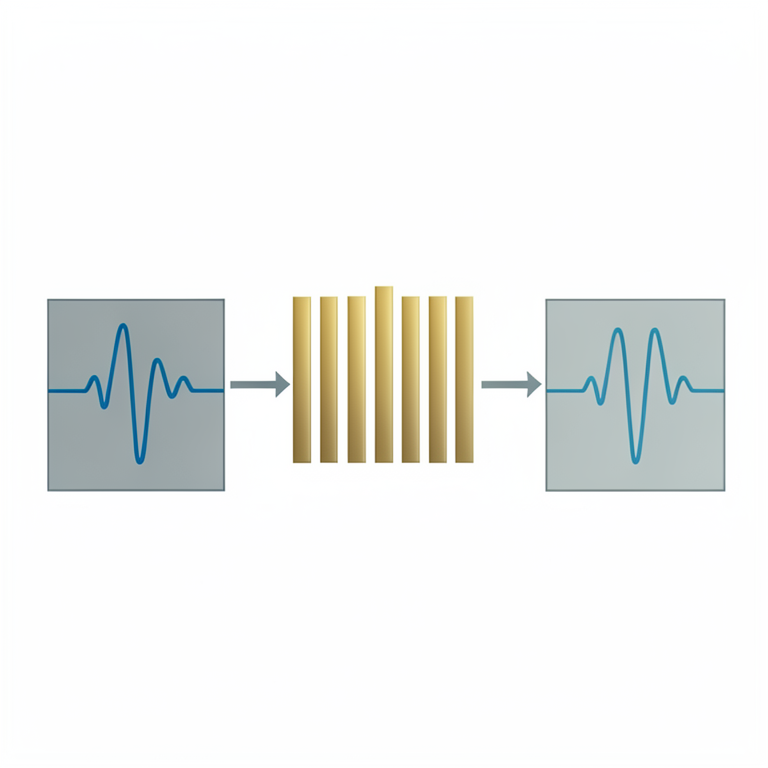
Frame Operator Composition
AI-generated conceptual illustration (A mathematical signal processing schematic represented by abstract geometric waveforms and operator blocks). It explains the idea and does not show study data.
View source evidence ↗Introduction
We set ℓ 2 𝑀 = ℓ 2 (1,…, M}. This space in fact coincides with ℝ 𝑚 or ℂ 𝑚 , endowed with the standard inner product and the associated Euclidean norm. The analysis, synthesis, and frame operators determine the operations of a frame when analysing and reconstructing a signal.
Analysis and synthesis Operators
Two of the main operators associated with a frame are the analysis and synthesis operators. The analysis operator, as the name suggests, analyses a signal in terms of the frame by computing its frame coefficients. We start by formalizing this notion.
Definition 1. Let (𝜑 𝑖 ) 𝑖=1
𝑀 be a family of vectors in H N . Then the associated analysis operator T:
𝑚 is define by Tx = (〈𝑥, 𝜑 𝑖 〉) 𝑖=1 𝑀 , x ∈ H N .
In the following lemma we derive two basic properties of the analysis operator.
Lemma 1. Let(𝜑 𝑖 ) i=1 M be a sequence of vectors in H N with associated analysis operator T.
1. We have ‖T𝑥‖ 2 = ∑ |〈𝑥, 𝜑 𝑖 〉| m i=1
Hence, (𝜑 𝑖 ) i=1 M is a frame for H N if and only if T is injective.
2. The adjoint operator T*: ℓ M 2 → H N of T is given by T*(𝜑 𝑖 ) i=1 M =∑ 𝑎 𝑖 φ i M i=1
Proof. (i) This is an immediate consequence of the definition of T and the frame property.
ii) For x = (𝑎 𝑖 ) 𝑖=1 𝑀 and y ∈ H N , we have
Thus, T* is adjoint operator.
The second main operator associated to a frame, the synthesis operator, is now defined as the adjoint operator to the analysis operator given in Lemma1 (ii).
Definition 2. Let (𝜑 𝑖 ) 𝑖=1
𝑀 be a sequence of vectors in H N with associated analysis operator T. Then the associated synthesis operator is defined to be the adjoint operator T*.
The next result summarizes some basic, but useful, properties of the synthesis operator.
Lemma 2. Let (𝜑 𝑖 ) i=1
M be a sequence of vectors in H N with associated analysis operator T. 1. Let (e i ) i=1
M denote the standard basis of ℓ 2 m . Then for all i = 1,2,…, M, we have T*e i = T*Pe i = φ i , where P : ℓ 2 m → ℓ 2 m denotes the orthogonal projection onto ran T.
(𝜑 𝑖 ) i=1
M is a frame if and only if T* is surjective.
Proof. The first claim follows immediately from Lemma1 and the fact that Ker T* = (ran T) ⊥ . The second claim is a consequence of ranT* = (𝑘𝑒𝑟 𝑇) ⊥ and Lemma 1(i).
Often frames are modified by the application of an invertible operator. The next result shows not only the impact on the associated analysis operator, but also the fact that the new sequence again forms a frame.
Proposition 3. Let ∅ = (𝜑 𝑖 ) i=1 M be a sequence of vectors in H N with associated analysis operator T ∅ and let F: H N → H N be a linear operator. Then the analysis operator of the sequence F∅ = (Fφ i ) i=1 M is given by TF∅ = T∅F*.
Moreover, if ∅ is a frame of H N and F is invertible, then F∅ is also a frame for H N .
This proves TF∅ = T∅ F*. The moreover part follows from lemma 2 (ii).
Next, we analyse the structure of the matrix representation of the synthesis operator. This matrix is of fundamental importance, since this is what most frame constructions in fact focus on.
The first result provides the form of this matrix along with stability properties.
Lemma 4. Let ∅ = (𝜑 𝑖 ) i=1 M be a frame for H N with analysis operator T, then a matrix representation of the synthesis operator T* is the N x M matrix given by
Moreover, the riesz bounds of the row vectors of this matrix equal the frame bounds of the column vectors.
Proof. The form of the matrix representation is obvious. To prove the moreover part, let (𝑒 𝑗 ) 𝑗=1 𝑁 be the corresponding orthonormal basis of H N and for j = 1, 2, …, N Let
Be the row vectors of the matrix. Then for
A much stronger result (Proposition 9) can be proven for the case in which the matrix representation is derived using a specifically chosen orthonormal basis. However, the choice of this orthonormal basis requires the introduction of the frame operator in the following Section 2.
The Frame Operator
The frame operator may be considered the most important operator associated with a frame. Although it is "merely" the joining together of the analysis and synthesis operators, it encodes crucial properties of the frame. Moreover, it is also fundamental for the reconstruction of signals from frame coefficients.
Fundamental Properties
The precise definition of the frame operator associated with a frame is as follow: Definition 3. Let (𝜑 𝑖 ) 𝑖=1 𝑀 be a sequence of vectors in H N with associated analysis operator T. Then the associated frame operator S: H N →H N is defined by
A first observation concerning the close relation of the frame operator to frame properties is the following lemma.
Lemma 5. Let (𝜑 𝑖 ) i=1
M be a sequence of vectors in H N with associated frame operator S. Then, for all x ∈ H N ,
Proof, The proof follows directly from 〈𝑆𝑥, 𝑥〉 = 〈𝑇 * 𝑇𝑥, 𝑥〉 = ‖𝑇𝑥‖ 2 and Lemma 1(i) Clearly, the frame operator S = T*T is self-adjoint and positive. The most fundamental property of the frame operatorif the underlying sequence of vectors forms a frameis its invertibility, which is crucial for the reconstruction formula.
Theorem 6. The frame operator S of a frame (𝜑𝑖) 𝑖=1
𝑀 for H N with frame bounds 𝛼 and 𝛽 is a positive, self-adjoint invertible operator satisfying 𝛼.Id ≤ S ≤ 𝛽.Id.
Proof. By Lemma 5, we have
This implies the claimed inequality.
The following proposition follows directly from proposition 3 Proposition 7. Let (φ i ) i=1 M be a frame for H N with frame operator S, and let F be an invertible operator on H N . Then ((Fφ i ) i=1 M is a frame with frame operator FSF*.
The special case of tight frames
Tight frames can be characterized as those frames whose frame operator equals a positive multiple of the identity. The next result provides a variety of similarly frame-operator-inspired classification.
Proposition 8. Let (𝜑 𝑖 ) i=1
M be a frame of H N with analysis operator T and frame operator S. Then the following conditions are equivalent.
(𝜑 𝑖 ) i=1
M is an 𝛼-tight frame for H N . 2. S = 𝛼.I 3. For every x ∈ H N ,
T/ √𝛼 is an isometry.
Proof. (i) ⇔ (ii) ⇔ (iii) ⇔ (iv) These are immediate from the definition of the frame operator and from Theorem 6. (ii) ⇔ (v) This follows from the fact that T / √𝛼 is an isometry if and only if T*T = 𝛼.I.
A similar result for the special case of a Parseval frame can be easily deduced from Proposition 8 by setting 𝛼 = 1.
Structure of the synthesis matrix
We now apply the previously derived results to obtain a complete characterization of the synthesis matrix of a frame in terms of the frame operator. Proposition 9. Let T: H N → 𝑙 2 M be a linear operator, Let (𝑒 𝑗 ) j=1 N be an orthonormal basis of H N , and let (𝑒 𝑗 ) j=1 N be a sequence of positive numbers. By A, denote the N × M matrix representation of T* with respect to (𝑒 𝑗 ) j=1 N (and the standard basis (𝑒 𝑖 ) i=1 M of ℓ 2 M ). Then the following conditions are equivalent.
1. (𝑇 * 𝑒 𝑖 ) i=1 M forms a frame for H N whose frame operator had eigenvectors (𝑒 𝑗 ) j=1 N and associated eigenvalues (λ j ) j=1 N .
2. The rows of A are orthogonal, and the j th row square sums toλ j .
3. The columns of A form a frame for ℓ 2 N , and AA* = diag(λ 1 , ⋯, λ N .
Proof. Let (𝑓 𝑗 ) 𝑗=1 𝑁 be the standard basis of ℓ 2 𝑁 and denote by U: ℓ 2 𝑁 → H N the unitary operator which maps f j to e j . Then T* = UA.
(i)⟹ (𝑖𝑖) For j, k ∈{1, ⋯, N} we have
Which is equivalent to (ii).
(ii)⟹(iii) since the rows of A are orthogonal, we have rank A = N, which implies that the columns of A form a frame for ℓ 2 𝑁 . The rest follows from 〈𝐴𝐴 * 𝑓 𝑗 , 𝑓 𝑘 〉 = 〈𝐴 * 𝑓 𝑗 , 𝐴 * 𝑓 𝑘 〉 = 𝜆 𝑗 𝛿 𝑗𝑘 for j, k = 1, ⋯, N.
𝑀 is a spanning set for ℓ 2 𝑁 and T* = UA, it follows that (𝐴ê 𝑖 ) 𝑖=1 𝑀 forms a frame for H N . Its analysis operator is given by T, since for all x ∈ H N , (〈𝑥, 𝑇 * ê𝑖〉) 𝑖=1 𝑀 = (〈𝑇𝑥, ê𝑖〉) 𝑖=1 𝑀 = Tx. Moreover,
Which completes the proof.
Signal Reconstruction from Frame Coefficients
The analysis of a signal is typically performed by merely considering its frame coefficients. However, if the task is transmission of a signal, the ability to reconstruct the signal from its frame coefficients and also to do so efficiently becomes crucial. However, reconstruction from coefficients with respect to a redundant system is much more delicate and requires the utilization of another frame, called the dual frame. If computing such a dual frame is computationally too complex, a circumvention of this problem is the frame algorithm.
Exact Reconstruction
We start by stating an exact reconstruction formula.
Theorem 10. Let (φ i ) i=1 m be a frame for H N with frame operator S. then, for every x ∈ H N , we have
Proof. The proof follows directly from the definition of the frame operator in Definition 3 by writing
Notice that the first formula can be interpreted as a reconstruction strategy, whereas the second formula has the flavour of a decomposition. We further observe that the sequence (𝑆 -1 𝜑𝑖) 𝑖=1 𝑀 plays a crucial role in the formulas in Theorem 11. The next result shows that this sequence indeed also constitutes a frame. Proposition 11. Let (φ i ) i=1 m be a frame for H N with frame bounds 𝛼 and 𝛽 and with frame operator S. Then the sequence (S -1 φ i ) i=1
M is a frame for H N with frame bound 𝛽 -1 and 𝛼 -1 and with frame operator S -1 .
Proof. By Proposition 7, the sequence(𝑆 -1 𝜑 𝑖 ) 𝑖=1 𝑀 forms a frame for H N with associated frame operator S -1 (S -1 )* = S -1 . This in turn yields the frame bounds 𝛽 -1 and 𝛼 -1 . This new frame is called the canonical dual frame. In the sequel, we will discuss that other dual frame may also be utilized for reconstruction.
Definition 4. Let (φ i ) i=1
m be a frame for H N with frame operator denoted by S. then (S -1 φ i ) i=1 M is called the canonical dual frame for(φ i ) i=1 m .
The canonical dual frame of a Perseval frame is now easily determined by Proposition 11.
Corollary 12. Let (φ i ) i=1 m be a Parseval frame for H N . Then its canonical dual frame is the frame (φ i ) i=1 m itself, and the reconstruction formula in Theorem 10 reads
As an application of the above reconstruction formula for Parseval frames, we prove the following proposition which again shows the close relation between Parseval frames and orthonormal bases. . This implies
As mentioned earlier, many other dual frames for reconstruction exist. We now give a precise definition of the same.
Definition 5. Let (φ i ) 𝑖=1
𝑚 be a frame for H N . Then a frame(Ψ i ) 𝑖=1 𝑚 is called dual frame for (φ i ) 𝑖=1 𝑚 , if
Dual frames, which do not coincide with the canonical dual frame, are often coined alternate dual frames.
Similar to the different forms of the reconstruction formula in Theorem 11, dual frames can also achieve reconstruction in different ways.
Proposition 14. Let (φ i ) i=1 m and Ψ i i=1 M be frames for H N and let T and T ̃ be the analysis operators of (φ i ) i=1 m and Ψ i i=1 M , respectively. Then the following conditions are equivalent.
We have
φi for all x ∈H N . 2. We have x = ∑ 〈𝑥, φ i 〉 M i=1 Ψ i for all x ∈H N . 3. We have (x, y) = ∑ 〈𝑥, φ i 〉 M i=1 〈ψi, 𝑦〉 for all x, y ∈H N . 4. T*T ̃ = I and T ̃*T = I.
Proof. Clearly (i) is equivalent to T*T ̃ = I, which holds if and only if T ̃*T = I. The equivalence of (iii) can be derived in a similar way.
One may ask what distinguishes the canonical dual frame from the alternate dual frames besides its explicit formula in terms of the initial frame. Another seemingly different question is which properties of the coefficient sequence in the composition of some signal x in terms of the frame (see Theorem 10).
x =∑ 〈𝑥, 𝑆 -1 φ i 〉φ i 𝑀 𝑖=1
, uniquely distinguishes it from other coefficient sequences; redundancy allows infinitely many coefficient sequences. Interestingly, the next result answers both questions simultaneously by stating that this coefficient sequence has minimal ℓ 2 -norm among all sequences and in particular those, with respect to alternate dual frames, representing x. Proposition 15. Let (φ i ) i=1 M be a frame for H N with frame operator S, and let x ∈H N . If (a i ) i=1 M are scalars such that x = ∑ a i φ i M i=1
Proof. Letting T denote the analysis operator of (φ i ) 𝑖=1 𝑀 , we obtain
References
6 in the original paper- Bodmann BG. Optimal linear transmission by loss-insensitive packet encoding. Appl. Comput. Harmon, 2007.
- Bodmann B, Casazza PG. The road to equal-norm Parseval frames. J Funct, 2010.
- Bodmann BG, Casazza PG, Kutyniok G. A quantitative notion of redundancy for finite frames. Appl. Comput. Harmon, 2011.
- Bodmann BG, Casazza PG, Paulsen VI, Speegle D. Spanning and independence properties of frame partitions. Proc. Am. Math. Soc, 2012.
- Bodmann B, Lipshitz S. Randomly dithered quantization and sigma-delta noise shaping for finite frames. Appl. Comput. Harmon, 2008.
- Bodmann BG, Paulsen VI. Frames, graphs and erasures. Linear Algebra Appl, 2005.