
Research article · 2017 · Full text
International Journal of Statistics and Applied MathematicsStudy on the data in Bi Li Si Xian Xin Biao
Volume 2(2) · Pages 26–30
Research areasEnvironmental and Agricultural SciencesDiverse Interdisciplinary Research InnovationsAdvanced Decision-Making Techniques
Abstract
Author-writtenThe Bi Li Si Xian Xin Biao was an important book compiled by Xue Fengzuo, a famous calendarian and a mathematician living in the end of Ming dynasty and early Qing dynasty. This book introduced the western trigonometric function logarithm, and received widespread attention and acclaim at that time and the later. However, after analyzing the data in this book carefully, it could be found that about 80% of the data actually were of relatively large deviation, and some of them were even completely wrong. The reason for this might be that Xue Fengzuo misunderstood the nature of the trigonometric function, and used the incorrect calculation method. This showed that, when compiling the book, Xue Fengzuo did not conduct strict logarithmic calculation, instead just did some simple arithmetic operation.
Summary
Source-checkedPlain-language reading of the full paper, prepared with AI and checked against the text. Each point links to the authors' own words.
Why it matters
- The Bi Li Si Xian Xin Biao is a significant historical work by Xue Fengzuo, a mathematician and calendarian from the late Ming and early Qing dynasties. View evidence ↗
- The book is noted for introducing Western trigonometric function logarithms to China, earning it widespread acclaim. View evidence ↗
- Analyzing the accuracy of the data in this book is important because it served as the foundation for many of Xue Fengzuo's other works. View evidence ↗
The question
- The research aims to determine if the data in the Bi Li Si Xian Xin Biao were correct, how they were calculated, and if they were directly translated from Western sources. View evidence ↗
What they did
- The authors analyzed a total of 18,000 data points from the book, divided into four categories: sine, cosine, tangent, and cotangent function logarithms, with 4,500 entries each. View evidence ↗
- The authors compared the book's data against various contemporary Western trigonometric logarithm tables to check for direct translation. View evidence ↗
What they found
- Analysis revealed that approximately 80% of the data in the book exhibit relatively large deviations, with some values being completely incorrect. View evidence ↗
- Comparison with John Newton's 1658 'Trigonometria Britanica' showed that Newton's values matched modern calculations, unlike the erroneous data in Xue Fengzuo's work. View evidence ↗
- The authors discovered a pattern where the difference between adjacent values in groups of five was nearly constant. View evidence ↗
- The author concludes that Xue Fengzuo incorrectly treated trigonometric function logarithms as an arithmetic progression, which would falsely imply that the function values themselves form a geometric progression. View evidence ↗
What it means
- The authors conclude that Xue Fengzuo used an unreasonable method of arithmetic progression to fill in intermediate data rather than using correct logarithmic formulas. View evidence ↗
- The authors suggest that Xue Fengzuo relied on simple elementary arithmetic based on existing data rather than conducting strict logarithmic calculations. View evidence ↗
Visual summary
2 visualsIllustrations explain the paper; charts are replotted from the paper's own table values.
Arithmetic Progression Error
AI-generated conceptual illustration (Mathematical geometric shapes and lines on a parchment background). It explains the idea and does not show study data.
View source evidence ↗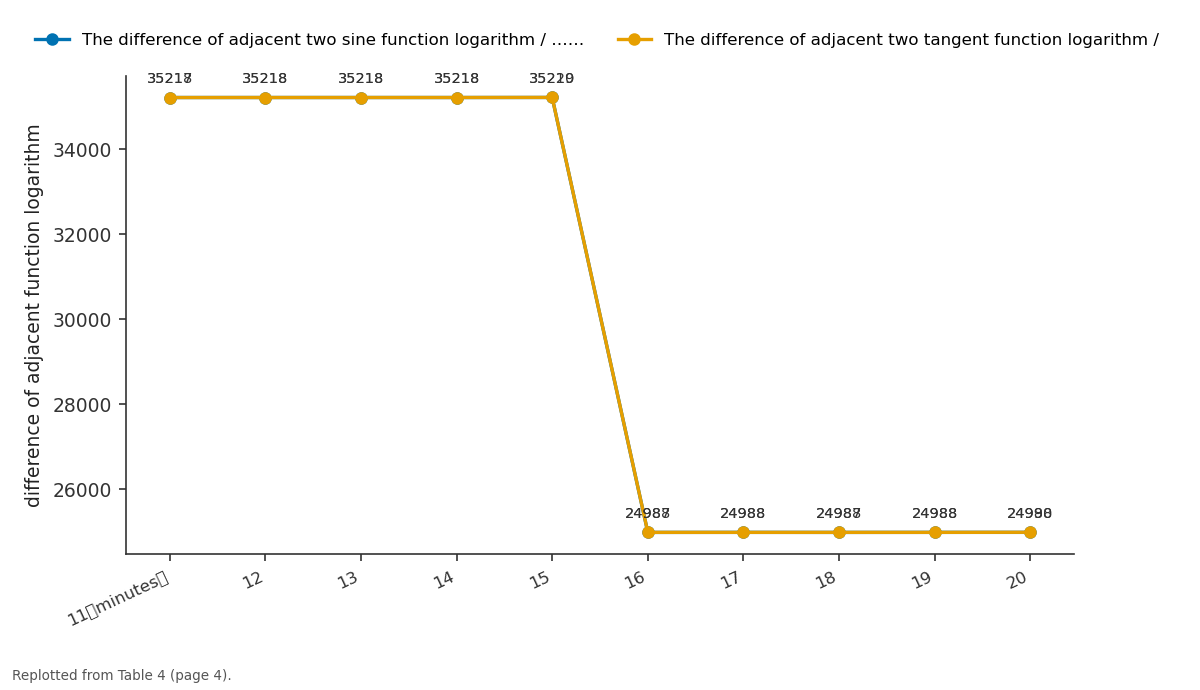
The difference of adjacent two sine function... and The difference of adjacent two tangent...: 11(minutes) vs 12 vs 13 vs 14 vs 15
Replotted from Table 4 (page 4) of the original paper. Every bar is the paper's own table value.
View source evidence ↗Figures & tables
From the original paper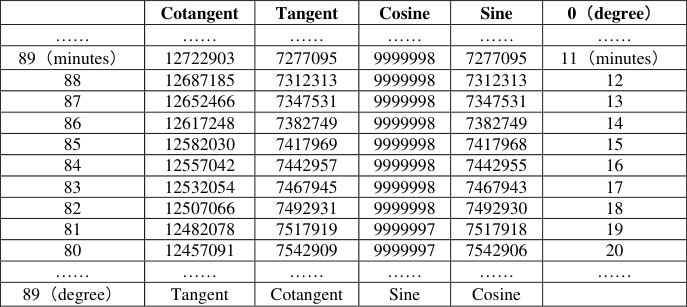 Table 1
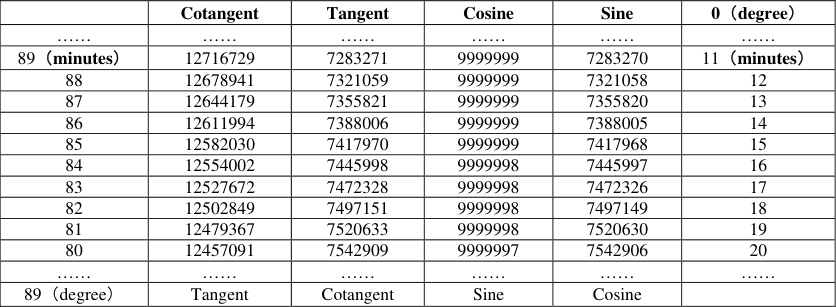 Table 2
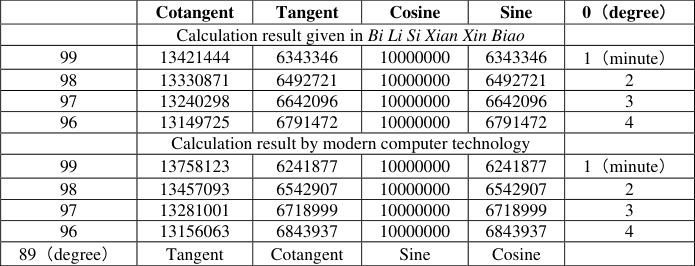 Table 3
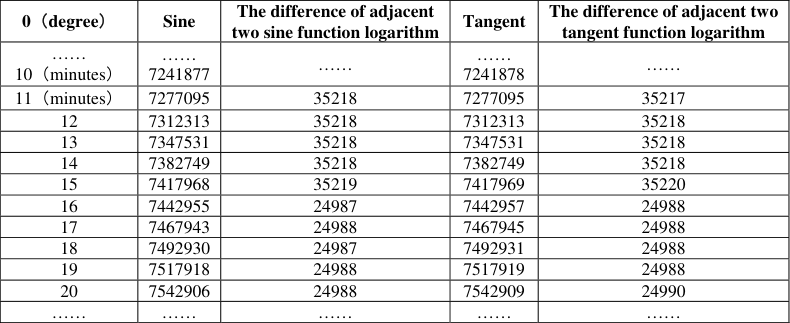 Table 4
Text
However, these works have been controverted for a long time (Zhao, E.X., 1986) [4] . There are different opinions on the scientificity and rationality of these works (Liu, X.X., 2011) [5] . As a result, studying the Bi Li Si Xian Xin Biao is beneficial for people to understand Xue Fengzuo' research further more, especially the work in astronomical calendar, and give a more precise statement, etc. In order to answer the above questions, this paper will analyze the data in Xue Fengzuo' Bi Li Si Xian Xin Biao.
The analysis of the data in Bi Li Si Xian Xin Biao
Bi Li Si Xian Xin Biao has only one volume, and it is mainly composed of some data. These data can be divided into four categories ---sine function logarithm values, cosine function logarithm values, tangent function logarithm values, and cotangent function logarithm values. Each category includes 4500 data, so there are a total of 18000 data. These data are all positive integers, no negative numbers and decimals. In addition, the data are all seven digits, only the cotangent function logarithmic values are eight digits. The data are shown in table 1. Starting from the angle , , , ,…… that are easy to transform into sixtieth system, it can be found that Xue Fengzuo is likely to apply the following four formulas to calculate function logarithm values. The reason is that the values in the book are almost the same as the results calculated by the following formulas (there is only a slight difference in the last digit of some values).
| — | Cotangent | Tangent | Cosine | Sine | 0(degree) |
|---|---|---|---|---|---|
| …… | …… | …… | …… | …… | …… |
| 89(minutes) | 12722903 | 7277095 | 9999998 | 7277095 | 11(minutes) |
| 88 | 12687185 | 7312313 | 9999998 | 7312313 | 12 |
| 87 | 12652466 | 7347531 | 9999998 | 7347531 | 13 |
| 86 | 12617248 | 7382749 | 9999998 | 7382749 | 14 |
| 85 | 12582030 | 7417969 | 9999998 | 7417968 | 15 |
| 84 | 12557042 | 7442957 | 9999998 | 7442955 | 16 |
| 83 | 12532054 | 7467945 | 9999998 | 7467943 | 17 |
| 82 | 12507066 | 7492931 | 9999998 | 7492930 | 18 |
| 81 | 12482078 | 7517919 | 9999997 | 7517918 | 19 |
| 80 | 12457091 | 7542909 | 9999997 | 7542906 | 20 |
| …… | …… | …… | …… | …… | …… |
| 89(degree) | Tangent | Cotangent | Sine | Cosine |
Table text extracted from the original PDF; superscript letters are shown inline. The original table image is below.
View original table image
sine function logarithm values = Round (10 6 log1010 sin a, 0) cosine function logarithm values = Round (10 6 log1010 cos a, 0) tangent function logarithm values= Round (10 6 log1010 tan a, 0) cotangent function logarithm values = Round (10 6 log1010 cot a, 0) For example, using to verify, the results calculated by the above four formulas are as follows:
The results are exactly the same as the results given in Bi Li Si Xian Xin Biao. Did Xue Fengzuo really use the above formulas or a similar approach? To verify with the other angles, we find that the calculation results are quite different from those given in Bi Li Si Xian Xin Biao. For example, use the above formulas to calculate the trigonometric function logarithm values of the angles between and (as shown in table 2), and then compare with the results in table 1, it can be found that they are significantly different.
| — | Cotangent | Tangent | Cosine | Sine | 0(degree) |
|---|---|---|---|---|---|
| …… | …… | …… | …… | …… | …… |
| 89(minutes) | 12716729 | 7283271 | 9999999 | 7283270 | 11(minutes) |
| 88 | 12678941 | 7321059 | 9999999 | 7321058 | 12 |
| 87 | 12644179 | 7355821 | 9999999 | 7355820 | 13 |
| 86 | 12611994 | 7388006 | 9999999 | 7388005 | 14 |
| 85 | 12582030 | 7417970 | 9999999 | 7417968 | 15 |
| 84 | 12554002 | 7445998 | 9999998 | 7445997 | 16 |
| 83 | 12527672 | 7472328 | 9999998 | 7472326 | 17 |
| 82 | 12502849 | 7497151 | 9999998 | 7497149 | 18 |
| 81 | 12479367 | 7520633 | 9999998 | 7520630 | 19 |
| 80 | 12457091 | 7542909 | 9999997 | 7542906 | 20 |
| …… | …… | …… | …… | …… | …… |
| 89(degree) | Tangent | Cotangent | Sine | Cosine |
Table text extracted from the original PDF; superscript letters are shown inline. The original table image is below.
View original table image
(10 log10 tan 0 20 , 0) Thus, it can be sure that Xue Fengzuo didn't use the above formulas or a similar way. If he use the above formulas, there will never be such a big error, also there will not be so many errors. Moreover, there won't appear a strange phenomenon that the trigonometric function logarithm values of special angles (the angles that are positive integer multiple of 5) are correct but those of other angles are wrong.
The above results were calculated with the help of the modern computers. Modern computing technology has a strong computing function, the precision and accuracy of calculation is of no doubt. From this we can know that the trigonometric function logarithm values of angles within 90 degrees at the interval of 1 minute (centesimal system) calculated by above formulas are certainly not wrong. However, the differences between the results calculated by the above formulas with the help of modern computer technology and the data in Bi Li Si Xian Xin Biao are so big and so many---the data that are different almost accounts for 80% of all the data in Bi Li Si Xian Xin Biao. The conclusion only can be that the errors of the data in Bi Li Si Xian Xin Biao are so large that the accuracy and scientificity of the authors' calculation are not believable.
The analysis about the causes of numerical error in Bi Li Si Xian Xin Biao
Why there are so many wrong data in Bi Li Si Xian Xin Biao ? Figuring out this problem is undoubtedly very important to have a comprehensive understanding of Xue Fengzuo' work. From the the above analysis, it can be known that the data in Xue Fengzuo' Bi Li Si Xian Xin Biao are not calculated by the above formulas or its equivalent method. So the question is how he calculated it. In order to figure out this problem, the author looked through the Xue Fengzuo' related books in Li Xue Hui Tong carefully, and found an instruction about the method of making the trigonometric function table in the first book Sine of Li Xue Hui Tong. More, using the method described in the book, we can completely calculate all the 9000 sine function values of the angles that interval of 1 minute (centesimal system). The formula adopted to calculate the sine function values of very small angles in this book is:
. For example, calculate the value of from the known value of . The concrete computation method is as follows:
.Take another instance. Calculate the value of from the known value of . The concrete computation method is as follows: (Yang, Z.Z., 2011) [6] . So whether the author used the above method? The four kinds of trigonometric function values can be worked out in this way obviously. The process is: calculate the sine value of angle, then use relevant formulas to calculate the cosine value of angle, and then find out the tangent and cotangent value. The author carried out a verification, and found that the calculation results by this method were also different from that in Bi Li Si Xian Xin Biao. It can be illustrated by the examples of the logarithm of , , and . The corresponding calculation results are 6241877, 6542907, 6718999, 6843937. These results were as same as that calculated by the above formula---. From this we can see that Xue Fengzuo did not apply the method in the Sine. So are these data directly from the western mathematical books? In order to figure out this problem, the author reviewed many kinds of trigonometric function logarithm tables published in western society at that time --including that had been introduced into China and had not been introduced into our country, but none was been found to be identical. John Newton, a westerner, published the book Trigonometria Britanica in 1658. He also put forward a trigonometric function logarithm table within 90 degrees at the interval of 1 minute (centesimal system), but its values were 9 digits. The results were exactly the same as the results calculated by modern computing tool (as shown in table 1), so what John Newton had calculated were correct and it had not any similar errors appeared in Xue Fengzuo' Bi Li Si Xian Xin Biao(John, N.,1658) [7] . So whether these results were from the old Bi Li Si Xian Biao written by Jean Nicolas Smogolenski-Xue Fengzuo's teacher? Because Jean Nicolas Smogolenski' Bi Li Si Xian Biao was missing, we are unable to do any direct examination now (Li, Y. & Qian, B.C., 1998) [8] . According to the contents of Zhong Fa Si Xian Yin written by Xue Fengzuo, it can be concluded that the above conjecture is impossible too. To sum up, the results should be calculated by Xue Fengzuo himself. In Zhong Fa Si Xian Yin, Xue Fengzuo said, "There is a thought that to unify the advanced western mathematical methods with the traditional Chinese mathematics research habits,but worried that Chinese traditional approach is too unrestrained. According to the old methods, the sexagesimal system and the centesimal system are not compatible so we have to change one to unify. After that, the research method of all the books including Ba Xian is the centesimal system instead of the sexagesimal system and therefore the unification is (10 log10 sin , 0) Round "("海岱薛凤祚篡著,颍川后学刘拱键较"). From this, it can be seen that this book should be the work of Xue Fengzuo, rather than using the values of Jean Nicolas Smogolenski. Then how did Xue Fengzuo calculate the results in the book? The author collated the data. Firstly, sort all the angles from small to large. After that, put every 5 angles into one group to obtain several small units. When comparing the data, the author found a phenomenon. In every unit contained 5 trigonometric function logarithm values, the result of a number minus the number in front of it was basically the same. For example, the difference of ten sine function logarithms and tangent function logarithms between and were 35218, 24987, 35218 and 24988 respectively. The specific situation was shown in table 4. This rule was throughout the whole indicator. As a result, the author speculated that Xue Fengzuo was likely to calculate by the following ways:
| 0(degree) | Sine | The difference of adjacent two sine function logarithm | Tangent | The difference of adjacent two tangent function logarithm |
|---|---|---|---|---|
| …… 10(minutes) | …… 7241877 | …… | …… 7241878 | …… |
| 11(minutes) | 7277095 | 35218 | 7277095 | 35217 |
| 12 | 7312313 | 35218 | 7312313 | 35218 |
| 13 | 7347531 | 35218 | 7347531 | 35218 |
| 14 | 7382749 | 35218 | 7382749 | 35218 |
| 15 | 7417968 | 35219 | 7417969 | 35220 |
| 16 | 7442955 | 24987 | 7442957 | 24988 |
| 17 | 7467943 | 24988 | 7467945 | 24988 |
| 18 | 7492930 | 24987 | 7492931 | 24988 |
| 19 | 7517918 | 24988 | 7517919 | 24988 |
| 20 | 7542906 | 24988 | 7542909 | 24990 |
| …… | …… | …… | …… | …… |
Table text extracted from the original PDF; superscript letters are shown inline. The original table image is below.
View original table image
(1) calculated the trigonometric function logarithm of two adjacent angle that was positive integer multiples of 5, then got the difference;
(2) divided the difference into five equal parts;
(3) based on the trigonometric function logarithm of the smaller angle that was positive integer multiples of 5, added the number just calculated in last step successively---if there was decimal, the digit after decimal point should be leaved or into 1 appropriately, then the four trigonometric function logarithm value in the middle can be got. Take the calculation of the sine function logarithm of 、 、 、 for example: , add the number calculated in last step successively, then the required four logarithm can be got. 7417968+24987.67442955 7442955+24987.67467943 7467943+24987.67492930 7492930+24987.67517918 After verification, the author found that all the trigonometric function logarithm can be calculated by this method, and the results were almost as same as the data in Xue Fengzuo' Bi Li Si Xian Xin Biao. Thus, here Xue Fengzuo should evaluate trigonometric function logarithm by the method that calculate the numbers in the middle of arithmetic progression based on the first and the last number. This method was obviously easy to operate and extremely fast to calculate, but it was also obviously incorrect. This question was very easy to proof. Xue Fengzuo regarded triangle function logarithm of consecutive angle as the arithmetic progression, and calculated the values by using the properties of arithmetic progression. Then, if Xue Fengzuo' method was right, we can deduce that the triangle function value of continuous angle should be geometric progression. For example, , , , and are five continuous angles, their sine function value should comply with the following relations: , .That is obviously not right. Therefore, the Xue Fengzuo' method that used to calculate the trigonometric function logarithm of the angles that was not positive integer multiples of 5 was not correct. Thus, the author considers that Xue Fengzuo may more likely to take the following ways to give the data in Bi Li Si Xian Xin Biao: firstly, reference the trigonometric function logarithm of the angles that was positive integer multiples of 5 in other scholar' Bi Li Si Xian Biao. It should be noted that the angles that was positive integer multiples of 5 in Xue Fengzuo' book were positive integer multiples of 3 in sexagesimal, and the trigonometric function logarithm table had already been introduced into our country by western missionaries at that time, so the first step is very easy to implement. What's more, among the incoming table, some trigonometric function logarithms are precise to ten decimal places (Wu, W.J., 2000) [9] . Secondly, use the method that calculate the intermediate numbers in arithmetic progression to evaluate trigonometric function logarithms of four angles between two successive angles that was positive integer multiples of 5. Pay attention to rounding decimals in this process.
10
10
Figures and tables from the paper
| — | Cotangent | Tangent | Cosine | Sine | 0(degree) |
|---|---|---|---|---|---|
| Calculation result given in Bi Li Si Xian Xin Biao | |||||
| 99 | 13421444 | 6343346 | 10000000 | 6343346 | 1(minute) |
| 98 | 13330871 | 6492721 | 10000000 | 6492721 | 2 |
| 97 | 13240298 | 6642096 | 10000000 | 6642096 | 3 |
| 96 | 13149725 | 6791472 | 10000000 | 6791472 | 4 |
| Calculation result by modern computer technology | |||||
| 99 | 13758123 | 6241877 | 10000000 | 6241877 | 1(minute) |
| 98 | 13457093 | 6542907 | 10000000 | 6542907 | 2 |
| 97 | 13281001 | 6718999 | 10000000 | 6718999 | 3 |
| 96 | 13156063 | 6843937 | 10000000 | 6843937 | 4 |
| 89(degree) | Tangent | Cotangent | Sine | Cosine |
Table text extracted from the original PDF; superscript letters are shown inline. The original table image is below.
View original table image
References
7 in the original paper- Yuan ZT. Xue Fengzuo. Famous Calendarian in Qing Dynasty. History Teaching University Edition, 1991, (06).
- Ruan Y. Biography of the Academic Activities of Chinese Scholars in Past Dynasties. Guangling Publishing House, 2009, 405.
- Mei WD. Calendar Records of Wu An. The Commercial Press, 1935, 29.
- Liu XX. Radical Changes of the Big Dipper and Stars' Positions Resulted from Errors of Root Number. Pioneers of Chinese and Western culture. Qilu Press. 2011, 311328.
- Yang ZZ. The Study on Xue Fengzuo's book Sine. Shandong Social Science. 2011, (06).
- Li Y, Qian BC. Collected Works in History of Science by Li Yan, Qian Baocong. Liaoning Education Press, 1998; 7:240.
- Wu WJ. History of Mathematics in China.Beijing Normal University Press. 2000; 7:102.