
Research article · 2020 · Full text
International Journal of Horticulture and Food ScienceCombined control of Adoxophyes orana Fischer von Rosslerstamm (Lepidoptera: Tortricidae) on Peach trees in Imathia Greece
Volume 2(1) · Pages 41–44 · DOI: 10.33545/26631067.2020.v2.i1a.36 ↗
Research areasBiological Control of Invasive SpeciesInsect Pheromone Research and ControlInsect-Plant Interactions and Control
Abstract
Author-writtenThe purpose of the present study was to explore combined chemical control of A. orana in peach trees orchards in Imathia, Greece. Recordings of generations during season have been performed and total peach production was measured in treated and untreated part of orchard. Eight traps were placed for each year and orchard. Each trap was checked every 15 days and the pheromone was updated monthly until the end of August. Subsequently, 3 treatments were applied to the experimental orchard, with the insecticides Delegate, Lamdex and Runner, to control the insect populations. The three different insecticides used in this study managed to control A. orana below economic damage levels, without the development of considerable resistance of the insects. Treated orchards yielded better than untreated by almost 30%. In 2018 was better control of the insect and populations were decreased in treated orchards by 65% approximately, in comparison to 54% in 2017, indicating continuous efficiency of insecticides.
Summary
Source-checkedPlain-language reading of the full paper, prepared with AI and checked against the text. Each point links to the authors' own words.
Why it matters
- The summer fruit tortrix moth, Adoxophyes orana, is a polyphagous pest that causes severe damage to peach trees in Greece. View evidence ↗
- The economic risk limit for this pest is established at 5 to 10 insects per trap per week. View evidence ↗
- Previous research has indicated that A. orana can develop significant resistance to certain organophosphate insecticides like chlorpyrifos. View evidence ↗
The question
- The study aimed to investigate the effectiveness of a combined chemical control strategy for A. orana in peach orchards located in Imathia, Greece. View evidence ↗
What they did
- Eight white Delta-type pheromone traps were used annually in each orchard section to monitor male moth populations. View evidence ↗
- The experimental orchard was treated with three insecticides: Delegate (spinetoram), Lamdex (lambda-cyhalothrin), and Runner (methoxyfenozide). View evidence ↗
- Peach production was measured in kilograms using a weighbridge balance with 1 kg precision for both the treated and control areas. View evidence ↗
What they found
- Peach yields in the treated orchards were nearly 30% higher than those in the untreated control orchards. View evidence ↗
- Insect populations in treated orchards decreased by approximately 54% in 2017 and by approximately 65% in 2018. View evidence ↗
- In 2017, treated orchards produced 19,820 kg compared to 15,220 kg in the control; in 2018, treated orchards produced 20,650 kg compared to 15,832 kg in the control. View evidence ↗
- The combination of the three insecticides successfully kept A. orana populations below economic damage levels without causing significant insect resistance. View evidence ↗
What it means
- The authors conclude that using three different insecticides is an effective way to control A. orana while preventing the development of resistance. View evidence ↗
- The increase in population reduction from 2017 to 2018 indicates that the insecticide treatments maintained continuous efficiency over time. View evidence ↗
Visual summary
2 visualsIllustrations explain the paper; charts are replotted from the paper's own table values.
Experimental Layout
AI-generated conceptual illustration (Peach trees in an orchard). It explains the idea and does not show study data.
View source evidence ↗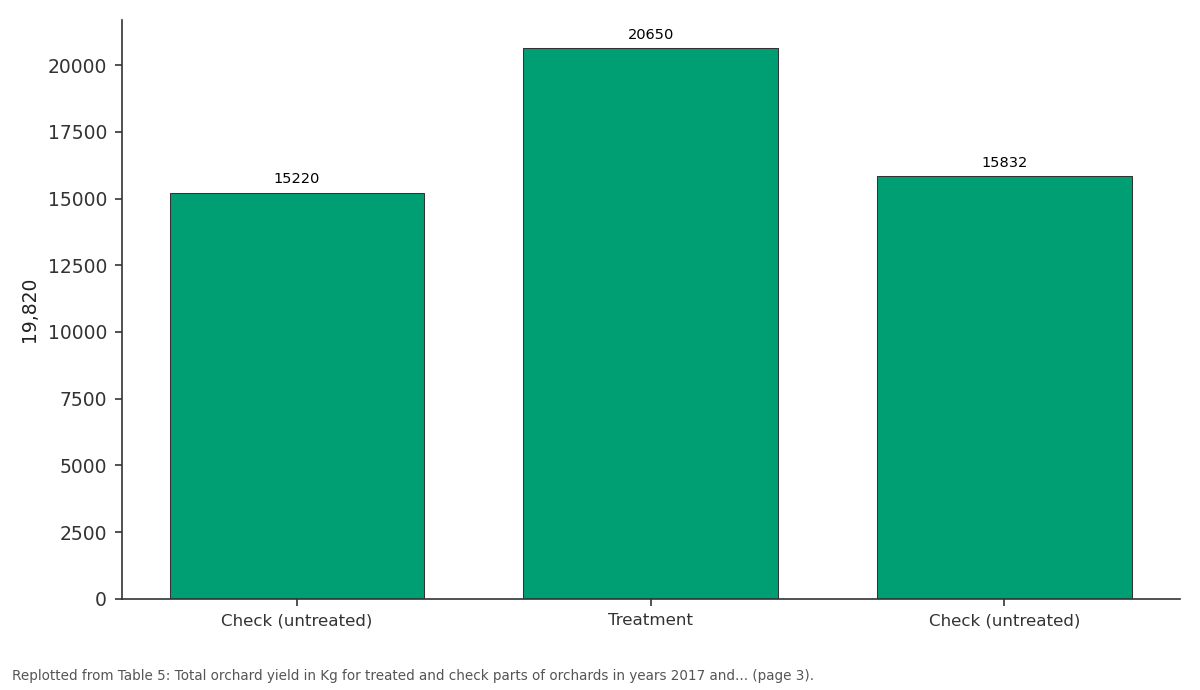
19,820: Check (untreated) vs Treatment vs Check (untreated)
Replotted from Table 5 (page 3) of the original paper. Every bar is the paper's own table value.
View source evidence ↗Figures & tables
From the original paper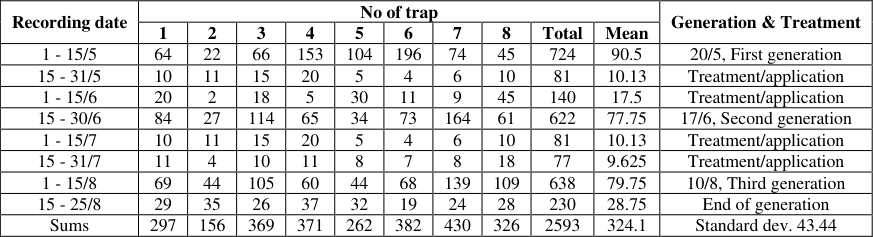 Table 1
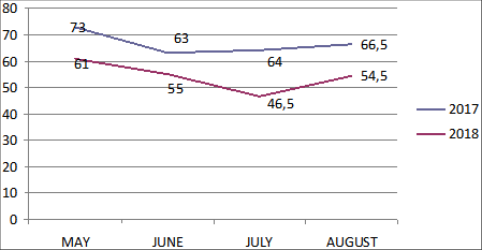 Figure 2
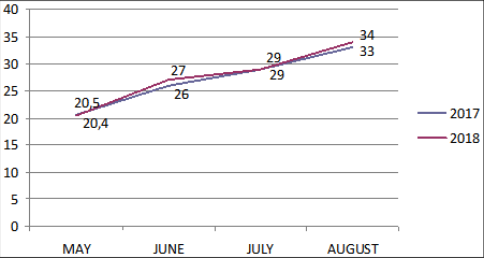 Figure 1
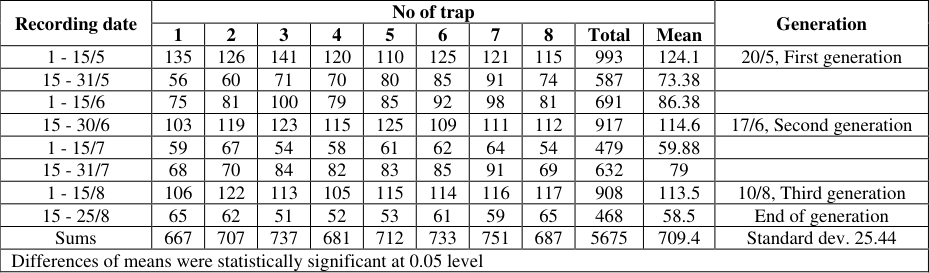 Table 2
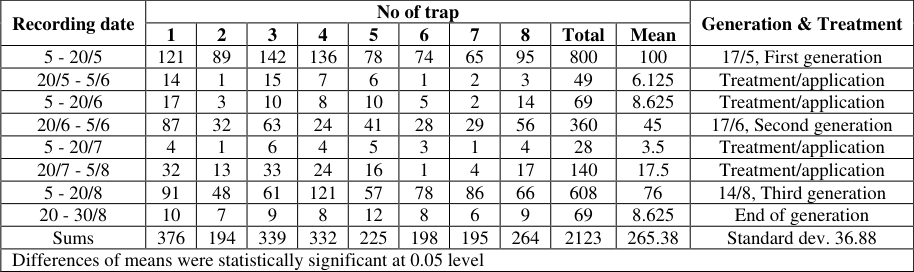 Table 3
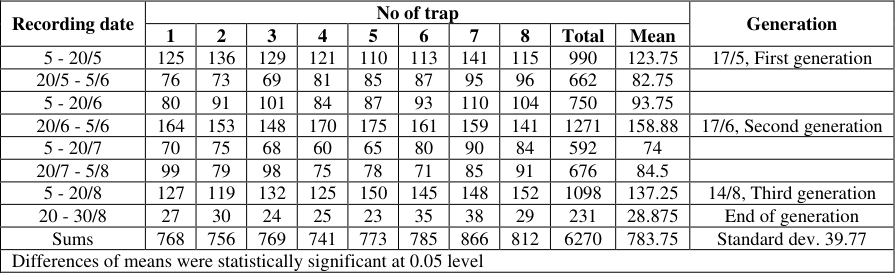 Table 4
 Table 5
Introduction
Summer fruit tortrix Adoxophyes orana Fischer von Rosslerstamm (Lepidoptera: Tortricidae) is a polyphagous moth species and severe enemy of peach trees in Greece (Navrozidis and Tzanakakis, 2005; Navrozidis et al., 2011) [14,15] as well as in rest of Europe and Asia, and lately in North America (HYPP Zoology Fact Sheet, 2013) [10] . A. orana overwinters in the larval stage in a loosely woven cocoon on the host plant. The overwintered larvae feed and pupate in the spring to produce the first generation of adults which emerge during late May to late June in Europe. Males have a wingspan of 15-19mm. The forewings of the male are a light grayish-brown or yellowish-brown with distinct dark brown markings. The hing wings are light gray. The first generation of adults gives rise to the first generation of summer caterpillars. Larvae are 18-22 mm in length and greenish yellow to olive green in colour. The head of the caterpillar is brown when young and turns to a honey-yellow colour when mature. Thoracic legs are light brown. Females have a wingspan of 19-22mm. The forewings are a dullish gray-brown colour with markings that are less distinct than in the male moth. The hindwings are brown-gray. The second generation of adults flies in July in Europe and then gives rise to the third generation of fall caterpillars (in August to September) which overwinter until the following spring (Davis et al., 2005; Navrozidis et al., 2011; HYPP Zoology Fact Sheet, 2013) [7,15,10] . In Greece, first appear was recorded in 1985 with many damages on cherry, apple and peach trees (Savopoulou-Soultani et al., 1985) [18] . According to Minks and de Jong (1975) [13] it appears that the economic risk limit (loss) is determined at 5 -10 insects/ trap /week. Sex pheromone traps (Delta-type) (Minks and Voerman, 1973; Pehlevan and Kovanci, 2014) [12,16] are used for both surveillance and partial population control of the insect. Against A. orana, a large number of insecticides are being widely used, like organophosphates with active substances chlorpyrifos -methyl, triazophos, etc., synthetic pyrethroids, but also carbamids acting through the carbaryl compound (Charmillot and Brunner, 1989; Cross, 1997; Charmillot and Pasquier, 2006) [3,6,4] , although research by Cross (1997) [6] describes the development of considerable resistance of A. orana to the use of organophosphate insecticide, chlorpyrifos. Also, the organophosphate insecticide phosalone has anti-insect action.
In addition, hexaflumuron is considered a remarkable growth regulator, comparable to conventional insecticides, which has been used successfully against A. orana. Injections of hexaflumuron should start at the onset of laying or at the egg stage or even at the beginning of the prepupa-pupa stage. Spraying should cover the entire carpal and leaf area (Komblas et al., 1989) [11] . Application of the phenoxycarb carbamide growth regulator in spring, against the larval stages of the wintering generation, showed good results (de Reed et al., 1984; Galli, 1984; Charmillot and Blaser, 1985; Charmillot and Brunner, 1989; Cross, 1997) [17, 9, 2, 3, 6] . However, fenoxycarb is considered to be a high risk for insect pests and predators (Dorn et al., 1981; Staubli et al., 1988) [8,19] . In addition to phenoxycarb, other growth regulators such as lufenuron, methoxyfenozide, tebufenozide, with remarkable insecticide effectiveness against A. orana larvae, are reported. The use of indoxacarb and the biological control chemicals like emamectin and spinosad against the insect appears to be effective (Charmillot et al., 2006; Charmillot and Pasquier, 2006) [4,5] . The purpose of the present study was to explore combined chemical control of A. orana in peach trees orchards in Imathia, Greece. Recordings of generations during season have been performed and total peach production was measured in treated and untreated part of orchard.
Materials and methods
Materials and methods
Results
The prevailing climate conditions per month (temperature, relative humidity) of the area during the two years of the survey are described in the Figures (1, 2) below. Differences in chemically treated and untreated orchards were obvious in both years (Tables 1, 2, 3, 4). Statistically significant differences were found between mean values found across time and generations. Differences between years were also obvious, especially for treatment application efficiency. In 2018 were better control of the insect and standard deviations were similar in treated and untreated orchards (in comparison to 2017). According to the results (Table 5), total yield of peach production in the experimental orchard was 19,820 Kg, while in the check (untreated control) production reached 15,220 Kg in 2017. For 2018, the treated orchard production was 20,650 Kg and in the check (untreated control), 15,832 Kg. In year 2018 production was somewhat higher in comparison to 2017 and difference between treated and untreated orchards was better for 2018 (4,818 Kg in comparison to 4,600 Kg).
| 2017 | — | 2018 | — |
|---|---|---|---|
| Treatment | Check (untreated) | Treatment | Check (untreated) |
| 19,820 | 15,220 | 20,650 | 15,832 |
| Weighbridge balance of 1 Kg precision |
Table text extracted from the original PDF; superscript letters are shown inline. The original table image is below.
View original table image
Discussion
Treated orchards showed lower numbers of captured males after insecticide applications. This resulted in lower mean values between treated and untreated orchards showing the efficiency of insecticide applications. Environment-friendly insecticides have been proven efficient (Dorn et al., 1981; Charmillot et al., 2006) [8,4] , especially for methoxyfenozide, with remarkable insecticide effectiveness against A. orana larvae (Borchert et al. 2004) [1] , which was used in the present study. Efficiency between years was found different. In 2018 were better control of the insect and populations was decreased in treated orchards by 65% approximately, in comparison to 54% in 2017. This may be due to effective insecticide application in two continuous years, without the development of considerable resistance of A. orana to the use of other insecticides Cross (1997) [6] . This result is also depended on the use of three different insecticides in the present study. Treated orchards yielded better than untreated by almost 30%. This was in accordance to reported damages by Savopoulou-Soultani et al. (1985) [18] . Also, efficiency was in accordance to Minks and de Jong (1975) [13] reports where economic risk limit (loss) was determined at 5 -10 insects/ trap /week. Production levels were in accordance to the expected ones for the insecticide treated peach tree orchards (Tavoularis, 2012) [20] , indicating satisfactory efficiency of applications. Concluding, the three different insecticides used in this study managed to control A. orana below economic damage levels, without the development of considerable resistance of the insects. In 2018 was better control of the insect and populations were decreased in treated orchards by 65% approximately, in comparison to 54% in 2017, indicating continuous efficiency of insecticides.
Figures and tables from the paper
| Recording date | No of trap | — | — | — | — | — | — | — | — | — | Generation & Treatment |
|---|---|---|---|---|---|---|---|---|---|---|---|
| 1 | 2 | 3 | 4 | 5 | 6 | 7 | 8 | Total | Mean | ||
| 1 - 15/5 | 64 | 22 | 66 | 153 | 104 | 196 | 74 | 45 | 724 | 90.5 | 20/5, First generation |
| 15 - 31/5 | 10 | 11 | 15 | 20 | 5 | 4 | 6 | 10 | 81 | 10.13 | Treatment/application |
| 1 - 15/6 | 20 | 2 | 18 | 5 | 30 | 11 | 9 | 45 | 140 | 17.5 | Treatment/application |
| 15 - 30/6 | 84 | 27 | 114 | 65 | 34 | 73 | 164 | 61 | 622 | 77.75 | 17/6, Second generation |
| 1 - 15/7 | 10 | 11 | 15 | 20 | 5 | 4 | 6 | 10 | 81 | 10.13 | Treatment/application |
| 15 - 31/7 | 11 | 4 | 10 | 11 | 8 | 7 | 8 | 18 | 77 | 9.625 | Treatment/application |
| 1 - 15/8 | 69 | 44 | 105 | 60 | 44 | 68 | 139 | 109 | 638 | 79.75 | 10/8, Third generation |
| 15 - 25/8 | 29 | 35 | 26 | 37 | 32 | 19 | 24 | 28 | 230 | 28.75 | End of generation |
| Sums | 297 | 156 | 369 | 371 | 262 | 382 | 430 | 326 | 2593 | 324.1 | Standard dev. 43.44 |
Table text extracted from the original PDF; superscript letters are shown inline. The original table image is below.
View original table image
| Recording date | No of trap | — | — | — | — | — | — | — | — | — | Generation |
|---|---|---|---|---|---|---|---|---|---|---|---|
| 1 | 2 | 3 | 4 | 5 | 6 | 7 | 8 | Total | Mean | ||
| 1 - 15/5 | 135 | 126 | 141 | 120 | 110 | 125 | 121 | 115 | 993 | 124.1 | 20/5, First generation |
| 15 - 31/5 | 56 | 60 | 71 | 70 | 80 | 85 | 91 | 74 | 587 | 73.38 | |
| 1 - 15/6 | 75 | 81 | 100 | 79 | 85 | 92 | 98 | 81 | 691 | 86.38 | |
| 15 - 30/6 | 103 | 119 | 123 | 115 | 125 | 109 | 111 | 112 | 917 | 114.6 | 17/6, Second generation |
| 1 - 15/7 | 59 | 67 | 54 | 58 | 61 | 62 | 64 | 54 | 479 | 59.88 | |
| 15 - 31/7 | 68 | 70 | 84 | 82 | 83 | 85 | 91 | 69 | 632 | 79 | |
| 1 - 15/8 | 106 | 122 | 113 | 105 | 115 | 114 | 116 | 117 | 908 | 113.5 | 10/8, Third generation |
| 15 - 25/8 | 65 | 62 | 51 | 52 | 53 | 61 | 59 | 65 | 468 | 58.5 | End of generation |
| Sums | 667 | 707 | 737 | 681 | 712 | 733 | 751 | 687 | 5675 | 709.4 | Standard dev. 25.44 |
| Differences of means were statistically significant at 0.05 level |
Table text extracted from the original PDF; superscript letters are shown inline. The original table image is below.
View original table image
| Recording date | No of trap | — | — | — | — | — | — | — | — | — | Generation & Treatment |
|---|---|---|---|---|---|---|---|---|---|---|---|
| 1 | 2 | 3 | 4 | 5 | 6 | 7 | 8 | Total | Mean | ||
| 5 - 20/5 | 121 | 89 | 142 | 136 | 78 | 74 | 65 | 95 | 800 | 100 | 17/5, First generation |
| 20/5 - 5/6 | 14 | 1 | 15 | 7 | 6 | 1 | 2 | 3 | 49 | 6.125 | Treatment/application |
| 5 - 20/6 | 17 | 3 | 10 | 8 | 10 | 5 | 2 | 14 | 69 | 8.625 | Treatment/application |
| 20/6 - 5/6 | 87 | 32 | 63 | 24 | 41 | 28 | 29 | 56 | 360 | 45 | 17/6, Second generation |
| 5 - 20/7 | 4 | 1 | 6 | 4 | 5 | 3 | 1 | 4 | 28 | 3.5 | Treatment/application |
| 20/7 - 5/8 | 32 | 13 | 33 | 24 | 16 | 1 | 4 | 17 | 140 | 17.5 | Treatment/application |
| 5 - 20/8 | 91 | 48 | 61 | 121 | 57 | 78 | 86 | 66 | 608 | 76 | 14/8, Third generation |
| 20 - 30/8 | 10 | 7 | 9 | 8 | 12 | 8 | 6 | 9 | 69 | 8.625 | End of generation |
| Sums | 376 | 194 | 339 | 332 | 225 | 198 | 195 | 264 | 2123 | 265.38 | Standard dev. 36.88 |
| Differences of means were statistically significant at 0.05 level |
Table text extracted from the original PDF; superscript letters are shown inline. The original table image is below.
View original table image
| Recording date | No of trap | — | — | — | — | — | — | — | — | — | Generation |
|---|---|---|---|---|---|---|---|---|---|---|---|
| 1 | 2 | 3 | 4 | 5 | 6 | 7 | 8 | Total | Mean | ||
| 5 - 20/5 | 125 | 136 | 129 | 121 | 110 | 113 | 141 | 115 | 990 | 123.75 | 17/5, First generation |
| 20/5 - 5/6 | 76 | 73 | 69 | 81 | 85 | 87 | 95 | 96 | 662 | 82.75 | |
| 5 - 20/6 | 80 | 91 | 101 | 84 | 87 | 93 | 110 | 104 | 750 | 93.75 | |
| 20/6 - 5/6 | 164 | 153 | 148 | 170 | 175 | 161 | 159 | 141 | 1271 | 158.88 | 17/6, Second generation |
| 5 - 20/7 | 70 | 75 | 68 | 60 | 65 | 80 | 90 | 84 | 592 | 74 | |
| 20/7 - 5/8 | 99 | 79 | 98 | 75 | 78 | 71 | 85 | 91 | 676 | 84.5 | |
| 5 - 20/8 | 127 | 119 | 132 | 125 | 150 | 145 | 148 | 152 | 1098 | 137.25 | 14/8, Third generation |
| 20 - 30/8 | 27 | 30 | 24 | 25 | 23 | 35 | 38 | 29 | 231 | 28.875 | End of generation |
| Sums | 768 | 756 | 769 | 741 | 773 | 785 | 866 | 812 | 6270 | 783.75 | Standard dev. 39.77 |
| Differences of means were statistically significant at 0.05 level |
Table text extracted from the original PDF; superscript letters are shown inline. The original table image is below.
View original table image
References
20 in the original paper- Borchert DM, Walgenbach JF, Kennedy GG, Long JW. Toxicity and residual activity of methoxyfenozide and tebufenozide to codling moth (Lepidoptera: Tortricidae) and oriental fruit moth (Lepidoptera: Tortricidae). Journal of Economic Entomology. 2004; 97(4):134252.
- Charmillot PJ, Blaser C. Le fenoxycarb, un regulateur de croissance d' insectes homologue contre la tordeuse de la pelure Adoxophyes orana F. v. R. Revue suisse de Viticulture, Arboriculture, Horticulture. 1985; 17(2):8592.
- Charmillot PJ, Brunner JF. Summerfruit tοrtrix, Adoxophyes orana, life cycle, warning system and control. Entomologia Hellenica. 1989; 7:17-26.
- Charmillot PJ, Pasquier D. Efficacite et remanence de differents insecticides sur les chenilles de capua (Adoxophyes orana). Revue suisse de Viticulture, Arboriculture, Horticulture. 2006; 38(6):371-276.
- Charmillot PJ, Blanc G, Pasquier D. Premier cas de resistance en Suisse de la tordeuse de la pelure capua (Adoxophyes orana) aux insecticides. Revue suisse de Viticulture, Arboriculture, Horticulture. 2006; 38(2):8793.
- Cross JV. Susceptibility of the summer fruit tortrix moth, Adoxophyes orana (Lepidoptera: Tortricidae), to chlorpyrifos and strategies for insecticidal control in orchards. Annals of Applied Biology. 1997; 131:197212.
- Davis EE, French S, Venette RC. Mini risk assessment: summer fruit tortrix moth, Adoxophyes orana (Fischer von Roslerstamm, 1834) (Lepidoptera: Tortricidae). USDA -CAPS Pest Risk Assessment, 2005.
- Dorn S, Frischknecht ML, Martinez V, Zurfltih R, Fischer U. A novel non -neurotoxic insecticide with a broad activity spectrum. Zeitschrift fuer Pflanzenkrankheiten und Pflanzenschutz, 1981; 88L:269-275.
- Galli P. Use of natural enemies to control the apple fruit tortrix. Obstbau -Weinbau. 1984; 21:289-292.
- HYPP Zoology Fact Sheet. Summer Fruit Tortrix Moth. November 10, Wayback Machine. Massachusetts Dept. of Agricultural Resources, 2013.
- Komblas Κ, Tsakonas P, Lysandrou M, Elia Τ. Control of insect pests on fruit and field crops with hexaflumuron in North Greece. Entomologia Hellenica. 1989; 7:35-41.
- Minks AK, Voerman S. Sex pheromones of the summerfruit tortrix moth, Adoxophyes orana, trapping performance in the field. Entomologia Experimentalis et Applicata. 1973; 16:541-549.
- Minks AK, de Jong DJ. Determination of spraying dates for Adoxophyes orana by sex pheromone traps and temperature recordings. Journal of Economic Entomology. 1975; 68:729-732.
- Navrozidis EI, Tzanakakis ME. Tomato fruits as an alternative host for a laboratory strain of the olive fruit fly Bactrocera oleae. Phytoparasitica. 2005; 33:225236.
- Navrozidis Ε, Zartaloudis Ζ, Argyropoulos D, Servis D, Mpozoglou Κ. Sex confusion with sprayers RAK 3+4 και RAK 5+6 for insect control of Adoxophyes orana, (Lepidoptera: Tortricidae), Anarsia lineatella (Lepidoptera: Gelechiidae) and Grapholitha molesta (Lepidoptera: Tortricidae) in Imathia. 14 th Hellenic Entomology Society Congress, 11-14, Nafplio, Greece, 2011, 316-317.
- Pehlevan B, Kovanci OB. First report of Adoxophyes orana in northwestern Turkey: population fluctuation and damage on different host plants. Turkish Journal of Agriculture and Forestry. 2014; 38:847-856.
- de Reede RH, Groendijk RF, Wit AKH. Field tests with the insect growth regulators, epofenonane and fenoxycarb, in apple orchards against leafrollers and sideeffects on some lefroller parasites. Entomologia Experimentalis et Applicata. 1984; 35:275-281.
- Savopoulou -Soultani M, Hatzivassiliadis A, Vlug HJ, Minks AK, Tzanakakis ME. First records of the summer fruit tortricid, Adoxophyes orana Fv.R. in Greece. Entomologia Hellenica. 1985; 3:65-66.
- Staubli A, Baillod M, Charmillot P, Guignard E. Le point sur la lutte contre certains ravageurs importants en vergers. Revue suisse de viticulture arboriculture horticulture. 1988; 20(1):21-29.
- Tavoularis K. Mean production of main cultivations in Greece. Ministry of Agriculture, Statistics department. Greece, 2012.